Managing a fleet is no longer only about knowing where vehicles are. Businesses also need to understand how those vehicles are being driven, what risks drivers are facing on the road and what actually happened when an incident occurs. This is where AI dashcams and video telematics are becoming increasingly important. By combining cameras, GPS data and driver-behaviour monitoring, businesses can gain a much clearer picture of what is happening inside and around their vehicles.
For companies operating in Kenya, this technology can be especially useful for logistics fleets, staff transport vehicles, delivery businesses, contractors, commercial trucks and other organisations that depend heavily on road transport. An AI dashcam can help identify risky behaviour such as speeding, distraction or signs associated with fatigue, while also providing video evidence that may help when investigating accidents, customer complaints or disputes involving company vehicles. Instead of relying only on verbal explanations, fleet managers can use actual driving data and video footage to understand events more accurately.
What Is an AI Dashcam?
A traditional dashcam mainly records video of the road ahead, but an AI dashcam goes further by combining video recording with intelligent monitoring features. Depending on the system installed, it may be able to identify certain risky driving behaviours and generate alerts or event recordings for review. When connected with GPS tracking, the system can also provide information such as location, speed, route history and the time when a particular driving event occurred.
This combination makes the information far more useful to a fleet manager. If a driver is involved in an incident, for example, the manager may be able to review the location of the vehicle, the speed it was travelling and video footage showing what was happening at the time. This creates a more complete picture than GPS tracking or video recording would provide on their own and can support better decisions around safety, driver coaching and operational management.
How AI Dashcams Can Help Monitor Speeding
Speeding is one of the most common risks in fleet operations. A driver who consistently exceeds safe or authorised speeds can increase fuel consumption, tyre wear, brake wear and the likelihood of a serious accident. GPS tracking can already provide speed information, but an AI dashcam can add important visual context by showing the road conditions, surrounding traffic and the driver’s behaviour at the time of the speeding event.
This means fleet managers can move beyond simply telling a driver that they exceeded a speed limit. They can review specific incidents, identify patterns and discuss the circumstances that led to the behaviour. This can make driver coaching more practical and evidence-based. Businesses can also use the same information to recognise safer drivers and develop a stronger safety culture across the fleet rather than focusing only on punishment.
Monitoring Driver Distraction
Distracted driving has become a major concern because drivers may be tempted to use their phones, look away from the road or engage in other activities while driving. Even a few seconds of inattention can create serious risk, particularly in busy urban traffic or at higher speeds. Depending on the AI dashcam system, a driver-facing camera may help detect behaviour that suggests distraction and record the event for later review.
For fleet managers, this information can help identify repeated patterns before they lead to accidents. If a driver is regularly distracted while driving, the company can intervene through coaching, clearer driving policies or additional training. The purpose should not be to monitor employees unnecessarily, but to reduce preventable risk and improve road safety. Clear communication is therefore important so that drivers understand what the system monitors, why it is being used and how the information will be handled.
Fatigue and Drowsiness Risks
Fatigue is another major concern for drivers who spend long hours on the road. Long-distance transporters, delivery drivers and commercial operators may work early mornings, late nights or extended shifts, increasing the likelihood of reduced concentration and drowsiness. Some AI dashcam systems are designed to identify certain signs that may be associated with fatigue, such as prolonged eye closure or repeated head movement patterns.
For fleet operators, this information can help identify whether work schedules, long shifts or driver habits are creating unnecessary safety risks. It may also support better planning around rest periods, shift rotation and journey scheduling. Technology cannot replace proper rest, but it can provide another layer of awareness and help businesses identify risky situations that might otherwise go unnoticed until an accident happens.
Video Evidence Can Help After an Accident
One of the strongest benefits of an AI dashcam is the ability to provide video evidence after a road incident. When an accident occurs, different drivers and witnesses may provide conflicting versions of what happened. Without video evidence, fleet managers may have to rely on statements, vehicle damage and police reports alone, which may not always provide a complete picture.
Dashcam footage can help show road position, traffic movement, sudden braking, lane changes and other events leading up to an incident. When this is combined with GPS location and speed information, the business may be able to build a more accurate timeline of what happened. This can be useful for internal investigations, insurance discussions, driver training and dispute resolution. It may also help protect a driver who has been wrongly blamed for an accident.
AI Dashcams Can Improve Driver Coaching
A strong fleet safety programme should not focus only on catching drivers doing something wrong. The most valuable use of telematics data is often coaching and behaviour improvement. If a driver repeatedly brakes harshly, speeds in certain areas or becomes distracted, the fleet manager can use real examples to explain why the behaviour is risky and what should change.
This is often more effective than giving generic warnings because the discussion is based on actual driving events. Over time, businesses can also identify trends across the fleet. If several drivers are struggling with the same type of behaviour, the company may need broader training, improved route planning or changes to work schedules. In this way, the AI dashcam becomes more than a recording device; it becomes a tool for improving driving standards and reducing operational risk.
Video Telematics Can Help With Customer Disputes
Businesses that make deliveries, transport passengers or operate service vehicles sometimes face complaints about driver behaviour. A customer may claim that a driver was speeding, driving dangerously or involved in an incident. Without reliable evidence, it can be difficult for management to know what actually happened.
Video telematics can provide another source of information by allowing the fleet manager to review the relevant footage, route and vehicle data before making a decision. This can reduce the risk of unfairly blaming a driver or dismissing a genuine complaint. For customer-facing businesses, this kind of evidence can improve professionalism, accountability and confidence when resolving disputes.
AI Dashcams and Fleet Security
AI dashcams are mainly associated with driver monitoring and accident evidence, but they can also support vehicle security. Depending on the camera configuration, video footage may help record suspicious activity around the vehicle before, during or after an incident. When combined with GPS tracking, fleet managers can review both location data and visual evidence to understand where the vehicle was and what may have happened.
This can be useful when investigating unauthorised vehicle use, suspicious stops or incidents involving company assets. For commercial fleets and high-value vehicles, combining GPS tracking, AI dashcams and other security systems can provide a more complete monitoring setup than relying on a single technology.
Privacy and Responsible Use
Businesses should use AI dashcams responsibly because driver-facing cameras and location tracking involve monitoring employees. Companies should have clear policies explaining what information is collected, why it is collected, who can access it and how it will be used. Drivers should also understand that the system is intended to improve safety, accountability and operational efficiency rather than simply to monitor them unnecessarily.
Transparency is important because monitoring technology works best when employees understand its purpose. If drivers believe the system is being used only to punish them, they may resist it. If they understand that it can also protect them from false accusations, provide evidence during accidents and support fairer investigations, the technology is more likely to be accepted as a useful safety tool.
Who Can Benefit From an AI Dashcam?
AI dashcams can be useful for many types of organisations in Kenya. Logistics companies can use them to monitor long-distance drivers, while contractors can supervise vehicles operating at remote sites. Staff transport businesses can use them to improve passenger safety, and delivery companies can review incidents involving drivers operating on busy urban routes.
Public service vehicle operators, corporate fleets, agricultural businesses and companies transporting valuable goods may also benefit from video telematics. The technology is especially useful where vehicles are used frequently, driver behaviour has a direct impact on safety and operating costs, and the financial consequences of accidents or disputes are high.
Finatrack AI Dashcam Solution
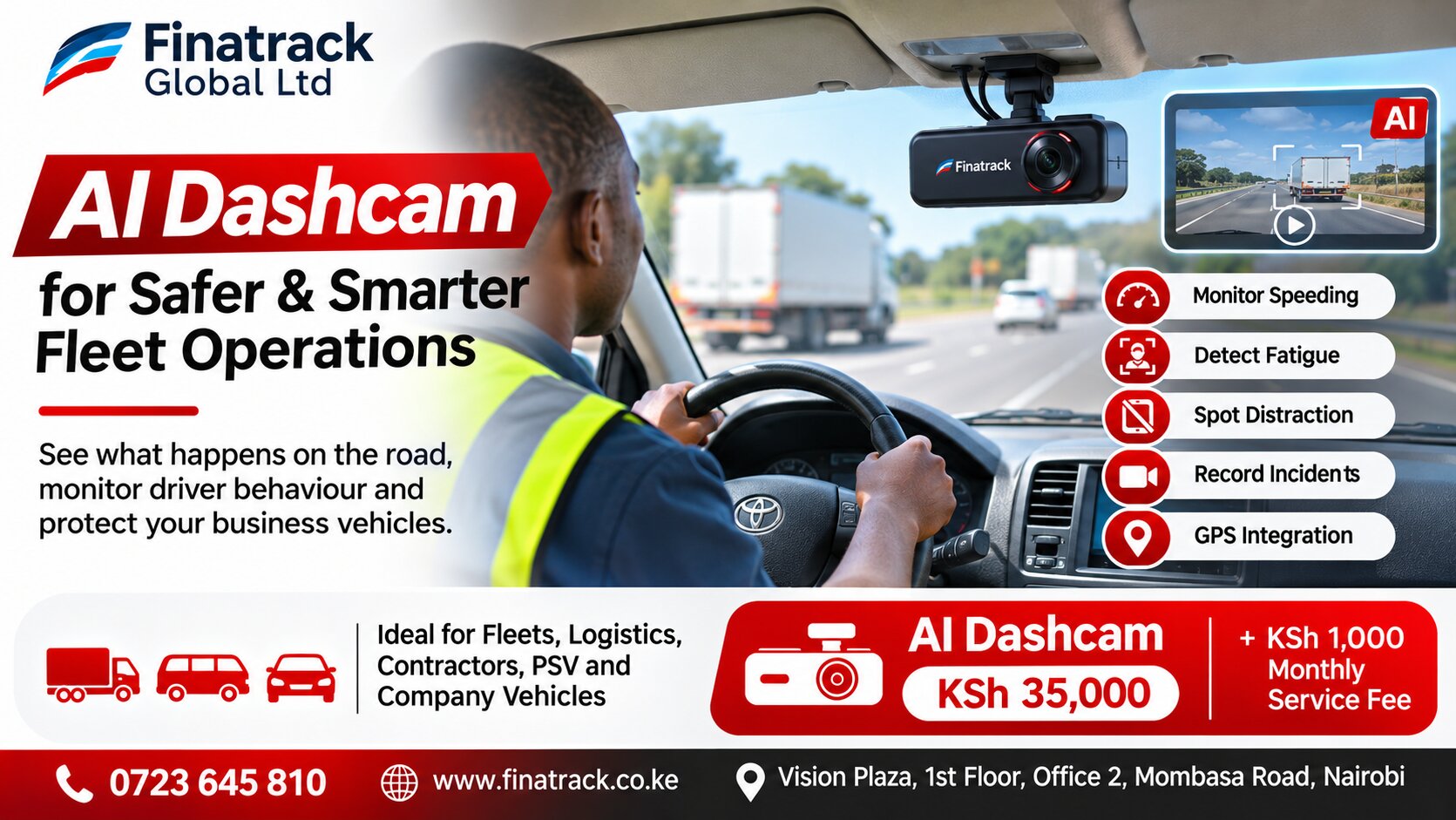
Finatrack Global Ltd provides AI dashcam solutions for businesses and vehicle owners who want greater visibility over driver behaviour and road incidents. The system can support driver monitoring, video recording and fleet accountability when used alongside GPS tracking, helping businesses move from assumptions to evidence-based fleet management.
The Finatrack AI Dashcam is available at KSh 35,000 plus KSh 1,000 monthly service fee. It is suitable for commercial fleets, logistics companies, staff transport vehicles, contractors and other organisations that want to strengthen road safety and accountability. Finatrack also provides wired and wireless GPS trackers, fuel monitoring systems, tracking tags, motorcycle trackers and advanced car alarm systems.
Better Fleet Decisions Need Better Evidence
Fleet managers make better decisions when they have reliable information. GPS data can show where a vehicle travelled and how fast it was moving, while an AI dashcam can add the visual evidence needed to explain what was happening at the same time. Together, these tools can help businesses identify risky driving behaviour, investigate incidents, coach drivers and improve accountability across the fleet.
For enquiries or installation, contact Finatrack Global Ltd on 0723 645 810, visit www.finatrack.co.ke, or visit our office at Vision Plaza, 1st Floor, Office 2, Mombasa Road, Nairobi.
The goal is not simply to record drivers. It is to understand risk early enough to reduce avoidable losses, improve safety and make better fleet decisions.