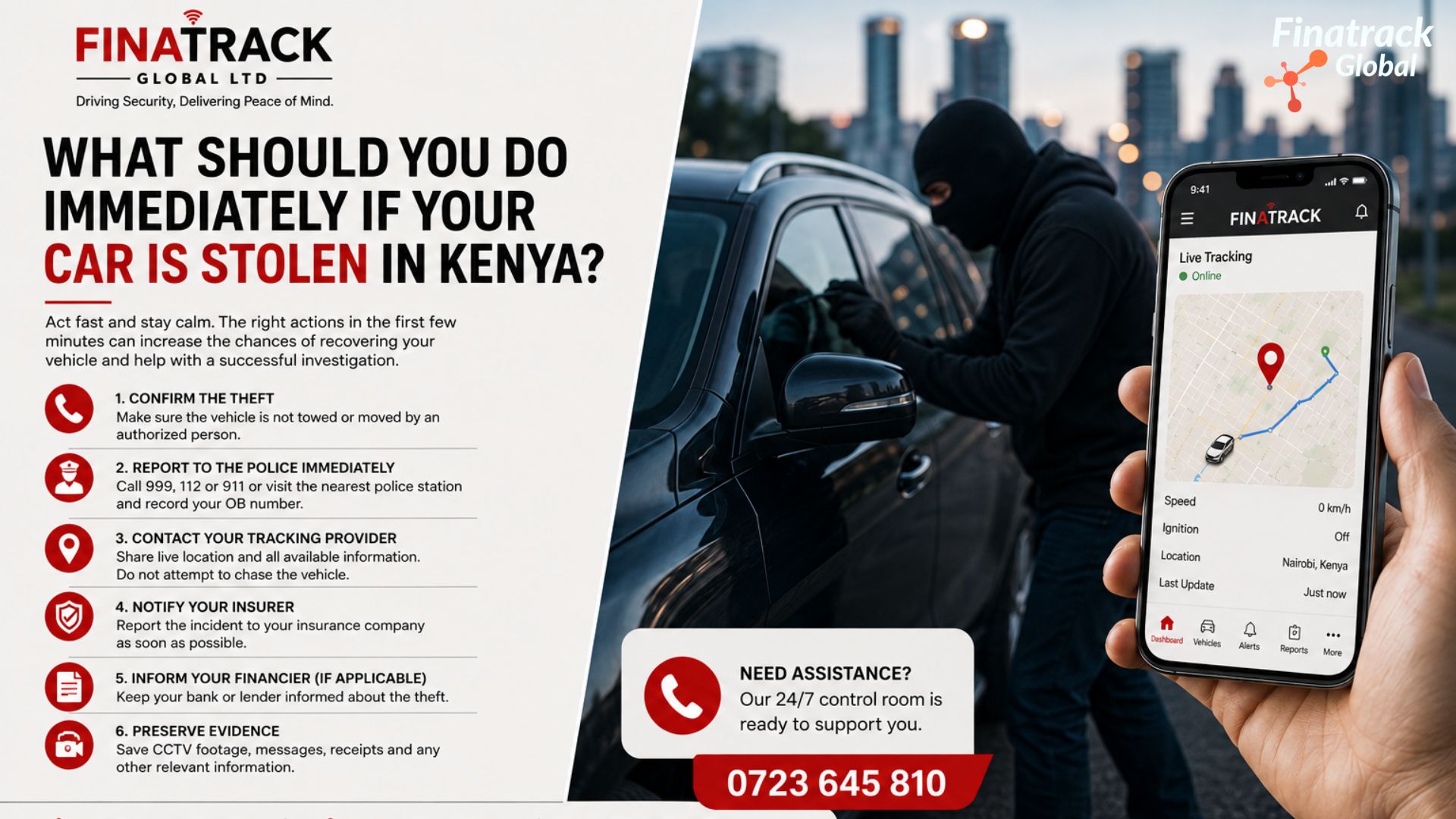
Discovering that your car has been stolen can trigger panic, anger and an immediate urge to begin searching for it yourself. Yet the first few hours after a vehicle disappears are often the most important, particularly where a GPS tracking system is installed. A vehicle owner’s response should therefore be fast but organised, beginning with confirming the theft, alerting the authorities and providing investigators with accurate information that can support recovery.
Vehicle theft remains a serious concern for motorists in Kenya, with private owners, businesses, insurers and lenders all exposed to the financial consequences. A stolen vehicle can also create risks beyond the value of the car itself, particularly where important documents, company property, house keys or other valuables were inside. Knowing what to do before such an incident occurs can make the response considerably more effective.
The first step is to establish that the vehicle has actually been stolen. If a car disappears from a shopping centre, office compound, residential parking area or other managed location, check with security personnel, parking attendants and anyone else authorised to use the vehicle. In some cases, vehicles may have been moved or towed, and confirming the circumstances can prevent unnecessary confusion before a theft report is made.
Once there are reasonable grounds to believe the vehicle has been stolen, the police should be informed immediately. Provide the vehicle registration number, make, model, colour and any other distinctive information that could assist identification. Owners should also have access to the chassis number because registration plates can potentially be removed or replaced after a theft, while the chassis number remains an important identifier of the actual vehicle.
After making the report, retain the police station details together with the occurrence book or case reference issued in connection with the incident. These records may later be required by the insurance company, financier, tracking provider or other parties involved in the investigation and claims process. It is also useful to record approximately when the vehicle was last seen and the location from which it disappeared.
If the vehicle has a GPS tracker installed, the tracking provider should be contacted as soon as possible. A professionally installed system may provide information about the vehicle’s current position, previous route, ignition status and movement after leaving the original location. This information can be extremely valuable to investigators, particularly where the tracker continues transmitting live location updates.
Vehicle owners should, however, resist the temptation to personally pursue a stolen car simply because they can see its location on a smartphone. Tracking information should be treated as intelligence that can support the police and authorised recovery teams rather than as an invitation to confront suspected thieves. The people involved may be armed, may be operating as part of a larger group or may deliberately lead anyone following the vehicle into a dangerous location.
A tracker that suddenly stops updating should not automatically be assumed to have failed completely. The vehicle may have entered an area with poor mobile connectivity, the device may have lost power or somebody may have attempted to interfere with it. Where the tracking system records tampering or power disconnection, those events can also provide useful information about what happened during the theft.
Some wired GPS tracking systems include remote vehicle immobilisation, but this feature should be used with considerable care. Switching off a vehicle travelling at speed could endanger the occupants, other motorists and pedestrians. Where immobilisation is available, the safest approach is to coordinate its use with the tracking provider and relevant authorities so that the vehicle can be disabled under appropriate circumstances.
The insurance company should also be notified promptly. Motor insurance policies normally contain procedures governing how theft claims should be reported and which documents must be supplied, so owners should follow the requirements of their individual policies. Depending on the insurer, supporting information may include police documentation, ownership records, vehicle keys and other evidence required during the investigation of the claim.
Where the stolen vehicle was financed through a bank, SACCO, microfinance institution or another lender, the financier should also be informed. A financed vehicle normally serves as security for an outstanding financial obligation, which means its theft affects both the borrower and the institution. Owners should continue communicating with the lender and follow the terms of the financing agreement while the recovery and insurance processes are underway.
Preserving evidence can also make a significant difference. If the vehicle disappeared from a location covered by CCTV cameras, the owner should quickly request that potentially relevant footage be preserved for investigators because many surveillance systems automatically overwrite recordings after a certain period. Parking records, photographs, access logs, suspicious messages and any communication received around the time of the theft should also be retained.
Particular caution is required if somebody later calls claiming to know where the stolen vehicle is and demands money. Vehicle owners who are desperate to recover their cars can become easy targets for further fraud or extortion. Rather than immediately paying somebody making such claims, the information should be passed to the investigating officers so that it can be assessed as part of the wider case.
For companies, a stolen fleet vehicle can create additional operational risks. Management should establish what the vehicle was carrying, which employee was responsible for it and whether company documents, stock, access cards, fuel cards or payment instruments were inside. Where necessary, cards and access credentials should be cancelled quickly while fleet tracking records, journey history and other relevant information are preserved.
If the vehicle is eventually recovered, owners should avoid assuming that the incident has ended simply because the car is back. The vehicle should be professionally inspected for damage to the ignition system, locks, electrical wiring, tracker, immobiliser and other security equipment. Tracking devices should be tested again, and where thieves discovered or interfered with the original installation, the owner should consider changing the security configuration.
Recovery should also trigger a broader review of how the theft occurred. Owners should examine whether the alarm was functioning, whether the tracker was too easy to locate, whether an immobiliser was installed and whether useful movement or ignition alerts were received. The incident may reveal weaknesses that can be corrected before the vehicle returns to normal use.
This is also why vehicle security is increasingly moving towards a layered approach. A car alarm can provide an early warning of unauthorised access, while an immobiliser can make the vehicle harder to start. A wired GPS tracker provides location visibility, and an independent wireless backup tracker can provide another layer if the main system is disconnected or discovered.
No single security technology can guarantee that a vehicle will never be stolen. The objective is to make theft more difficult, improve the chances of detecting suspicious activity early and provide useful information if the vehicle is taken. A thief who has to defeat several independent security measures faces a substantially more difficult task than one dealing with a single visible device.
Motorists can also prepare long before an incident occurs. Keep secure copies of the vehicle registration and chassis details, insurance information and tracking provider contacts, and ensure that you know how to access the GPS tracking account. Important security features should be tested periodically rather than first being checked during an emergency.
Businesses operating commercial fleets should go further by developing a formal stolen vehicle response procedure. Drivers should know who to contact, fleet managers should know who is authorised to communicate with the tracking provider, and management should understand who handles police, insurer and financier communication. When responsibilities are established before an incident occurs, valuable time is less likely to be lost during the recovery process.
The immediate response to a stolen vehicle should therefore be built around speed, accurate information and coordination. Confirm that the vehicle is genuinely missing, report the theft to the police, contact the tracking provider, notify the insurer and financier where relevant, and preserve any evidence that could support the investigation. Most importantly, avoid confronting suspected criminals personally even when the vehicle’s location is visible.
A GPS tracker may seem like a convenience when everything is normal, showing little more than a vehicle moving across a digital map. During a theft, however, the same system can become one of the most important sources of information available to the owner and investigators.
For professional GPS tracking, vehicle security and fleet telematics solutions in Kenya, Finatrack Global Ltd can be contacted on 0723 645 810 or through www.finatrack.co.ke.
The best time to prepare for vehicle theft is before the vehicle disappears, because once it does, every minute can matter.