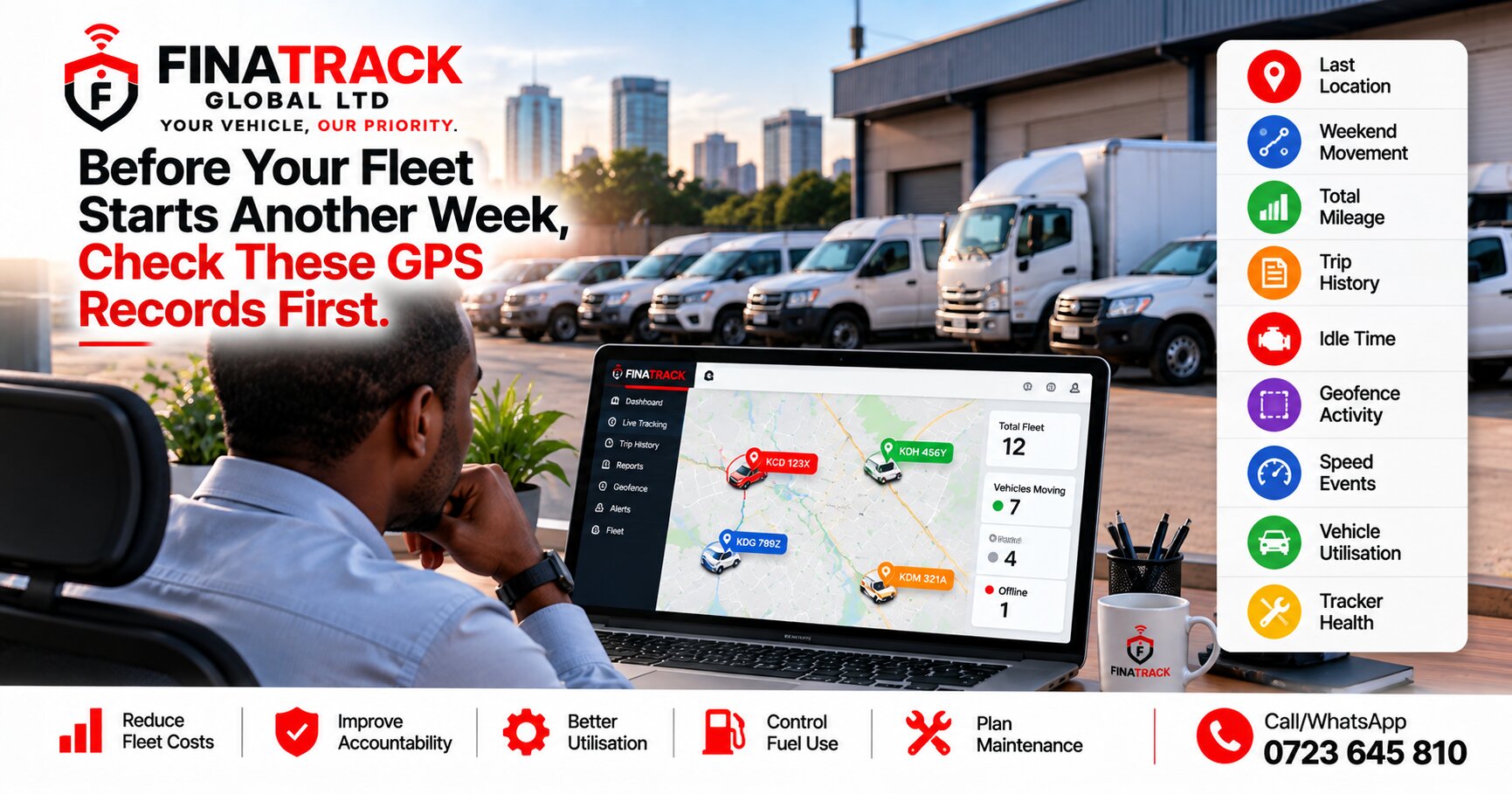
Monday morning is often when fleet problems begin to surface. A vehicle used heavily over the weekend may have accumulated unexpected mileage, another may have been driven outside its assigned area, while a tracker on a third vehicle may have stopped reporting without anyone noticing. By the time these issues are discovered later in the week, unnecessary fuel, mileage and operational costs may already have accumulated.
A simple weekly review of GPS tracking records can help fleet managers identify unusual activity early. The purpose is not to spend hours watching vehicles on a map or checking every journey individually. Instead, management can focus on a few important records that quickly show which vehicles deserve attention.
The first thing to check is the last reported location and update time of every active vehicle. A vehicle that has been operating normally should generally have recent tracking information. If the platform shows that a vehicle has not reported for several hours or days despite being in use, the tracker may require attention.
An old update does not automatically mean that the tracking device has failed. Mobile network conditions, vehicle power, electrical repairs or temporary communication problems can all affect reporting. However, discovering the problem during a Monday review is better than realising several weeks later that the vehicle has been operating without reliable tracking.
Fleet managers should also review weekend and after-hours movement. For businesses whose vehicles are expected to remain parked after working hours, unexpected Saturday, Sunday or late-night journeys may require clarification. A vehicle leaving the company yard at midnight can be investigated quickly while the details of the journey are still fresh.
This does not mean that every after-hours trip represents misuse. Staff may have been completing an authorised assignment, responding to an emergency or taking a vehicle for maintenance. GPS tracking provides the movement record, while the business still needs operational context before reaching conclusions.
The next useful record is total mileage for each vehicle. Comparing kilometres travelled during the previous week can reveal significant differences across the fleet. One vehicle may have covered 1,500 kilometres while another similar unit completed only 400.
The difference may be completely legitimate. A salesperson covering several counties will naturally travel more than an employee assigned to a small area of Nairobi. What matters is whether the mileage makes sense for the work the vehicle was expected to perform.
Unexpected increases can indicate unauthorised trips, inefficient routing or changes in workload. They can also help management identify vehicles approaching maintenance intervals more quickly than expected. Mileage therefore connects fleet operations with both cost control and preventive maintenance.
Trip history should be reviewed when mileage looks unusual. Rather than asking a driver to remember every journey from the previous week, the fleet manager can review the routes recorded by the tracking system and compare them with assignments, deliveries or customer visits.
A company vehicle may have completed all its official work but added several personal journeys after working hours. Another may show excessive mileage simply because poor scheduling required repeated travel across Nairobi. The first situation may require a vehicle-use discussion, while the second could be solved through better route planning.
This distinction is important because GPS data should help businesses improve operations rather than automatically blame drivers. Sometimes the problem is not the person behind the wheel but the way jobs are being allocated.
Fleet managers should also look at long stops and excessive idle periods. A vehicle may cover very little distance yet still consume substantial fuel because the engine remains running while parked. Depending on the tracking system, ignition information can help identify repeated stationary periods that deserve review.
Some idling is unavoidable. Delivery vehicles may wait for loading, drivers may queue at customer sites and certain operations may require the engine to remain running. The useful question is whether the same vehicle repeatedly spends long periods idling without a clear operational reason.
Another important Monday check is geofence activity. If a business has defined operating areas around its warehouse, office, project site or customer region, managers can review vehicles that entered or exited those locations unexpectedly.
For example, a pickup assigned to a construction project may be expected to remain within the site and nearby supply routes. If its weekend history shows a long journey to an unrelated area, management has a reason to ask what happened. The movement itself does not prove misuse, but it highlights an exception that deserves attention.
The same approach can help businesses managing vehicles across several branches. A vehicle allocated to Nairobi may repeatedly appear in another county, while another unit remains underused. GPS records can show whether the current fleet allocation still matches the organisation’s actual needs.
Speed events can also be reviewed as part of the weekly routine. A single overspeed alert does not necessarily describe a driver’s overall behaviour, but repeated patterns across several journeys may justify further attention.
Management should consider the road, operating conditions and type of assignment before drawing conclusions. The purpose should be identifying recurring safety risks rather than punishing drivers based on one isolated event.
Where supported by the installed system, harsh braking and acceleration records can add more context. Frequent aggressive driving can increase fuel consumption, tyre wear and accident risk. Repeated events may indicate a need for driver coaching or closer review of working schedules.
The weekly GPS review can also reveal underutilised vehicles. Some businesses concentrate only on cars that travel too much, but a vehicle that barely moves can also represent a financial problem.
Insurance, depreciation, licensing and other ownership costs continue even when the vehicle remains parked. If one unit is used every day while another similar vehicle operates only occasionally, management can consider whether the fleet could be allocated more efficiently.
This becomes particularly useful when a department requests another vehicle. Before approving a purchase or long-term rental, management can examine whether existing vehicles are already being used effectively. GPS utilisation records can help turn that decision into a data-based discussion.
Fuel expenses should also be compared with vehicle activity. A vehicle that travelled twice as far as usual would naturally be expected to consume more fuel. If fuel expenditure increases sharply while mileage remains relatively stable, management may need to investigate other causes.
These could include excessive idling, mechanical issues, driving conditions or weaknesses in fuel-control procedures. Businesses with high fuel exposure can go further by installing dedicated fuel-monitoring systems that provide additional visibility into fuel-level changes and refilling activity.
One of the easiest records to overlook is tracker health itself. Fleet managers often concentrate on vehicle movement but forget that the monitoring equipment also needs attention. A tracker that has been offline for several days creates a blind spot in the fleet.
Battery replacement, electrical repairs or workshop work can sometimes disturb tracker wiring. This is why vehicles that recently visited a garage should be checked to confirm that location, ignition and trip reporting remain normal.
The entire Monday review does not need to be complicated. A fleet manager can concentrate on exceptions: vehicles with old last-update times, unusually high mileage, unexpected weekend movement, repeated geofence activity, excessive idling, unusual speed events and trackers showing communication problems.
This approach becomes more important as the fleet grows. A manager responsible for twenty or fifty vehicles cannot realistically watch every vehicle throughout the day. Exception-based monitoring allows attention to be directed toward the few vehicles that show something unusual.
The review can also improve communication with drivers. Instead of making general accusations about fuel, mileage or vehicle misuse, management can ask about a specific journey, date or location. Drivers can then provide the operational explanation while the discussion is still based on recent events.
Used consistently, this creates a better fleet-management culture. Employees understand that vehicle records are reviewed routinely, while management becomes more disciplined about using data instead of assumptions.
Finatrack Global Ltd provides GPS tracking and fleet-management solutions for businesses that want better visibility over their vehicles. Depending on the selected solution, authorised users can monitor vehicle location, route history, mileage, geofencing, ignition information and selected driving events through the tracking platform.
The Finatrack wired GPS tracker is available at KES 15,000, providing a permanent everyday tracking solution for company cars, pickups, vans and commercial vehicles. Businesses requiring additional visibility can also consider wireless GPS trackers, tracking tags, fuel-monitoring systems and AI dashcams according to their fleet requirements.
Professional installation can be arranged at the customer’s convenient location or through Finatrack Global Ltd at Vision Plaza, 1st Floor, Office 2, Mombasa Road, Nairobi. Businesses can contact 0723 645 810 or visit www.finatrack.co.ke for more information.
A fleet does not become expensive because of one dramatic problem alone. Costs often accumulate through small issues such as unnecessary mileage, excessive idling, poor vehicle allocation, delayed maintenance and unnoticed tracker outages. A short GPS review at the beginning of every week can help management identify those problems early and make better decisions before they become expensive.