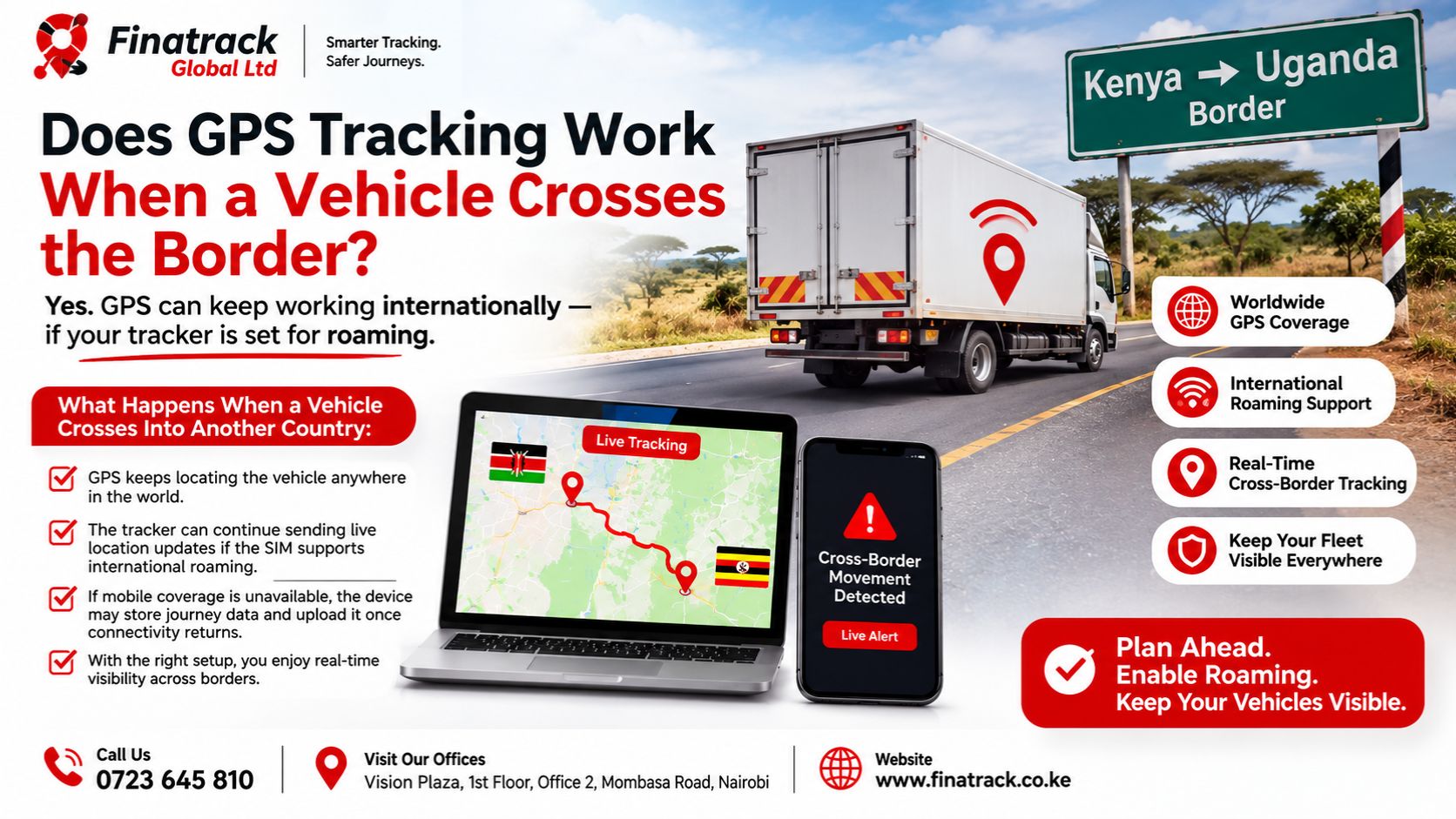
A truck leaves Nairobi carrying goods towards Kampala. Several hours later it crosses the border into Uganda. For the fleet manager watching the vehicle from an office in Kenya, an important question arises: will the GPS tracker continue working once the vehicle is outside the country?
In many cases, it can. Crossing an international border does not automatically stop a GPS tracker from determining the vehicle’s location. GPS itself is a satellite-based positioning system designed for worldwide use, so the device can continue receiving positioning information wherever it has an adequate view of the satellites. (GPS.gov)
What changes at the border is usually not the GPS signal but the mobile network carrying the tracking information back to the monitoring platform. Most vehicle trackers combine satellite positioning with cellular data communication. The tracker determines where the vehicle is using GNSS/GPS and then sends that information to a server over a mobile network. (Teltonika Telematics Wiki)
That distinction is important because a tracker can know where the vehicle is while temporarily being unable to tell the fleet manager.
When the vehicle crosses from Kenya into another country, the SIM card inside the tracking device may have to connect to a foreign mobile network. This is essentially an IoT version of international roaming. GSMA describes mobile IoT roaming as enabling connected devices to access IoT services across countries and networks. (GSMA)
Whether live tracking continues therefore depends partly on the SIM card and roaming arrangement being used by the tracking provider. If the SIM has permission to roam onto a compatible network in the destination country and cellular coverage is available, the tracker may continue communicating with the tracking platform without the driver doing anything.
The transition can appear almost seamless to the fleet manager. A vehicle may leave Kenya, cross the border and continue appearing on the same tracking map as it travels through the neighbouring country.
Professional tracking devices can recognise whether they are connected to their home mobile operator or a roaming operator and can use different data-acquisition settings accordingly. Teltonika documentation, for example, describes tracking units switching between Home, Roaming and, on some configurations, Unknown modes according to the mobile operator to which the device connects. (Teltonika Telematics Wiki)
The important point for a fleet operator is that international tracking should be confirmed before the vehicle begins the journey. A tracker that works perfectly within Kenya should not automatically be assumed to provide the same live connectivity everywhere else.
The first thing to establish is whether roaming is enabled on the tracking SIM.
A fleet manager planning regular journeys into Uganda, Tanzania, Rwanda or other markets should ask the tracking provider whether the installed SIM and tracking platform have been configured for international use. That conversation should happen before the truck reaches the border rather than after it disappears from the live tracking screen.
Network coverage is another factor.
Even with roaming enabled, a tracker still requires an available cellular connection to send information to the remote server. Teltonika’s technical documentation notes that cellular connectivity must be available for a tracking device to transmit data remotely. (Teltonika Telematics Wiki)
This means a vehicle can temporarily stop updating on the platform when travelling through an area with poor or unavailable mobile coverage.
That does not necessarily mean the GPS tracker has stopped recording the journey.
Some professional trackers can continue storing location records in internal memory when GSM or mobile-data connectivity is unavailable. Once connectivity returns, the device can transmit the stored records to the server, depending on its configuration and available memory. (Teltonika Telematics Wiki)
This creates an important difference between live tracking and trip recording.
Live tracking requires the device to communicate with the server. A temporary network outage may therefore prevent the fleet manager from seeing an immediately updated location.
Trip recording can continue separately because the tracker may still be receiving satellite positioning information and storing records locally. When mobile connectivity returns, those stored records can be uploaded and the missing section of the journey may become visible. (Teltonika Telematics Wiki)
For fleet managers, an apparent gap in live reporting should therefore be investigated before concluding that the device has failed or been tampered with.
The platform may show the vehicle’s last transmitted location. If the truck continues moving while the tracker has no cellular connection, the map can temporarily make it appear that the vehicle is still at that last location.
This can become particularly important during international journeys.
Imagine a truck approaching a border region and then disappearing from live tracking for 45 minutes. The natural reaction may be to suspect that somebody disconnected the tracker.
That is one possibility, but it is not the only one.
The device may have lost mobile coverage, experienced a roaming connection delay or encountered another communication problem. Teltonika’s troubleshooting guidance identifies missing GSM coverage, inactive mobile data, SIM configuration and APN settings among factors that can prevent a tracker from sending information to a server. (Teltonika Telematics Wiki)
A good fleet monitoring procedure should therefore look at more than the map.
Managers should check whether the device is online, when it last communicated and whether normal reporting resumes after the vehicle reaches stronger network coverage.
If the tracker returns online and uploads stored journey records, the temporary gap may have been a communication problem rather than a security incident.
If communication does not return, further investigation may be necessary.
Cross-border fleets should also think about how frequently their trackers report while roaming. Some professional tracking devices allow different reporting intervals to be configured for home and roaming networks, partly because data usage and connectivity requirements may differ. (Teltonika Telematics Wiki)
A vehicle may therefore appear to update less frequently abroad depending on how the system has been configured.
This is something transport companies should understand before judging the performance of the system.
For a truck carrying ordinary commercial goods, slightly less frequent reporting may be acceptable. A vehicle transporting high-value cargo may require a configuration designed around much closer operational monitoring.
The appropriate setup should reflect the risk of the journey.
High-value cargo introduces another reason cross-border tracking matters. Once a truck enters another country, the transport company may be dealing with different roads, unfamiliar stopping points and longer distances from its own security or operations team.
Real-time location visibility can help management confirm that the vehicle is still moving towards its intended destination.
Geofencing can also remain useful where the platform and connectivity support it. A transport company may create monitoring areas around border points, warehouses, customer facilities or other significant locations and use those locations as part of its journey-management process.
The technology becomes particularly valuable when combined with clear operating procedures.
If a truck leaves an expected corridor shortly after entering another country, someone in the organisation should know who is responsible for verifying the movement.
The response should not automatically be to assume something criminal has happened. Drivers may encounter diversions, border procedures, road closures or instructions from authorised personnel.
The value of tracking is that the deviation becomes visible.
Cross-border businesses should also avoid relying entirely on one tracking layer when the cargo or vehicle carries substantial financial risk.
A primary wired GPS tracker may provide everyday fleet visibility, while an independent wireless tracker or tracking tag can provide another security layer. The objective is to reduce dependence on a single device or communication method.
That becomes especially important during long journeys where the vehicle may spend several days away from the company’s normal operating environment.
Fleet managers should also confirm what happens to alerts while the vehicle is roaming.
A tracking system may be configured to report ignition changes, geofence events, speeding, unexpected movement or other events. Whether those alerts reach management immediately depends on the device being able to communicate with the tracking platform at that time.
If cellular data is temporarily unavailable, some information may only reach the platform after connectivity is restored, depending on the device and configuration.
This means businesses should not treat GPS technology as a replacement for cross-border journey-management procedures.
Drivers should still have communication protocols, approved routes, emergency contacts and procedures for unexpected incidents.
Tracking provides visibility.
Good operational planning determines what the business does with that visibility.
Companies transporting vehicles internationally should also test their systems before depending on them for a critical journey.
A fleet operator that regularly sends trucks between Kenya and neighbouring countries should understand how its trackers behave during those journeys. Management should know whether reporting continues normally, where connectivity gaps commonly occur and what an offline event looks like on the platform.
The worst time to discover that international roaming was never enabled is when a valuable truck has already crossed the border.
A practical preparation process should therefore begin before departure.
Confirm that the tracking device is online. Check that international roaming is supported for the intended countries. Verify that the monitoring team can access the tracking platform. Make sure the vehicle is reporting normally before it leaves Kenya.
If the journey involves high-value cargo, management may also consider whether additional tracking or security layers are appropriate.
Historical trip records become useful after the journey as well.
Once the vehicle has returned or completed the international trip, management can review the route taken, major stops and journey duration. Where records were temporarily stored during connectivity gaps, compatible devices can transmit them once mobile communication is restored. (Teltonika Telematics Wiki)
This gives fleet managers a better understanding of the complete journey rather than relying entirely on what they saw live at every moment.
International tracking is therefore not simply a question of whether GPS works outside Kenya.
GPS satellite positioning is designed for global use. The more important operational question is whether the tracking device has the cellular connectivity, roaming configuration and platform setup required to transmit that location information from the country in which the vehicle is travelling. (GPS.gov)
For companies operating cross-border fleets, that distinction can determine whether a vehicle remains visible throughout the journey or temporarily disappears from the monitoring screen.
Finatrack Global Ltd provides GPS tracking and fleet telematics solutions for businesses operating commercial vehicles. Companies planning cross-border operations should confirm the required coverage and roaming configuration for their intended routes before depending on continuous international tracking.
For assistance with GPS tracking for trucks and commercial fleets, contact Finatrack Global Ltd on 0723 645 810 or visit www.finatrack.co.ke. Professional installation is also available at Vision Plaza, 1st Floor, Office 2, Mombasa Road, Nairobi.
Crossing the border does not necessarily mean leaving GPS coverage behind.
The question is whether your tracking system is prepared to cross the border with the vehicle.