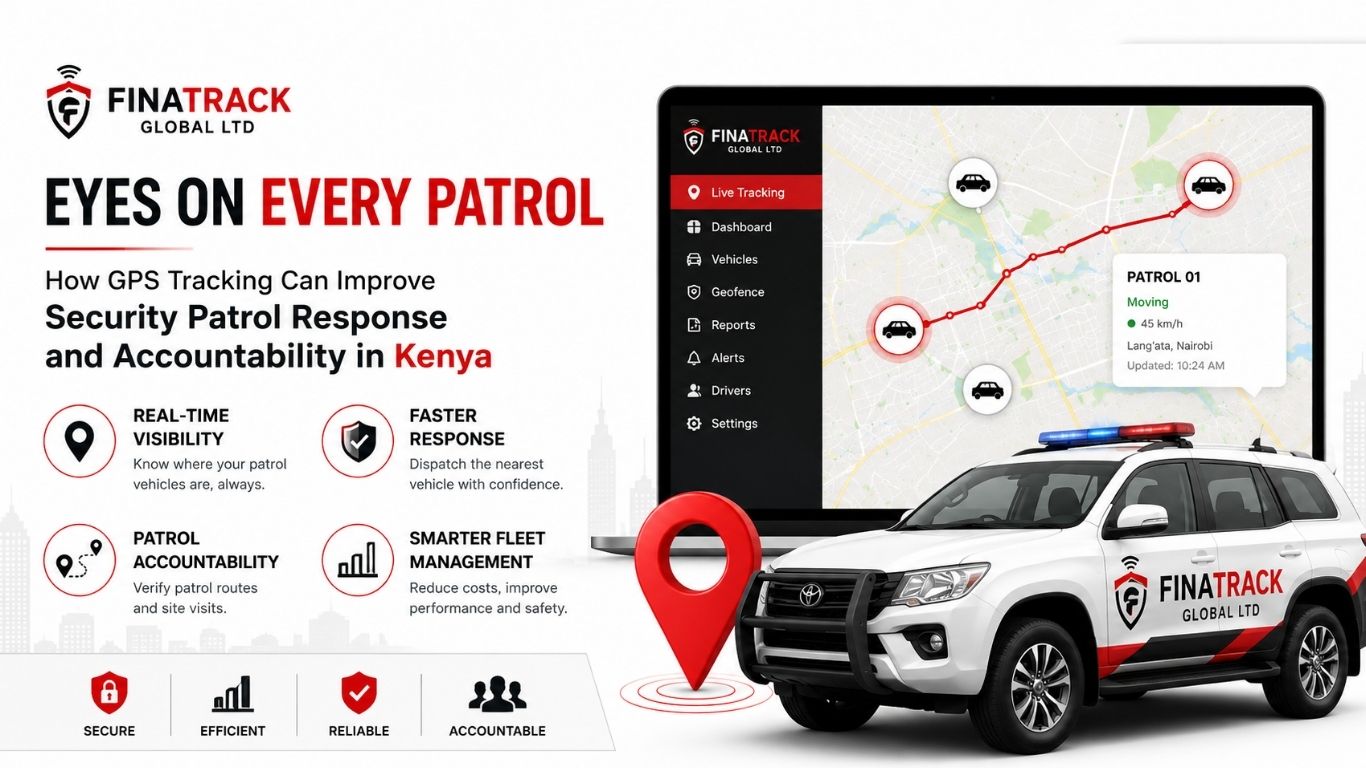
Security companies depend heavily on vehicles to supervise guards, respond to alarms, investigate incidents and move personnel between different client locations. Once a patrol vehicle leaves the control room, however, management may have limited visibility over exactly where it is, which sites it has visited and whether it is positioned appropriately for the next incident. GPS tracking can help close that information gap by giving authorised supervisors a clearer view of patrol vehicle activity throughout the shift.
For a small security company operating one or two response vehicles, supervisors may initially manage operations through phone calls and WhatsApp updates. That approach becomes increasingly difficult when the company begins protecting several estates, offices, warehouses, construction sites or commercial properties at the same time. As the number of vehicles and client locations grows, relying entirely on verbal reports can make response coordination slower and accountability more difficult.
GPS tracking gives the control room a central platform from which authorised managers can see the current or most recently reported location of patrol vehicles. Instead of calling every driver to ask where they are, the supervisor can check the tracking system and determine which vehicle is closest to a client requesting assistance. This can help the company make faster and more informed dispatch decisions.
The ability to identify the nearest suitable response vehicle can be particularly valuable during an alarm activation. A control-room operator may have several patrol cars working in different parts of Nairobi, but without fleet visibility the operator may not immediately know which unit can reach the customer fastest. GPS location data provides the operational information needed to make that decision without wasting time on several phone calls.
Faster dispatch does not automatically guarantee faster arrival because traffic, road conditions and the nature of the incident still matter. GPS tracking simply gives the dispatcher a better starting point by showing where available vehicles are operating. When combined with experienced control-room staff and realistic response procedures, that visibility can improve the way resources are deployed.
Patrol route accountability is another important use of GPS tracking. Security companies often assign vehicles to inspect client locations during night shifts or to supervise guards at different sites. Management may receive written or verbal confirmation that a patrol was completed, but it can be difficult to independently confirm whether the vehicle actually reached every expected location.
Trip history can provide useful supporting information. Supervisors can review where the patrol vehicle travelled, which areas it entered and approximately how long it remained near selected locations. This creates an independent record that can be compared with patrol logs, supervisor reports and other security documentation.
GPS records should not be treated as proof that a guard inspection or security check was properly completed. A patrol vehicle can arrive at a client’s gate without the supervisor carrying out the required inspection. Tracking confirms vehicle movement and location, while the actual security activity still requires appropriate operational records and procedures.
Geofencing can make patrol monitoring more efficient. A virtual boundary can be created around an important client location, estate, warehouse or other assigned area, allowing the tracking system to recognise when a vehicle enters or leaves that zone depending on the configuration. This can reduce the need for somebody to watch every patrol car on the map throughout an entire shift.
For a company serving several commercial clients, geofence information can help supervisors understand whether patrol vehicles are reaching expected areas during the night. If a vehicle repeatedly fails to enter one of its assigned zones, management has a reason to investigate why. The explanation may involve an emergency assignment, a route change or another legitimate operational issue, but the missed movement becomes visible rather than disappearing into paperwork.
Route deviations also deserve attention. A patrol driver may occasionally take an alternative route because of traffic, roadworks, police activity or an urgent client request. GPS information should therefore be interpreted with context rather than treating every deviation as misconduct.
Repeated unexplained deviations, however, can expose an operational weakness. A vehicle assigned to patrol one area may consistently spend long periods elsewhere without a clear reason, reducing the level of coverage available to clients in the assigned zone. Tracking allows management to identify the pattern and determine whether routes, staffing or supervision need adjustment.
Security companies can also use GPS tracking to improve vehicle positioning before an incident occurs. A patrol car parked too far from the clients it is responsible for may create unnecessary response delays even when the driver reacts immediately. Historical tracking records can help management understand where vehicles spend most of their time and whether those positions support the company’s response commitments.
Over time, managers may discover that one patrol zone is too large for a single vehicle. Another area may have several vehicles operating close together while clients elsewhere remain relatively far from the nearest response unit. GPS information can therefore support broader decisions about how patrol resources should be distributed.
This becomes particularly important as security companies expand into new estates or commercial districts. Adding more clients without reviewing patrol geography can gradually stretch existing response vehicles beyond what is operationally realistic. Tracking data gives management evidence that can support decisions about adding vehicles, redesigning zones or creating new response bases.
Vehicle utilisation is another important consideration. Some response units may travel almost continuously during a shift while others spend long periods parked. That difference does not automatically mean one vehicle is underused because different patrol zones can have different risk and demand patterns, but it gives management information that deserves examination.
A heavily utilised patrol car will also accumulate mileage much faster than other vehicles in the fleet. This affects servicing, tyres, brakes and eventual replacement costs, making tracking information useful for maintenance planning as well as security operations. A vehicle operating through most of the night may reach maintenance intervals much sooner than another vehicle of the same age.
Preventive maintenance is particularly important for rapid-response vehicles because a breakdown can affect the company’s ability to serve clients. A patrol vehicle that fails mechanically during an emergency creates both operational disruption and reputational risk. Tracking mileage can help fleet managers plan servicing before heavily used vehicles become unreliable.
When a breakdown still occurs, location information can help management respond more quickly. The control room can identify where the patrol vehicle has stopped and coordinate a mechanic, recovery vehicle or replacement unit more accurately. Another patrol vehicle may also be redirected where appropriate so that the affected area is not left without coverage.
Fuel is another major operating cost for security patrol fleets. Vehicles may spend many hours driving through estates, industrial areas and commercial zones, and small inefficiencies can become significant when repeated every night. Trip history gives management a clearer picture of how much distance each patrol vehicle is actually covering.
If one vehicle begins using considerably more fuel than comparable units while covering similar mileage, management has a reason to investigate. Mechanical condition, excessive idling, unnecessary journeys and driving style can all influence fuel consumption. GPS records provide useful context before the company decides what is causing the increase.
Idling can be particularly relevant in security operations because patrol vehicles may remain parked at strategic locations while the engine is running. Some of that may be operationally necessary, particularly where lighting, communications or environmental conditions require the vehicle to remain active. Repeated excessive idling, however, can increase fuel expenditure without improving the company’s actual response coverage.
Tracking information can help management compare idling patterns between vehicles and understand where long stationary periods occur. The goal should not be to eliminate legitimate waiting time but to identify behaviour that is unnecessarily increasing operating costs. Even modest reductions can become financially meaningful across a fleet operating every night.
Driver behaviour monitoring can also contribute to patrol fleet safety. Security drivers may sometimes operate under pressure, particularly when responding to alarms or incidents, but urgency should not automatically result in unsafe driving. Repeated speeding can expose employees, other road users and company vehicles to additional risk.
Depending on the telematics solution installed, management may be able to review speed-related events and other driving indicators. The information can support driver coaching and safer fleet policies, particularly where certain drivers repeatedly show high-risk behaviour. Individual events should always be interpreted according to the circumstances rather than automatically treated as misconduct.
Harsh braking and acceleration information can provide additional context. Nairobi traffic can force even careful drivers to brake suddenly, especially at night when road conditions or unexpected obstacles may be difficult to anticipate. Repeated aggressive patterns across many journeys are generally more useful for management than one isolated event.
AI dashcams can provide another layer of information for security response fleets. GPS data can show where a patrol vehicle was and how it was moving, while video may help explain what occurred during an accident or disputed road incident. This can support internal investigations, driver coaching and management review when used appropriately.
For security companies, video should be managed carefully because patrol vehicles may travel through sensitive client locations. Access to footage should remain limited to authorised personnel with a legitimate operational reason to view it. Vehicle tracking and video systems should support professional security operations rather than create unnecessary exposure of client information.
Vehicle security itself is another reason to install GPS tracking. Patrol cars may contain communication equipment, uniforms and other business assets while also representing a significant financial investment. If a patrol vehicle is stolen or moved unexpectedly, location information can support a faster response.
Unexpected ignition activity can also provide useful information where the system supports it. A response vehicle expected to remain parked after a shift should not normally become active several hours later unless there is an authorised reason. When ignition activity appears together with unexpected movement, management has a reason to verify what is happening.
Power-disconnection alerts can provide another layer of awareness depending on the tracker installed. If the vehicle battery or tracker power is unexpectedly interrupted, the system may generate an alert. The event may be caused by legitimate workshop activity or an electrical fault, but outside those situations it deserves investigation.
Higher-value response vehicles may benefit from layered security rather than depending on one device alone. A wired GPS tracker can provide the primary monitoring system, while a separate wireless tracker or tracking tag can provide an additional recovery layer. Alarms and immobilisation systems may also be appropriate depending on the vehicle and operational risk.
The purpose of layered security is not to create unnecessary complexity. It is to avoid a situation where disabling one tracker removes every security layer from a valuable vehicle. Different technologies can provide different forms of resilience when they are selected and installed professionally.
Communication reliability also matters for patrol fleets. GPS positioning and cellular communication perform different functions, meaning a tracker may temporarily stop sending live updates if mobile network coverage becomes weak. This can occur in some remote or poorly covered operating areas even though the tracking device itself has not necessarily failed.
Depending on the equipment and configuration, the tracker may store journey records and transmit them when communication returns. Security companies should understand how their devices behave during network interruptions so that an expected coverage gap is not immediately mistaken for tampering. At the same time, an unexplained outage in an area where the tracker normally communicates should not be ignored.
The last update time therefore becomes one of the most important pieces of information on the tracking platform. A patrol vehicle may still appear on the map even when the device has not communicated for a long period. Supervisors should always consider how recent the location information is before relying on it for dispatching or security decisions.
Regular tracker-health checks can help prevent hidden failures. A patrol vehicle may continue operating normally for weeks while its tracker has stopped communicating, particularly if nobody regularly reviews the platform. Discovering that problem during a theft or emergency would be far more serious than identifying it during routine fleet management.
Security companies should periodically review whether all patrol units are reporting and whether recent journey records are appearing normally. Devices with unusually old last-update times can then be inspected before the vehicles begin another shift. This simple practice can improve the reliability of the entire monitoring system.
Trackers should also be checked after battery replacement, dashboard work or other electrical repairs. A mechanic may unintentionally disturb tracker wiring while working on an unrelated vehicle problem. Confirming that the device is online before the patrol car returns to service reduces the risk of an unnoticed tracking failure.
Professional installation remains especially important for vehicles that operate long hours. Patrol cars may travel over rough roads, remain active throughout the night and experience significant daily vibration. Poor wiring can gradually create intermittent power problems that reduce the reliability of the tracking information.
A proper installation should include secure power connections, discreet device placement and testing of important functions before the vehicle returns to duty. Control-room personnel and fleet managers should also understand how to check location, trip history, ignition status and selected alerts. A sophisticated system provides little value when nobody knows how to interpret it.
Access to tracking information should also be managed carefully. A control-room operator may require visibility over active patrol units, while a branch manager may need information only about vehicles assigned to that branch. Senior management may primarily need reports and operational summaries rather than minute-by-minute location access.
Restricting access reduces unnecessary exposure of sensitive fleet information. Patrol vehicle locations can reveal where a security company is concentrating its resources, so tracking accounts should not be shared casually among employees. Authorised access should reflect operational responsibility.
Tracking should also be transparent within the organisation. Drivers and supervisors should understand that company vehicles are being monitored for legitimate reasons such as response coordination, client accountability, fleet security, cost management and driver safety. Clear policies make the technology easier to manage and reduce unnecessary conflict around vehicle monitoring.
The best results occur when GPS tracking becomes part of the company’s operating procedures rather than remaining a device used only during emergencies. Control-room staff can use live vehicle location for dispatching, supervisors can use trip history for patrol review and fleet managers can use mileage for maintenance planning. The same tracking platform can therefore support several departments without losing sight of its primary purpose.
For a small security company, GPS tracking may begin as a way to know where one response vehicle is during the night. As the business grows, the same technology can become part of a structured patrol-management system that supports response allocation, client accountability, fleet maintenance and operating-cost control. The value grows as management uses the data to improve how the patrol operation is organised.
Finatrack Global Ltd provides professionally installed GPS tracking, fleet telematics, AI dashcam and vehicle-security solutions for security companies and other businesses operating response and patrol fleets in Kenya. Solutions can be configured according to the size of the fleet, operating areas and the organisation’s security and management requirements.
Professional installation can be arranged at the customer’s convenient location or at Vision Plaza, 1st Floor, Office 2, Mombasa Road, Nairobi. Security companies seeking better visibility over patrol and rapid-response vehicles can contact Finatrack Global Ltd on 0723 645 810 or visit www.finatrack.co.ke to discuss a suitable tracking solution.
A patrol vehicle cannot provide effective coverage simply because it is somewhere on the road. Management needs to know where that vehicle is, whether it is operating within the expected area and how quickly it can be deployed when the next client needs help. GPS tracking provides that visibility and gives security companies a stronger foundation for managing response operations with greater accountability.