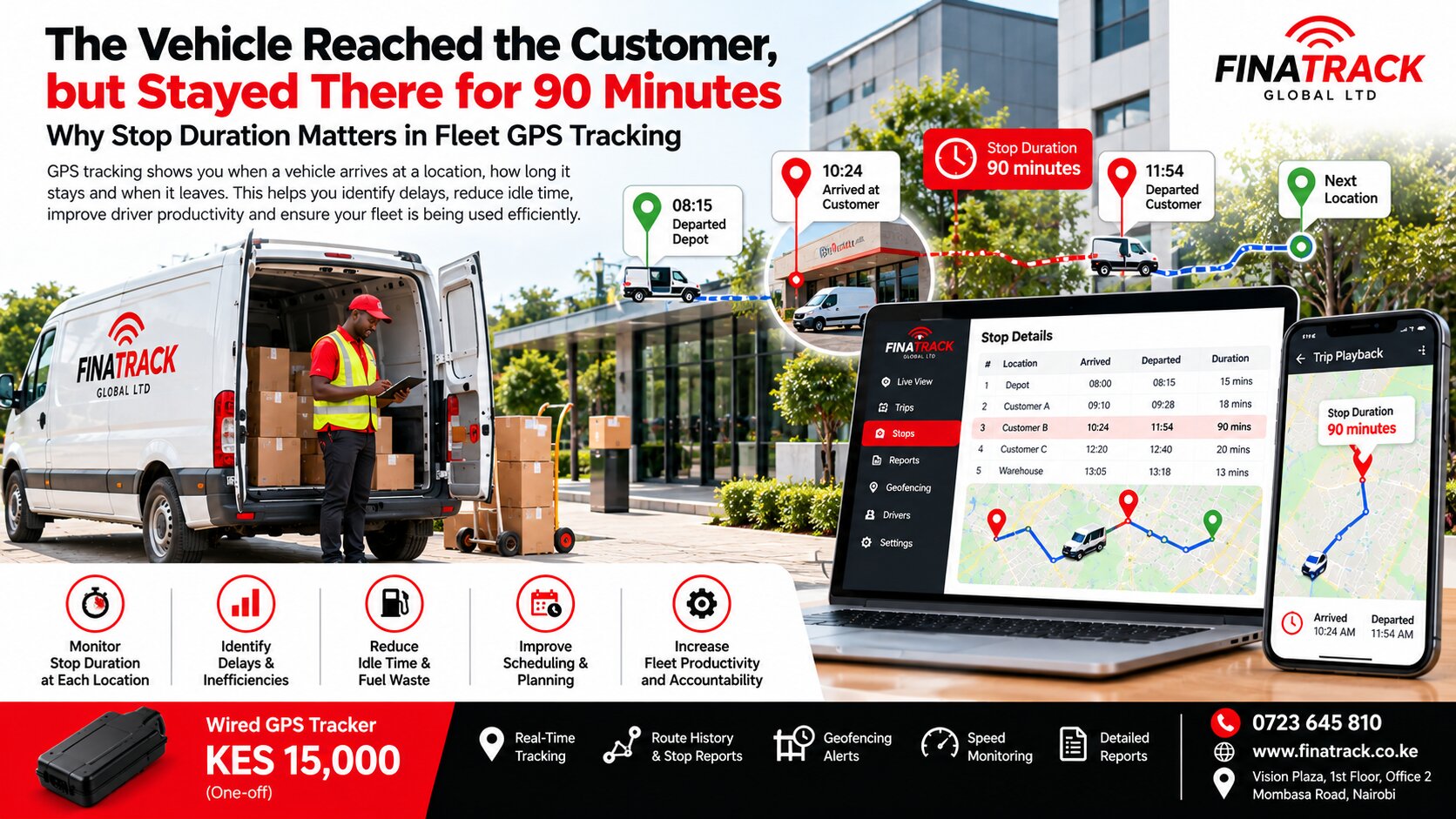
A delivery vehicle can follow the correct route, arrive at the correct customer and still lose hours of productive time during the working day. For many businesses, the problem is not always where the vehicle travels but how long it remains stopped at each location. A van that spends ninety minutes at a customer site where a normal delivery takes twenty minutes can create delays that affect the rest of the day’s schedule. This is why vehicle stop duration tracking in Kenya can be just as important as monitoring routes and mileage.
GPS tracking can help fleet managers identify when a vehicle arrived at a location, how long it remained there and when it continued its journey. When this information is reviewed over several trips, patterns begin to emerge. One customer may genuinely require longer loading or paperwork, while another location may repeatedly show unnecessary delays. Instead of assuming every late delivery is caused by traffic, management gains information that can help determine where time is actually being lost.
Stop duration is particularly useful for delivery, courier and distribution fleets. A vehicle may be scheduled to complete ten customer visits in a day, but completing that target depends on more than driving speed. If three stops take thirty minutes longer than expected, the vehicle could lose more than an hour before the afternoon schedule even begins. GPS records allow the business to compare planned stop times with actual activity and identify locations where the delivery process may need improvement.
The same principle applies to sales and field-service vehicles. A salesperson may travel to several customer locations, while a technician may visit multiple service sites during the day. Management should not automatically assume that a long stop represents poor productivity because the employee may be carrying out legitimate work. However, comparing stop duration with job records, customer appointments or work orders can help the business understand whether vehicle time matches the work being performed.
Unexpected roadside stops deserve a different type of attention. A vehicle that repeatedly remains stationary for long periods at locations unrelated to customers, depots or assigned work may require investigation. The explanation could be traffic, a mechanical issue, a driver’s rest break or another legitimate event. GPS information should therefore provide a starting point for asking questions rather than being treated as automatic proof of misconduct.
Stop-duration analysis can also help reduce engine idling and fuel waste. A vehicle may be parked for forty minutes while the engine remains running, especially during loading, waiting or driver breaks. If this happens repeatedly across several fleet vehicles, the business can consume significant amounts of fuel without adding productive mileage. Combining GPS stop information with ignition or fuel-monitoring data can help managers distinguish between a parked vehicle with the engine switched off and one that is unnecessarily idling.
Businesses can use the data to improve scheduling rather than simply monitor drivers. If several vehicles consistently spend too long at the same warehouse, loading bay or customer location, the problem may be operational rather than driver-related. The company may need to change appointment times, improve loading procedures or discuss delays with the customer. Telematics becomes more valuable when the information leads to changes in the business process instead of being used only to watch vehicles on a map.
Fleet managers should review trends over weeks rather than overreacting to one unusual stop. A single ninety-minute delay could be caused by paperwork, a breakdown or a customer who was not ready to receive a delivery. Repeated long stops involving the same route, driver or destination provide a stronger reason to investigate. Comparing stop duration, trip history, customer schedules and fuel usage can create a much clearer picture of fleet productivity.
Finatrack Global Ltd provides GPS tracking and fleet-management solutions for Kenyan businesses that need better visibility over routes, stops and vehicle utilisation. Finatrack’s wired GPS tracker is available at KES 15,000, with location monitoring, trip history, geofencing and other fleet information depending on the configured solution. For installation or enquiries, call or WhatsApp 0723 645 810 or visit www.finatrack.co.ke. Knowing where the vehicle went is important, but for a business trying to improve productivity, knowing how long it remained there can be just as valuable.