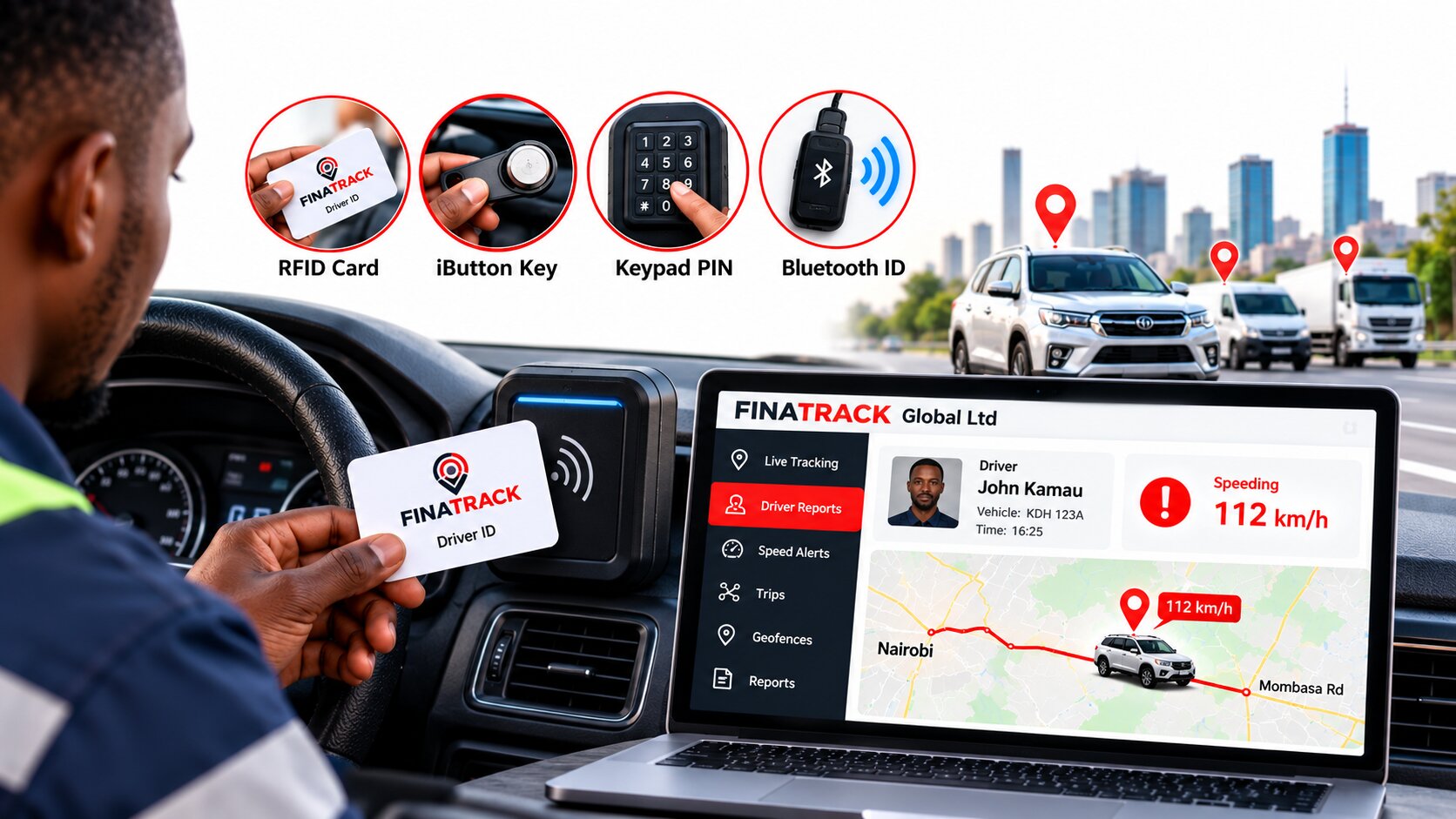
A fleet manager receives a speeding alert showing that one of the company vehicles was travelling much faster than expected. The GPS platform clearly shows the vehicle, location, time and route, but there is one important problem: three different employees used that vehicle during the day. Management knows what the vehicle did but cannot immediately establish who was actually driving when the speeding event occurred. For businesses operating shared company vehicles, driver identification systems in Kenya can help close this accountability gap.
GPS tracking is excellent at identifying the behaviour of a vehicle. Depending on the installed system, management can review location, route history, speed, ignition activity, stops, geofences and other telematics information. A conventional tracker, however, usually identifies the vehicle rather than the individual person behind the steering wheel. If only one employee ever uses the vehicle, this may not create much difficulty. When cars, vans, pickups or trucks are shared between several drivers, the situation becomes more complicated.
Imagine a company with ten vehicles and twenty employees authorised to drive them. Driver A may use Vehicle 5 in the morning, Driver B takes it after lunch and Driver C uses the same vehicle for an evening assignment. At 4:25 p.m., the tracking platform records repeated speeding events. Without an independent driver identification method, management may know exactly which vehicle generated the alert but still need to call several employees to establish who had possession of it at that time.
This is where driver identification technology becomes useful. Instead of assuming that whoever is normally assigned to the vehicle must have been driving, the system can associate a specific driver identity with the vehicle before or during a trip. Depending on the tracking hardware and configuration, this can be achieved through technologies such as RFID cards, iButton keys, identification keypads or Bluetooth-based identifiers.
Teltonika, for example, documents fleet solutions where each employee receives an individual RFID card that communicates with a reader connected to a compatible GPS tracker. The unique identification number associated with that card can then be recorded together with the vehicle’s telematics information. The company also supports iButton-based identification using a similar principle.
The idea is relatively simple. Before beginning a journey, the driver identifies themselves using the assigned card, key or other approved method. The tracking system records that identity together with the vehicle activity. If the vehicle later generates a speeding, harsh-braking or route event, management can review not only which vehicle was involved but also which authenticated driver was associated with the trip.
This can significantly improve shared vehicle accountability. A company may have pool vehicles that are not permanently assigned to one employee. Staff members collect whichever car is available, use it for customer visits or field work and return it later. Traditional GPS tracking shows where the car went, but driver identification helps connect those trips with the person who used the vehicle.
The distinction is important because businesses should avoid making disciplinary decisions based purely on assumptions. If three people use a pickup during the same day, blaming the employee whose name appears on the vehicle allocation sheet may be unfair if somebody else actually drove it during the event. Proper driver identification can create a stronger factual connection between the vehicle record and the individual responsible for that particular journey.
RFID identification is one common approach. An RFID card contains a unique electronic identifier. A compatible reader is installed inside the vehicle and connected to the GPS tracking equipment. The driver presents their assigned card to the reader when beginning the journey, allowing the system to associate the driver’s ID with subsequent vehicle activity. Teltonika specifically describes RFID-based identification as a way of electronically authenticating drivers and recording their working activity.
An iButton works differently physically but serves a similar purpose. It is a small electronic identification key, sometimes referred to as a Dallas key, containing a unique ID. The driver touches it against a reader inside the vehicle to authenticate themselves. Compatible tracking equipment can then send the driver identity together with vehicle data. Teltonika lists both RFID and iButton as supported ways of recording who is driving particular fleet vehicles.
Some fleets may use Bluetooth identifiers or beacons instead. A Bluetooth device assigned to the driver can be detected by compatible tracking hardware inside the vehicle. This can reduce the need to physically touch a reader, although system design becomes important because the business needs to ensure that the identifier detected inside the vehicle genuinely represents the person driving rather than somebody simply nearby.
Keypad systems provide another option. Instead of carrying a card or electronic key, the driver enters an individual PIN before beginning the journey. Teltonika documents driver identification keypads that transmit the entered identification code to compatible GPS devices through a 1-Wire interface. This method can be useful in environments where businesses prefer individual codes rather than physical credentials.
Whichever method is selected, the identification process must be easy enough that drivers actually use it consistently. A sophisticated system provides little value if employees frequently forget to identify themselves or share credentials. Businesses therefore need operational procedures alongside the technology.
Management may require every employee to authenticate before moving a shared vehicle. If a driver forgets, the fleet platform could show an unidentified trip depending on the system configuration. Fleet managers can then investigate why the required procedure was not followed rather than discovering weeks later that several journeys cannot be associated with anyone.
Some advanced configurations can go a step further and use driver identification as an authorisation control. Teltonika’s RFID documentation describes scenarios where an approved identification credential can be required before the vehicle is allowed to start, with unauthorised credentials rejected by the system. Whether this function should be used depends on the vehicle, tracker, installation and safety requirements.
This can be useful for companies with strict vehicle-access rules. A pool vehicle may be available only to authorised drivers, while another employee who has not been cleared to operate company vehicles should not be able to start it. Driver authentication can therefore support both accountability and access control.
Businesses should still think carefully about failure scenarios. What happens if an employee loses their RFID card while working far from the office? What happens if the reader fails? What if a keypad becomes damaged? A fleet policy should include an authorised fallback procedure so that legitimate operations do not stop unnecessarily while still preventing uncontrolled vehicle use.
Lost driver credentials should also be disabled promptly. If an employee loses an RFID card or iButton and the company simply issues another one without deactivating the original credential, the missing identifier could potentially remain authorised. Fleet administrators need a process for managing active driver IDs in the same way businesses manage access cards for offices.
Driver identification becomes particularly valuable when reviewing speeding alerts. Suppose the tracking system shows that a vehicle exceeded the company’s internal speed threshold several times during a particular trip. Management can examine the time, route and driver identity together. Instead of sending a general message to everyone who might have used the vehicle, the fleet manager can discuss the event with the specific driver associated with that journey.
Speed data should still be interpreted carefully. A telematics record should not automatically result in disciplinary action without considering location, road conditions, system configuration and applicable limits. The purpose of driver identification is to improve accountability, not remove the need for fair investigation.
The same technology can help analyse harsh braking and acceleration. If a fleet consistently identifies which employees are operating which vehicles, management can begin building driver-level trends rather than vehicle-only trends. One employee may operate several different vehicles but generate similar aggressive-driving patterns across all of them. Without driver identification, those events could appear to belong to several unrelated vehicles.
This is a major advantage for companies that rotate drivers frequently. A business may incorrectly conclude that Vehicle 6 is the problem because it repeatedly records harsh braking. Driver identification could reveal that the same employee also produces similar events whenever they use Vehicle 2 or Vehicle 9. The issue may therefore be driving style rather than vehicle condition.
The reverse can also occur. Several different drivers may experience unusual braking or handling events in the same vehicle. That pattern could point toward a mechanical problem instead of driver behaviour. Accurate driver-to-trip information helps management separate vehicle-related and driver-related patterns.
Fuel efficiency analysis can also become more meaningful. Two employees may operate the same truck during different shifts. If fuel consumption is consistently higher during one driver’s trips, management can examine speed, acceleration, idling, payload and route conditions. This provides a much fairer comparison than assigning all of the truck’s monthly fuel performance to whichever employee is listed as the primary driver.
Idling is another useful example. One driver may regularly leave the engine running while making deliveries, while another switches it off during longer stops. When driver identification is combined with ignition and stop information, fleet managers can coach the correct employee instead of sending a generic instruction to the entire team.
The technology also helps with after-hours vehicle use. A company car may leave the depot at 9:00 p.m. when no normal assignment is scheduled. GPS can show that the vehicle moved, but driver identification can provide additional evidence about who authenticated before the journey. This can help management determine whether the movement was authorised.
However, fleet operators should not assume that driver identification is impossible to misuse. Employees could share RFID cards, exchange iButtons or tell colleagues their keypad codes. Technology works best when company policy clearly prohibits credential sharing and when unusual usage is reviewed.
A driver credential appearing in two different vehicles at impossible or overlapping times may also indicate that something is wrong. Depending on the platform and data available, this type of pattern can help management identify shared credentials or inaccurate assignments.
Driver identification can be especially valuable for security, courier and field-service fleets. These organisations may have employees working different shifts and using whichever vehicle is available at the time. When an incident occurs, management needs a reliable way to reconstruct who was operating the vehicle without relying only on handwritten vehicle registers.
Paper sign-out books can still support fleet operations, but they depend on employees remembering to complete them accurately. Teltonika’s driver-identification use case highlights common weaknesses of manual records, including delays, writing errors, lost records and inaccurate reporting, and positions electronic authentication as a way to automate the process.
For a growing business, electronic driver identification can reduce administrative work. Instead of asking drivers to record every trip manually, the tracking platform can connect the authenticated identity with vehicle movement. This creates a more consistent operational record.
Maintenance investigations can also benefit. A clutch may wear unusually quickly, tyres may suffer repeated damage or a vehicle may be returned with new body damage. Management can review which employees drove it during the relevant period rather than questioning everyone who had theoretical access to the keys.
This does not mean the tracking record automatically proves that a specific employee caused the damage. The system shows who was associated with the vehicle and when. Physical inspections, dashcam footage, driver reports and other evidence may still be required to determine what actually happened.
AI dashcams can add another layer of context. Driver identification tells the fleet system who authenticated for the journey, while a driver-facing camera may provide visual information around selected safety events. Used together, these technologies can make incident investigation significantly more precise.
For example, an AI dashcam might record a distraction event at 3:42 p.m. The GPS record shows the vehicle travelling along a particular route, while the driver-identification record indicates which employee was assigned to that trip. Management now has several independent pieces of information rather than relying on one dataset.
Businesses should still be careful about privacy and employee transparency. Driver identification links a named or identifiable employee with detailed location and behaviour records. Kenya’s Office of the Data Protection Commissioner specifically recognises GPS tracking and fleet-management systems as technologies that process personal information relating to drivers and employees. Its 2026 transport-sector guidance says transport operators should handle that information lawfully, transparently and securely.
Employees should therefore understand that company vehicles use driver identification, what information is collected and why the company needs it. The ODPC states that data subjects have a right to be informed about how their personal data is used and that personal information should be collected for explicit and legitimate purposes.
A sensible company policy might explain that the system is used for vehicle security, driver safety, trip accountability, fuel management and investigation of incidents. It should also define who is allowed to access driver records and how long the information is retained.
The business should avoid using driver identification as an excuse for unlimited surveillance unrelated to fleet operations. The strongest systems are built around clear operational purposes. Drivers are more likely to understand the value of monitoring when management applies the information consistently and fairly.
Access to driver data should also be controlled. A dispatcher may need to see who is driving a vehicle right now. A safety manager may need driving-behaviour reports. A senior administrator may need to create and deactivate driver credentials. Not every employee requires access to the complete historical record.
The ODPC’s transport guidance stresses the importance of protecting driver and passenger data from unauthorised access and misuse. Good fleet management therefore requires both accurate identification and appropriate information security.
Another important consideration is driver handover during the day. A vehicle may leave the depot with Driver A and later be handed to Driver B without returning to the office. The second driver should authenticate before continuing the journey so the platform knows where the responsibility changed.
Without this step, all subsequent trips may remain associated with the first driver even though that person is no longer operating the vehicle. Fleet procedures should therefore require identification whenever the driver changes, not only once each morning.
Shift-based fleets particularly benefit from this approach. A truck may operate during a daytime and nighttime shift with different drivers. Driver identification can automatically separate activity according to who authenticated instead of treating the vehicle’s entire twenty-four-hour record as belonging to one individual.
For shared corporate cars, identification can also help distinguish business and authorised private use where company policy allows both. Some identification accessories can support business or private modes depending on the system and configuration. Teltonika documents Bluetooth RFID equipment that can associate authorised users with vehicles and support business/private operating modes.
Fleet managers should still define what information is genuinely necessary. If the company only needs total business mileage for reimbursement, it may not need to retain detailed personal-location history during authorised private use. Technology should support the policy rather than encourage unnecessary data collection.
Driver identification can also improve vehicle key management. In many offices, keys are collected from reception or a security desk and signed out manually. Electronic authentication cannot necessarily replace every physical key process, but it can create an independent digital record showing who actually operated the vehicle.
This can help resolve situations where one employee signs out a vehicle but later allows a colleague to drive. The paper register may show the first employee, while the driver ID record shows who authenticated during the journey.
The technology becomes especially valuable when linked to fleet reports. Management can review kilometres travelled per driver, number of trips, average speeds, speeding events, idling and other relevant metrics depending on the telematics platform. Instead of managing only vehicles, the business begins understanding how individual drivers use those vehicles.
Driver reports should still account for context. An employee assigned to long-distance highway work should not be compared directly with someone driving only in congested Nairobi traffic. Different vehicles, loads and routes affect driving data. The strongest fleet programmes compare similar assignments and use telematics for coaching rather than simplistic ranking.
The business can also use driver identification to recognise good performance. If one employee consistently demonstrates safe speeds, smooth driving and low unnecessary idling, telematics can provide evidence for positive recognition. Monitoring should not only be used when something goes wrong.
This can improve employee acceptance. Drivers are more likely to view telematics fairly when good performance is acknowledged as clearly as poor performance is investigated.
Before implementing driver identification, a company should consider which authentication method fits its operations. RFID cards are familiar and simple but can be misplaced. iButtons are durable but still require the driver to physically authenticate. PIN keypads remove the need for a physical credential but create the risk of code sharing. Bluetooth identification can be convenient but requires careful configuration.
There is no universally best method. A construction company, courier service, corporate pool fleet and long-distance trucking company may each have different requirements. The appropriate solution depends on the number of drivers, vehicle types, shift arrangements, security risk and tracking equipment already installed.
Compatibility must also be confirmed. Not every GPS tracker supports every identification accessory. Some systems require a 1-Wire interface, Bluetooth capability or specific digital inputs. Teltonika’s documentation, for example, shows that RFID and iButton solutions depend on compatible tracking hardware and configuration.
Businesses should therefore assess their existing fleet technology before purchasing accessories independently. The driver-identification system, GPS tracker and monitoring platform need to work together.
Professional installation matters as well. The reader should be positioned where drivers can use it conveniently without interfering with safe vehicle operation. Wiring should be secure and should not create unnecessary electrical problems.
After installation, the system should be tested using several drivers. Management should confirm that the correct identity appears on the platform, that driver changes are recorded and that unauthorised credentials behave according to the selected configuration.
The business should then create a simple onboarding procedure. Every authorised driver receives a unique credential, the credential is associated with their employee record and the driver is shown how to authenticate correctly. When the employee leaves the company, the credential is removed or disabled.
Periodic audits can help maintain accuracy. Fleet managers can review active driver IDs and remove old credentials that are no longer required. This is particularly important in businesses with regular staff turnover.
Finatrack Global Ltd provides GPS tracking and fleet-management solutions for businesses in Kenya that want greater visibility over vehicle movement, trip history and driver behaviour. Finatrack’s wired GPS tracker is available at KES 15,000. For businesses operating shared fleets and requiring driver-level accountability, the available driver-identification options should be assessed against the specific tracker hardware, vehicle configuration and operational requirements before deployment.
For professional installation and fleet tracking enquiries, call or WhatsApp 0723 645 810 or visit www.finatrack.co.ke. GPS tracking can tell management that Vehicle 7 was speeding at 4:25 p.m., but in a shared fleet that may only answer half the question. Driver identification adds the missing layer by helping the company establish who was actually associated with that trip, allowing fleet decisions to be based on stronger evidence rather than assumptions.