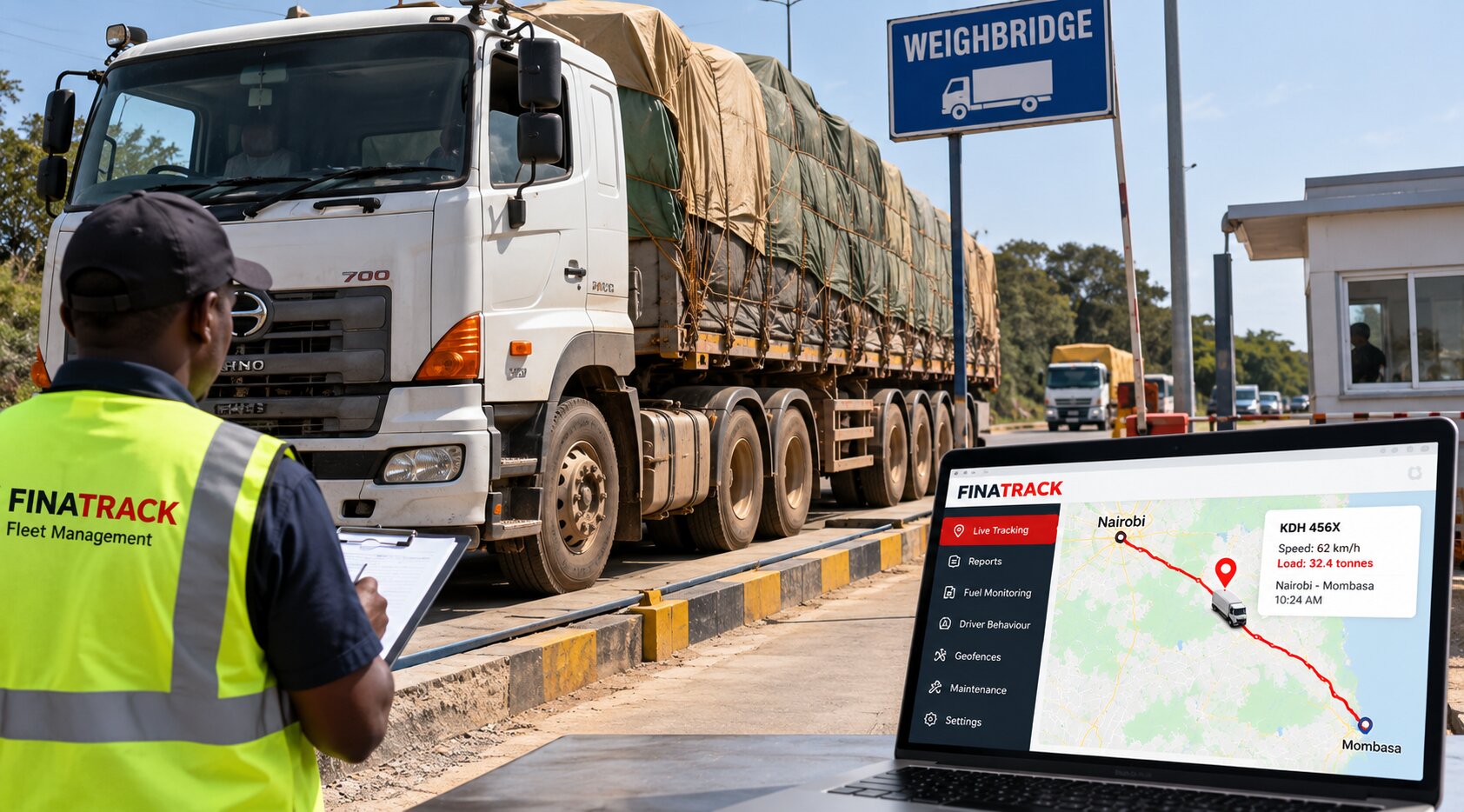
A truck can leave a loading yard looking completely normal while carrying more weight than it should. The driver may not immediately notice the difference, the customer may be happy that more goods have been loaded into one trip and the vehicle may continue moving without an obvious mechanical problem. Yet the extra weight can affect braking, tyres, fuel consumption, suspension, vehicle stability and compliance with axle-load rules. For transport companies operating commercial vehicles in Kenya, truck overload monitoring is therefore not simply a weighbridge issue. It is part of wider fleet safety and cost control.
Kenya maintains legal controls on gross vehicle mass and axle loading, and the country’s transport authorities continue to treat axle-load enforcement as part of road-management policy. The Ministry of Roads and Transport lists axle-load control policy and standards among its transport responsibilities, while the State Department for Roads is responsible for enforcement of axle-load control. Kenya’s Traffic framework also prohibits the use of vehicles above applicable gross-weight limits unless an appropriate exemption or special permit applies.
For a fleet operator, however, the biggest problem is that a standard GPS tracker cannot simply look at a truck and announce that it is overloaded. GPS primarily tells the business where the vehicle is, how it has moved and, depending on the system, information such as speed, ignition, stops and driver behaviour. Actual load weight generally needs to come from a weighbridge, on-board weighing equipment, suspension sensors, axle-load sensors or another compatible system.
This distinction is important because telematics can help identify overloading risk without necessarily measuring the exact load directly. A fleet manager may combine weight information from another source with GPS location, route history, speed, fuel consumption and tyre information. The result is a much stronger operational picture than simply waiting for the truck to reach the next weighbridge.
A common overload problem starts at the loading point. A customer may request an additional pallet, several extra bags or another piece of machinery after the original load has already been planned. The commercial pressure is understandable. An extra trip costs money, and both the transporter and customer may prefer to move everything at once. The risk is that seemingly small additions can push an axle or the entire vehicle beyond the permitted loading configuration.
Gross vehicle weight is only part of the issue. How the load is distributed between axles also matters. A truck may remain below an overall gross-weight limit while placing excessive weight on a particular axle or axle group. Kenya’s Traffic Rules set maximum weights according to vehicle and axle configuration, and the rules provide a limited tolerance on permissible axle loads while not applying the same tolerance to maximum permissible gross vehicle weights.
This is why simply knowing the total cargo weight is not always enough. Ten tonnes positioned incorrectly can create a very different axle-loading pattern from the same ten tonnes distributed properly. Freight should therefore be loaded with both total weight and distribution in mind.
Telematics becomes useful when the loading process is linked to the vehicle assignment. A transport-management or dispatch system may know what goods are being loaded, while the GPS platform identifies the exact truck assigned to the job. If the business also has an on-board weighing system, that information can potentially be brought into the same operational workflow so management can compare the planned load against the actual vehicle configuration before departure.
For many Kenyan transport businesses, a full integrated on-board weighing system may not be available. Even then, GPS and fleet data can help identify indirect signs that a heavily loaded truck is operating differently from normal. Increased fuel consumption, slower acceleration, longer journey times, unusual tyre behaviour or repeated braking events can all justify closer investigation.
These indicators do not prove overloading by themselves. A truck can consume more fuel because of congestion, road conditions, headwinds, mechanical problems or a heavier but still legal load. Telematics should therefore be used to identify abnormal patterns and prompt investigation rather than automatically conclude that the vehicle is overloaded.
Fuel consumption is one useful example. Carrying more weight generally increases the amount of energy required to move a vehicle. Official heavy-vehicle guidance in other jurisdictions similarly notes that extra load increases fuel consumption and operating costs. If a truck that normally records fairly stable consumption on the same route suddenly starts using substantially more fuel after loading, management has a reason to compare the load, route and operating conditions.
The business should still avoid simplistic comparisons. A truck travelling uphill toward a construction site with a full legal load will naturally behave differently from the same truck returning empty on a highway. Good telematics analysis compares similar work with similar work.
Braking is one of the most important safety concerns associated with excessive weight. As vehicle weight increases, the braking system has more kinetic energy to manage. Ontario’s official heavy-vehicle air-brake guidance states that brake demand increases as vehicle speed or weight rises and warns that overloading can reduce braking performance, particularly when heat builds up during repeated or severe braking.
A fleet manager may not be able to measure stopping distance remotely, but telematics can still provide supporting information. Repeated harsh braking, unusually high brake-related events or driver reports of the vehicle feeling difficult to stop should not be ignored, especially when the truck is carrying a heavy load.
Driver behaviour becomes particularly important on hills. A heavily loaded truck travelling down a long descent places significant demand on its braking system. A driver who enters the descent too quickly may need to brake repeatedly, increasing heat and the possibility of brake fade. Proper driving technique, speed management and vehicle condition therefore remain essential regardless of how much telematics is installed.
This also demonstrates why overloading cannot be solved purely through technology. A tracking device may reveal unusual speed or braking patterns, but the fleet still needs proper loading controls, competent drivers, roadworthy vehicles and disciplined maintenance. Telematics strengthens these controls rather than replacing them.
Tyres are another major concern. Overloading places greater stress on tyres and can increase heat and wear. UK government heavy-goods guidance warns that excessive load can cause tyres to overheat and wear rapidly, increasing the risk of premature failure or blowouts. For a commercial fleet, this can create both safety and financial consequences.
This becomes even more serious when tyres are already underinflated. A tyre carrying excessive weight while also operating below the correct pressure is working under two different forms of stress. Businesses with tyre-pressure monitoring can therefore gain additional value by reviewing tyre readings together with vehicle load information.
The same applies to suspension. Trucks are designed to operate within specified loading limits. Repeated excessive loading can place additional stress on suspension components, chassis parts, axles and wheel-end components. Even when the vehicle does not fail immediately, long-term overloading can accelerate wear.
This is one reason fleet managers should not judge the cost of overloading only by whether the truck receives a fine. The hidden cost can include premature tyres, suspension repairs, brake wear, fuel consumption, downtime and reduced vehicle life.
Road infrastructure is another reason axle-loading laws exist. Heavy vehicles place substantial loads on pavements and bridges, and international road authorities consistently identify overloaded vehicles as a significant contributor to infrastructure damage. PIARC, the World Road Association, notes that overweight vehicles can adversely affect pavements, bridges and road safety, with the actual impact depending on axle configuration, suspension, road condition and the magnitude of the overload.
In Kenya, weighbridge enforcement is therefore not simply designed to inconvenience transporters. It forms part of protecting road infrastructure and ensuring that trucks using national roads remain within permitted loading configurations.
KeNHA uses both conventional and increasingly digital methods for axle-load control. Its public guidance explains that a virtual weighbridge uses high-speed weigh-in-motion technology together with sensors and cameras to classify vehicles and transmit information to a control centre for analysis. This reflects the wider movement toward data-based enforcement of commercial vehicles.
A truck operator should therefore assume that loading compliance is becoming more visible, not less visible. Trying to manage overload risk only when the vehicle reaches a traditional static weighbridge is increasingly inadequate. Good fleet practice should begin before the truck leaves the loading yard.
One useful control is to maintain a clear load record for every trip. The business should know the commodity, estimated or measured cargo weight, vehicle configuration and destination before dispatch. For repeat customers, historical records can help identify consignments that regularly approach the truck’s capacity.
Telematics can then add trip information. Management can see which truck actually collected the cargo, where it departed, which route it followed and whether it encountered unusual delays associated with weighbridge stops or load adjustment.
Repeated weighbridge delays can themselves become an operational metric. If one truck or customer route regularly results in lengthy stops near weighbridge stations, management may want to investigate whether loading practices are creating compliance problems. GPS stop-duration records can help identify these patterns even if the tracking system itself does not know the exact axle weight.
Suppose two trucks normally pass through the same corridor with minimal delay, but a third repeatedly spends a long period at weighbridge facilities after loading from one particular customer. That pattern may justify a review of loading procedures. Perhaps the cargo is frequently positioned poorly or loaded close to the maximum limit without enough margin.
These are the kinds of questions telematics helps management ask.
Route planning also matters for abnormal loads. Certain unusually large or heavy loads may require special permits and operating conditions. Kenya’s axle-load regulations allow for special permits in specified abnormal-load circumstances, subject to applicable requirements. Fleet managers should therefore distinguish between ordinary commercial loading and legitimately authorised abnormal-load transport.
A special permit is not a general solution for routine overloading. It applies to specific transport circumstances and should be handled through the proper authority. Businesses should avoid designing normal operations around repeatedly exceeding standard limits.
Driver training remains one of the strongest defences against load-related risk. Drivers should know that being told “just carry it” does not remove the physical effect of weight on the vehicle. They should understand why tyres, braking, steering and stability can change when the vehicle is heavily loaded.
Drivers should also be encouraged to report vehicles that feel unusual after loading. A truck leaning to one side, steering differently or responding poorly under braking should be inspected rather than simply sent onto the road because the customer is waiting.
Telematics can support these reports. If the driver says the truck feels unusually heavy, management can compare the current trip with previous trips on the same route. Fuel use, acceleration, speed behaviour and travel time can provide additional context.
For companies operating tipper trucks, construction vehicles and bulk transport, load consistency can be especially difficult. Sand, ballast, soil and similar materials can vary in density. A loader operator may visually fill the truck to a familiar level while the actual weight differs significantly from the previous load.
This makes proper weighing more reliable than estimating by volume alone.
Agricultural freight creates similar challenges. Produce, grain and other commodities can vary in weight depending on moisture content and packaging. The number of sacks or crates does not always translate neatly into one predictable load.
A disciplined fleet therefore combines proper load measurement with digital operational records. The weighbridge establishes the weight. The telematics platform establishes what happened to the vehicle after loading.
The two data sources become more valuable when linked.
On-board weighing technologies can potentially provide another layer for fleets where overloading is a frequent operational risk. Depending on the vehicle, these systems may use air-suspension pressure, axle sensors, strain gauges or other measurement methods to estimate load. The accuracy and suitability depend on the equipment and calibration.
Fleet managers should not assume that any random suspension sensor provides the same legal certainty as an approved weighbridge. On-board systems are most useful for operational guidance and preventing obvious overload before a vehicle reaches official enforcement.
A company loading trucks at its own warehouse may use this information to tell staff to stop loading when the vehicle approaches its planned capacity. This can reduce the likelihood of sending a truck onto the road only to discover the problem later.
The business should also monitor loading margins. Operating every trip exactly at the theoretical maximum leaves little room for variation in cargo weight, fuel, equipment or measurement. A safer operational policy may include a reasonable internal margin below the applicable maximum.
This is particularly valuable where cargo weight is estimated rather than measured precisely.
Maintenance data should also be reviewed alongside loading. If a truck consistently requires brakes, suspension parts or tyres more frequently than similar vehicles, management should investigate whether its route or loading pattern differs from the rest of the fleet.
Repeated repairs are often treated as purely mechanical problems. Telematics can help reveal whether operational behaviour is contributing.
A truck carrying heavier loads may also record slower acceleration. This does not necessarily indicate poor driver performance. Fleet managers should be careful when comparing driver metrics across different payloads. A heavily loaded vehicle and an empty vehicle will naturally respond differently.
This is why fair driver monitoring requires context. A driver should not be penalised for slower acceleration or higher fuel consumption if the vehicle is carrying a heavier authorised load. Driver performance metrics should be interpreted alongside route, payload and vehicle condition.
The same caution applies to speed. A heavily loaded commercial vehicle may require more conservative speeds even where the legal limit would technically allow faster travel. Fleet policies can establish internal safety thresholds based on vehicle type, load and route.
Telematics speed alerts can support those policies.
Fleet operators should also remember that an overloaded truck affects more than the vehicle carrying the goods. Longer braking distances and reduced stability create risks for other road users. A tyre failure on a heavily loaded truck can become a serious highway incident.
Commercial pressure should therefore never override the basic safety principle that the vehicle needs to remain controllable.
Kenya’s wider commercial-vehicle regulatory environment is also becoming more structured. The National Transport and Safety Authority’s Operation of Commercial Vehicles Regulations, 2026 establish a framework for commercial-vehicle operators, while the Traffic (Motor Vehicle Inspection) Rules, 2026 took effect from July 1, 2026. The Ministry has described these measures as part of improving roadworthiness, safety and accountability in commercial transport.
This makes it increasingly important for transport businesses to maintain records that demonstrate disciplined fleet management.
Telematics can support this culture of accountability by creating a history of vehicle operations. It can show where the truck travelled, when it moved, how fast it travelled, where it stopped and how the trip compared with normal operations. When combined with loading and maintenance records, fleet management becomes much more evidence based.
The strongest system would connect load information, GPS tracking, fuel monitoring, tyre monitoring, driver behaviour and maintenance history. A fleet manager could then investigate a truck that suddenly consumes more fuel, generates more tyre alerts and requires longer braking distances by first asking whether the payload has changed.
This does not require every business to install every sensor immediately. Smaller fleets can begin with basic controls: professional GPS tracking, proper weighbridge use, documented cargo weights, driver training and preventive maintenance.
As the fleet grows, additional integrations can be added where the business case justifies them.
Businesses should also use telematics to improve communication with customers. If a customer repeatedly requests loads that exceed the truck’s safe or legal capacity, management can use trip records and weighing history to explain why another vehicle or additional trip may be required.
This can turn a difficult commercial conversation into an operational decision based on evidence.
The cost of an extra trip may appear expensive, but it should be compared with the possible cost of vehicle damage, fuel inefficiency, roadside delay, compliance action or a serious accident caused by excessive loading.
For logistics firms, profitability should be measured per safe and compliant trip, not simply by how much cargo can be squeezed onto one truck.
Finatrack Global Ltd provides GPS tracking, fuel monitoring, AI dashcam and fleet-management solutions for Kenyan transport businesses seeking stronger visibility over their commercial vehicles. Finatrack’s wired GPS tracker is available at KES 15,000, providing location monitoring, trip history, geofencing, speed information and other fleet features depending on the configured solution.
Where a transport business specifically needs weight or axle-load monitoring, the appropriate weighing hardware must be selected according to the vehicle and operational requirement. GPS tracking does not replace a weighbridge, but it can connect the weight-management process with route, fuel, driver and fleet information so that overload risk becomes easier to manage operationally.
For professional fleet tracking and telematics enquiries, call or WhatsApp 0723 645 810 or visit www.finatrack.co.ke. A truck does not need to visibly struggle before excessive weight becomes a problem. When businesses combine proper weighing, disciplined loading and telematics data, they can identify abnormal operating patterns earlier, protect tyres and brakes, reduce unnecessary fuel costs and improve compliance before the truck reaches the weighbridge.
:::