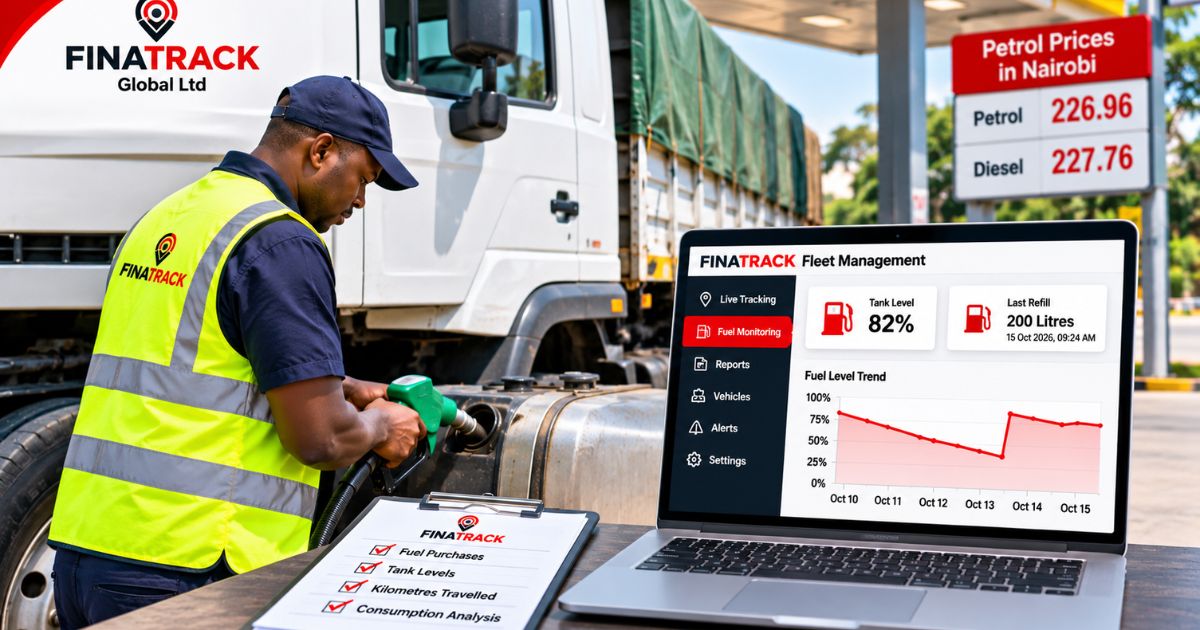
Fuel is one of the easiest fleet expenses to approve and one of the hardest to control properly. A driver requests diesel, the business sends money or authorises a fuel card, the filling station issues a receipt and the vehicle continues with its journey. From an accounting perspective, everything may appear complete. From a fleet-management perspective, however, one critical question remains: did all the fuel the company paid for actually reach the vehicle’s tank and contribute to productive kilometres?
That question has become more important for Kenyan businesses as fuel prices continue putting pressure on transport costs. For the pricing period from October 15 to November 14, 2026, the Energy and Petroleum Regulatory Authority lists diesel in Nairobi at KSh 227.76 per litre and super petrol at KSh 226.96 per litre. When every litre costs more than KSh 200, even relatively small unexplained differences across several vehicles can become a meaningful monthly expense.
For many companies, the traditional way of controlling fuel is still based on receipts. A driver receives KSh 20,000 for fuel and returns with a receipt showing the amount purchased. The accounts department confirms that the receipt matches the money issued, and the transaction is considered complete. The problem is that a receipt proves that a fuel transaction was recorded; it does not by itself show what happened inside the vehicle’s tank before and after that transaction.
This is where fuel reconciliation becomes important. Fuel reconciliation means comparing several pieces of information instead of relying on only one. A business can examine the quantity of fuel purchased, the change in the actual tank level, the distance travelled, the vehicle’s expected consumption and any unusual fuel-level changes that occurred during the trip. When those records broadly agree, management gains greater confidence that the fuel expense makes sense.
The first comparison should be between the fuel receipt and the change in tank level. Suppose a truck arrives at a filling station with a relatively low fuel level and the company authorises a substantial refill. A properly configured fuel-monitoring system can help management see whether the tank level increased at approximately the same time and location as the reported purchase. If a large receipt appears in the accounts but the tank level shows only a small increase, there is a reason to investigate further.
This does not automatically prove fraud. The tank may already have contained more fuel than expected, the sensor may need calibration, the truck could have multiple tanks or the transaction might have been split between vehicles. Good fuel management is about identifying discrepancies and investigating them fairly rather than treating every unusual reading as theft.
Location information adds another useful layer. GPS tracking can show whether the vehicle was actually at the filling station when the reported refuelling occurred. If a receipt is timestamped at 2:15 p.m. at a station on Mombasa Road while the GPS history shows the truck somewhere completely different at that time, management has a clear discrepancy that deserves attention.
Again, GPS should be interpreted carefully. The company should confirm that the timestamp, vehicle assignment and receipt all refer to the same transaction. The objective is to build a reliable picture using several records rather than using one digital point to make an accusation.
The next comparison is between fuel consumed and kilometres travelled. A truck may legitimately consume a large amount of diesel because it covered a long distance with a heavy load. Another vehicle may consume a similar amount while travelling far fewer kilometres. Without comparing fuel with mileage, the accounting records may show both transactions as normal.
GPS trip history helps establish how far the vehicle actually travelled. Fuel-monitoring data can then be considered alongside that distance to estimate whether consumption is broadly consistent with the vehicle’s historical performance. Instead of asking only how much fuel was purchased, management begins asking how much productive movement the business received from that fuel.
Historical comparison is particularly valuable because different vehicles naturally consume different amounts. A heavy truck should not be compared directly with a small delivery van, and even two trucks of similar size may behave differently because of load, route, engine condition or driver behaviour. The strongest benchmark is usually the same vehicle performing comparable work over time.
Suppose a truck normally operates within a reasonably stable consumption range on a regular Nairobi to Nakuru route. If the same vehicle suddenly begins using substantially more fuel without any meaningful increase in load, traffic or distance, something has changed. The cause could involve driving behaviour, excessive idling, mechanical deterioration, tyre pressure, route changes, fuel leakage or possible unauthorised fuel loss.
This is why a fuel-monitoring system should not be marketed simply as a fuel theft detector. Its greater value lies in helping management understand the full movement of fuel through the vehicle. The system can help show refuelling, gradual consumption and significant changes in fuel level, but the business still needs operational context to understand what those changes mean.
Modern telematics offers several different ways of obtaining fuel information. Depending on the vehicle and required accuracy, fuel data can come from the vehicle’s CAN bus, an OBD-connected device or a dedicated fuel-level sensor. Teltonika’s 2026 fuel-control guidance notes that fleets can monitor fuel through native vehicle data or dedicated sensors, with the appropriate method depending on the type of vehicle and the monitoring objective.
For trucks where detailed tank monitoring is important, a dedicated fuel-level sensor can provide stronger visibility into what is physically happening inside the tank. The sensor records changes in the fuel level over time, which can then be displayed on a fleet-management platform together with vehicle location. This makes it easier to compare a fuel change with the exact place and time where it occurred.
CAN-based fuel monitoring works differently. Instead of adding an independent sensor to the tank, compatible telematics hardware can read fuel information generated by the vehicle’s own electronic systems. Recent Teltonika implementations show that CAN-enabled trackers can provide parameters such as fuel level, total fuel consumption, mileage, engine RPM and accelerator-pedal position on supported vehicles.
Neither method should automatically be described as universally better. A fleet mainly interested in consumption trends may find vehicle CAN information useful, while a transport company concerned about detailed refill and drainage events may prefer dedicated tank sensors. The correct choice depends on the vehicle, available data, installation requirements and the level of control the business needs.
Calibration is particularly important with dedicated sensors. A rectangular tank does not always behave exactly like an irregularly shaped commercial fuel tank, where the relationship between fuel depth and litres may vary at different levels. Professional calibration helps the monitoring system translate sensor readings into more meaningful estimates of actual fuel volume.
Without proper calibration, a business can end up with attractive graphs that are difficult to trust. This is why fuel monitoring should be treated as an installed measurement system rather than simply another GPS accessory. The sensor, tracker, tank and software all need to work together correctly.
Refuelling events are one of the most useful records to review. When the tank level rises significantly while the vehicle is stationary, the platform may identify that change as a refill depending on configuration. Fleet managers can compare the event with the filling station, receipt, driver report and amount authorised.
Suppose the company authorised 200 litres and the monitoring record shows a substantial increase at the correct filling station. That does not guarantee perfect litre-for-litre agreement because measurement conditions can introduce variation, but the records support each other. If the authorised amount and the observed tank change are consistently far apart, management has a reason to investigate the process.
The timing of the measurement also matters. A truck may be parked on a slope, fuel may move inside the tank and the sensor reading may fluctuate temporarily. Fleet systems usually need filtering and sensible event rules so ordinary fuel movement is not treated as repeated refuelling or drainage.
This is why businesses should look for meaningful patterns rather than tiny fluctuations. A small change while the truck is moving may simply reflect fuel sloshing, gradient or measurement variation. A significant sustained reduction while the vehicle has been parked for a long period deserves much more attention.
Sudden fuel drops can therefore become useful exception events. Imagine that a truck parks at an unscheduled roadside location at 1:30 a.m. and remains there for forty minutes. During the same period, the fuel graph records a substantial decrease that does not resemble normal engine consumption. GPS location, stop duration and fuel information together create a stronger basis for investigation.
The business should still avoid declaring that a driver stole fuel solely because the graph dropped. Fuel may have been transferred legitimately, the vehicle could have entered a workshop or a sensor issue may exist. Management should verify the circumstances before taking action.
This evidence-based approach is important for employee relations. Fuel monitoring should make investigations more accurate, not encourage accusations whenever the numbers look unusual. Drivers should understand what information the business monitors, how it is used and what procedure is followed when a discrepancy appears.
In many fleets, the bigger problem is not dramatic fuel theft but small recurring losses. Ten litres here, a questionable receipt there, excessive idling every afternoon and repeated route deviations can gradually become more expensive than one obvious drainage incident. Each individual event may appear too small to attract management attention, but across twenty vehicles and twelve months, the cost can become substantial.
This is why monthly fuel reports are valuable. Instead of investigating only emergencies, management can compare litres purchased, estimated litres consumed, kilometres travelled, average consumption and unusual fuel events for every vehicle. The objective is to identify which vehicles are moving away from their normal performance.
The report should also separate fuel price changes from fuel-efficiency changes. If diesel becomes more expensive, the company’s total fuel bill can increase even when vehicles consume exactly the same number of litres. Management needs to know whether the higher monthly expense came from the pump price, greater mileage, poorer efficiency or unexplained losses.
This distinction is particularly important in late 2026. EPRA’s current Nairobi diesel price of KSh 227.76 per litre is higher than many businesses may have built into earlier operating budgets. A company may conclude that fuel costs are rising simply because of market prices when part of the increase may actually come from internal fleet behaviour.
A good fleet manager therefore looks at both shillings and litres. Finance sees how much money was spent, while fleet operations should see how many litres were purchased and what work those litres produced. Focusing only on the cash amount makes it difficult to separate market inflation from operational waste.
Consider a company whose fuel bill rises by 15 percent. If the price per litre also increased significantly, part of that change is understandable. But if kilometres travelled remained constant while litres consumed also rose sharply, the business has an additional efficiency problem that higher pump prices alone cannot explain.
This is where telematics changes the quality of management conversations. Instead of saying, “Fuel is too high this month,” management can ask, “Why did Vehicle 6 use more litres per kilometre than its normal range?” The second question is more specific and much more actionable.
Driver behaviour can explain some of these differences. Repeated harsh acceleration, unnecessary speeding and excessive idling can increase fuel consumption. CAN-enabled telematics can even combine fuel information with operational data such as RPM and accelerator-pedal behaviour on compatible vehicles, giving managers deeper context about why consumption may be changing.
A driver should not automatically be blamed for every increase, however. Nairobi traffic, roadworks, heavier cargo, difficult terrain or long waiting periods can all affect consumption. The company should compare similar routes and conditions before judging individual performance.
Idling deserves particular attention because it consumes fuel while producing no kilometres. A truck can spend hours waiting at depots, warehouses or customer yards with the engine running. The fuel disappears from the tank normally, but the odometer records little or no useful distance.
When fuel data is combined with ignition and stop information, management can determine whether poor efficiency is being caused partly by long idle periods. This may lead to driver coaching, better dispatch planning or discussions with customers whose facilities regularly create excessive waiting.
Route deviation can create another hidden cost. A driver may use a longer route to avoid congestion, which could be completely reasonable. Repeated unexplained deviations, however, can add kilometres and fuel expenditure without increasing revenue.
Trip history allows management to compare the routes actually travelled with the routes normally used for the assignment. If the vehicle travelled an additional 80 kilometres, its higher fuel consumption may suddenly make sense. The next question becomes whether that additional distance was necessary.
Tyre condition can also affect fuel use. Underinflated tyres increase rolling resistance and can cause a vehicle to require more energy to move. A fleet investigating rising consumption should therefore avoid assuming that the fuel system or driver is always responsible.
Mechanical condition is another factor. Engine problems, poor servicing, braking resistance and other faults can contribute to deteriorating efficiency. A truck that steadily consumes more fuel across several different drivers may require inspection rather than disciplinary action.
The strongest fuel-control system therefore combines technology with maintenance management. Fuel monitoring identifies that the pattern changed. GPS shows where and how the vehicle was used. Driver data adds operational context. The workshop determines whether a mechanical fault is involved.
The reconciliation process should also begin before fuel enters the vehicle. Companies operating their own fuel tanks or bowsers face another question: how much fuel left the storage tank, and how much reached each vehicle? A business can lose fuel in the gap between procurement, storage and vehicle dispensing even when every truck itself is perfectly monitored.
This requires a broader fuel-control process. Purchase records, storage-tank readings, dispensing records and vehicle-tank changes should ideally connect. The closer those records can be reconciled, the harder it becomes for unexplained losses to disappear inside monthly totals.
For businesses buying fuel from commercial stations, fuel cards and digital receipts can improve the paper trail but do not remove the need for operational verification. A card can show that Vehicle A was allocated 150 litres at a station. Telematics can help confirm that Vehicle A was physically there and that its tank level changed accordingly.
This does not mean every company needs a complicated control room. Even a business with five trucks can begin with a simple weekly reconciliation. The fleet manager reviews kilometres travelled, refuelling events, receipts and major fuel drops. Vehicles with unusual patterns receive closer attention.
Larger fleets can automate more of this process. Exception reports can highlight vehicles whose consumption exceeds established benchmarks, tanks showing unusual drainage or refuelling quantities that do not align with normal patterns. Management then focuses on the exceptions rather than manually checking every litre.
This is much more efficient than trying to watch the fuel graph continuously. Good telematics should reduce management workload, not create another screen someone has to stare at all day.
Historical data also helps management establish realistic benchmarks. A new truck may not yet have enough information to define normal consumption. After several months across different routes and loads, the business begins to understand its typical operating range.
The benchmark should not become rigid. Seasonal traffic, route changes and business growth can alter vehicle performance. Fleet managers should update expectations when operations change significantly.
One useful approach is to compare consumption by route and vehicle combination. A truck travelling Nairobi to Mombasa can be compared with its previous journeys on that corridor. Another truck operating mainly around Nairobi can be measured against its own urban pattern.
The company can then identify outliers more fairly. A vehicle running in city traffic should not automatically be judged against a truck cruising steadily on the highway.
Fuel monitoring also creates value when customers dispute transport charges. A logistics company may be able to show that an unusual assignment required additional kilometres, long idle periods or extensive detours. Operational data makes pricing discussions more evidence based.
The same information can help management decide whether a contract remains profitable. A customer may generate strong revenue while requiring routes, waiting times and loads that produce unusually high fuel consumption. Once those operating costs are visible, the business can review pricing or service arrangements.
For construction companies, fuel monitoring has another advantage. Trucks and machinery may work in environments where fuel is issued manually and equipment spends long periods away from head office. Digital records reduce dependence on handwritten logs and memory.
Agricultural fleets face similar conditions. Tractors, pickups, trucks and generators may operate across large areas where managers cannot physically supervise every refuelling event. Monitoring helps create visibility even when the asset is far from the office.
The technology can also support fuel budgeting. Once the business understands typical consumption by vehicle and route, it can forecast fuel requirements more accurately. Instead of simply adding a percentage to last month’s expenditure, management can estimate litres based on planned mileage and workload.
This becomes increasingly valuable when pump prices are volatile. The business cannot control EPRA’s monthly price adjustments, but it can control how efficiently the fuel it purchases is used.
That distinction is critical. Fuel prices are external. Fuel accountability is internal.
A business may not be able to prevent diesel from increasing by several shillings per litre, but it can investigate unexplained tank losses, reduce unnecessary idling, improve route planning and maintain vehicles that are consuming more than expected.
Fleet managers should also avoid chasing impossible perfection. A sensor reading and a filling-station receipt may not match to the exact decimal litre every single time. Measurement tolerances, tank shape, parking angle and operating conditions can create differences.
The objective is consistency. If discrepancies remain small and explainable, the system is working as a management tool. If one vehicle repeatedly shows large unexplained differences, that is where attention should go.
Training drivers can make the system more effective. Drivers should understand that fuel monitoring is not installed simply because management assumes everyone is stealing. It exists to protect the company’s largest recurring operating expenses, identify vehicle problems and create fairer records.
The technology can even protect honest drivers. When fuel goes missing from a vehicle overnight while nobody was assigned to it, a proper monitoring record can show when and where the level changed rather than automatically blaming whoever last drove the truck.
Clear procedures are equally important. If an unusual fuel drop occurs, the company should define who reviews the event, what records are checked and when the driver is contacted. Consistent investigation is better than emotional accusations.
Businesses should also schedule periodic fuel-system health checks. A sensor that becomes loose, damaged or poorly calibrated can produce misleading information. If one vehicle’s readings suddenly become erratic, the hardware should be inspected before management assumes the fuel itself is disappearing.
The GPS tracker and communication system should also be functioning reliably. A sensor can measure the tank correctly but still fail to provide useful remote information if the telematics device cannot transmit the data.
Professional installation therefore matters. The fuel sensor, GPS tracker, wiring and platform need to operate as one system. A poorly installed solution can create false alerts that eventually cause management to stop trusting the technology.
Finatrack Global Ltd provides fuel monitoring, GPS tracking and fleet-management solutions for Kenyan businesses seeking better control over fuel expenditure. Finatrack’s Fuel Monitoring System is available at KES 35,000, with a KES 1,000 monthly maintenance and system fee, and can be integrated with vehicle tracking so management can view fuel behaviour together with location and trip information depending on the configured installation.
The system is particularly suitable for trucks and commercial vehicles where fuel represents a significant operating cost. Businesses can use it to monitor tank-level changes, review refuelling behaviour, investigate unusual drops and compare fuel information with GPS movement and fleet operations.
For professional installation and enquiries, call or WhatsApp 0723 645 810 or visit www.finatrack.co.ke. When fuel prices rise, simply telling drivers to “save fuel” is not enough. The stronger approach is to create an evidence trail showing what the business purchased, what entered the tank, where the vehicle travelled and how the fuel was consumed.
A receipt tells you what you paid for. GPS tells you where the vehicle went. Fuel monitoring helps show what happened inside the tank. When those three records are reconciled, a fleet manager can finally answer the question that matters most: is the money being spent on fuel producing the kilometres and work the business expected, or is part of that cost disappearing somewhere in between?