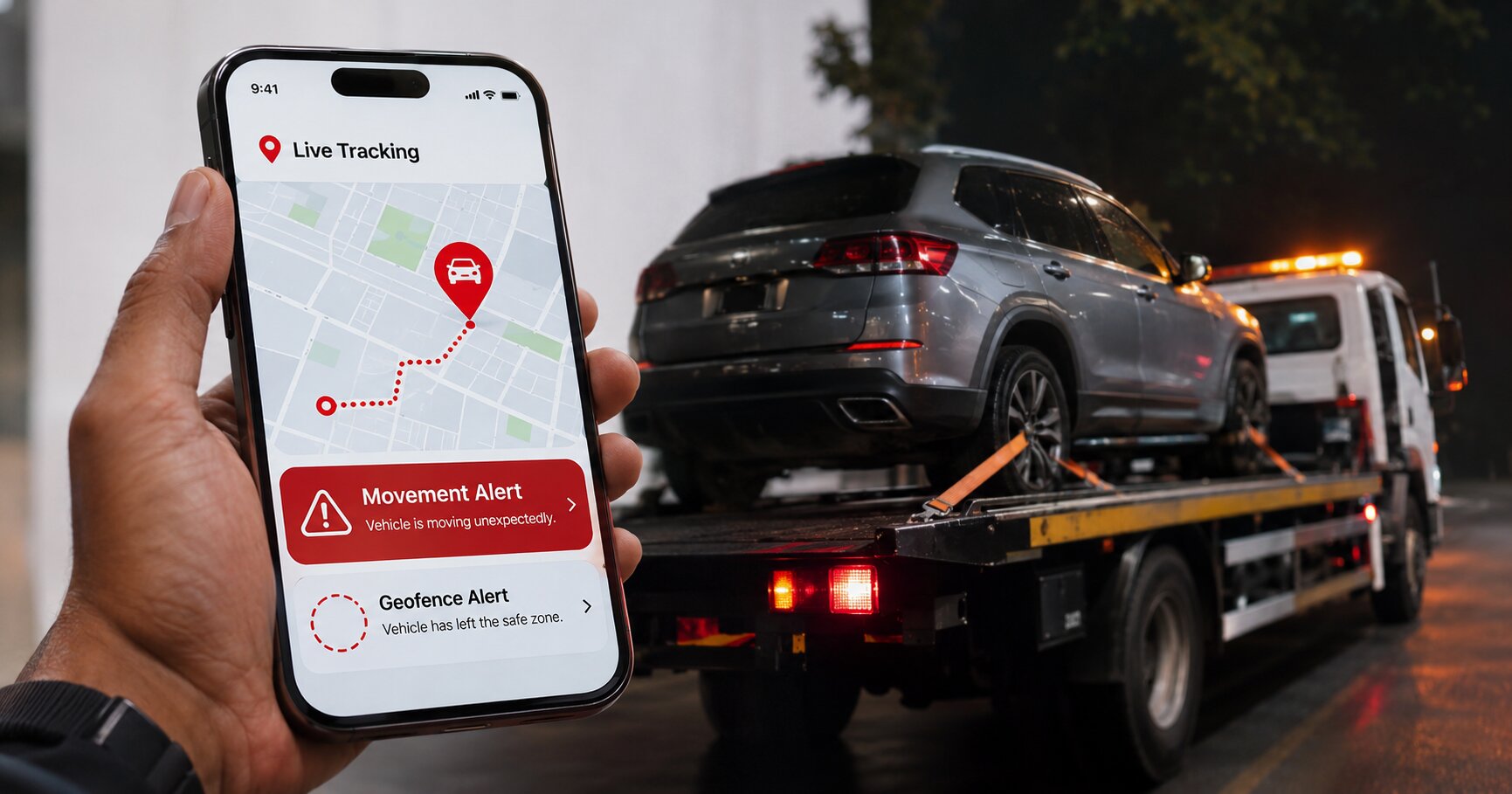
Many vehicle owners assume that as long as their car engine has not been started, the vehicle is safe where they left it. The thinking is understandable: if a thief cannot start the engine because of a factory immobiliser, steering lock or car alarm, then surely the vehicle cannot go anywhere. In reality, however, a vehicle does not have to be started before it can be moved. It can be pushed, towed, lifted onto a recovery truck or transported using another vehicle. This creates a security risk that many motorists only think about after something has already happened.
For vehicle owners in Kenya, this is one reason GPS tracking has become an important addition to traditional vehicle security. A car alarm may warn you when someone interferes with the vehicle, while an immobiliser may make it harder to start the engine without the correct key. A GPS tracker serves a different purpose: it helps you know where the vehicle is and, depending on how the system is configured, can help alert you when its location changes unexpectedly. Instead of relying entirely on whether the engine has been switched on, you gain another way of monitoring what is happening to your vehicle when you are not physically near it.
A Vehicle Can Move Even When the Ignition Is Off
There are several situations in which a vehicle can change location without the engine being started. A car may be pushed for a short distance, pulled using another vehicle, loaded onto a flatbed truck or moved using towing equipment. In a genuine recovery situation, this is perfectly normal, but the same principle means that a person intending to steal a vehicle may not necessarily need to start it at the point where it is parked. Someone trying to avoid attracting attention may first move the vehicle from its original location before attempting to bypass other security systems elsewhere.
This is why an ignition notification alone should not be treated as a complete vehicle security solution. An ignition alert is useful because it can tell the vehicle owner when the ignition has been switched on or off, but it does not necessarily tell the full story. If the car starts changing location while its ignition remains off, location information becomes just as important. A GPS tracking system gives the owner an opportunity to monitor the vehicle beyond simply knowing whether the engine has been started.
Consider a vehicle parked overnight outside an apartment, in an office parking area or inside a residential compound. The owner may assume everything is fine because no alarm has sounded and no ignition notification has been received. If the vehicle is being slowly towed away, however, its physical location is changing. A tracking system that allows the owner to monitor the vehicle’s position can provide important information that would otherwise be unavailable until the owner physically checks the parking space.
How GPS Tracking Helps You Monitor Unexpected Movement
A GPS tracker determines the location of a vehicle using satellite positioning and communicates that information to a tracking platform, normally through a mobile network. The vehicle owner can then use a smartphone, tablet or computer to view the vehicle’s location. Depending on the tracking solution installed, the platform may also provide route history, ignition status, speed information, geofence notifications and other alerts.
The advantage of this approach is that you are not limited to knowing whether the vehicle’s engine is running. You can see whether the vehicle is still where you left it. If you parked your car at home in Nairobi in the evening and later notice that its location has changed, that information immediately gives you a reason to investigate, even if the ignition status still appears to be off. In a genuine emergency, discovering unexpected movement early can make a significant difference compared with finding an empty parking space several hours later.
GPS tracking should not be understood as a device that physically prevents every vehicle theft. Its value is in visibility, information and faster awareness. When you know where the vehicle is or where it was recently located, you have more information to work with when contacting security personnel, recovery professionals or the relevant authorities. Without tracking, a vehicle that disappears may leave its owner with very little information about which direction it travelled or when it left.
Geofencing Can Make Unexpected Movement Easier to Notice
One of the most useful GPS tracking features for this type of situation is geofencing. A geofence is a virtual boundary that you create around a particular location on the tracking platform. You might create one around your home, office, yard, warehouse or regular parking area. When a tracked vehicle crosses the defined boundary, the system can generate a notification depending on the device, platform and settings being used.
For example, imagine that your vehicle is normally parked inside your compound overnight. You establish a geofence around the property, meaning the system expects the vehicle to remain within that area. If the car leaves the geofence during the night, the system can notify you that it has moved beyond the expected location. Importantly, this type of alert is based on location rather than only on the ignition being turned on. Even if a vehicle is being transported or towed, crossing the virtual boundary may still indicate that something requires your attention.
Geofencing is also useful beyond vehicle theft. Businesses can create boundaries around authorised operating areas, warehouses, customer locations or project sites. A fleet manager may want to know when a company vehicle enters or leaves a particular zone, while a private motorist may want a notification when a vehicle leaves home. The feature therefore combines security with everyday vehicle management and accountability.
Live Tracking and Route History Give You More Information
Live location tracking helps answer one of the first questions a vehicle owner asks after receiving a suspicious alert: where is the car now? Through the tracking application, you can view the vehicle’s current or most recently reported position. If the location is different from where the vehicle was supposed to be, you can begin investigating immediately rather than waiting until you physically reach the parking location.
Historical playback, sometimes called route history, adds another important layer. While live location shows where the vehicle is currently located, route history helps you understand how it got there. If you discover that a vehicle has been moved overnight, the system may allow you to review its previous movement, including the route it followed and the locations where it stopped. For businesses, the same information can help investigate unauthorised journeys, after-hours vehicle use, unexplained mileage and disagreements about where a company vehicle was used.
This combination of live location and historical information makes GPS tracking useful both during an incident and afterwards. A driver may claim that a particular route was taken, a company vehicle may appear somewhere it was not authorised to be, or a vehicle owner may simply want to understand how the car moved from one location to another. Instead of relying entirely on memory or verbal explanations, the tracking platform can provide location records that help build a clearer picture.
What Happens When There Is No Mobile Network?
Vehicle owners should also understand that GPS tracking normally involves two different technologies working together. GPS satellites help the tracking device determine its position, while a mobile network is commonly used to transmit that location information to the tracking platform. These functions are related, but they are not the same thing. A vehicle can therefore be in a location where the tracker can determine its position but temporarily cannot send the information because mobile network coverage is poor or unavailable.
Depending on the tracking device being used, location records may be stored and uploaded once communication is restored. The exact behaviour varies between tracking devices and systems, which is why vehicle owners should understand the specifications of the solution installed in their car. It is also important to test the tracking system regularly, confirm that alerts are working and ensure that the application is accessible before an emergency occurs.
A GPS tracker should not be installed and then forgotten for years without any checks. Vehicle security equipment works best when the owner understands how to use it. After installation, confirm that the location displayed on the tracking application corresponds with the actual position of the vehicle. Take a short drive and check whether the route appears correctly, test your geofence and ignition alerts, and familiarise yourself with the historical playback function. This simple testing helps ensure that you know where to look and what to do when an unusual alert appears.
Why Layered Vehicle Security Is Better
No single vehicle security device can deal with every possible method of theft. For this reason, motorists should think about vehicle security in layers. A factory immobiliser may make it difficult to start the engine without the authorised key. An advanced car alarm can help detect certain types of interference and attract attention. A GPS tracker gives you location visibility, while a secondary or backup tracking device can provide another layer of tracking if the primary device is discovered, damaged or disconnected.
This layered approach is particularly important for vehicle owners who are highly concerned about theft or who operate high-value vehicles. A criminal who manages to overcome one security measure should ideally encounter another. The objective is not simply to install as many devices as possible, but to ensure that different technologies perform complementary roles. Prevention, detection, alerts and location tracking all contribute differently to vehicle security.
A backup tracker can be especially valuable because a determined thief may search for an installed tracking device after gaining access to the vehicle. A primary wired GPS tracker can provide regular vehicle monitoring and useful features such as ignition alerts and route history, while a separate backup tracking device provides additional redundancy. If the first tracking device is interfered with, the vehicle owner may still have another possible source of location information.
GPS Tracking Is Useful Even When Your Vehicle Is Not Being Stolen
Although theft prevention and recovery are major reasons for installing a GPS tracker, the technology also provides benefits during normal vehicle use. Private motorists can check where their vehicles are, review previous journeys and monitor how the car is being used. Parents can monitor family vehicles, while businesses can use tracking information to improve driver accountability and supervise company assets without constantly calling drivers for updates.
A business with several vehicles, for example, can use route history to check whether drivers are following assigned routes, while speed alerts can help identify risky driving behaviour. Geofencing can show when vehicles arrive at or leave specific locations, and mileage information can support service planning. For companies with sales teams, delivery vehicles, contractors or field staff, the information generated by a tracking system can therefore become useful for both security and operational control.
The broader lesson is that GPS tracking is not only useful after a car disappears. Its greatest value comes from giving the owner ongoing visibility. You can see whether the vehicle is where it should be, examine where it has travelled and receive selected notifications when something unusual happens. That information creates greater control over an asset that may frequently be several kilometres away from you.
Protect Your Vehicle With Finatrack Global Ltd
Your vehicle does not need to have its engine started before it can be moved. It can be pushed, towed or transported while the ignition remains off, which is why relying entirely on a car alarm or ignition notification may leave gaps in your security strategy. GPS tracking adds another layer by helping you monitor your vehicle’s location, review its movement and receive useful alerts based on the tracking solution and settings selected.
Finatrack Global Ltd provides vehicle tracking and security solutions for private motorists and businesses in Kenya. Our solutions include wired GPS trackers, wireless and magnetic trackers, backup tracking devices, tracking tags, motorcycle trackers, fuel monitoring systems, AI dashcams and advanced car alarm systems. Customers who require stronger vehicle security can also combine more than one solution to create a layered approach to protecting their vehicles.
The Finatrack wired GPS tracker is available at KSh 15,000 as a one-off payment with no annual subscription, or customers can choose the KSh 10,000 installation option with a KSh 3,000 annual subscription. Vehicle owners looking for additional security can choose the tracking device plus backup tracker combo at KSh 25,000.
For enquiries or installation, call or WhatsApp 0723 645 810, visit www.finatrack.co.ke, or visit Finatrack Global Ltd at Vision Plaza, 1st Floor, Office 2, Mombasa Road, Nairobi.
Your car may be parked with the engine switched off, but that does not necessarily mean it cannot move. With the right tracking solution, the important difference is that you have a better chance of knowing when it does.