Knowing where a vehicle is right now is one of the most familiar benefits of GPS tracking, but modern vehicle tracking systems can provide much more than a live location on a map. For many motorists and businesses in Kenya, one of the most useful features is the ability to look back and see where a vehicle has travelled before.
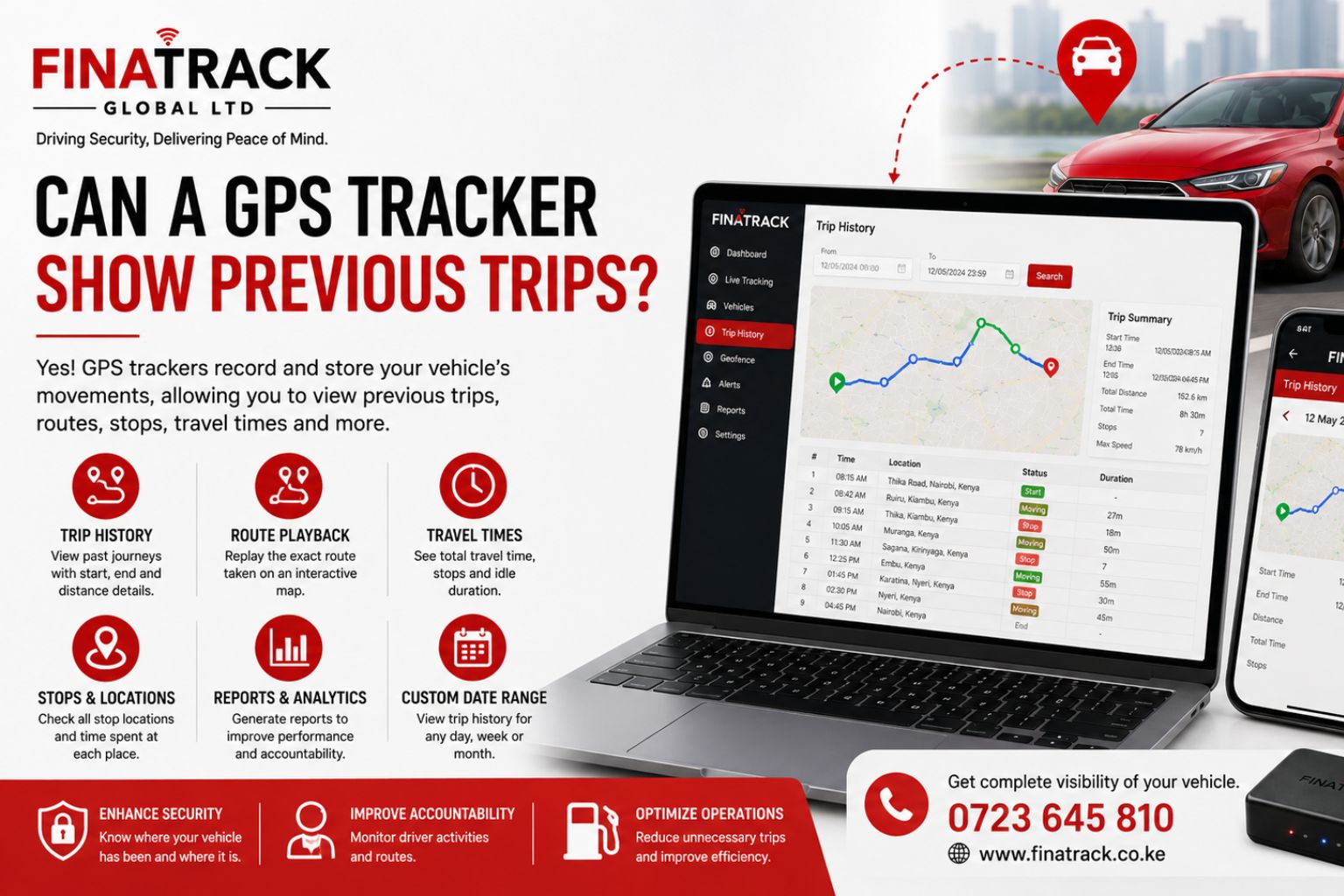
This feature is commonly known as trip history, route history or journey playback. It allows an authorised vehicle owner or fleet manager to review previous movements recorded by the GPS tracking system. Depending on the tracking platform, a user may be able to see routes travelled, departure and arrival times, locations visited, stops made, distances covered and other information associated with previous journeys.
The feature changes GPS tracking from a tool that simply answers the question “Where is my vehicle?” into one that can also answer “Where has my vehicle been?”
A typical GPS tracker installed in a vehicle continuously determines its position while the vehicle is operating. The device then transmits location information through a mobile network to a tracking platform, where the information can be stored and presented to the authorised user. Finatrack Global Ltd, for example, lists live location and trip history among the features available through its GPS tracking solutions.
When a vehicle owner opens the tracking application or web platform, they can normally select a previous date or period and review the journeys recorded during that time. Instead of seeing only the vehicle’s current position, the platform can reconstruct the route it followed.
For a private vehicle owner, this can be useful when a car is shared with another driver or family member. If the vehicle was away for several hours, trip history can provide a clearer picture of the route travelled without requiring the owner to rely entirely on someone’s memory or explanation.
For businesses, the value can be significantly greater. A company operating delivery vans, trucks, sales vehicles or field service vehicles can use historical tracking information to understand whether vehicles followed authorised routes, reached customer locations or made unexpected journeys.
Consider a distribution company sending a vehicle from Nairobi to several customer locations. At the end of the day, management may want to know whether all planned areas were visited. Trip history can provide an independent record of the vehicle’s movement and can help support delivery records, driver reports and other operational information.
The same feature can help investigate route deviations. If a driver was expected to travel from one location directly to another but the vehicle covered considerably more distance than expected, historical tracking information can help management understand what occurred.
This does not automatically mean that every unusual journey represents misconduct. Traffic diversions, road closures, customer instructions and other legitimate circumstances can affect a route. GPS information is most useful when it provides management with evidence that can be considered alongside the wider circumstances.
Trip history can also provide useful information after a security incident. A vehicle owner may discover that a car moved without authorisation several hours earlier. Even if the vehicle is no longer at the original location, historical tracking records may show the route it followed and the places where it stopped.
Where the tracker continues communicating, live tracking can then be used alongside the previous trip information to understand the vehicle’s movement. This can provide useful information when responding to suspected theft, although recovery efforts should involve appropriate security personnel and law enforcement rather than encouraging vehicle owners to confront suspects themselves.
Historical journey information can also help businesses analyse vehicle utilisation. A company may own several vehicles but have limited information about how frequently each one is actually being used. Reviewing trip records can help identify vehicles that travel regularly, those that remain parked for long periods and those covering significantly more kilometres than comparable vehicles.
This information can influence fleet management decisions. A business may discover that some vehicles are overused while others remain underutilised. Rather than purchasing additional vehicles immediately, management may be able to redistribute existing assets more effectively.
Trip history can also support mileage analysis. When a tracking system records routes and distances travelled, businesses gain another source of information for evaluating vehicle usage. This can be useful when comparing fuel consumption, maintenance costs and operating performance between vehicles.
For example, if one vehicle is consuming considerably more fuel than another, historical journey information can provide context. The vehicle may be travelling further, spending more time in congested areas or making more journeys than originally assumed.
When GPS tracking is combined with fuel monitoring and telematics, this information becomes even more useful. Fleet managers can begin comparing location, distance, fuel usage and driver behaviour instead of examining each issue separately.
Historical tracking can also be useful when resolving customer disputes. A customer may claim that a delivery vehicle never arrived at a particular location, while a driver may say that it did. Where accurate trip records are available, management can review the vehicle’s recorded movement before reaching conclusions.
For field service businesses, similar information can help confirm visits made by technicians or sales teams operating company vehicles. The tracking data should, however, be used responsibly and in accordance with applicable workplace and data protection requirements when it can identify individual employees.
Another useful feature offered by some tracking platforms is trip playback. Rather than simply displaying a list of recorded locations, playback can visually reconstruct the vehicle’s journey along a map. The user can follow the route and see how the vehicle moved from one point to another.
This can make historical information easier to understand, particularly when investigating an unusual journey.
However, vehicle owners should understand that GPS trip history is not necessarily stored forever. The amount of historical information available depends on the tracking provider, platform configuration, subscription package and data retention policy.
Some systems may provide several months of historical information while others may retain records for different periods. Businesses requiring historical records for operational or compliance purposes should therefore ask about retention before selecting a tracking solution.
There are also technical limitations to consider. GPS tracking depends on satellite positioning, device functionality and communication networks. If a device temporarily loses mobile connectivity, live transmission may be interrupted. Some trackers are capable of storing information internally and transmitting it later when communication is restored, but capabilities vary between devices.
This means trip history should generally be treated as valuable operational information rather than assumed to be an infallible record under every possible circumstance.
Vehicle owners should also consider privacy. A detailed record showing where a vehicle travelled can reveal sensitive information about the person using it. Historical location information may indicate where someone lives, works or regularly visits.
For private motorists, tracking account credentials should therefore be protected carefully. Anyone who gains unauthorised access to the account may potentially see not only where the vehicle is now but also where it has been.
Businesses should apply even stronger access controls. Fleet information should only be available to employees who require it for legitimate responsibilities. A fleet manager may need access to all vehicle histories, while other employees may only require limited access.
The growing use of vehicle tracking therefore creates a balance between operational visibility and responsible handling of information.
When choosing a GPS tracking system, motorists should ask the provider to demonstrate how trip history works before installation. A customer should know how to select a date, view previous journeys and interpret the information presented by the platform.
It is also worth asking how much historical information is retained and whether the system can be accessed from both a smartphone and a computer.
Finatrack Global Ltd provides GPS tracking solutions that include live tracking and history alongside features such as geofencing and ignition alerts. Its services are available to private vehicle owners, SMEs and corporate fleets, with installations available from its Nairobi office or at a customer’s location.
For private motorists, trip history provides greater visibility over how a vehicle is being used. For businesses, the same information can support route management, accountability, utilisation analysis and investigation of unusual journeys.
So, can a GPS tracker show previous trips?
Yes. A properly installed GPS tracking system with trip history functionality can maintain records of previous vehicle movements and make them available through a tracking application or web platform.
Live tracking tells you where the vehicle is.
Trip history tells you the story of how it got there.
For enquiries about GPS vehicle tracking and fleet telematics solutions in Kenya, Finatrack Global Ltd can be contacted on 0723 645 810 or through www.finatrack.co.ke.