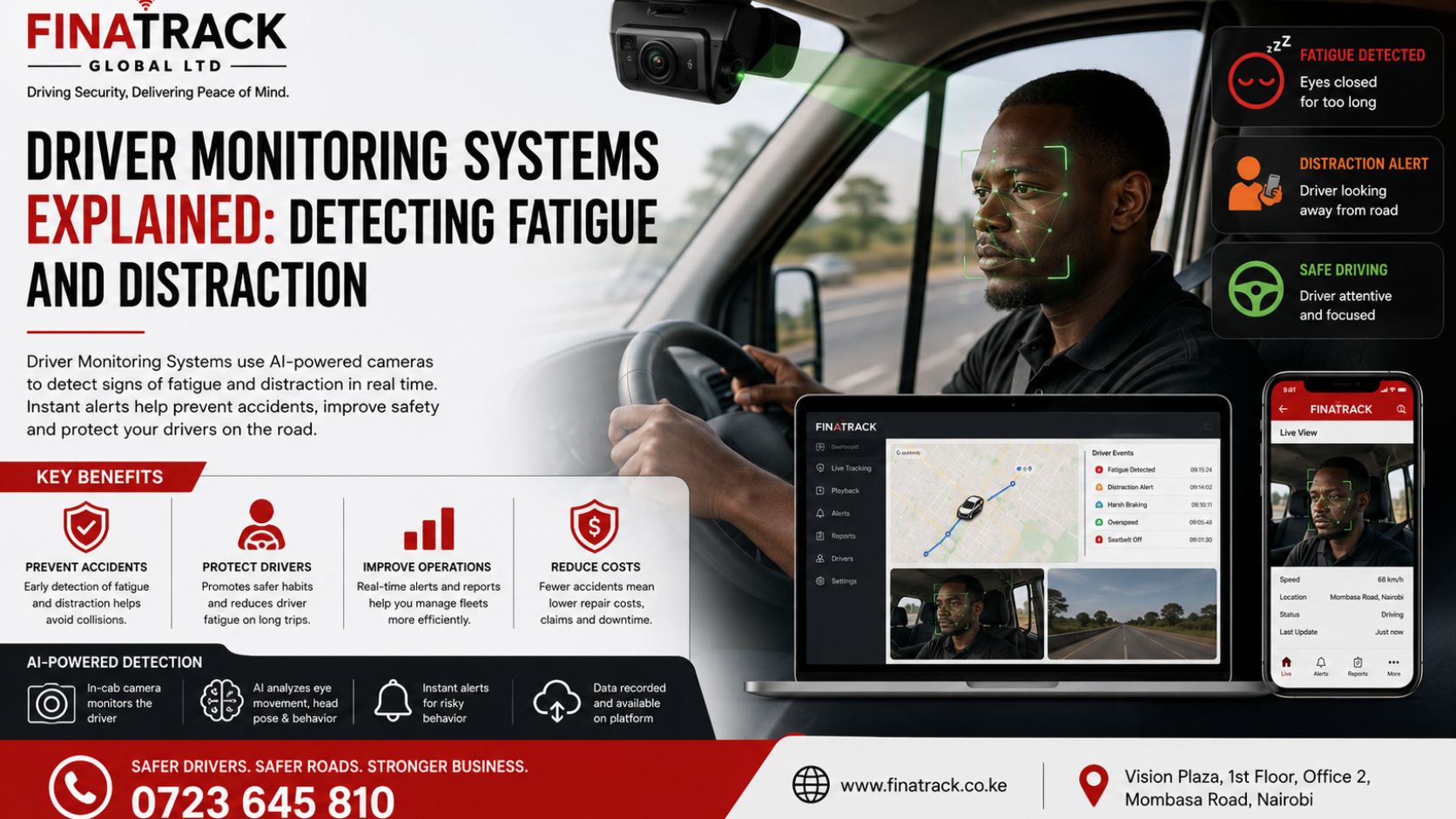
A driver can be physically behind the wheel while mentally being somewhere else. Fatigue, mobile phone use, conversations, long working hours and loss of concentration can reduce attention even when a vehicle appears to be moving normally. For businesses operating commercial fleets, this creates a risk that traditional GPS tracking alone cannot fully address because knowing where a vehicle is does not necessarily reveal whether the person driving it is alert.
Driver Monitoring Systems are designed to help close that gap. These technologies monitor indicators associated with the driver’s attention and alertness and can provide warnings when signs of fatigue or distraction are detected. International vehicle safety regulation is increasingly recognising this technology, with the United Nations Economic Commission for Europe describing Driver Drowsiness and Attention Warning systems as technologies that assess reduced driver alertness and warn the driver.
The technology is particularly relevant for businesses whose drivers spend long hours on the road. Trucking companies, logistics operators, passenger transport businesses, distributors, construction firms and organisations with field vehicles may have drivers covering hundreds of kilometres during a working day. While GPS tracking can monitor routes, speed and vehicle movement, a Driver Monitoring System focuses more directly on what is happening inside the cabin.
Many modern systems use an inward-facing camera positioned to observe the driver. Computer vision software analyses visual indicators such as eye direction, head position and other behavioural patterns associated with attention. UNECE work on advanced driver distraction warning systems specifically recognises camera-based monitoring of a driver’s visual attention, while emerging driver-state monitoring requirements use eye gaze as an important indicator of visual disengagement.
Fatigue monitoring uses a related approach. A driver becoming sleepy may begin showing changes in eye behaviour, facial movement or general attentiveness before actually falling asleep. Driver-monitoring technology can look for indicators such as prolonged eyelid closure and changes in visual attention, allowing a warning to be issued when the system determines that the driver’s alertness may be deteriorating. UNECE work on drowsiness monitoring has specifically considered physiological indicators such as eyelid closure together with behavioural indicators such as prolonged gaze deviation.
The objective is not to diagnose whether somebody is medically fatigued. Driver Monitoring Systems are safety assistance technologies rather than medical devices. Their role is to identify patterns that may indicate reduced attention and provide an opportunity for the driver or fleet operator to respond before those patterns contribute to a serious incident.
Distraction presents a different but closely related problem. A driver may be completely awake yet spend too much time looking away from the road. Mobile phones are an obvious example, but distraction can also involve adjusting equipment, looking at passengers, reaching for objects or focusing on something inside the cabin rather than the traffic environment.
Road safety authorities internationally describe distracted driving as any activity that diverts attention away from the task of driving. The US National Highway Traffic Safety Administration notes that distractions can include phone use, eating, conversations and interaction with entertainment or navigation systems, all of which can take attention away from safe driving.
A camera-based Driver Monitoring System can help identify when a driver’s visual attention remains away from the road for longer than the configured threshold. Depending on the technology, the system may then provide an audible warning inside the vehicle, create an event in the monitoring platform or notify fleet management.
This ability to warn the driver immediately is particularly important. A fleet manager sitting in Nairobi may be hundreds of kilometres away from a truck travelling toward Mombasa, Kisumu, Eldoret or another destination. By the time management manually reviews a driver’s behaviour, the dangerous moment may already have passed. An in-cab warning attempts to intervene while the behaviour is occurring.
Some advanced fleet systems combine Driver Monitoring Systems with artificial intelligence dashcams. One camera faces the road while another observes the driver. This allows the system to place driver behaviour within the wider context of what was happening around the vehicle.
Consider a driver whose eyes move away from the road shortly before harsh braking occurs. Traditional telematics may record only the sudden braking event. A video telematics system can potentially provide additional context showing whether the driver was distracted immediately before the incident.
This is one of the reasons driver monitoring can become valuable for fleet safety investigations. After a near miss, collision or complaint, management is often forced to rely on conflicting explanations. Vehicle data can show speed and location, while video and driver-monitoring events may provide additional information about what was happening immediately before the incident.
However, Driver Monitoring Systems should not be used merely to punish drivers. Businesses that treat the technology exclusively as an employee surveillance tool risk losing much of its potential value. The information is more useful when it forms part of a broader safety programme involving driver coaching, appropriate working hours, route planning and investigation of recurring risk patterns.
A single fatigue warning does not automatically mean a driver is irresponsible. Long journeys, demanding schedules, inadequate rest and poor shift planning can all contribute to fatigue. If the same driver repeatedly generates fatigue alerts on a particular route or during a particular shift, the business should investigate the wider operational conditions rather than simply blaming the individual.
This distinction matters for fleet management. Technology can identify a pattern, but management must still understand why that pattern exists. A professional safety programme uses data to improve decisions rather than treating every electronic alert as proof of misconduct.
Driver monitoring can also help identify recurring distraction. If a driver repeatedly triggers attention warnings, management may be able to review the events and provide targeted coaching. The purpose should be to correct risky behaviour before it results in an accident.
Electronic monitoring and feedback technologies have long been studied as tools for identifying risky driving behaviours such as distraction, drowsiness and aggressive driving. NHTSA notes that monitoring technologies can provide information about driver performance and that feedback based on monitored behaviour can support efforts to reduce unsafe driving patterns.
For fleet operators, the strongest system is therefore not necessarily one that produces the largest number of alerts. Too many unnecessary warnings can create alert fatigue for both drivers and managers. A useful system should identify events that genuinely deserve attention and present the information in a form that management can understand.
Integration with GPS tracking makes this information more valuable. Instead of receiving an isolated fatigue alert, the fleet manager can see which vehicle was involved, where it was travelling, the time of the event and potentially the route being followed. When video is available, management may also be able to review the associated footage.
Speed information provides additional context. A distracted driver travelling slowly inside a controlled yard presents a different level of immediate risk from a distracted driver operating a loaded commercial truck at highway speed. Combining multiple data sources allows management to prioritise the most serious events.
Geofencing can add another layer of information. A company may want to know whether repeated fatigue events occur during long-distance journeys, overnight operations or particular sections of a route. Over time, this information can help management identify areas where scheduling, rest periods or driver allocation may need to be reviewed.
The technology can also help businesses move from reactive safety management toward prevention. Traditional fleet management often becomes involved after an accident has already occurred. Management reviews the damaged vehicle, speaks to the driver and examines the costs after the event.
Driver monitoring creates an opportunity to identify some forms of risky behaviour earlier. If frequent distraction or fatigue events begin appearing before a serious accident occurs, management has an opportunity to intervene through coaching, scheduling changes or other appropriate measures.
This does not mean the technology can guarantee that accidents will be prevented. Driver Monitoring Systems have limitations, and performance can depend on factors such as camera position, lighting, driver appearance, system calibration and the algorithms used by the equipment. They should therefore be regarded as another layer of safety rather than a substitute for responsible driving and professional fleet management.
Privacy also deserves careful consideration. An inward-facing camera can collect information about an employee while they are working, making the way that information is handled important. Employers should have a clearly defined reason for installing the system and should explain to drivers what is being monitored, how the information will be used and who is authorised to access it.
The objective should be improving road safety and protecting company assets rather than introducing uncontrolled surveillance. Access to driver footage and monitoring information should be limited to people who genuinely require it for legitimate operational, safety or investigative purposes.
For businesses considering Driver Monitoring Systems, the starting point should therefore be the risk they are trying to manage. A company operating short urban deliveries may have different requirements from a long-distance transport business whose drivers spend several hours continuously behind the wheel.
Long-distance trucking fleets may place greater emphasis on fatigue detection. Distribution businesses operating in busy urban environments may be particularly interested in distraction alerts. Passenger transport businesses may value both because driver behaviour directly affects the safety of multiple passengers.
Fleet size also matters. A company operating five vehicles may be able to manually review individual events, while an organisation running hundreds of vehicles needs a platform capable of organising alerts and helping management identify which drivers or vehicles require the greatest attention.
The broader global trend also suggests that driver monitoring is moving from optional fleet technology toward an increasingly important component of vehicle safety. European vehicle safety rules already require driver drowsiness and attention warning systems among safety features on new vehicles, while UNECE continued developing international requirements for drowsiness and distraction monitoring during 2025 and 2026.
For Kenyan fleet operators, the significance is not that every commercial vehicle must immediately be fitted with such technology. The more important point is that driver safety technology is advancing beyond traditional GPS tracking, creating new tools for businesses that want better visibility into the risks occurring inside the cabin.
A GPS tracker answers an important operational question: where is the vehicle?
A dashcam can answer another: what happened around the vehicle?
A Driver Monitoring System adds a third question: what was happening with the driver?
When these technologies are combined, fleet managers gain a more complete view of both vehicle movement and driver safety.
For transport businesses, the financial argument can also extend beyond accident prevention. Serious incidents can result in vehicle repairs, insurance claims, damaged cargo, operational downtime, customer disputes and reputational damage. Reducing risky driving behaviour therefore supports both safety and business continuity.
The most effective approach is to use driver monitoring as part of a wider telematics strategy. GPS tracking, speed monitoring, route history, geofencing, driver behaviour analysis and video monitoring can work together rather than operating as separate technologies.
Finatrack Global Ltd provides GPS tracking, vehicle telematics and AI-enabled vehicle monitoring solutions for businesses and commercial fleets in Kenya. Driver monitoring technology can complement conventional GPS tracking by helping fleet operators identify signs of fatigue, distraction and other behaviours that may increase driving risk.
The goal should not be to watch drivers for the sake of watching them.
It should be to identify risk early enough to do something about it.
Because when a driver begins losing concentration at highway speed, knowing where the vehicle is may no longer be enough.
Knowing what is happening behind the wheel can matter just as much.
For enquiries about GPS tracking, AI dashcams, driver monitoring and fleet telematics solutions, contact Finatrack Global Ltd on 0723 645 810 or visit www.finatrack.co.ke.