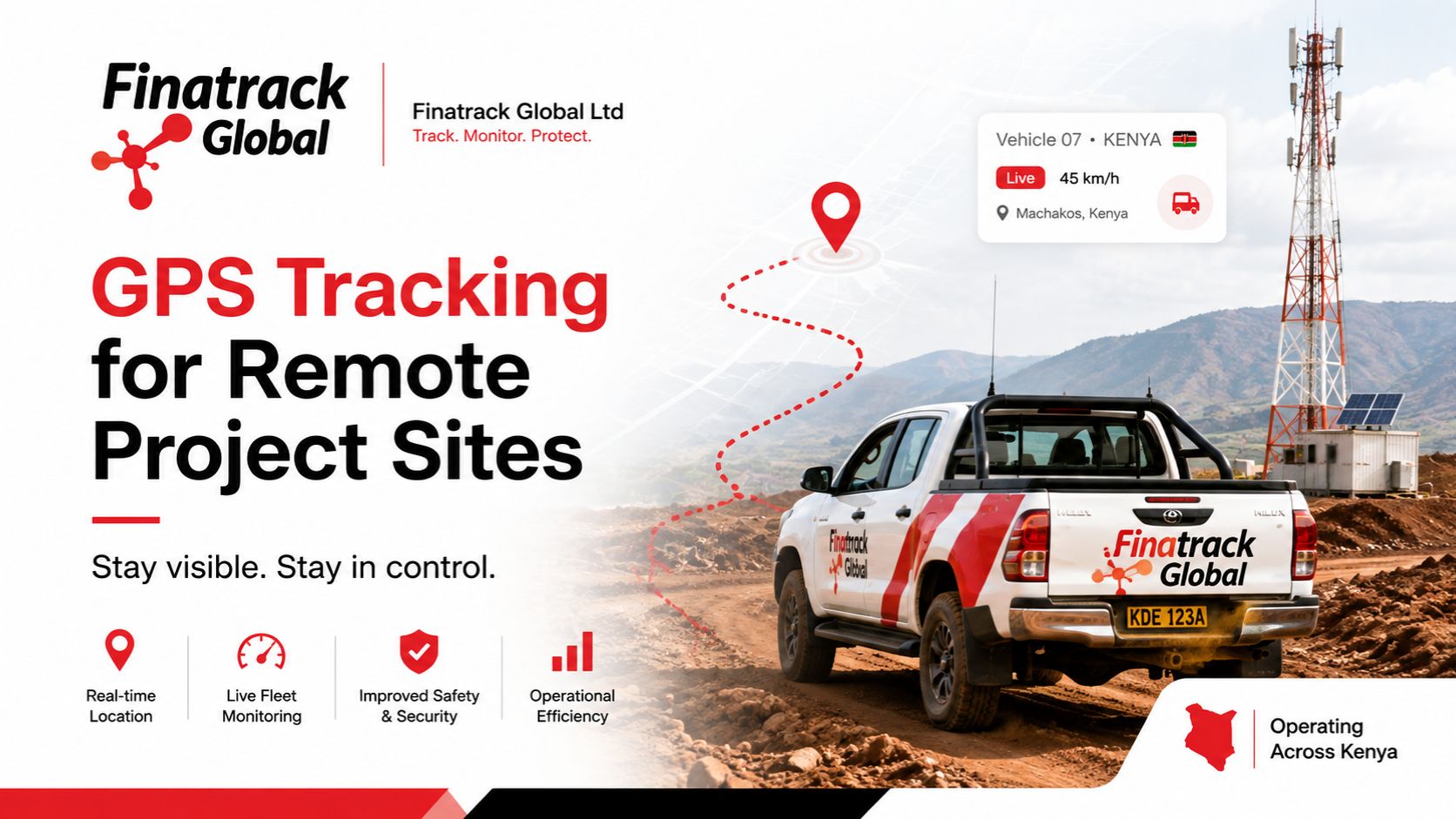
Vehicles assigned to remote project sites often operate far from the direct supervision of head office. They may spend days or weeks moving between camps, construction zones, telecom sites, farms, energy projects, infrastructure works and supplier locations where managers cannot physically see how they are being used.
For businesses with vehicles stationed outside Nairobi or in difficult-to-reach areas, this creates an obvious management challenge. A pickup may be assigned to one project but end up serving several unrelated tasks. A truck may take longer than expected to reach a site. Another vehicle may spend most of the day parked while management assumes it is fully occupied.
The further a vehicle moves from head office, the more important reliable information becomes.
GPS tracking gives businesses a way to maintain visibility over vehicles even when they are operating hundreds of kilometres away. An authorised manager can check the location of a company vehicle through a tracking platform instead of depending entirely on phone calls, handwritten reports or verbal updates from employees at the project site.
This can be particularly valuable for companies managing several projects at the same time. One vehicle may be assigned to a site in Naivasha, another to a project in Nanyuki and several others to locations around Nairobi. Without centralised tracking, management may have little understanding of how those vehicles are actually being used once they leave the main office.
Live location information creates a common operational picture.
Management can see which vehicles are at project sites, which are travelling and which have remained stationary for unusually long periods. This does not replace communication with site teams, but it gives managers independent information that can help them ask better questions.
Consider a vehicle assigned to transport supervisors between a remote project camp and several work locations. Management may expect the vehicle to make multiple trips during the day. If the tracking history shows that it remained parked for most of the afternoon, there may be a legitimate reason, but the company now has information worth reviewing.
Perhaps the vehicle was not needed. Perhaps work at the site stopped. Perhaps the driver was waiting for materials. The important point is that management can understand what happened instead of assuming that every assigned vehicle was productive.
Remote projects also create opportunities for unauthorised use.
A vehicle stationed away from head office may be used for personal trips because the employee operating it knows management is unlikely to see the movement directly. Evening journeys, weekend use or trips far outside the project area can gradually increase mileage, fuel consumption and maintenance costs.
GPS tracking makes those movements more visible.
Trip history can show where a vehicle travelled, approximately when the journey began and where significant stops occurred. Repeated movements outside expected working areas can then be investigated against project requirements.
This is particularly useful where employees are allowed to take vehicles to accommodation facilities after work. The company may permit a pickup to travel between the project site and staff housing but restrict other private journeys.
A clear company vehicle policy combined with GPS visibility can help management enforce those expectations fairly.
Geofencing can provide another level of control. A business can establish virtual boundaries around a project site, camp, depot, warehouse or other approved operational area.
Depending on the tracking system configuration, management can receive an alert when a vehicle enters or leaves that location.
This can be useful for projects where vehicles should remain within a defined area for most of the assignment. If a pickup unexpectedly begins travelling far from the project late in the evening, the responsible manager can verify whether the movement was authorised.
The purpose should not be to interpret every deviation as misconduct. Remote sites often involve changing operational requirements, emergency purchases, medical trips, equipment collection and other legitimate reasons for vehicles to move unexpectedly.
The value of tracking is that these movements do not have to remain invisible.
Security is another important concern. Vehicles stationed at remote projects may spend nights in locations with limited physical security. Some may be parked in temporary compounds, roadside camps or areas without permanent guards or surveillance.
A professionally installed GPS tracker can help maintain location visibility when a vehicle is away from the main premises. Unexpected movement can be identified more quickly, especially where appropriate ignition or movement alerts are configured.
For higher-value vehicles, businesses may consider layered tracking rather than relying on one device alone.
A wired GPS tracker can serve as the main fleet-management system while a wireless tracker or tracking tag provides an additional backup. If the primary system becomes unavailable, the business may retain another source of location information.
The appropriate security setup will depend on the vehicle, project environment and level of risk involved.
Fuel management also becomes more difficult at remote sites. Vehicles may be refuelled at local stations, project tanks or temporary fuel points far from the normal control systems used at head office.
When management only receives receipts and expense reports, it can be difficult to determine whether fuel consumption is consistent with actual vehicle movement.
GPS trip information provides useful context. If one project pickup records significantly higher fuel expenditure than another vehicle doing similar work, management can compare mileage, routes and working patterns before deciding whether there is a problem.
For larger commercial vehicles, dedicated fuel monitoring can provide an additional layer of information by helping businesses observe fuel levels, refilling events and unusual reductions depending on the system installed.
This becomes particularly valuable when remote operations consume large quantities of diesel.
Fuel losses that appear small on an individual day can become significant when repeated over several months of a project.
Driver behaviour also deserves attention because remote roads can encourage very different driving habits from urban routes. Long open roads may tempt drivers to travel at excessive speeds, while rough terrain can increase wear when vehicles are driven aggressively.
Telematics can help management identify repeated speeding, harsh braking or harsh acceleration events depending on the solution installed.
A single event should always be interpreted in context. Remote roads can involve animals, poor surfaces, sudden obstacles and other conditions requiring defensive driving.
Patterns are more useful than isolated incidents.
If one driver repeatedly records significantly more harsh-driving events than others operating under similar conditions, management has a reason to investigate whether training, supervision or vehicle inspection is needed.
Remote projects can also make maintenance planning more difficult. Vehicles may accumulate large distances while operating away from the workshop normally responsible for servicing them.
By the time the vehicle returns to head office, it may already have travelled far beyond its expected service interval.
Tracking information can help management understand how heavily each vehicle is being used and identify assets accumulating mileage faster than expected. This allows maintenance to be planned around actual utilisation rather than assumptions.
Preventive maintenance matters even more when the vehicle is working in a remote location. A breakdown hundreds of kilometres from the nearest company workshop can cause more disruption and expense than the same problem occurring near head office.
A stranded project vehicle may require recovery, replacement transport and emergency repair arrangements while employees remain unable to complete assigned work.
Better utilisation information can reduce some of that risk.
GPS tracking can also help project managers understand vehicle availability.
A manager may request another pickup because the vehicles already assigned to the site appear constantly busy. Tracking records may reveal that one vehicle spends significant parts of the day parked.
The problem may not be a shortage of vehicles at all.
It may be poor scheduling or allocation.
For businesses managing several sites, this information can support transfers between projects. One location may have excess vehicle capacity while another project is struggling to meet transport demand.
Without central visibility, both sites may request additional vehicles.
With tracking information, management can compare actual utilisation before deciding whether to buy, hire or transfer another asset.
This can influence major capital decisions.
Company vehicles are expensive to purchase and operate. If better allocation allows the business to postpone buying another pickup or truck, the value of improved fleet visibility can extend far beyond security.
Remote project tracking can also improve coordination with suppliers and management teams.
If a vehicle has been sent to collect equipment, management can check whether it has reached the supplier and whether it has started the return journey. This reduces the need to repeatedly contact the driver.
The same applies when senior managers are waiting for materials to reach a project before the next phase of work can begin.
Knowing that the vehicle is still 80 kilometres away is more useful than being told that it is “almost there.”
Trip information can also provide supporting records when project delays are investigated.
A contractor may claim that materials arrived late because transport was delayed. Tracking history can help establish when the vehicle departed, which route it followed and when it reached the project location.
This may reveal that the delay occurred during transport, but it may also show that the vehicle did not leave the supplier until much later than expected.
That distinction can help management identify where the real operational problem occurred.
Companies working for clients under formal project contracts may find this information particularly useful. Reliable movement records can support internal reporting and strengthen accountability when several contractors or departments are involved in the same project.
However, businesses should use vehicle tracking responsibly.
Employees should understand that company vehicles are being tracked for legitimate purposes such as asset security, project coordination, fleet utilisation, maintenance and cost control.
The objective should not be to create unnecessary surveillance of employees outside the legitimate management of company assets.
Access to the tracking platform should remain limited to authorised personnel. A project manager may need visibility of vehicles assigned to their site, while senior fleet management may require access across the entire organisation.
Not every employee needs unlimited access to all vehicle movements.
Clear permissions help protect both operational information and employee privacy.
Professional installation is also essential because remote project vehicles often operate in demanding environments. Dust, vibration, rough roads, long operating hours and limited technical support can expose poorly installed equipment quickly.
Tracking devices should be installed securely and tested properly before the vehicle is deployed to a distant site.
The management team should also know how to use the platform.
A company gains little from installing trackers in remote project vehicles if nobody at head office knows how to review trip history, check alerts or determine whether a device has gone offline.
Training converts the tracker from a security accessory into a practical fleet-management system.
For a business operating one remote project, GPS tracking can provide reassurance that assigned vehicles remain visible. For organisations managing projects across several counties, it can become an important part of coordinating fleet operations from one central location.
The distance between the vehicle and head office should not determine how much control management has over the asset.
Finatrack Global Ltd provides professionally installed GPS tracking, fleet telematics, fuel monitoring, AI dashcams, wireless tracking and vehicle security solutions for businesses operating vehicles across Kenya. Solutions can be configured for pickups, trucks, commercial vehicles and other fleet assets assigned to remote projects.
Professional installation can be arranged at the customer’s convenient location or at Vision Plaza, 1st Floor, Office 2, Mombasa Road, Nairobi.
Businesses seeking greater visibility over vehicles assigned to remote projects can contact Finatrack Global Ltd on 0723 645 810 or visit www.finatrack.co.ke.
A project may be hundreds of kilometres from head office.
The vehicles supporting it should not be hundreds of kilometres beyond management’s visibility.