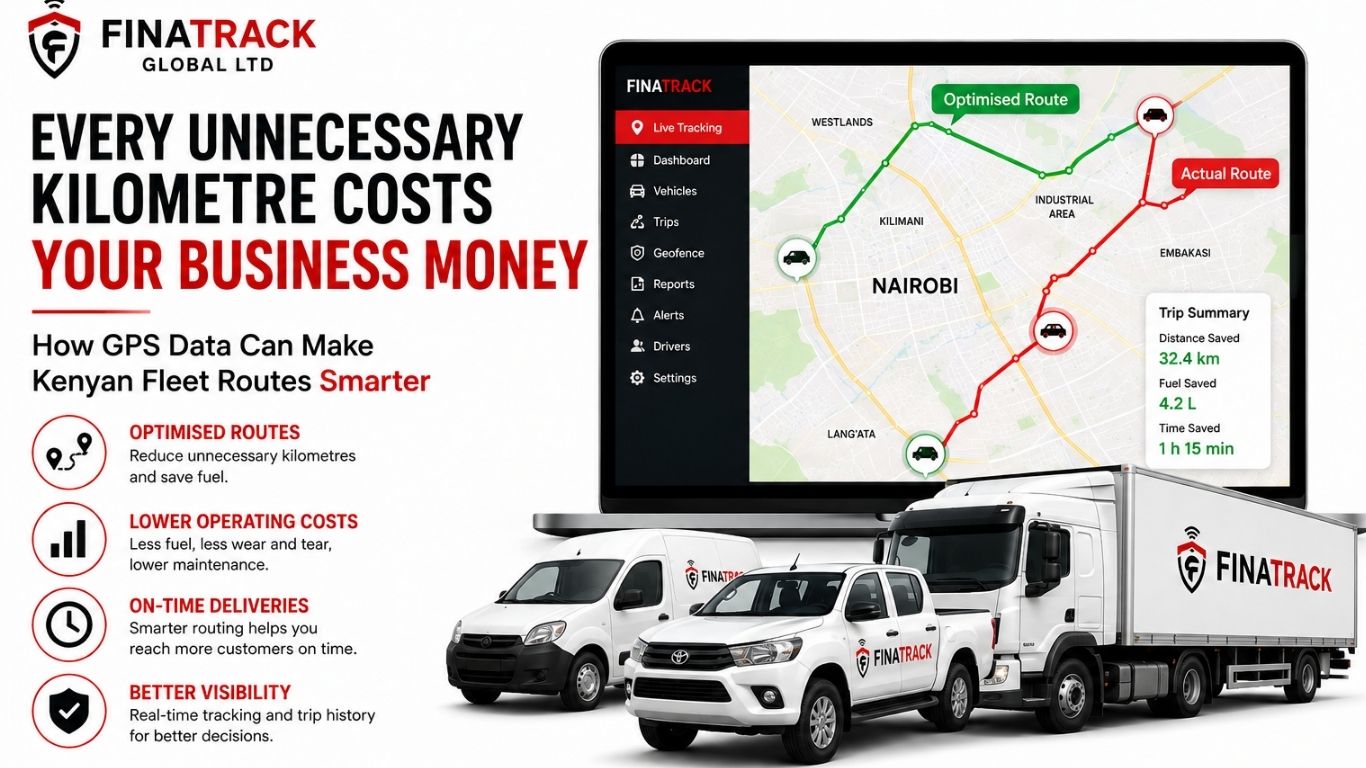
For businesses that depend on vehicles, the cost of an inefficient route is much bigger than a few extra litres of fuel. Every unnecessary kilometre adds fuel consumption, driver time, tyre wear, servicing requirements and depreciation while reducing the number of productive assignments a vehicle can complete. When the same inefficiency is repeated across several vehicles every working day, what appears to be a small routing problem can become a significant business expense.
This is why fleet route optimisation is becoming increasingly important for Kenyan businesses operating delivery vans, trucks, sales vehicles, service cars and other commercial fleets. GPS tracking provides the movement data managers need to understand how vehicles are actually travelling rather than how they were expected to travel. By reviewing real journeys, businesses can identify unnecessary kilometres and redesign operations around more efficient routes.
Route optimisation does not simply mean finding the shortest possible distance between two points. In practical fleet management, the best route must consider customer locations, delivery priorities, traffic conditions, vehicle availability and the sequence in which assignments should be completed. GPS data gives businesses a historical picture of how these factors are affecting actual vehicle movement.
Consider a distributor with several customers around Nairobi. One vehicle may leave a warehouse along Mombasa Road, make a delivery in Industrial Area, travel to Westlands, return towards the city centre and later head back towards another customer near the original route. The driver may have completed every assignment, but the order in which those deliveries were arranged may have created far more mileage than necessary.
When management only reviews completed delivery notes, that inefficiency can remain invisible. The company sees that every customer was served and assumes the day’s operations were successful. GPS trip history adds another dimension by showing how much travelling was required to achieve that result.
This allows fleet managers to ask a more useful question. Could the same work have been completed using fewer kilometres?
Grouping customers geographically is one of the simplest ways businesses can reduce unnecessary movement. Deliveries within the same part of Nairobi can be scheduled together rather than sending vehicles repeatedly across the city. Sales representatives can also organise customer appointments by territory instead of accepting meetings in an order that creates constant backtracking.
GPS data helps management see whether this is happening in practice. A route that repeatedly crosses the same area several times during one working day may indicate that assignments need to be organised differently. By reviewing multiple journeys rather than one isolated trip, managers can identify recurring patterns that deserve attention.
The same principle applies outside Nairobi. A company making regional deliveries may have vehicles travelling between several towns, and the order of those stops can substantially affect total mileage. Poor sequencing can add dozens or even hundreds of unnecessary kilometres during long distance operations.
Route optimisation should therefore begin before the vehicle leaves the yard. Dispatchers need to understand which customers are being served, where they are located and which vehicle is best positioned to handle the work. Real time vehicle location provides an additional advantage because plans can be adjusted according to where fleet resources actually are.
A common mistake is automatically sending the next available vehicle from the office. Another company vehicle may already be operating close to the customer and could handle the assignment with far less additional mileage. Without central fleet visibility, management may never realise that a more efficient option existed.
Field service companies frequently encounter this problem. A technician may be dispatched from Mombasa Road to a customer in Westlands even though another technician has just completed an assignment nearby. The company then pays for an unnecessary cross city journey while the nearer employee waits for another job.
Real time GPS tracking can help the dispatcher identify the closest suitable vehicle. The decision should still consider the technician’s skills, workload and equipment, but location provides important operational context. When used consistently, this approach can reduce both customer waiting time and fleet mileage.
Courier and delivery businesses can use the same principle. When a new collection request arrives, management can see which rider, van or truck is already near the collection point. Assigning the closest appropriate resource can reduce empty kilometres where vehicles travel without carrying productive work.
Empty mileage is particularly important for logistics operations. A truck may deliver goods to one location and then travel a long distance without cargo before reaching its next collection point. Some empty movement is unavoidable, but GPS journey data helps transport managers identify where it is happening repeatedly.
If the same route consistently produces long empty return journeys, the business can investigate whether collections, return loads or alternative scheduling could improve utilisation. Even where another load cannot be found, understanding the true amount of unproductive movement allows management to price transport services more accurately.
Traffic conditions are another important part of route optimisation in Kenya. The geographically shortest route may not always be the most efficient route when congestion is considered. A driver who uses a slightly longer road but avoids a major traffic delay may complete the journey faster and with less idling.
This is why managers should avoid judging routes only by distance. Trip history can show how long journeys actually took, where vehicles remained stationary and which routes consistently create delays. Over time, this information can help the business develop better operating knowledge around frequently travelled corridors.
Historical GPS information becomes especially useful when the same customers are served repeatedly. A distributor may notice that one route consistently performs well early in the morning but becomes inefficient later in the day. Deliveries can then be rescheduled to reflect the operating conditions the fleet actually experiences.
The objective is not to create rigid routes that drivers must follow regardless of what happens on the road. Accidents, roadworks, demonstrations, flooding and other disruptions can require legitimate deviations. A good route management process allows drivers to respond to conditions while still giving management visibility over what changed.
Repeated unexplained deviations should nevertheless be reviewed. A driver who frequently leaves the expected operating corridor may be adding unnecessary mileage to the business. GPS trip history allows management to identify those patterns before they become accepted as normal fleet behaviour.
Geofencing can provide another useful tool for route control. Virtual boundaries can be created around territories, branches, warehouses, project sites or customer zones. Depending on the tracking configuration, management can identify when vehicles enter or leave these areas.
A sales vehicle assigned mainly to one territory, for example, should not consistently spend large portions of the working day in unrelated locations without a clear reason. A construction pickup assigned to a particular project may also be expected to remain around the project area unless management authorises another assignment.
Geofencing allows the business to manage these exceptions more efficiently. Managers do not need to watch every vehicle continuously because unusual movement can be identified through the tracking system. The resulting information can then be reviewed alongside operational schedules.
Route optimisation also affects fuel expenditure directly. Every kilometre removed from unnecessary travel reduces the amount of fuel required to complete the day’s work. The saving may appear modest on one journey, but repeated across a fleet throughout the year, the financial impact can become substantial.
Suppose a company reduces unnecessary travel by only twenty kilometres per vehicle each working day. Across ten vehicles, that represents two hundred kilometres avoided daily. Over weeks and months, the business is eliminating thousands of kilometres that previously consumed fuel and vehicle life without creating additional revenue.
Fuel is only one part of that saving. Every unnecessary kilometre also brings the vehicle closer to its next oil change, tyre replacement and other maintenance requirements. Reducing wasteful mileage can therefore lower operating costs across several different categories at the same time.
This is why route optimisation should be viewed as a fleet cost strategy rather than merely a navigation exercise. Better routing allows businesses to produce more work from the same vehicles while slowing the rate at which those assets are consumed. The company receives greater productive value from every kilometre travelled.
Driver time also needs to be considered. An employee spending three hours travelling unnecessarily is not only consuming fuel. The business is also paying for three hours during which fewer deliveries, customer visits or service assignments can be completed.
For mobile sales teams, this becomes particularly important. Sales representatives generate value through customer interaction rather than through driving. Reducing unnecessary road time gives them more opportunities to meet customers, follow up prospects and complete revenue generating activities.
The same applies to technicians. A field service employee who spends most of the working day travelling between poorly arranged assignments has less time available to complete actual technical work. Route optimisation can therefore improve employee productivity without extending the working day.
Delivery businesses can also increase capacity through better routing. A vehicle that previously completed eight deliveries might be able to complete additional stops when unnecessary travel is removed. The business effectively creates more transport capacity without purchasing another vehicle.
This is especially valuable for growing SMEs. Management may believe another van is needed because existing vehicles appear busy throughout the day. GPS records may reveal that those vehicles are busy partly because routing is inefficient.
Before purchasing another asset, management can review current utilisation and journey patterns. If improved dispatching and route organisation can release additional capacity, the company may postpone a major capital expense. If every route is already efficient and vehicles remain fully utilised, the data provides stronger justification for expanding the fleet.
GPS tracking can also help businesses understand route profitability. Two customers may generate similar revenue while one requires considerably more kilometres, fuel and driver time to serve. Once the business understands the real transport effort involved, pricing and customer service decisions can become more informed.
A distant customer may still be highly profitable, but management should know the real cost of servicing that account. Route data can help businesses avoid pricing transport and delivery services solely according to intuition. Mileage and journey information provide part of the operational evidence required for better costing.
Route planning becomes even more important when vehicles serve several branches or depots. A company may be sending vehicles back to the main warehouse unnecessarily when stock, staff or another vehicle is already available at a nearer branch. Central fleet visibility can help management coordinate resources across the organisation.
The system can also expose recurring bottlenecks. Vehicles may spend excessive time waiting at one warehouse because loading processes are slow, while another location handles vehicles much faster. Although this is not technically a route problem, the delay still affects how efficiently the fleet completes its journeys.
GPS trip and stop information helps reveal these patterns. If several vehicles repeatedly spend an hour at the same location, management can investigate whether loading, paperwork, customer procedures or internal processes are responsible. Route optimisation therefore involves improving what happens at stops as well as what happens between them.
Idling is closely connected to this issue. A vehicle may arrive at a customer and remain running for thirty minutes while waiting for unloading. Those thirty minutes do not add mileage, but they still consume fuel and driver time.
Fleet managers should therefore examine both distance and journey duration. A route that looks efficient according to kilometres may still perform poorly because vehicles spend excessive time stationary. GPS telematics can help businesses understand where those delays occur.
Driver behaviour can also influence how efficiently routes are completed. A driver who repeatedly misses turns, makes unnecessary stops or deviates from the planned operating area can increase mileage. However, businesses should investigate the reasons rather than automatically assuming poor discipline.
The route itself may be unrealistic. The navigation instructions may not account for local access restrictions, difficult customer entrances or practical road conditions. Driver feedback combined with GPS evidence can help management design routes that work in the real world rather than only looking efficient on paper.
This collaborative approach usually produces better results. Drivers spend more time on the routes than office managers and may understand local conditions that are not obvious from a map. GPS provides objective journey information, while driver experience helps explain why certain movements occurred.
After hours vehicle use can also increase fleet mileage. A company car or delivery vehicle that continues travelling after the day’s assignments are complete may accumulate kilometres unrelated to business activity. Unless management reviews trip history, that movement may remain hidden inside the vehicle’s overall monthly mileage.
Clear vehicle use policies are therefore necessary. Employees should understand when vehicles may be used outside working hours and what journeys require authorisation. Tracking can then support those policies by giving management accurate information when unusual movement occurs.
The goal should not be unnecessary employee surveillance. Company vehicles are business assets, and monitoring their movement can support legitimate purposes such as security, fuel management, route optimisation and maintenance planning. Transparency about how the system is used creates a more professional fleet management environment.
Route data also supports vehicle maintenance. A vehicle travelling inefficient routes accumulates mileage faster and therefore reaches servicing requirements sooner. Reducing unnecessary journeys helps extend the time between mileage based maintenance events while improving overall vehicle utilisation.
Different routes can also create different levels of wear. A pickup operating mostly on rough project roads may experience more suspension and tyre stress than another vehicle travelling mainly on highways. Understanding where vehicles operate provides useful context when maintenance costs differ significantly between units.
Security is another reason route deviations deserve attention. A vehicle unexpectedly leaving its normal operating area may simply have received a legitimate new assignment, but it can also indicate unauthorised use or another security concern. GPS visibility allows the company to verify the situation rather than discovering the unusual journey much later.
Unexpected movement outside working hours deserves particular attention. When location, ignition activity and trip information show that a vehicle is being used when it should be parked, management can investigate promptly. Early visibility can help reduce both operating losses and security exposure.
Businesses operating rural or cross county routes should also understand the limits of live tracking. GPS positioning and mobile communication perform different roles, meaning a tracker may temporarily stop sending information when cellular coverage becomes weak. This does not necessarily mean the vehicle stopped travelling or the tracker failed.
Depending on the tracker and its configuration, journey records may be stored and transmitted later after communication returns. Fleet managers should therefore consider the last update time before interpreting what they see on the map. Historical trip information can still provide valuable route analysis even where live updates were temporarily interrupted.
Reliable tracking hardware is essential if businesses want to use GPS information for route optimisation. A device that frequently loses power or communication creates incomplete journey records and makes analysis more difficult. Professional installation should therefore be considered part of the fleet management solution rather than a separate technical detail.
Businesses should periodically check whether every tracker is reporting normally. A vehicle that has been offline for several weeks can continue accumulating mileage while management loses the data required to understand its routes. Tracker health checks protect the quality of the information on which fleet decisions are based.
Software usability matters as well. A fleet manager should be able to review routes, identify vehicles and understand trip history without spending excessive time navigating complicated systems. The objective is to make operational decisions faster, not create another administrative burden.
For small fleets, route optimisation may begin with something as simple as reviewing the previous week’s journeys. Management can identify repeated backtracking, unusually long trips and vehicles that regularly leave expected areas. Even this basic analysis can reveal opportunities for improvement.
Larger fleets can take a more structured approach. Vehicles can be organised by region, department or route, while managers compare mileage and journey patterns across similar units. Exceptions can then receive attention instead of supervisors manually analysing every trip.
Businesses should also measure whether their changes are working. If a new delivery schedule is introduced, management can compare average mileage before and after the change. A route optimisation programme becomes much more valuable when its effect can be measured rather than assumed.
The same comparison can be applied to fuel expenditure and customer response times. If mileage falls while the same or greater number of deliveries is completed, the fleet is becoming more efficient. If customers are also receiving faster service, the improvement is producing value beyond fuel savings.
The strongest route optimisation strategy therefore combines GPS information with operational management. Technology provides location, trip history, mileage and vehicle status, but managers still need to organise schedules, communicate with drivers and adjust processes. GPS does not optimise a fleet automatically; it gives businesses the information needed to optimise it intelligently.
Finatrack Global Ltd provides professionally installed GPS tracking and fleet telematics solutions for Kenyan businesses seeking better visibility over routes, mileage and vehicle utilisation. Depending on the organisation’s needs, solutions can provide real time tracking, trip history, geofencing, driver monitoring, fuel monitoring and other fleet management capabilities.
Professional installation can be arranged at the customer’s convenient location or at Vision Plaza, 1st Floor, Office 2, Mombasa Road, Nairobi. Businesses looking to reduce unnecessary fleet mileage can contact Finatrack Global Ltd on 0723 645 810 or visit www.finatrack.co.ke to discuss a tracking solution suited to their operations.
A profitable fleet is not necessarily the one with the most vehicles or the drivers covering the greatest distance. It is the fleet that completes the required work using its vehicles, fuel and employee time efficiently. GPS route data helps businesses identify where kilometres are being wasted and gives management an opportunity to turn those unnecessary journeys into lower costs and greater productivity.