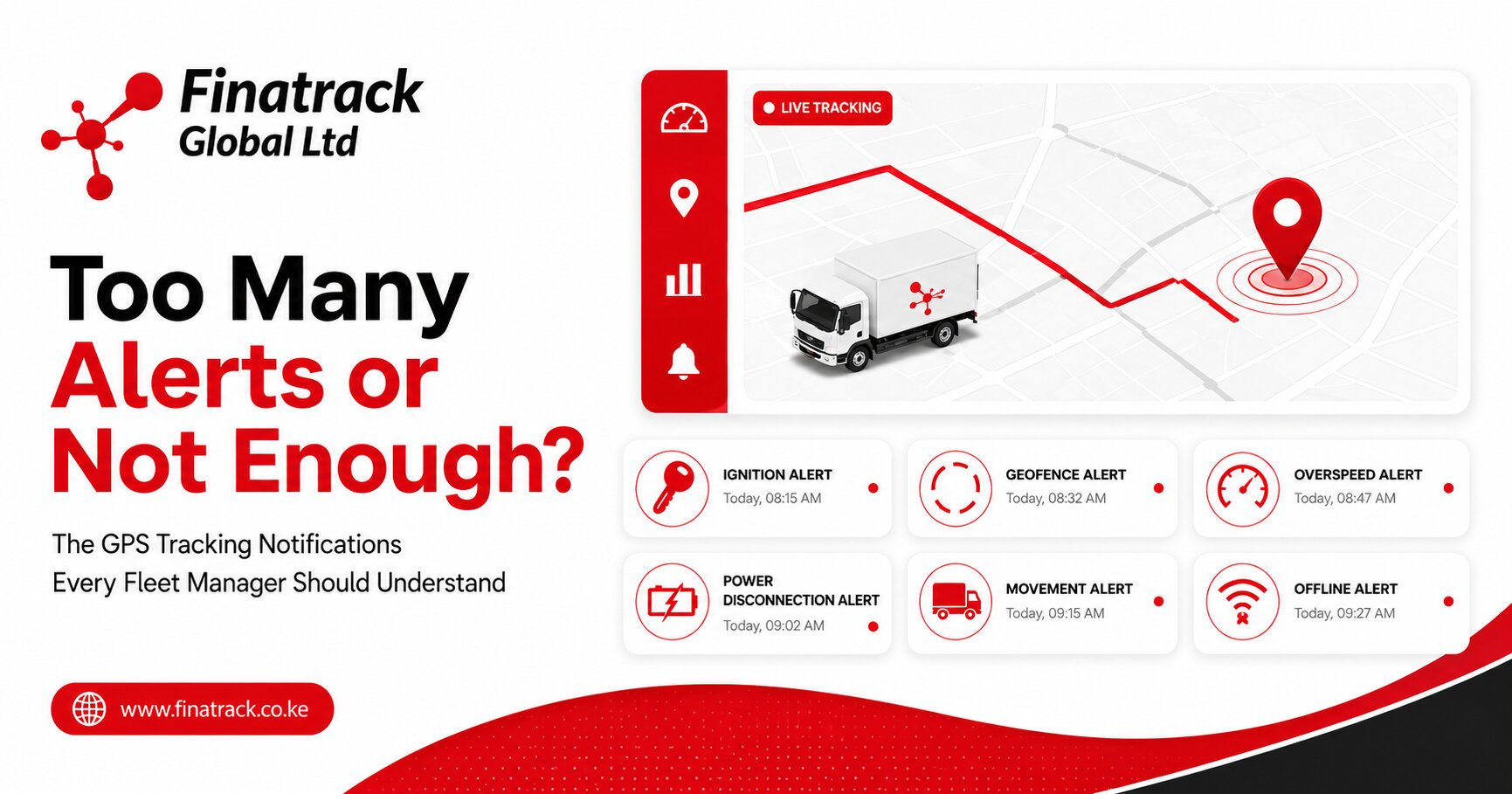
GPS tracking systems can generate a large amount of information, but more notifications do not automatically mean better fleet management. A fleet manager who receives alerts every few minutes may eventually stop paying attention, while another business with almost no alerts may miss important warning signs such as unauthorised vehicle movement, excessive speeding or power disconnection. The real value comes from understanding which alerts matter, why they are triggered and how the business should respond when they appear.
For Kenyan businesses operating commercial vehicles, GPS tracking alerts can turn a tracking platform from a passive map into an active management tool. Instead of waiting for someone to notice that a vehicle has moved unexpectedly or that a tracker has stopped communicating, the system can notify authorised users when predefined events occur. This gives management an opportunity to respond sooner and investigate unusual activity before it becomes a larger operational or security problem.
One of the most common notifications is the ignition alert. Depending on the tracker installation and configuration, the system can identify when the vehicle ignition changes from off to on or from on to off. This information can help managers understand when vehicles begin operating, when they stop and whether activity is occurring outside the expected working schedule.
An ignition alert received at 7:30 a.m. when a delivery van normally starts its working day may be completely routine. The same alert arriving at 2:00 a.m. while the vehicle is supposed to be parked at the company yard deserves more attention. The meaning of the notification therefore depends on the time, location and normal operating pattern of the vehicle.
Fleet managers should avoid configuring every normal ignition event as an urgent notification if the fleet contains many vehicles. A business with fifty vehicles starting every morning could generate dozens of routine alerts within a short period. It may be more practical to focus notifications on vehicles that start outside approved hours or in unexpected locations.
Ignition information can also be useful when investigating vehicle use. A manager may discover that a company car regularly starts late at night even though trip records show relatively little daytime activity. The information does not automatically prove misuse, but it gives management a reason to review the circumstances and compare them with the vehicle’s assignment.
Geofence alerts are another valuable category. A geofence is a virtual boundary created around an important location or operating area such as a warehouse, office, project site, branch, customer location or approved territory. Depending on the system configuration, an alert can be generated when a vehicle enters or leaves that boundary.
For a construction company, a geofence around a project site can help management understand when assigned vehicles leave the area. For a distribution business, geofences around warehouses or branches can provide visibility over vehicle arrivals and departures. The same feature can also support security when vehicles are expected to remain inside a parking yard overnight.
The usefulness of geofencing depends heavily on how boundaries are configured. A boundary that is too small may generate unnecessary alerts when normal GPS variation places the vehicle just outside the defined area. A boundary that is too large may fail to provide meaningful information because the vehicle can travel a considerable distance before leaving it.
Businesses should therefore create geofences around locations that have clear operational significance. The purpose should be to answer a useful management question such as whether the vehicle has left the project site, whether it reached the warehouse or whether it moved outside an approved operating territory. Creating dozens of unnecessary geofences can produce alerts that managers eventually ignore.
Overspeed alerts are especially important for businesses concerned about driver safety and vehicle operating costs. Depending on the system installed, the tracking platform can generate a notification when a vehicle exceeds a configured speed threshold. This gives management visibility over repeated speeding without requiring somebody to watch every vehicle continuously.
A single overspeed event should still be interpreted carefully. Road conditions, overtaking or temporary circumstances may explain a brief event, and the manager should consider the context before reaching conclusions. Repeated overspeeding across several journeys provides a much stronger indication that driver behaviour may need attention.
The speed threshold itself should also reflect the business and operating environment. A truck, staff shuttle and executive car do not necessarily have the same operating requirements. Companies should configure alerts according to internal safety policies, vehicle type and the routes on which the vehicles operate.
Too low a threshold can create constant notifications during ordinary driving. When managers receive dozens of overspeed alerts every day, the information loses its urgency and alert fatigue develops. The system should highlight meaningful risk rather than report every small variation in vehicle speed.
Driver coaching can become more effective when overspeed alerts are reviewed as patterns rather than isolated accusations. A manager can compare the same driver over several days and determine whether speeding is repeated, route specific or linked to unrealistic schedules. This approach makes the information more useful for improving safety.
Power disconnection alerts are among the most important security related notifications on wired GPS tracking systems. A wired tracker normally receives external power from the vehicle electrical system, and an alert may be generated when that supply disappears. This can occur for legitimate reasons, but it can also indicate a wiring problem or possible interference with the tracking system.
Battery replacement is one common legitimate cause. When a mechanic disconnects the vehicle battery, the tracker may detect the loss of external power and report the event. Electrical repairs, alarm installation or other workshop procedures can produce the same notification.
The timing and circumstances should therefore be checked immediately. A power loss alert received while the vehicle is at a workshop during the day is very different from one received at midnight while the vehicle is parked at home or at a company yard. Managers should review the location, ignition status and any movement occurring around the same time.
A sequence of events can be more informative than one alert. If the tracking platform reports power loss, unexpected ignition activity and then vehicle movement within a short period, the combination deserves greater attention. Looking at several events together helps management distinguish routine maintenance from potentially serious interference.
Some trackers may continue operating temporarily using internal backup power after external power disappears. The behaviour depends on the device installed and its configuration, so businesses should understand what their specific system can and cannot do. Backup power should generally be viewed as temporary support rather than indefinite operation.
Repeated power disconnection alerts can also indicate a technical problem. Loose wiring, poor grounding or unstable electrical connections may cause the tracker to repeatedly lose and regain power during ordinary driving. These events should be investigated rather than simply disabling the notifications.
Movement alerts can be useful when a vehicle is expected to remain stationary. Depending on the device and configuration, the system may recognise movement or location change and generate an alert. This can be particularly useful for vehicles parked overnight, high value assets or machinery that should remain within one site.
Movement information should still be interpreted alongside ignition status. A vehicle can move without the engine being switched on if it is being towed, loaded onto another vehicle or physically pushed. This can make movement alerts useful in situations where ignition monitoring alone would not provide enough information.
A company vehicle that suddenly changes location at 3:00 a.m. while ignition remains off may deserve immediate investigation. The vehicle may be undergoing legitimate towing or workshop activity, but if no such activity is expected, the movement could indicate a security issue. Context remains the difference between useful monitoring and unnecessary panic.
Tracker offline alerts are another category fleet managers should understand. A GPS tracker depends on power, device operation and communication connectivity to send information to the tracking server. If that communication stops for longer than expected, the system may show the device as offline or generate a related notification.
An offline tracker does not automatically mean the device has failed. The vehicle may have entered an area with weak mobile network coverage, parked underground or temporarily lost communication. The tracker may still be functioning internally even though the server has not received a recent update.
The last update time becomes extremely important in this situation. Managers should check when the tracker last communicated and where the vehicle was at that time. A tracker that disappeared while travelling through a remote area may require a different response from one that stopped communicating in a normally well covered part of Nairobi.
Depending on the tracker and configuration, journey information may be stored while communication is unavailable and uploaded later after the device reconnects. Historical trip records can therefore become more complete after the communication gap ends. Fleet managers should understand this behaviour so that they do not automatically treat every temporary offline event as a theft emergency.
A tracker that remains offline for several days while the vehicle continues operating should not be ignored. The problem could involve power, the SIM connection, wiring or the tracking device itself. Technical inspection should be arranged before the business develops a long term blind spot.
Offline alerts are particularly useful for larger fleets because one failed tracker can easily go unnoticed among dozens of vehicles. A manager may see most of the fleet moving normally and fail to notice that one unit has not communicated for weeks. Exception based notifications make it easier to identify those devices before they are urgently needed.
Harsh braking and harsh acceleration alerts can provide additional driver behaviour information depending on the telematics system. These events can indicate aggressive driving, but they must be interpreted carefully because road conditions can force sudden reactions. Kenyan traffic can involve pedestrians, motorcycles, potholes and unexpected lane changes that make occasional harsh events unavoidable.
The strongest value comes from reviewing repeated patterns. If one driver consistently records significantly more harsh braking and acceleration events than others operating similar vehicles on similar routes, management has a reason to investigate. The issue may involve driving style, route conditions or unrealistic schedules.
Driver behaviour alerts should support coaching rather than become an automatic punishment system. Employees are more likely to respond positively when the business explains that the objective is improving safety, fuel efficiency and vehicle life. Data should help managers have better conversations rather than replace judgement.
AI dashcams can add further context where more advanced systems are used. A telematics platform may show that a harsh braking event occurred at a particular location, while video can help explain whether the driver was reacting to a pedestrian, another vehicle or unsafe driving behaviour. This can make incident investigation more balanced.
Long stop or idling alerts can also be useful for fleets focused on fuel and productivity. A vehicle may remain stationary with ignition active for an extended period, consuming fuel without covering additional distance. Depending on the system, management can configure notifications or reports around unusually long stationary periods.
The threshold should reflect the operation. A delivery van waiting outside a customer for twenty minutes may deserve attention, while a security patrol vehicle stationed at a strategic location may legitimately remain stationary much longer. The same idling rule should not be applied to every fleet without considering how the vehicles work.
Excessive idling can expose operational problems beyond driver behaviour. Several vehicles repeatedly waiting at the same warehouse may indicate slow loading procedures, while long delays at one customer location may reveal service inefficiency. GPS alerts provide an entry point for investigating the underlying cause.
This is an important principle across all tracking notifications. The alert tells management that something happened, but it does not always explain why. The business still needs to interpret the event within the wider operating context.
Maintenance alerts can also support fleet management where the platform or associated processes allow them to be configured. Vehicles accumulate mileage at different rates, meaning one unit may reach its next service requirement far earlier than another. Notifications based on mileage or scheduled servicing can help management plan workshop visits before maintenance becomes overdue.
This can reduce the risk of vehicles being serviced only when drivers remember to report that the odometer has reached a particular number. For fleets operating continuously, preventive maintenance notifications can support a more organised approach. They should still be used alongside manufacturer recommendations and professional mechanical inspections.
A maintenance alert does not diagnose a mechanical problem. It simply reminds management that a planned service requirement is approaching or due. The value is organisational rather than diagnostic, helping the business avoid losing track of heavily utilised vehicles.
Battery or low voltage alerts may also be available depending on the tracker and configuration. A weakening vehicle battery or unusual voltage behaviour can affect tracker operation and may indicate a broader electrical issue. The alert should be treated as a reason to inspect the vehicle rather than proof that the battery has failed.
This can be particularly useful for vehicles that remain parked for long periods. A company car or project vehicle may spend several weeks unused and gradually develop a weak battery. Early awareness can reduce the likelihood of discovering the problem only when the vehicle urgently needs to start.
Wireless trackers require a different approach because their battery is independent from the vehicle’s main electrical system. Management may need to monitor the device’s own battery level and charging or replacement requirements. A wireless backup tracker with an exhausted battery offers little recovery value during a theft.
Businesses using both wired and wireless tracking should therefore understand the alert behaviour of each device. Different technologies play different security roles and may require different maintenance routines. Treating every tracker as though it behaves identically can create gaps in protection.
Geofence entry alerts can also support customer service and logistics operations. A distribution vehicle entering a customer’s location may provide useful information that the delivery is approaching or has arrived in the area. Similarly, a truck leaving a warehouse can indicate that the next stage of the journey has begun.
These events can reduce the need for manual calls when integrated into normal operations. The office can review vehicle movement and give customers more informed updates. However, a vehicle entering a geofence should not automatically be treated as proof that a delivery was completed.
Location proves presence, not completion of the business task. Delivery notes, electronic proof of delivery or customer confirmation may still be required. GPS alerts should support those processes rather than replace them.
Unauthorised hour alerts can be especially valuable for businesses concerned about after hours vehicle use. Instead of receiving every ignition event during the day, the system can be configured around activity occurring outside approved schedules where the platform supports it. This focuses management attention on events that are more likely to require verification.
A vehicle starting at 10:00 a.m. may be routine, while the same vehicle starting at 1:00 a.m. may deserve investigation. Time based monitoring can therefore reduce unnecessary notifications while making unusual activity more visible. This is a good example of how intelligent configuration improves alert quality.
The same approach can be used with operating areas. A vehicle moving within its normal territory may require no immediate notification, while leaving the approved region can trigger an exception. Fleet managers should design alerts around business risks rather than simply switching on every available setting.
This brings us to one of the biggest challenges in telematics: alert fatigue. When a fleet manager receives too many notifications, the brain begins treating them as background noise. Important events can then be missed because they look identical to dozens of routine messages that arrived earlier.
A system that generates five meaningful alerts is often more useful than one generating two hundred routine notifications. Businesses should therefore review which alerts actually lead to action. If nobody does anything when a particular notification arrives, management should ask whether that alert needs to be configured differently.
Different people may also require different notifications. The fleet manager may need overspeed and maintenance information, while the security officer may be more interested in power disconnection and unexpected movement. Senior management may only need periodic reports rather than real time notifications.
Sending every alert to every employee creates unnecessary noise. A structured approach assigns each type of notification to the person responsible for responding. This improves accountability because employees know which events they are expected to investigate.
Escalation procedures can also help. A minor operational alert may initially go to the fleet supervisor, while a serious security event can be escalated to management or security personnel if necessary. The organisation should decide in advance how important alerts will be handled rather than improvising during an emergency.
Response time matters most when the alert has a clear security implication. Unexpected movement, power disconnection and unusual ignition activity outside working hours may require faster verification than routine maintenance reminders. Alert priority should therefore reflect the potential consequence of the event.
Businesses should also document what happened after important alerts. If a tracker reports repeated power disconnections and technical inspection reveals loose wiring, that information should be recorded and the fault corrected. If repeated overspeeding leads to driver coaching, management can later review whether the behaviour improved.
This turns tracking alerts into part of a broader fleet management process. The purpose is not simply receiving notifications but learning from them and reducing repeated problems. Data becomes useful when it changes behaviour, maintenance or operational decisions.
Fleet managers should periodically review their alert configuration. A business changes over time, and the settings appropriate for five vehicles may not work when the fleet grows to fifty. New branches, routes, working hours and vehicle types may require different thresholds and geofences.
Vehicles themselves may also change roles. A pickup previously assigned to a Nairobi branch may later move to a remote project site where network coverage and operating hours are different. The alert configuration should reflect the vehicle’s new purpose.
Driver communication is equally important. Employees should understand which vehicle events are being monitored and why. Transparency helps position GPS tracking around safety, security and fleet efficiency rather than unnecessary surveillance.
The business should also consider who has access to historical alert information. Location and driver data can be sensitive, particularly for management vehicles or customer related operations. Tracking accounts should therefore remain restricted to authorised users with a legitimate operational reason to access them.
Professional installation is essential because inaccurate alerts can undermine confidence in the entire tracking system. Incorrect ignition wiring may generate false ignition events, while unstable power connections can produce repeated power disconnection notifications. Secure installation and correct configuration reduce these problems.
Technical support is equally important when alerts suddenly change behaviour. If a tracker that previously worked normally begins producing repeated false notifications, the device or installation may require inspection. Simply disabling the alert without investigating could hide a genuine technical problem.
Trackers should also be checked after battery replacement, alarm work or dashboard repairs. A mechanic may disturb tracker wiring while working on another vehicle system, causing inaccurate alerts or communication problems. Confirming normal operation after workshop work helps protect the reliability of the tracking platform.
Network limitations should also be considered when alerts appear delayed. A tracker may detect an event while communication is weak but only send the information after reconnecting. Fleet managers should therefore look at the event timestamp rather than assuming the notification arrived at the exact moment the event occurred.
This distinction can be important during security investigations. A power disconnection alert received at 4:00 p.m. may have been recorded earlier if the tracker temporarily lacked network communication. Reviewing timestamps and surrounding events provides a more accurate sequence.
For small businesses, GPS alert management does not need to become complicated. Management can begin with a few important notifications such as unexpected ignition, geofence movement, power disconnection and prolonged offline status. Additional alerts can be introduced later as operational needs become clearer.
Larger fleets may benefit from more detailed alert policies. Driver behaviour, maintenance, idling and route exceptions can be assigned to different managers, while security events receive higher priority. The objective is to turn hundreds of vehicle events into a manageable number of decisions.
The strongest GPS tracking system is therefore not the one that sends the most notifications. It is the one that gives the right people the right information at the right time and makes unusual activity easy to recognise. Smart configuration can help businesses reduce noise while maintaining visibility over the events that genuinely matter.
Finatrack Global Ltd provides professionally installed GPS tracking and fleet telematics solutions for private vehicles and commercial fleets in Kenya. Depending on the tracking solution and configuration, businesses can access location, trip history, geofencing, ignition information, driver monitoring and selected security or operational alerts.
Professional installation can be arranged at the customer’s convenient location or at Vision Plaza, 1st Floor, Office 2, Mombasa Road, Nairobi. Businesses seeking better control over GPS tracking alerts and fleet visibility can contact Finatrack Global Ltd on 0723 645 810 or visit www.finatrack.co.ke to discuss an appropriate solution.
Fleet alerts should help management notice the unusual without being overwhelmed by the ordinary. When ignition, geofence, speeding, power, movement and offline notifications are configured around real business risks, GPS tracking becomes more than a map. It becomes an early warning system that helps businesses protect vehicles, manage drivers and respond to operational problems before they become expensive.