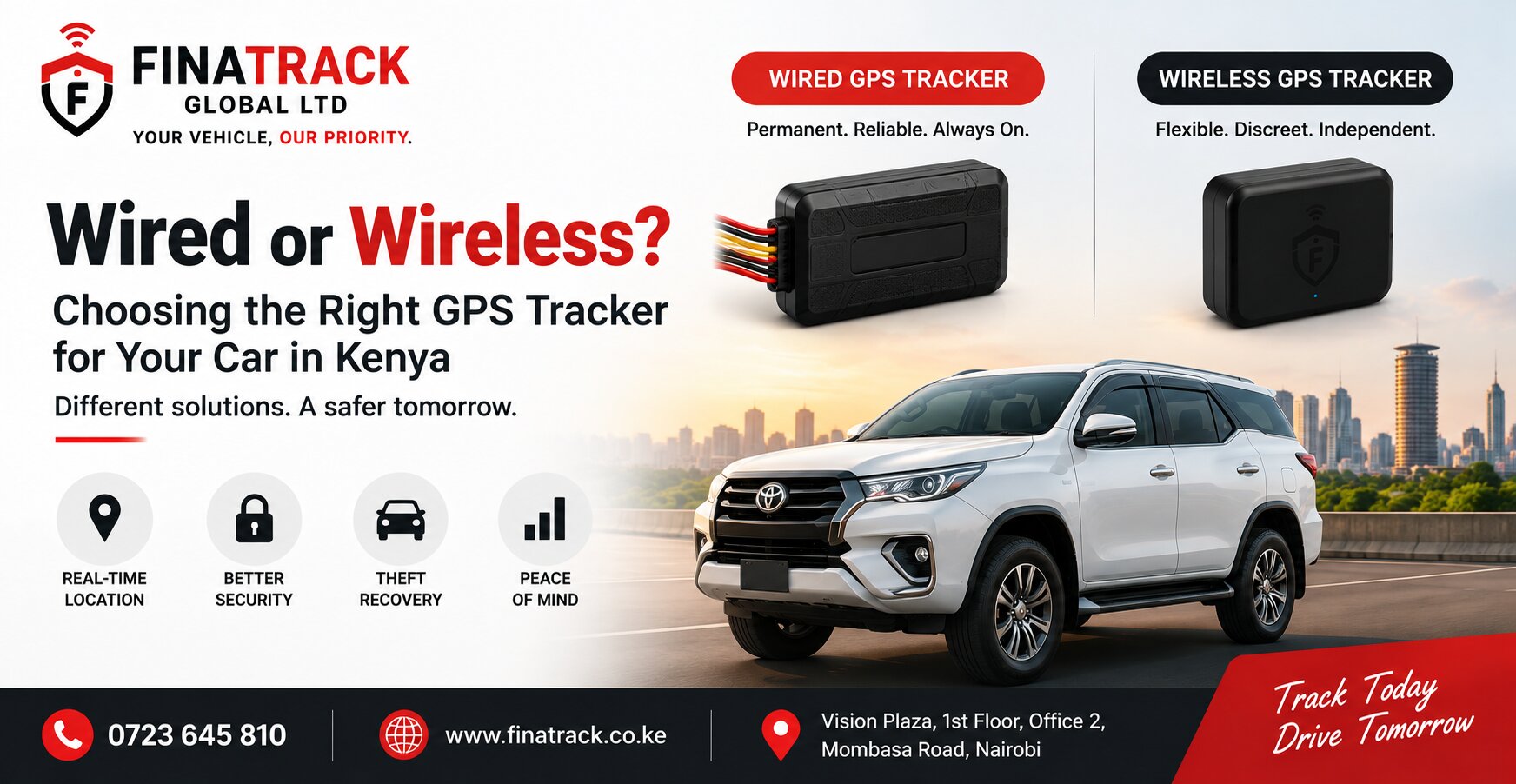
Installing a GPS tracker is one of the simplest ways to improve vehicle security, but choosing the right type of tracker can be less straightforward. Kenyan motorists are increasingly presented with two common options: a wired GPS tracker permanently connected to the vehicle and a wireless tracker that operates independently from the car’s electrical system. Both can provide valuable vehicle visibility, but they solve slightly different security problems.
The right choice depends on how the vehicle is used, the level of security required and whether the owner wants everyday tracking, backup recovery or both. A private motorist protecting a family car may have different requirements from a business operating several company vehicles, while the owner of a high value SUV may reasonably want more than one tracking layer. Understanding the strengths and limitations of wired and wireless tracking makes it easier to build a security system that matches the actual risk.
A wired GPS tracker is professionally installed inside the vehicle and connected to an appropriate power source. Once installed, the device can operate continuously without the owner having to remove it regularly for charging. This makes wired tracking particularly suitable for motorists and businesses that want a permanent everyday vehicle monitoring solution.
Depending on the tracking system and installation, a wired tracker can provide real time or recently reported vehicle location, trip history, ignition information, geofencing, speed alerts and other vehicle management functions. For fleet operators, the same platform can provide visibility over several vehicles without requiring drivers to carry or charge separate tracking devices.
One of the biggest advantages of wired tracking is convenience. Once the system is professionally installed and configured, the owner can normally open the tracking application whenever they need to check the vehicle. There is no routine requirement to remember where the device was placed or whether its internal battery has enough charge for the next journey.
This makes wired GPS tracking particularly attractive for commercial fleets. Delivery vehicles, sales cars, trucks, staff transport and service vehicles can operate every working day while transmitting movement information to a central platform. Management gains consistent fleet visibility without depending on drivers to maintain individual battery powered trackers.
Wired tracking can also support vehicle ignition monitoring. Because the device is integrated into the vehicle electrical system, the installer may configure the tracker to recognise when the ignition is switched on or off. This can help owners identify unexpected vehicle activity, particularly when the car should be parked.
For a company vehicle expected to remain at the office overnight, an ignition event in the middle of the night can provide a useful reason to verify what is happening. The alert itself does not automatically mean the vehicle is being stolen because maintenance, authorised staff movement or other legitimate activity can produce the same event. Its value lies in giving the owner earlier awareness.
Another important advantage of certain wired tracker installations is remote vehicle immobilisation. Depending on the system installed, an authorised user may be able to send a command that prevents the vehicle from continuing normal operation under appropriate conditions. This adds an active security capability beyond simply viewing the vehicle on a map.
Remote immobilisation should always be used responsibly. Attempting to disable a vehicle while it is travelling at high speed or in dangerous traffic conditions can create serious road safety risk. Vehicle owners should understand exactly how their installed immobilisation system works and follow appropriate procedures when using it during a security incident.
Wired trackers can also generate power disconnection alerts where the hardware and configuration support the feature. If the normal vehicle power supply to the tracker disappears, the system may notify the authorised user. This can provide useful information if somebody interferes with the wiring or disconnects the vehicle battery unexpectedly.
A power disconnection alert should still be interpreted within context. Battery replacement, electrical repairs and workshop activity can legitimately cause the same notification. The owner should check the vehicle location, time of the event and whether repairs were expected before deciding how serious the alert may be.
The permanent electrical connection is also the main limitation of a wired tracker. A determined thief who knows a vehicle contains GPS tracking may search for aftermarket wiring and attempt to disable the device. Professional concealment makes this more difficult, but no single wired tracker should be treated as impossible to find.
This is where a wireless GPS tracker becomes particularly interesting. A wireless tracker operates independently from the vehicle’s main electrical system and can be positioned discreetly without requiring a permanent wired connection. Depending on the device, it may contain its own rechargeable or replaceable battery.
Because the wireless tracker does not depend directly on the vehicle battery, disconnecting the car’s electrical supply does not automatically switch off the backup device. This makes wireless tracking valuable as an additional security layer for motorists concerned that the primary wired tracker could be discovered or disconnected.
The installation is also less invasive. A wireless device can often be positioned without modifying vehicle wiring, making it suitable for customers who want temporary or flexible tracking. It can also be moved between appropriate vehicles more easily than a permanently wired tracker.
This flexibility can be useful for car hire companies, vehicle dealers, businesses operating temporary assets and private owners who occasionally need to track different vehicles. The same principle can also support backup security where the owner wants a second tracking device in a different location from the primary system.
The main limitation of wireless GPS tracking is battery management. The device eventually requires charging or battery replacement depending on the model and operating configuration. An owner who forgets to maintain the wireless tracker may discover that the backup security layer is no longer available when it is urgently needed.
Battery life can also vary depending on how frequently the device reports, network conditions and how often the vehicle moves. A tracker configured to communicate very frequently may consume battery faster than one designed mainly for periodic backup location reporting. Owners should understand the expected operating behaviour of the specific device they install.
A wireless tracker is therefore not automatically better than a wired tracker simply because it has independent power. The two technologies are better understood as tools for different purposes. Wired tracking excels at continuous everyday monitoring, while wireless tracking is particularly valuable for flexibility and independent backup security.
For many motorists, the first question is therefore not “Which one is better?” but “What do I need the tracker to do?” If the main objective is monitoring a car every day, reviewing trips and receiving regular vehicle alerts, a professionally installed wired tracker is usually a practical starting point.
If the main concern is having an additional location source if the primary tracker is interfered with, a wireless device becomes attractive. Owners of high value vehicles may benefit from using both rather than forcing one system to handle every security requirement.
This layered approach can make vehicle tracking more resilient. A thief may discover one device without realising another tracker remains active elsewhere in the vehicle. The owner therefore reduces dependence on one source of location information.
A wired and wireless combination also protects against certain electrical problems. If the primary wired tracker loses vehicle power because of battery disconnection or wiring damage, the independent tracker may continue operating according to its battery condition and network availability. The second device becomes an additional opportunity to maintain visibility.
Owners should still avoid assuming that two trackers make a vehicle impossible to steal. GPS technology improves visibility and recovery potential, but physical security remains important. Alarms, immobilisation, secure parking, sensible key control and other measures can all contribute to a stronger security strategy.
Signal jamming is another consideration when comparing tracking solutions. Many conventional GPS trackers depend on satellite signals for positioning and mobile networks for transmitting data to the monitoring platform. Equipment designed to interfere with these signals can disrupt normal tracking communication regardless of whether the device is wired or wireless.
This means simply adding a second conventional tracker does not guarantee protection against every type of interference. Higher risk vehicle owners may consider additional tracking technologies designed to create another recovery layer. The important principle is avoiding complete dependence on one communication method where the vehicle risk justifies greater redundancy.
Network coverage also affects both wired and wireless trackers. A device may determine its position but temporarily struggle to transmit that information when the vehicle enters an area with weak mobile connectivity. The tracking platform can therefore show an older location until communication improves.
Owners should always look at the last update time instead of relying only on the map icon. A vehicle displayed in one location may have moved since that position was transmitted. The timestamp tells the user how recent the information actually is.
Depending on the tracker and configuration, journey information may be stored during temporary communication gaps and transmitted later once network connectivity returns. This can allow historical trip records to become more complete after the device reconnects. Customers should ask their tracking provider how the specific equipment behaves during offline periods.
For businesses, wired trackers usually provide the more practical foundation for fleet management. Managers can monitor several vehicles, review historical trips, analyse mileage and identify selected driver or vehicle events. The permanent installation means the system operates without depending on employees to remember a portable tracking device.
A company with ten sales vehicles, for example, can view the fleet through one monitoring platform. Management can identify which vehicles are active, which are parked and which are operating outside expected areas. The information can support dispatching, mileage accountability and security.
Geofencing becomes particularly useful in this environment. Virtual boundaries can be created around offices, warehouses, customer territories or project sites depending on the platform. Management can then identify when vehicles enter or leave selected areas.
A private vehicle owner may use the same feature differently. A geofence around home, office or a regular parking location can provide additional awareness of unexpected movement. The technology remains the same while the purpose changes according to the customer.
Wireless trackers are particularly useful where the asset changes frequently or permanent installation is inconvenient. A vehicle dealer may want temporary visibility over selected stock, while a company may need backup tracking on a vehicle assigned to a higher risk journey. Flexibility becomes one of the strongest reasons to choose wireless tracking.
Motorists should also consider the type and value of the vehicle. A relatively inexpensive everyday car may be adequately protected using professional wired GPS tracking combined with other basic security measures. A high value SUV, luxury car or commercial vehicle may justify a more layered approach.
The financial consequences of losing an expensive vehicle are greater, and the security system should reflect that risk. Installing a primary wired tracker together with an independent backup tracker can provide additional reassurance. Adding an alarm or hidden immobilisation system may strengthen the overall arrangement further.
Where the vehicle is financed, owners should also consider any tracking requirements imposed by the bank, SACCO, microfinance institution or other lender. The institution may require a particular type of tracking installation or documentation as part of its asset security arrangements. Vehicle owners should therefore confirm requirements before relying solely on a portable wireless device.
A professionally installed wired tracker can also provide an installation certificate where applicable. This can be useful for documenting which tracker is installed in which vehicle, particularly for businesses, lenders or insurance related purposes. The certificate should accurately identify the vehicle and tracking equipment.
Installation quality matters significantly with wired systems. Poor electrical connections can create tracker outages, inaccurate ignition information or other unnecessary problems. The installation should provide reliable power without interfering improperly with the vehicle’s electrical systems.
Modern cars contain increasingly sophisticated electronics, making professional installation even more important. Newer vehicles, hybrids and electric cars may require more careful assessment than older conventional cars. A technician should understand the vehicle before connecting aftermarket equipment.
Wireless trackers avoid many of these wiring concerns, but placement becomes especially important. The device should remain discreet while still having suitable conditions for GPS and mobile communication. Hiding a tracker in a location that blocks its signals can make it secure physically but unreliable technically.
Owners should also remember where the wireless device has been positioned. If the battery later requires charging or replacement, the tracker must remain accessible to the authorised owner or technician. Effective concealment should not make legitimate maintenance impossible.
Another important consideration is tracker health. Whether the device is wired or wireless, the owner should occasionally confirm that it is reporting normally. Installing a tracker and then ignoring it for two years can create false confidence if the device eventually stops communicating.
A simple test is to open the tracking application and check the last update time. If the vehicle has been used recently, the platform should generally show recent activity. Trip history can also be reviewed to confirm that new journeys are appearing.
For wired trackers, the system should be checked after battery replacement or significant electrical repairs. Mechanics can accidentally disturb hidden tracker wiring while working on another part of the vehicle. The car may leave the workshop functioning perfectly while the tracker remains offline.
For wireless trackers, the equivalent concern is battery condition. The device may remain hidden exactly where it was installed but gradually stop communicating because its internal battery has been exhausted. Backup security only provides value when the backup device remains active.
This is why businesses should include tracker checks in ordinary fleet management. Vehicles with old last update times can be identified before a security incident occurs. A tracking problem discovered while the vehicle is safely parked is much easier to correct than one discovered after theft.
Subscription status should also be considered. Many professional tracking systems depend on active connectivity and platform service in addition to the physical device. A tracker can remain installed while live monitoring, alerts or other functionality becomes unavailable if the service expires.
Both wired and wireless customers should therefore understand ongoing service requirements before installation. The initial price is only one part of the tracking relationship. Reliable vehicle security depends on hardware, connectivity, monitoring software and technical support continuing to work together.
Cost naturally influences the buying decision. Finatrack Global Ltd currently offers both wired GPS tracking and wireless GPS tracking at KES 15,000, allowing motorists to choose the technology according to their security requirements. Customers with higher risk vehicles can also discuss whether combining the two provides a more appropriate layered solution.
Price should nevertheless not be the only comparison. A tracker costing slightly less but poorly installed, rarely supported or unsuitable for the vehicle can provide limited value during an emergency. Reliability, technical support and the quality of the monitoring platform should form part of the purchasing decision.
Vehicle owners should also understand the functions included with the chosen system. Not every tracker automatically provides remote immobilisation, identical alerts or the same reporting frequency. Customers should ask what the actual installed package includes rather than assuming all devices advertised as GPS trackers behave the same way.
For a private motorist whose main concern is everyday vehicle security, wired GPS tracking is generally the most practical first layer. Continuous vehicle power makes it convenient, while location, trip history and selected security functionality remain available without routine charging.
For someone who needs temporary tracking or flexible placement, wireless tracking can be more appropriate. The device can provide independent visibility without permanent wiring and can be moved between suitable assets when necessary. Battery management then becomes the owner’s responsibility.
For a motorist who wants stronger theft recovery resilience, combining both makes more sense. The wired tracker handles normal daily monitoring, while the wireless device provides an independent backup layer. This reduces reliance on one installation point and one power source.
The same logic applies to commercial fleets, although businesses may deploy backup devices selectively. Installing two trackers in every ordinary fleet vehicle may not always be commercially necessary. Higher value units, cargo vehicles or assets operating in higher risk environments can receive stronger layered protection while standard vehicles use primary wired tracking.
A professional security assessment should therefore consider the value of the vehicle, where it is normally parked, who drives it and how disruptive theft would be to the owner or business. Vehicle security should be proportionate rather than identical across every asset.
An ordinary family car and a truck carrying valuable goods represent different risks. A tracking strategy should recognise that difference. The same technology can be configured differently depending on what the customer is trying to protect.
Motorcycle owners require another approach because installation space, electrical systems and weather exposure differ from cars. A tracker suited to a vehicle dashboard should not automatically be assumed to be ideal for a motorbike. The device and installation method should match the asset.
Commercial trucks also have distinct requirements. Beyond location security, operators may want fuel monitoring, driver behaviour information, route visibility or other telematics functions. A basic wireless tracker may not provide the management depth required by a larger fleet.
This highlights the difference between vehicle tracking and fleet telematics. A private owner may simply need to know where their car is, while a business may need information that helps manage dozens of vehicles. The correct tracker is therefore the one that supports the actual decisions the user needs to make.
The monitoring application is another part of the experience. Customers should be comfortable checking vehicle location, reviewing trip history and understanding basic alerts. Complicated technology provides little value if the user cannot confidently use it during an emergency.
Training should therefore form part of professional installation. The vehicle owner should know how to log in, check the last location, identify whether the device is online and review recent journeys. Where remote immobilisation exists, the customer should understand the correct and safe procedure for using it.
Businesses may require additional training for fleet managers and administrators. They should know how to view multiple vehicles, interpret reports and respond to tracking alerts. User access should also be restricted appropriately so that sensitive fleet location data is not available to unnecessary employees.
Account security matters for private motorists too. Tracking credentials should not be shared casually because anyone with access can potentially see sensitive vehicle location information. Passwords should remain under the control of authorised users.
When a vehicle is sold, tracking access should also be addressed. A wired tracker may be removed and professionally transferred to another vehicle, or the system may remain with the car according to the sale arrangement. The previous owner should not continue monitoring the new owner without an appropriate basis.
Wireless trackers are easier to physically remove during a sale, but account administration remains important. The device may later be assigned to another vehicle, meaning its name and details should be updated on the monitoring platform. Good administration prevents confusion during future incidents.
Ultimately, the wired versus wireless decision does not need to be complicated. Wired trackers are ideal for permanent everyday tracking because they remain connected to the vehicle power supply and can support deeper vehicle integration. Wireless trackers are valuable because they operate independently, offer flexible placement and can provide an important backup security layer.
The strongest security approach often comes from understanding that the two systems do not have to compete. They can complement each other. One provides continuous primary tracking while the other adds redundancy when the value or risk of the vehicle justifies it.
Finatrack Global Ltd provides professionally installed wired and wireless GPS tracking solutions for private motorists and businesses in Kenya. Customers can receive guidance on choosing the appropriate tracking configuration according to vehicle type, security requirements and fleet management needs.
Professional installation can be arranged at the customer’s convenient location or through Finatrack Global Ltd at Vision Plaza, 1st Floor, Office 2, Mombasa Road, Nairobi. For wired, wireless or layered GPS tracking solutions, contact 0723 645 810 or visit www.finatrack.co.ke.
Choosing between wired and wireless GPS tracking should therefore begin with the problem you are trying to solve rather than the device you have seen advertised. If you need dependable daily monitoring, wired tracking provides a strong foundation; if you need flexibility or an independent backup, wireless tracking offers an important advantage. For vehicles where theft would create a major financial loss, using both can turn GPS tracking from a single device into a more resilient vehicle security strategy.