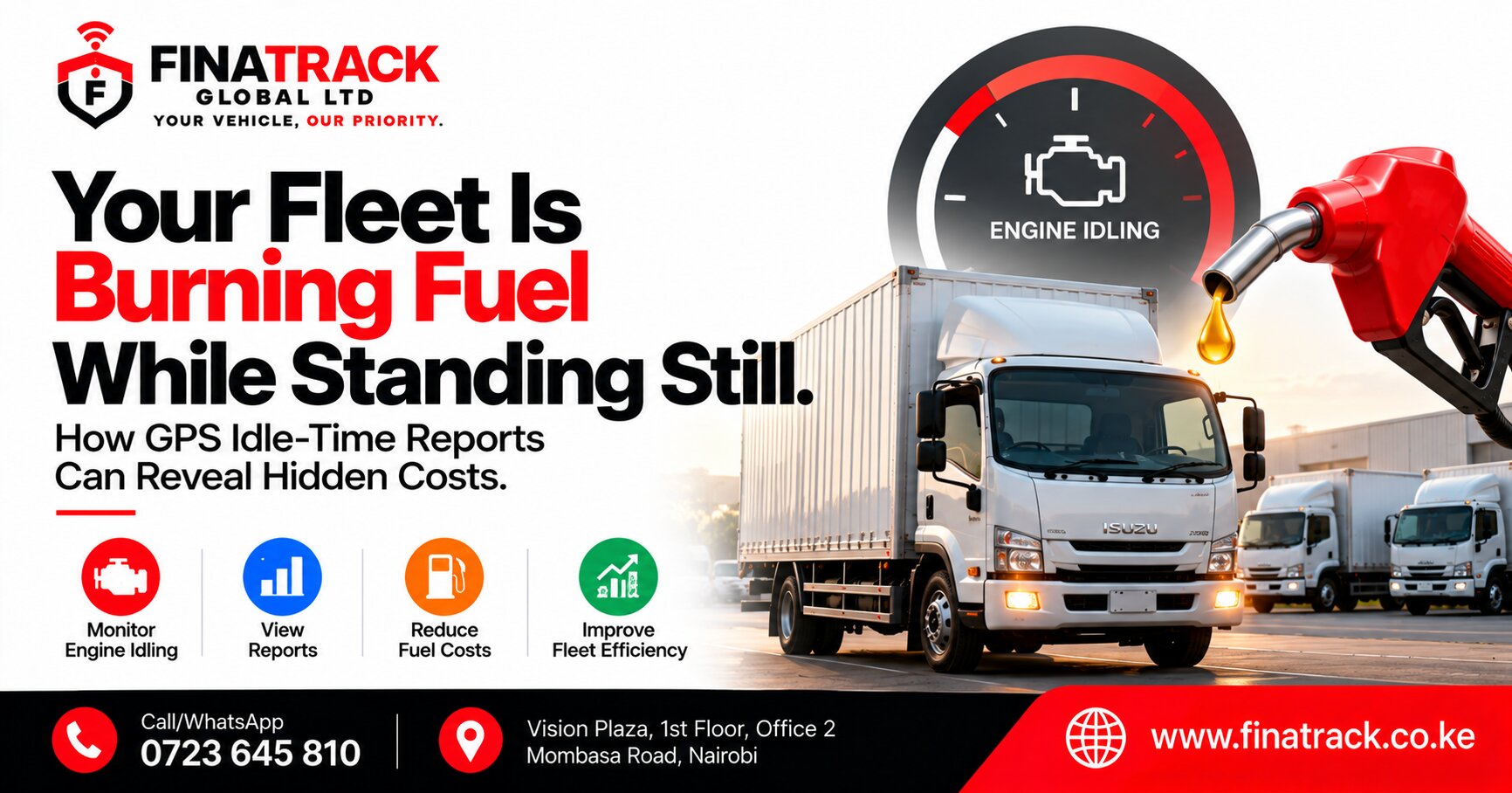
A company vehicle does not need to be moving to consume fuel. Across Nairobi and other busy urban areas, delivery vans, pickups, sales cars and service vehicles may spend long periods parked with the engine running while drivers wait for customers, load goods, complete paperwork or sit in traffic. Some of that idling is unavoidable, but when it becomes frequent and excessive, it can quietly increase fuel costs without adding meaningful mileage or business value.
This is where vehicle idling monitoring in Kenya can help fleet managers understand what is really happening. Depending on the tracking solution installed, authorised users may be able to review ignition status, trip history, stop duration and periods when the engine remains on while the vehicle is stationary. Instead of looking only at total fuel expenditure, management can begin asking a more useful question: how much of that fuel was consumed while the vehicle was actually working, and how much may have been burned while it was simply sitting still?
Idle-time reports can be especially useful for businesses operating delivery fleets, field-service vehicles, trucks, staff transport or sales cars. A vehicle may record relatively low mileage but still consume more fuel than expected because the engine remains running for long periods between jobs. If the same pattern appears repeatedly, management can investigate whether the cause is operational necessity, driver behaviour, poor scheduling or inefficient waiting procedures at customer locations.
The information should always be interpreted in context. A refrigerated truck may need to keep certain systems running, a driver may be waiting in traffic, and some commercial vehicles may have legitimate operational reasons for remaining on while stationary. The objective is not to eliminate every minute of idling. The more useful approach is to identify unusually long or repeated idle periods that do not appear necessary and then determine whether the process can be improved.
GPS data can also help businesses compare vehicles performing similar work. If three delivery vans operate on similar routes but one consistently records much longer engine-on stationary periods, that vehicle deserves closer attention. The issue may be the driver, the route, the type of customers being served or a mechanical condition affecting fuel efficiency. Tracking information provides the starting point, while fleet managers can then combine it with fuel records, maintenance reports and operational feedback.
Reducing unnecessary idling can also support maintenance planning. An engine that runs for long periods while the vehicle is stationary is still operating, even though the odometer may not increase significantly. This means mileage alone may not tell the complete story of how intensively a vehicle is being used. For fleets where idling is common, managers should combine GPS information with professional maintenance guidance rather than assuming a low-mileage vehicle has experienced very little engine use.
For businesses with high fuel exposure, GPS tracking can be combined with a dedicated fuel-monitoring system for deeper visibility. GPS can show where the vehicle was, whether it was moving and how long it remained stationary, while fuel-monitoring technology can provide additional information about fuel-level changes depending on the system installed. When both sets of data are reviewed together, fleet managers can better understand whether rising fuel costs are linked to mileage, long idle periods, operational conditions or another issue that requires investigation.
Finatrack Global Ltd provides GPS tracking and fuel-monitoring solutions for businesses that want better control over vehicle operating costs. Depending on the selected setup, authorised users can review vehicle location, trip history, ignition activity, mileage and selected operational information through the tracking platform. Finatrack’s wired GPS tracker is available at KES 15,000, while fuel-monitoring solutions are available for fleets requiring deeper fuel visibility. For enquiries, call or WhatsApp 0723 645 810 or visit www.finatrack.co.ke. When fuel costs keep rising, the problem may not always be the kilometres your vehicles are travelling; sometimes the hidden expense is the fuel being burned while they are going nowhere.