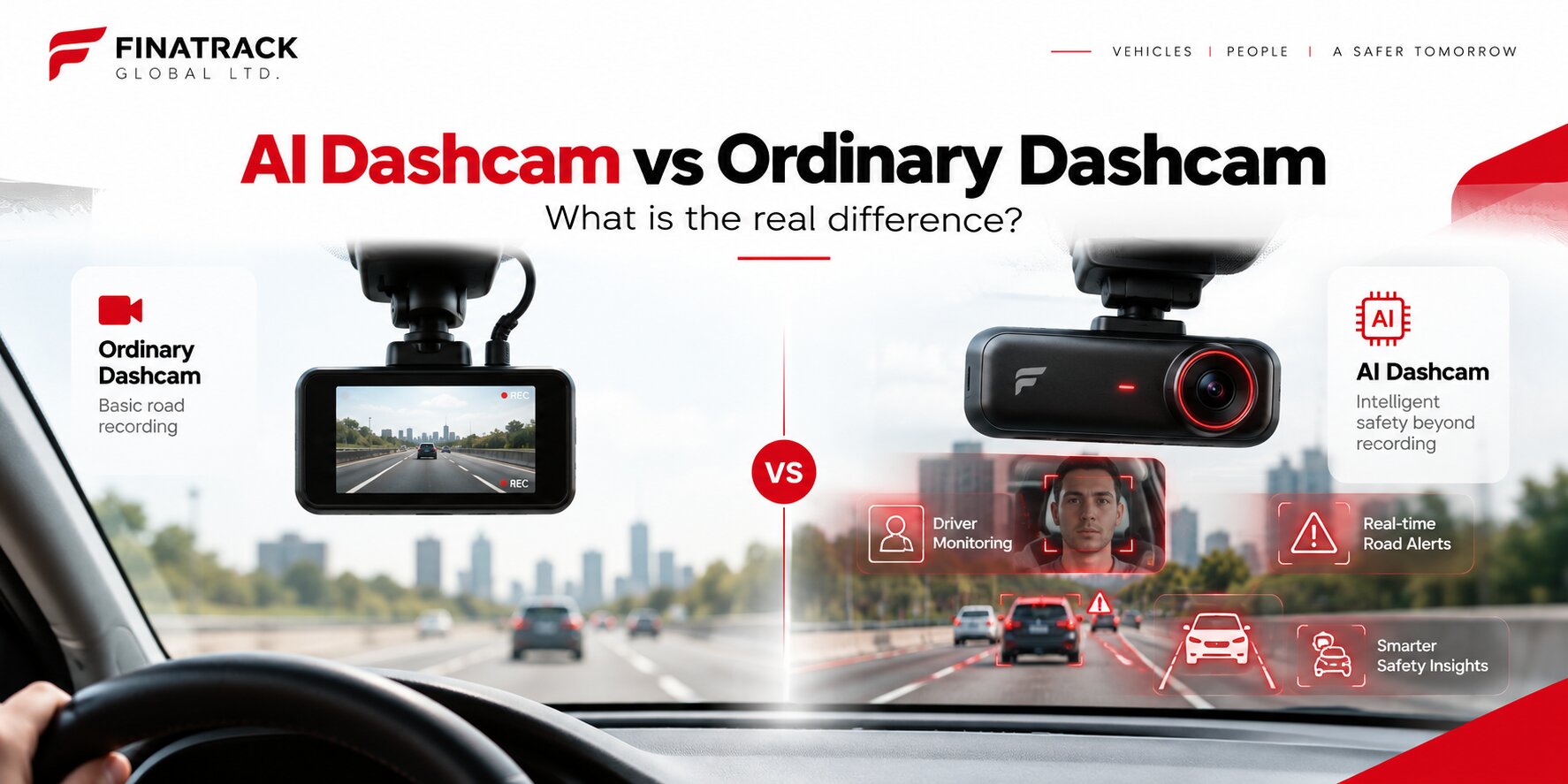
Dashcams have become increasingly popular among private motorists, truck operators and fleet managers in Kenya, but not every dashcam offers the same level of functionality. A conventional dashcam is mainly designed to record video of the road ahead, while an AI dashcam can combine video recording with driver monitoring and advanced safety alerts. For businesses managing vehicles, the difference can be significant because the system moves from simply recording what happened to helping identify risky driving behaviour while the journey is taking place.
An ordinary dashcam normally records footage continuously or when the vehicle is running, depending on how it has been installed. This can be useful after an accident, dispute or other road incident because the recorded video may help show what was happening in front of the vehicle. For many private drivers, that basic evidence function may be enough. The limitation is that a traditional camera usually does not analyse the driver’s behaviour or warn the driver about developing risks.
An AI dashcam with Driver Monitoring System technology, commonly referred to as DMS, can provide a different level of visibility. Depending on the system installed, the camera can monitor behaviour such as distraction, prolonged eye closure or other signs associated with driver fatigue. If the system detects a configured risk, it may generate an alert to warn the driver or create an event that fleet managers can later review. This can be particularly useful for long-distance trucks, delivery fleets, staff transport and vehicles whose drivers spend many hours on the road.
Another important difference is ADAS, or Advanced Driver Assistance System functionality. Depending on the dashcam configuration, ADAS can analyse the road ahead and generate alerts relating to situations such as unsafe following distance or lane-related risk. These warnings are designed to support driver awareness rather than replace the driver’s responsibility. Road conditions, weather, camera positioning and system configuration can all affect performance, so AI dashcams should be treated as driver-support technology rather than an automatic driving system.
For fleet managers, the biggest advantage may be the ability to review events instead of watching hours of ordinary video. A traditional dashcam may record an entire journey, but management still has to find the relevant moment manually. An AI-enabled system can flag selected driving events, helping a fleet manager focus attention on incidents that may require coaching or investigation. If one driver repeatedly generates distraction or harsh-driving events, for example, the business has an opportunity to address the pattern before it contributes to a more serious incident.
AI dashcams can also provide useful context after an accident. GPS information, video footage and selected driving events can help management reconstruct the sequence leading up to the incident. A driver may say that another vehicle cut into the lane suddenly, while the road-facing footage may provide additional context around what happened. The video should not automatically be treated as proof of legal liability, but it can provide valuable supporting information for internal investigations, insurers or other authorised parties where appropriate.
Choosing between an ordinary dashcam and an AI dashcam therefore depends on what the vehicle owner wants to achieve. A private motorist who mainly wants a video record of journeys may be satisfied with a conventional dashcam, while a transport company managing several drivers may benefit more from DMS, ADAS and event-based monitoring. The higher the vehicle exposure, journey distance and driver-management requirement, the more valuable intelligent video telematics can become. Professional installation is also important because camera positioning, power connections and system configuration can affect how reliably the equipment performs.
Finatrack Global Ltd provides AI dashcam solutions with DMS and ADAS capabilities for private vehicles and commercial fleets in Kenya. The Finatrack AI Dashcam is available at KES 35,000, with professional installation and support for businesses that want stronger driver-safety visibility alongside GPS tracking and fleet management. For enquiries, call or WhatsApp 0723 645 810 or visit www.finatrack.co.ke. An ordinary dashcam can show you what happened after an incident, but an AI dashcam can provide additional information that helps fleet managers identify risks, coach drivers and improve safety before the next incident occur.