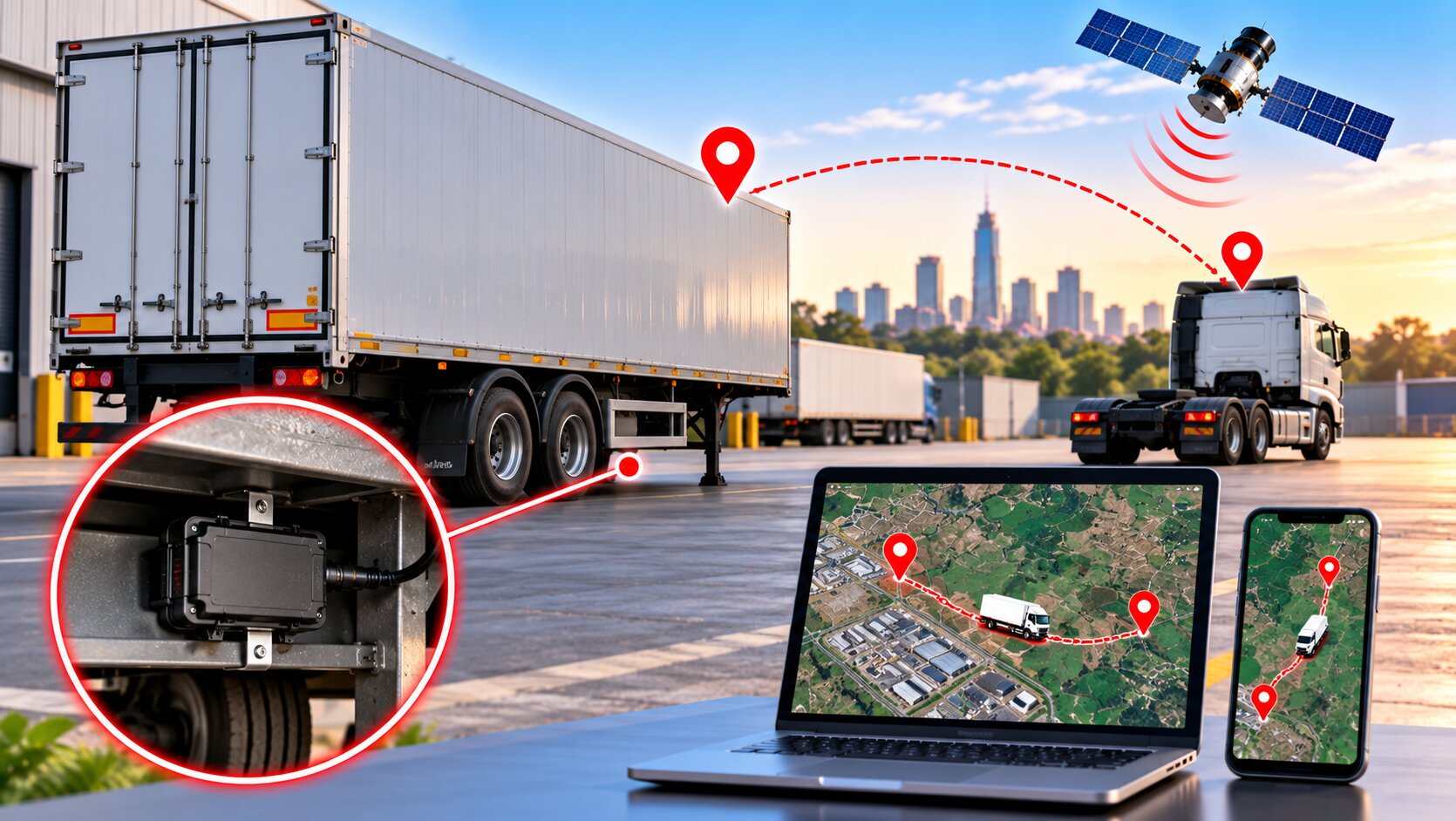
A prime mover arrives at a yard, drops its trailer and leaves with another load. From that moment, the GPS tracker installed in the truck may continue showing exactly where the tractor unit goes, but what happens to the trailer that has been left behind? For logistics companies, transporters, construction businesses and businesses operating high-value trailers in Kenya, trailer GPS tracking requires a different approach from ordinary vehicle tracking because the trailer may spend hours, days or even weeks disconnected from the truck that normally provides power and communication.
This distinction is important because many fleet managers think of a truck and trailer as one vehicle. Operationally, however, they are two separate assets. A tractor unit may change trailers several times during the week, while a semi-trailer may be parked in a depot, customer yard, roadside holding area or another location without any truck attached. If tracking exists only on the prime mover, management may know where the truck is while having very little visibility over the trailer itself.
A trailer can therefore benefit from its own independent tracking solution. Depending on the required level of visibility, this may involve an autonomous battery-powered GPS tracker, a wired tracker with an internal backup battery, a long-life tracking tag or a Bluetooth identification device used together with vehicle telematics. The correct option depends on whether the business needs continuous location updates, periodic location checks, proximity identification or simply an additional security layer.
The biggest technical challenge is power. A GPS tracker installed in a normal vehicle can usually obtain electricity from the vehicle’s battery. A trailer may receive power while connected to a tractor unit, but that supply can disappear when the trailer is disconnected. A trailer-tracking system therefore needs to be selected with those periods of independence in mind.
Some trailer trackers solve this by combining an external power connection with an internal battery. When the trailer is connected and powered, the device operates normally and can maintain its battery. After the trailer is disconnected, the tracker can switch to its internal power source and continue reporting according to its configuration. Teltonika, for example, documents trailer-security solutions specifically designed to continue monitoring after external power is removed, using internal batteries and low-power operating modes.
A completely autonomous battery-powered asset tracker provides another option. This type of device does not depend on the truck’s electrical system at all. It can be mounted discreetly on the trailer and configured to wake periodically, detect movement or transmit location according to a chosen schedule. Battery life can vary significantly depending on how frequently the device reports, how strong the available network is and how often movement wakes the tracker.
This creates an important trade-off between battery life and reporting frequency. A device sending its position every few seconds would normally consume far more energy than one waking only a few times per day. Teltonika’s autonomous asset-tracking documentation illustrates this clearly: some long-life devices are designed for periodic reporting and can operate for extended periods when configured to transmit relatively infrequently.
Fleet managers should therefore ask what they genuinely need to know. A high-value trailer moving through several locations during the day may justify more frequent reporting. A trailer that normally remains parked in the same depot for several weeks may only need periodic status checks together with an alert if unexpected movement occurs. Using the same reporting strategy for every asset can either drain batteries unnecessarily or provide less visibility than the business requires.
Geofencing is particularly useful for trailers. A virtual boundary can be created around a depot, customer yard or parking location. If the tracked trailer moves outside that area, the system can generate an event or notification depending on the equipment and platform configuration. This can give management an early indication that an asset has moved when no movement was expected.
Some tracker platforms can even create an automatic geofence around the place where an asset has remained stationary. When the trailer begins moving beyond the configured area, an alarm event can be generated. Teltonika describes this kind of auto-geofence functionality as useful for theft protection and unauthorised towing because movement can be detected without depending solely on ignition status.
This is especially relevant because trailers do not have a conventional ignition state in the same way that a powered vehicle does. A truck tracker can often use ignition information to help determine whether the vehicle has been started. A trailer may simply begin moving because another tractor unit has connected to it. Movement detection and geofencing can therefore be more meaningful security indicators.
Consider a logistics company that parks ten trailers in an industrial yard overnight. The prime movers may be somewhere else entirely. If one trailer unexpectedly leaves the compound at 2:00 a.m., a tracking device mounted directly on that trailer can potentially provide much more useful information than a tracker installed only on whichever truck last pulled it.
Trailer tracking can also improve asset utilisation, not just security. Large transport businesses may own more trailers than tractor units because trailers frequently remain at customer facilities while trucks continue working. Without an accurate system, dispatchers may spend time calling drivers or yard personnel to determine which trailer is available and where it was last left.
A location history can make this process more efficient. Management may be able to see that Trailer A is at a warehouse in Industrial Area, Trailer B remains at a customer’s premises and Trailer C is already back at the depot. Better visibility can reduce unnecessary searching, improve dispatch planning and help businesses use existing assets more effectively before purchasing additional trailers.
The technology used to identify trailers also matters. Bluetooth beacons, for example, can be attached to trailers and detected by compatible trackers installed in nearby trucks. Each beacon broadcasts a unique identity, allowing the system to identify which trailer is close to or connected with a particular tractor unit. Teltonika uses this approach for trailer identification and proximity monitoring across different trailer types.
Fleet managers should understand, however, that a Bluetooth beacon and an independent GPS tracker are not necessarily the same thing. A beacon may depend on a nearby compatible vehicle tracker or gateway to relay its identity and approximate location. An autonomous GNSS and cellular asset tracker can determine and transmit its own location independently. The right solution therefore depends on whether the business mainly needs trailer identification or independent remote tracking when no truck is nearby.
This difference becomes important after a trailer has been disconnected and left hundreds of kilometres from the fleet’s other vehicles. A proximity beacon may be excellent for confirming which trailer is attached to a particular truck but may not provide the same independent long-range tracking capability as a standalone cellular GPS asset tracker. Businesses should avoid assuming that every wireless tag provides identical functionality.
Trailer type also affects the installation. A refrigerated trailer, flatbed, tanker, low-loader and enclosed box trailer all present different mounting conditions. The device may need protection from rain, dust, pressure washing, impact and deliberate interference. Teltonika’s trailer-security examples use weather-resistant tracker housings specifically because trailers can remain outdoors for long periods in harsh conditions.
Refrigerated trailers introduce another layer of monitoring. Management may want to know not only where the trailer is but also whether the cargo compartment remained within an appropriate temperature range. Independent sensors can potentially be paired with a telematics system so that location and environmental information are reviewed together. This is particularly useful when refrigerated trailers remain parked or disconnected from the prime mover while still carrying temperature-sensitive goods.
Cargo-door monitoring can also be relevant for enclosed trailers. Depending on the system, door sensors can indicate that a trailer has been opened at an unexpected location. A door event by itself does not prove theft because authorised loading and unloading create the same basic event, but combining the timestamp with GPS location can give fleet managers useful context.
A trailer parked at an authorised customer facility and opened during a scheduled delivery presents a very different situation from one opened at an unplanned roadside stop. Once again, the value comes from combining several pieces of telematics information rather than treating one alert as proof of wrongdoing.
Businesses should also think about tracker concealment and tampering. An external tracker mounted in an obvious location can be easier for an unauthorised person to locate. At the same time, burying the device beneath heavy metal shielding may reduce GPS or cellular performance. Professional installation therefore needs to balance concealment, weather protection, antenna performance and serviceability.
Independent tracking can also support trailer rental businesses. A company renting trailers may want to confirm where the asset is being used, how long it remains away from the authorised operating area and whether it has been parked in locations that create additional theft risk. Location and utilisation information can help improve asset allocation and create better internal records.
Cross-border transport introduces additional considerations. A trailer travelling from Kenya into neighbouring countries may encounter changes in mobile-network availability and roaming conditions. Businesses operating across borders should confirm that the selected tracking device and SIM connectivity are appropriate for the countries in which the asset will operate. A tracker that works well locally should not automatically be assumed to provide identical connectivity everywhere.
Fleet managers should also define what happens when a tracked trailer goes offline. An offline event could result from network coverage, low battery, power disconnection, device damage, signal obstruction or tampering. Management should check the last known location, previous battery or power status and whether the trailer had recently entered a location with weak connectivity before assuming that it has been stolen.
Battery maintenance deserves attention as well. Long-life does not mean maintenance-free forever. Businesses should know the expected battery service interval and create a schedule for inspection or replacement. A backup tracker that has been ignored for several years may provide little value if its battery has already been exhausted when the business eventually needs it.
This is why routine device health checks should form part of fleet management. Instead of discovering that a trailer tracker stopped communicating months ago during a theft incident, management can regularly confirm that each device is reporting normally. Large fleets can build these checks into monthly or quarterly asset-management routines.
Trailer tracking also works best as part of layered fleet security. A GPS device can improve visibility, but physical locks, secure yards, controlled driver access, proper documentation and other security measures remain important. Tracking should help businesses respond to unusual movement rather than creating the impression that a trailer is impossible to steal.
For transport companies with many interchangeable trailers, independent tracking can also improve accountability during handovers. Management can record which tractor unit collected a particular trailer, when it was moved and where it was left. Bluetooth identification, GPS tracking or both can help reduce confusion when several visually similar trailers circulate between depots and customers.
Finatrack Global Ltd provides GPS tracking, wireless tracking and asset-security solutions for businesses managing vehicles and movable assets in Kenya. Finatrack’s wireless GPS tracker is available at KES 15,000, while the three-year tracking tag is also available at KES 15,000 for customers seeking an additional independent tracking layer. The most suitable setup depends on whether the trailer requires frequent live tracking, periodic position reporting, proximity identification or long-life backup monitoring.
For professional installation and enquiries, call or WhatsApp 0723 645 810 or visit www.finatrack.co.ke. A trailer should not become invisible simply because the tractor unit has driven away. By fitting the trailer itself with an appropriate independent tracking solution, fleet managers can maintain better visibility over location, unexpected movement, utilisation and security even when the asset is disconnected and parked on its own.