Losing a valuable asset can be frustrating, particularly when it represents a significant financial investment or plays an important role in business operations. Whether it is a vehicle, expensive equipment, commercial cargo or an item that regularly moves between different locations, knowing where an asset is located can provide greater security and peace of mind. However, traditional tracking devices often require regular charging or a permanent connection to an external power source, making them less convenient for assets that need to remain monitored over extended periods.
Long-life tracking technology is providing an alternative for individuals and businesses seeking location monitoring with fewer routine power requirements. The Finatrack Three-Year Tracking Tag is designed for applications where compact size, independent battery operation and long-term monitoring are important considerations. With a battery life advertised at up to three years under suitable operating conditions, the device offers an option for protecting valuable assets without the frequent charging associated with some portable trackers. Understanding how the technology works, what affects its battery life and where it can be used helps customers determine whether it is suitable for their tracking requirements.
What Is a Three-Year Tracking Tag?
A three-year tracking tag is a compact electronic device designed to provide location-monitoring capabilities while operating on a long-life internal battery. Unlike conventional wired GPS trackers that depend on a vehicle’s electrical system, this type of device can function independently, making it suitable for selected vehicles, equipment and movable assets.
The Finatrack long-life tracking device is designed to support location monitoring without permanent electrical wiring. Its compact design provides greater flexibility when choosing where to place it, while its independent power source makes it useful for assets that may remain unattended for extended periods.
An important distinction is that tracking tags do not all use the same technology. Some consumer tags depend on Bluetooth signals and nearby compatible smartphones to report their locations, while other devices use satellite positioning and mobile communication networks. Finatrack has also offered a long-life GPS/GSM tracking model designed for independent location reporting, which is different from an ordinary Bluetooth item finder. Customers should confirm the particular model and communication technology supplied before purchasing. Finatrack Global Ltd+1
How Does a Three-Year Tracking Tag Work?
The operating principle depends on the tracking technology incorporated into the device. A long-life GPS/GSM tracker determines its geographical position using satellite signals and communicates location information through a supported mobile network. This allows an authorised user to access reported locations through a compatible monitoring platform, subject to network coverage and the device’s configuration.
Unlike a conventional wired tracker, which can draw power continuously from a vehicle, a long-life tracking device must conserve its internal battery. Many such devices achieve extended operating periods through carefully managed reporting intervals, low-power components and sleep modes that reduce energy consumption when full tracking activity is unnecessary.
For example, a tracking device attached to an asset that remains stationary for several days may not need to transmit its location every few seconds. A suitably configured long-life tracker can conserve energy during periods of inactivity and provide location reports according to its programmed settings.
The actual reporting behaviour depends on the specific device. Buyers should establish whether their selected tag provides scheduled location updates, movement-triggered reporting or another method of monitoring before relying on it for security.
Can a Tracking Tag Really Last Three Years Without Charging?
Battery longevity is one of the main attractions of long-life tracking devices. A tracker designed to operate for several years can reduce the inconvenience of frequent charging, especially where the device is placed on equipment that is difficult to access regularly.
However, a three-year battery-life claim should be understood as a maximum expected operating period under specified conditions rather than a guarantee that the device will provide continuous live tracking for three years. The battery life depends on the device’s reporting frequency, network conditions, movement patterns, environmental temperature and other operating factors.
A tracker that communicates frequently may consume considerably more energy than one configured to send occasional location updates. Similarly, a device operating in an area with weak network coverage may require additional energy when attempting to communicate.
Finatrack’s previously published technical information for its long-life GPS tracker identifies a 3,100 mAh non-rechargeable battery and an advertised standby life of up to three years. This means customers should distinguish between maximum standby life and battery performance under their intended monitoring settings. Finatrack Global Limited
For vehicle owners and businesses, understanding this difference is important when selecting equipment intended for long-term asset security.
Can You Use a Tracking Tag to Protect Your Vehicle?
A long-life tracking device can provide an additional layer of vehicle location monitoring, particularly when used alongside an existing wired GPS tracker. Many motorists already rely on permanently installed tracking systems for regular vehicle monitoring, but having a secondary device can reduce dependence on a single source of location information.
Consider a car owner in Nairobi whose vehicle is equipped with a wired GPS tracker. The primary device provides routine monitoring and selected security notifications. Adding an independent battery-powered tracking device creates another possible source of location information if the primary tracker experiences a power interruption or communication problem.
This arrangement may be particularly useful for vehicles that spend extended periods parked or are frequently operated away from the owner’s immediate supervision. However, the secondary device’s usefulness depends on how often it reports, whether its battery remains functional and whether network connectivity is available.
A long-life tracking tag should not automatically be considered a substitute for a conventional live GPS tracking system. Motorists who require frequent location updates, ignition monitoring or remote immobilisation may still need a suitably equipped wired tracker.
Why Long-Life Tracking Tags Are Useful for Businesses
Businesses often own valuable assets that operate outside their main premises. These may include machinery, tools, equipment and movable commercial property used at construction sites, warehouses or customer locations. Managing such assets can become challenging when equipment is frequently transferred between different working environments.
For example, a construction company operating projects in Nairobi, Machakos and Nakuru may regularly relocate equipment between sites. Without a reliable asset register and suitable location-monitoring arrangements, identifying the whereabouts of particular equipment may require calls to several employees or visits to different locations.
A compatible long-life tracking device can provide an additional way to establish an asset’s reported location, helping businesses investigate misplaced equipment and improve asset management.
The same principle can apply to selected commercial cargo and equipment used in agricultural operations. However, the effectiveness of tracking depends on the equipment’s technology, placement, reporting settings and communication coverage. Businesses should evaluate the device against their actual operating requirements rather than assuming that every asset can be monitored continuously.
Can a Three-Year Tracking Tag Help Locate Lost Valuables?
One of the practical benefits of a compact tracking device is its potential use with valuable belongings that are occasionally misplaced or transported between locations. Depending on its dimensions, attachment method and positioning requirements, a tracking tag may be suitable for selected luggage, equipment cases or other valuable items.
For example, a business professional travelling between Nairobi and Mombasa may wish to monitor a valuable equipment case. A compatible tracking device can provide location information when its reporting conditions are met, potentially helping the owner establish where the case was last detected.
However, different tracking technologies have different limitations. Bluetooth-based item finders generally depend on nearby participating devices to assist with location reporting. Google’s Find Hub and Apple’s Find My network illustrate how compatible item-finding accessories can use surrounding devices to help identify the approximate location of belongings. Apple+1
A GPS/GSM tracking device operates differently and may have different coverage, power and placement requirements. Customers should therefore select a device based on the type of asset they intend to monitor, rather than treating all tracking tags as interchangeable.
What Is the Difference Between a Tracking Tag and a Wireless GPS Tracker?
Although both devices may operate without a permanent electrical connection, long-life tracking tags and rechargeable wireless GPS trackers are designed for different monitoring priorities.
A rechargeable wireless GPS tracker may offer more frequent location reporting, depending on the device’s capabilities and configuration. However, frequent reporting increases battery consumption and may require the owner to recharge the device regularly.
A long-life tracking device generally prioritises extended battery operation, often using energy-saving techniques that reduce the frequency of certain activities. This can make it attractive for assets that do not require continuous high-frequency location updates.
For example, a logistics operator who needs regular movement information about a delivery vehicle may prefer a conventional wired GPS tracker. A business monitoring equipment stored at a remote location may place greater importance on long battery life and periodic location reporting.
Neither device is universally better. The most suitable option depends on the asset being monitored, the required reporting frequency, the operating environment and the owner’s maintenance preferences.
Does a Three-Year Tracking Tag Need a SIM Card?
Whether a tracking tag requires a SIM card depends on the communication technology used. GPS/GSM tracking devices generally require access to a supported mobile network, often through a physical or embedded SIM arrangement, to transmit location information remotely.
By contrast, many Bluetooth item-finding tags do not require their own cellular SIM card because they rely on nearby compatible devices and associated location-finding networks.
Finatrack’s published specifications for its long-life GPS/GSM model identify GSM/GPRS communication capabilities. For that model, network connectivity forms part of the remote tracking process. Finatrack Global Limited
Consequently, motorists should avoid assuming that every product described as a tracking tag operates without a SIM card or mobile network service. Before purchasing, customers should confirm whether the selected device uses cellular connectivity, whether any network-related service charges apply and what happens when the asset enters an area with limited coverage.
Can a Tracking Tag Work in Areas Without Network Coverage?
Location tracking depends on several technical conditions. A device may be able to determine its position through satellite navigation while remaining unable to transmit that information because mobile communication coverage is unavailable.
For example, a long-life GPS/GSM tracker placed on equipment operating in a remote part of Kenya may experience delayed reporting when it moves outside supported network coverage. The monitoring platform may continue displaying the last successfully transmitted location until a new report becomes available.
Certain devices may store location information and transmit it once connectivity is restored, but this capability should be verified for the selected model. Satellite reception can also be affected by buildings, containers, underground parking areas and other physical obstructions.
Vehicle owners and asset managers should therefore understand the difference between the last reported position and the asset’s actual current location. A tracking device is most useful when users know the operating limitations of its positioning and communication systems.
Why Battery Maintenance Still Matters
Although a long-life tracking device is designed to minimise routine maintenance, it should not be forgotten completely after installation. Battery performance can change over time, and the operating life may be shorter than the advertised maximum when the device is used under demanding conditions.
For example, an asset that moves frequently may cause a compatible tracker to report more often than expected. Similarly, repeated attempts to communicate in areas with poor mobile network coverage may increase energy consumption.
Businesses should establish a reasonable inspection schedule to confirm that tracking devices remain functional and that available location information is being received correctly. Where the monitoring system supports battery-status reporting, users should review those records periodically.
Because some long-life devices use non-rechargeable batteries, the eventual maintenance requirement may involve replacing the battery or the tracking unit rather than plugging it into a charger. Customers should confirm the applicable replacement procedure before purchasing.
How Much Does a Three-Year Tracking Tag Cost in Kenya?
The price of a long-life tracking device depends on its battery technology, communication capabilities, supported features and monitoring arrangements. Devices intended primarily for locating nearby personal belongings may differ considerably from independent GPS/GSM trackers designed for vehicles and commercial assets.
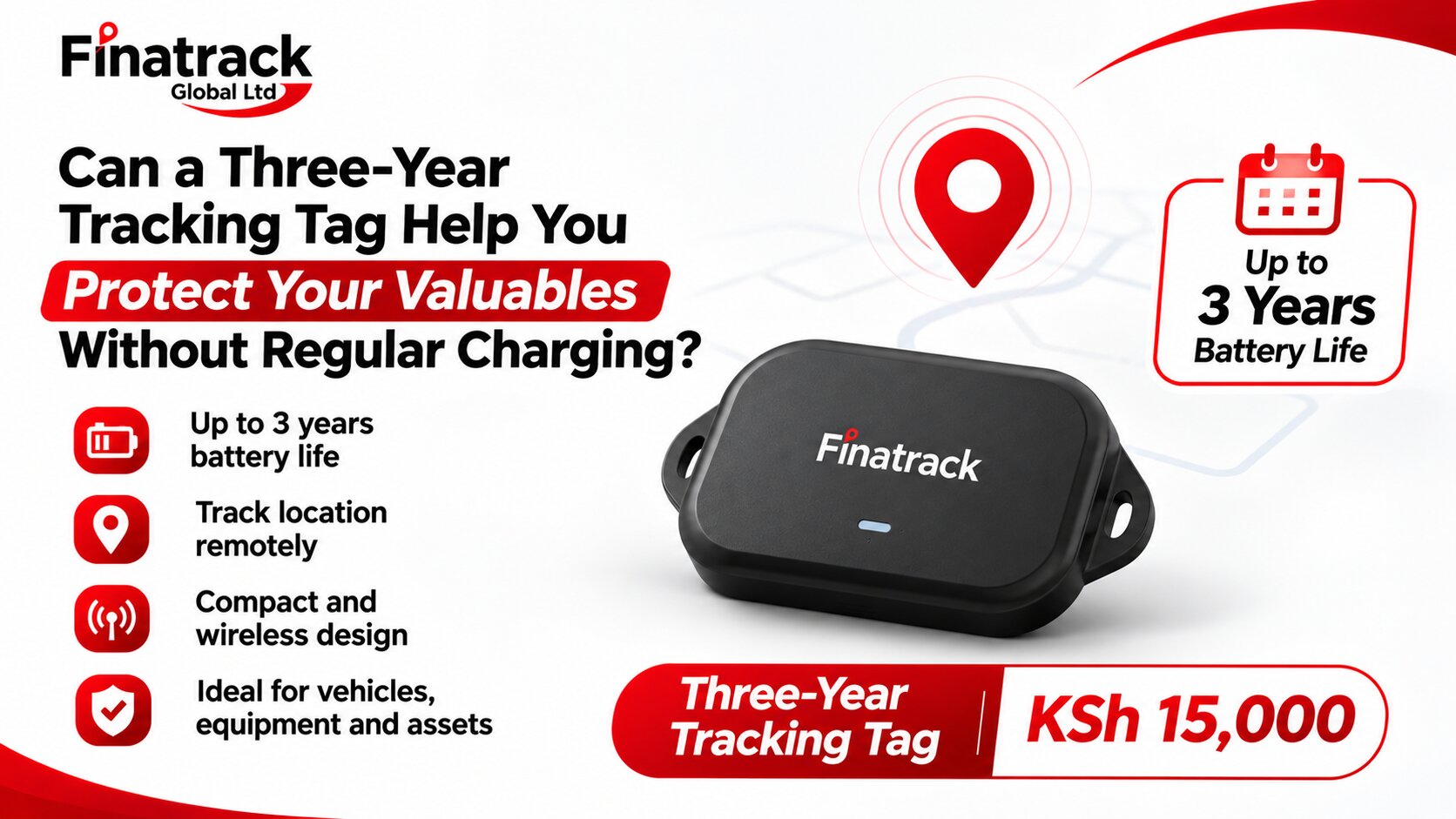
At Finatrack Global Ltd, our Three-Year Tracking Tag costs KSh 15,000. The product is designed for customers seeking compact, wireless and long-life location-monitoring technology for suitable vehicles and valuable assets.
The tag provides an option for motorists interested in additional vehicle tracking protection and businesses requiring location visibility for selected movable assets. Customers should confirm the particular model’s reporting frequency, battery-life conditions, supported tracking platform and any applicable connectivity requirements.
For vehicles that require frequent location monitoring, Finatrack also offers wired and rechargeable wireless GPS tracking solutions. The most appropriate choice depends on how frequently the owner needs updates and whether the primary objective is everyday monitoring or supplementary asset protection.
Is a Three-Year Tracking Tag Worth Investing In?
A three-year tracking tag can be a practical investment for people and businesses that need location visibility without the inconvenience of frequent battery charging. Its compact design and independent power source make it attractive for selected assets that cannot easily accommodate permanent wiring.
For private vehicle owners, the device may provide an additional monitoring layer alongside an existing GPS tracker. For businesses, it can support asset management by providing location information for suitable equipment and other valuable property.
However, customers should have realistic expectations about long-life tracking technology. Extended battery life often involves compromises in reporting frequency, while positioning accuracy and update availability remain dependent on operating conditions.
The best results come from selecting the right technology for the intended application, configuring it appropriately and maintaining an understanding of its limitations. When used as part of a broader asset security strategy, a long-life tracking tag can provide useful information and additional peace of mind.
Protect Your Valuables With Finatrack Global Ltd
Protecting valuable assets requires more than simply knowing where they were last seen. For individuals and businesses, having access to appropriate location-monitoring technology can make it easier to manage equipment, review asset movements and respond when property cannot be accounted for.
Finatrack Global Ltd provides tracking solutions for private motorists, businesses and fleet operators across Kenya. Our products include wired GPS trackers, rechargeable wireless trackers, long-life tracking tags and other vehicle security technologies designed to meet different monitoring requirements.
Our Three-Year Tracking Tag is available at KSh 15,000, offering compact, battery-powered location monitoring with an advertised battery life of up to three years under suitable operating conditions.
For enquiries and assistance selecting the most appropriate tracking solution, contact Finatrack Global Ltd on 0723 645 810 or visit our office at Vision Plaza, 1st Floor, Office 2, Mombasa Road, Nairobi. You can also explore our tracking products at www.finatrack.co.ke.
Your valuables deserve more than occasional attention. Choose a tracking solution designed to provide location visibility while reducing the need for frequent battery maintenance.