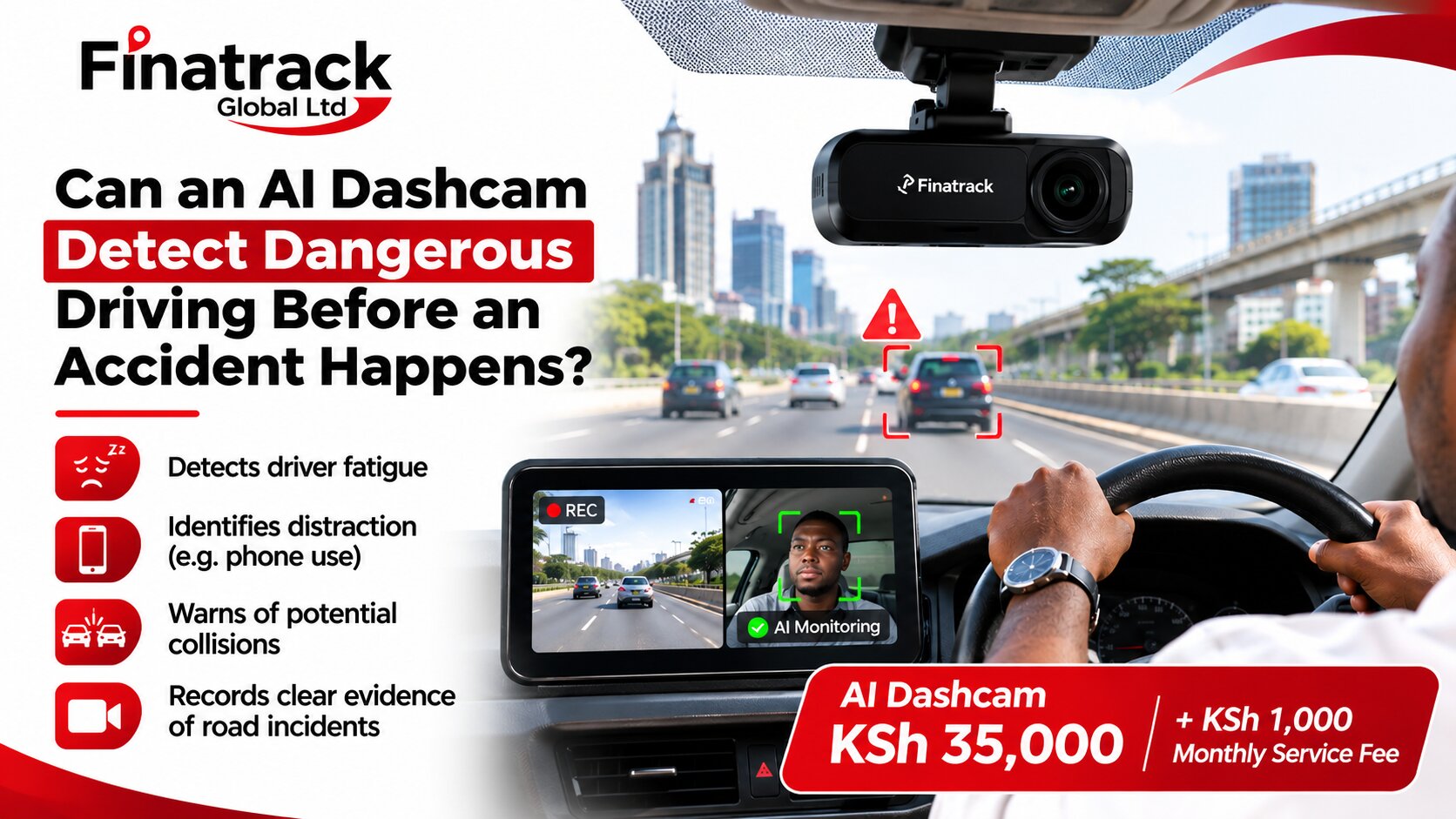
Road accidents can happen within seconds, but the behaviours that contribute to them often begin long before a collision occurs. A driver may become distracted by a mobile phone, struggle with fatigue after several hours behind the wheel, or follow another vehicle too closely without recognising the danger. On busy Kenyan roads, where motorists regularly encounter heavy traffic, motorcycles, pedestrians and unpredictable road conditions, even a momentary loss of concentration can have serious consequences. This raises an important question for vehicle owners and transport businesses: can an AI dashcam help identify dangerous driving before an accident happens?
Artificial Intelligence (AI) dashcams are changing how vehicle owners monitor road safety and driver behaviour. Unlike traditional dashboard cameras that primarily record footage for later review, advanced AI dashcams can analyse selected driving activities and identify behaviours associated with increased accident risks. Depending on the camera’s capabilities, these systems may detect driver fatigue, distraction, unsafe following distances and other potentially dangerous situations. For Kenyan motorists and businesses managing fleets, the technology provides an additional way to improve road safety, encourage responsible driving and obtain valuable video evidence when incidents occur.
How Does an AI Dashcam Work?
An AI dashcam is an advanced vehicle camera system that combines video recording with intelligent software capable of analysing particular driving events. While a conventional dashcam mainly records what happens in front of a vehicle, an AI-enabled system can use computer vision technology to identify certain movements and behaviours. Some systems include both a road-facing camera and a driver-facing camera, allowing the technology to monitor traffic conditions while also observing the driver’s activities.
When the system detects behaviour that matches a programmed risk condition, it may generate an audible warning or record the event for subsequent review. For example, a compatible AI dashcam may recognise when a driver repeatedly looks away from the road or follows another vehicle at an unsafe distance. Depending on the model and connectivity features, relevant information may also be transmitted to an authorised fleet manager. However, these capabilities vary between products, and vehicle owners should confirm the specific functions supported by their chosen system before installation.
Can an AI Dashcam Detect Driver Fatigue?
Driver fatigue is a major concern for motorists who spend extended periods travelling on Kenyan highways. Long-distance truck drivers, bus operators, delivery personnel and company drivers frequently cover considerable distances while working under demanding schedules. A driver travelling from Mombasa to Nairobi overnight, for example, may experience reduced concentration after several hours on the road, particularly when adequate rest has not been taken.
Certain AI dashcams equipped with driver-monitoring technology can identify visible signs associated with fatigue, including prolonged eye closure, frequent yawning and unusual head movements. When these patterns are detected, the system may generate an audible alert to encourage the driver to regain attention or stop for a rest. For businesses managing commercial fleets, compatible connected cameras can also provide information about repeated fatigue-related events, helping supervisors identify situations where changes to working hours or driver schedules may be necessary. Although the technology offers useful support, it cannot reliably detect every instance of fatigue and should never replace adequate rest or responsible driving.
How AI Dashcams Help Reduce Distracted Driving
Distracted driving is another significant challenge on Kenyan roads. Many motorists use their mobile phones for navigation, business communication and coordination with colleagues. While these activities may be part of everyday work, handling a phone or looking away from traffic while driving can create dangerous situations. A driver approaching a busy junction along Mombasa Road, for example, may fail to notice a motorcycle or pedestrian because their attention has shifted away from the road.
AI dashcams with suitable driver-facing monitoring capabilities can detect selected behaviours associated with distraction, such as looking away from the road for extended periods or using a mobile phone while driving. When a potential distraction is identified, the system may issue a warning that encourages the driver to refocus. For companies operating delivery vehicles, taxis or corporate fleets, reviewing these incidents can help managers understand recurring driving habits and provide appropriate safety training. The purpose of such monitoring should be to promote safer driving and prevent avoidable incidents rather than simply observe employees throughout their working day.
Can an AI Dashcam Warn Drivers About Potential Collisions?
Some advanced AI dashcams incorporate road-monitoring functions designed to identify potentially dangerous situations involving other vehicles. These features may include forward collision warnings, unsafe following-distance alerts and lane departure notifications. Using a forward-facing camera, the system analyses selected road conditions and generates warnings when predefined risk thresholds are reached.
Consider a motorist travelling along Thika Road during heavy traffic. If the vehicle ahead suddenly reduces speed while the driver is following too closely, a compatible AI dashcam may detect the developing situation and generate an alert. Such warnings can provide an additional opportunity for the driver to respond, although they do not guarantee that an accident will be avoided. Weather conditions, camera positioning, road markings and visibility can influence performance, making attentive driving essential even when advanced monitoring technology is installed.
Why Video Evidence Is Important After an Accident
When a road accident occurs, determining exactly what happened can become complicated. Drivers may provide conflicting explanations, witnesses may have observed different parts of the incident, and important details can be forgotten during the confusion that follows. Without reliable supporting information, vehicle owners may find it difficult to understand the circumstances surrounding a collision.
An AI dashcam can provide recorded footage that helps establish the sequence of events before and during an accident. Imagine a company vehicle involved in a collision at a busy Nairobi intersection. The company driver claims that another motorist changed lanes unexpectedly, while the other driver gives a different account. Reviewing available dashcam footage may help clarify the vehicles’ movements and provide useful information during an accident investigation. Such recordings may also support insurance claims and discussions with relevant authorities, although video evidence must still be interpreted alongside other facts and does not automatically establish who was responsible.
How AI Dashcams Benefit Fleet Owners in Kenya
Managing a fleet of vehicles involves more than knowing where each vehicle is located. Transport businesses must also consider how their drivers operate vehicles, whether safety procedures are being followed and how driving behaviour affects operating expenses. A GPS tracking system can provide information about routes, vehicle movements and speed, but video footage may offer additional context when unusual events occur.
For example, a logistics company operating trucks between Nairobi, Nakuru and Eldoret may identify repeated harsh-braking incidents through its fleet monitoring system. If relevant footage is available, managers can review the circumstances and determine whether the events were associated with unsafe following distances, unexpected road hazards or other factors. This information can help businesses conduct more meaningful driver training and develop better operational procedures. Rather than relying on assumptions about what happened during a journey, fleet managers can use recorded information to support informed decisions.
AI dashcams can also contribute to improved accountability within transport businesses. Where cameras support event recording and remote access, authorised managers may be able to investigate particular safety concerns without physically accompanying drivers on every journey. Over time, combining monitoring technology with effective driver coaching, vehicle maintenance and reasonable working schedules may help reduce avoidable incidents and related operational losses.
Can an AI Dashcam Help Reduce Vehicle Operating Costs?
Road accidents can be expensive for vehicle owners and transport businesses. Apart from repair costs, a damaged commercial vehicle may remain out of operation for several days, resulting in delayed deliveries, interrupted business activities and reduced revenue. Businesses may also incur towing expenses and additional administrative costs when investigating incidents or resolving disputes.
By helping identify certain risky driving behaviours, AI dashcams can support efforts to reduce preventable accidents and improve driver performance. For instance, a business that consistently identifies unsafe driving habits may use that information to provide targeted training and introduce better safety practices. Video recordings can also help clarify the circumstances surrounding vehicle damage or accidents, potentially reducing the time spent investigating conflicting explanations. However, the financial benefits are not guaranteed, and installing an AI dashcam does not automatically result in lower insurance premiums or reduced maintenance expenses. The greatest value comes when the technology forms part of a broader vehicle safety and fleet management strategy.
Is an AI Dashcam Suitable for Private Vehicles?
Although AI dashcams are commonly associated with commercial transport and fleet management, private motorists can also benefit from advanced vehicle recording systems. Drivers who frequently travel on highways, undertake long-distance journeys or share their vehicles with other authorised users may appreciate having recorded information about incidents that occur on the road.
For a private vehicle owner travelling between Nairobi and Nyeri, for example, an AI dashcam may provide footage of unexpected incidents during the journey. Depending on the selected model, additional monitoring features may also issue warnings about particular driving risks. However, motorists should evaluate their requirements carefully. Someone primarily interested in recording accidents may find a conventional dashcam sufficient, while those seeking supported driver-monitoring and safety-alert features may prefer an AI-enabled system. Understanding this distinction can help buyers avoid paying for capabilities they do not need.
What Should You Consider Before Buying an AI Dashcam in Kenya?
Before purchasing an AI dashcam, vehicle owners should understand the features included in the equipment being offered. Not every camera advertised as an AI dashcam can detect fatigue, mobile phone use, unsafe following distances or lane departures. The available functions depend on the camera hardware, software and configuration, making it important to request a clear explanation or demonstration before installation.
Recording quality is another important consideration because the usefulness of video footage depends partly on how clearly an incident is captured. Motorists should enquire about camera resolution, night-time recording, video storage, retrieval procedures and whether the system requires internet connectivity to access certain features. For commercial operators, the ability to review recorded incidents and manage authorised access to footage may be particularly valuable.
Professional installation is equally important. A poorly positioned camera may produce unreliable recordings or incorrect safety alerts, limiting the system’s effectiveness. Businesses must also consider privacy and data protection requirements, particularly when recording employees or passengers. Drivers should be appropriately informed about monitoring activities, while access to recordings should be restricted to authorised individuals and managed in accordance with applicable Kenyan data protection laws.
How Much Does an AI Dashcam Cost in Kenya?
The price of an AI dashcam depends on its recording capabilities, intelligent monitoring features, storage arrangements and associated services. Basic dashboard cameras generally focus on recording video, while advanced AI-enabled systems may incorporate driver behaviour analysis, event notifications and connected monitoring services. Buyers should therefore compare the actual capabilities of different products rather than relying entirely on their advertised prices.
At Finatrack Global Ltd, our AI Dashcam solution is available at KSh 35,000, with a monthly service fee of KSh 1,000. The solution is designed for vehicle owners and businesses interested in improving their visibility into road incidents and driver behaviour. Customers can consult our team to understand the specific camera capabilities, available monitoring features, video access arrangements and installation requirements.
For transport businesses operating multiple vehicles, investing in an appropriate camera system can be part of a long-term approach to improving safety and operational accountability. The purchasing decision should consider equipment quality, supported functionality, installation standards and ongoing service requirements.
Is an AI Dashcam Worth Investing In?
An AI dashcam can be a valuable addition to modern vehicle safety systems, particularly for motorists and fleet operators who want more information about driving behaviour and incidents occurring on the road. Its ability to combine video recording with selected intelligent detection features distinguishes it from conventional dashboard cameras and provides opportunities for more informed vehicle monitoring.
Nevertheless, an AI dashcam cannot predict every accident or eliminate the possibility of dangerous driving. Its effectiveness depends on the equipment installed, operating conditions, correct configuration and how drivers respond to warnings. Vehicle owners should therefore view the technology as an additional safety measure rather than a replacement for responsible driving, regular vehicle maintenance or proper driver training.
For Kenyan businesses, the combination of AI dashcams, GPS tracking and effective fleet management practices can create a more comprehensive approach to vehicle safety. GPS tracking helps establish where vehicles travel, while camera footage can provide greater context about selected events that occur during those journeys. Together, these systems can support improved accountability, more effective incident investigations and better-informed management decisions.
Improve Your Vehicle Safety With Finatrack Global Ltd
Protecting a vehicle involves more than knowing its location. Understanding what happens during a journey and identifying potentially dangerous driving behaviours can help motorists and businesses make better safety decisions. AI dashcams provide an opportunity to combine recorded video evidence with intelligent monitoring capabilities, making them a useful addition to modern vehicle security and fleet management systems.
Finatrack Global Ltd provides vehicle tracking and security solutions for private motorists, logistics companies, corporate fleets and transport operators across Kenya. Our solutions include GPS tracking devices, AI dashcams, fuel monitoring systems and advanced vehicle alarm systems.
Our AI Dashcam is available at KSh 35,000, plus a monthly service fee of KSh 1,000. For product enquiries, professional installation and information about supported features, contact Finatrack Global Ltd on 0723 645 810 or visit our office at Vision Plaza, 1st Floor, Office 2, Mombasa Road, Nairobi. You can also learn more about our vehicle security solutions at www.finatrack.co.ke.
An accident may happen in seconds, but the right technology can help you understand what happened and identify certain risks before another incident occurs.