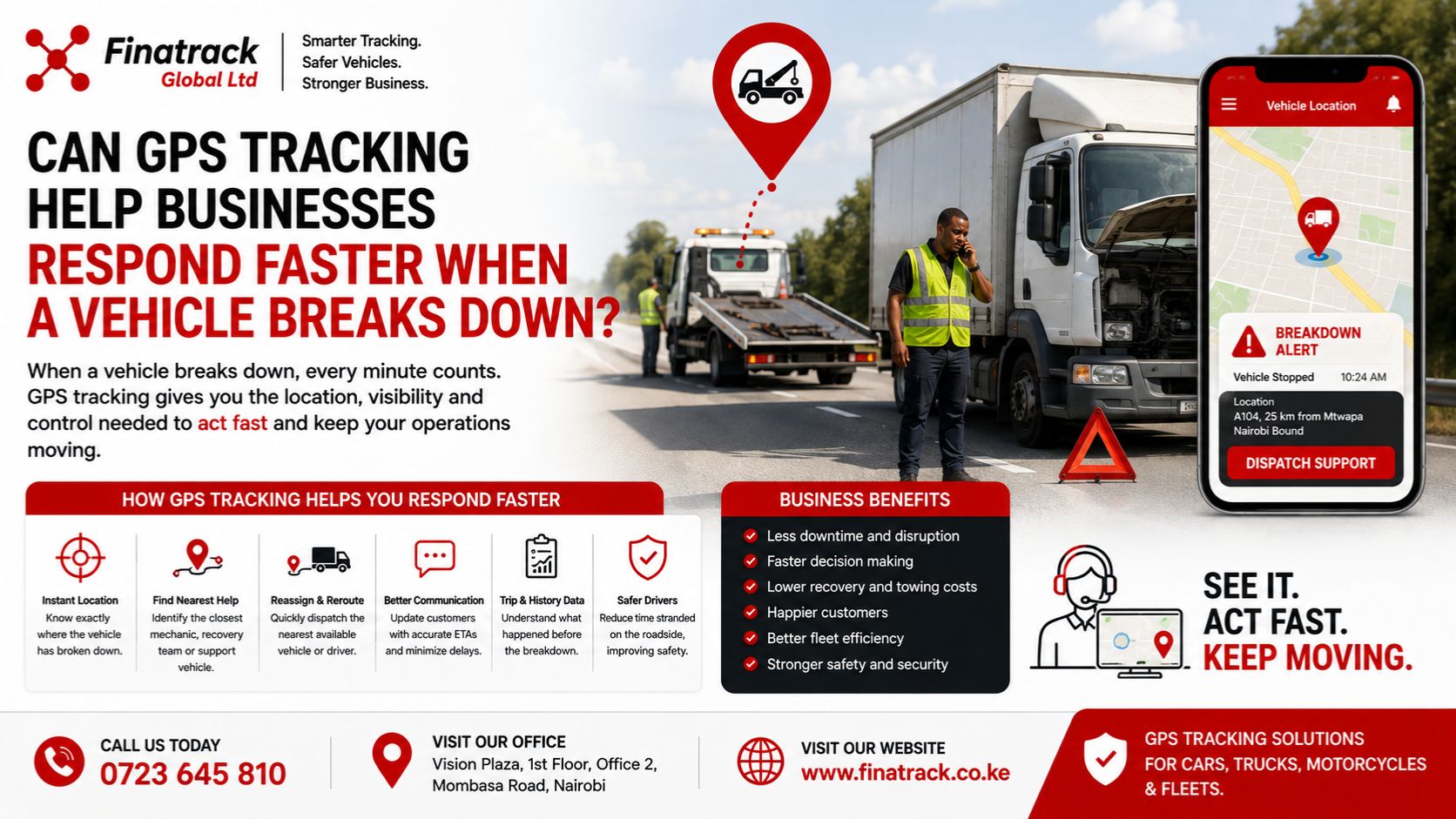
A vehicle breakdown rarely happens at a convenient time. It may occur while a delivery truck is carrying customer orders, when a field service van is heading to an urgent job or while a company pickup is travelling in a remote area far from the office. In that moment, the business is not only dealing with a mechanical problem. It is also dealing with lost time, delayed work, customer disruption and the challenge of finding the vehicle quickly enough to respond effectively.
For many businesses, the first reaction is still to call the driver and ask a simple question: where are you? That question sounds straightforward, but the answer is not always as clear as management hopes. A driver may not know the exact location, may describe a place using landmarks unfamiliar to the office or may be stranded in an area where giving precise directions is difficult.
GPS tracking helps solve that first problem immediately. Instead of depending entirely on a verbal explanation, an authorised manager can check the vehicle’s location on the tracking platform and see where it is. That alone can save valuable time.
When a business already knows where the broken-down vehicle is, it can make faster decisions. The office can determine which mechanic, recovery vehicle or support team is closest. It can advise another employee where to go. It can also communicate more accurately with customers whose deliveries or appointments may now be affected.
The location of the vehicle is only part of the value. GPS tracking can also show the route the vehicle followed before the breakdown and the last point at which it was moving normally. This can help management understand whether the vehicle stopped suddenly, whether it had been moving slowly for some time or whether it had already taken an unusual detour before the incident occurred.
That information can be especially useful when the breakdown happens far from the main office. A fleet manager in Nairobi may not be able to visualise exactly where a stranded truck is just from hearing the name of a trading centre or roadside petrol station. A live tracking map provides a much clearer picture.
The benefits become even greater for businesses operating several vehicles at once. A breakdown does not only create a recovery problem. It can also create an operational gap. If one van is stranded, management may need to know whether another nearby vehicle can take over the assignment.
GPS tracking makes that easier. The office can check which company vehicle is closest to the broken-down unit and decide whether work should be reassigned. A delivery may be transferred, a technician may be redirected or a supervisor may be sent to assist. This helps the business respond practically instead of waiting until the affected driver provides several updates by phone.
For customer-facing businesses, speed matters. A delayed delivery, missed appointment or stranded service team can quickly damage confidence if the customer feels the business does not know what is happening. GPS tracking allows the office to speak with more certainty.
Instead of telling a customer, “We are trying to find out where the vehicle is,” the business can say, “The vehicle has broken down near this area, and we are sending support” or “The nearest available vehicle is now being redirected.” Better information creates better communication.
Breakdowns also have a cost dimension. The longer a vehicle remains stranded, the longer work may remain incomplete. Drivers lose productive time, customers may experience delays and the company may incur towing or recovery expenses that increase with poor coordination.
GPS tracking helps reduce some of that delay by supporting quicker decisions. The system does not repair the vehicle by itself, but it helps the business respond faster and more intelligently.
This is particularly useful for businesses operating outside major towns. A vehicle that breaks down on a highway, in a rural project area or along a long delivery route may be difficult to locate quickly if management relies only on verbal directions. GPS data gives the office a direct view of the vehicle’s location and makes it easier to coordinate roadside support.
Trip history can also help after the immediate situation has been resolved. Management may want to understand whether the breakdown happened during normal operations, after an unusually long journey or following repeated use in demanding conditions. This does not mean GPS tracking diagnoses the mechanical fault, but it can provide useful context around how the vehicle was being used before it failed.
That context can influence future decisions. If vehicles repeatedly break down in similar operating conditions, the business may need to examine maintenance schedules, driver habits, route planning or vehicle suitability. Good fleet management depends not only on reacting to incidents but also on learning from them.
The same applies to recurring breakdown locations. A business may discover that certain vehicles frequently develop problems after long trips, rough road use or extended operations at remote sites. Tracking data can help identify these patterns because it shows where vehicles have been working and how they have been used over time.
Speed of response also depends on visibility across the rest of the fleet. A breakdown is easier to manage when the company can immediately see which other vehicles are active, which ones are nearby and which ones are available to support. Without tracking, that information may require several calls and too much guesswork.
This is why GPS tracking becomes more valuable as fleets grow. In a small business with one or two vehicles, everyone may already know where the vehicles are most of the time. In a larger operation with ten, twenty or fifty vehicles, one breakdown can become much harder to manage unless the business has a central view of its assets.
Field service companies benefit particularly well from this visibility. If a technician’s vehicle breaks down while travelling to a customer, the company may be able to redirect another technician who is already closer to the destination. This can reduce missed appointments and preserve service quality even when one vehicle becomes unavailable.
Delivery businesses face similar advantages. A breakdown involving one van does not automatically need to stop all the deliveries inside it. If another company vehicle can reach the location quickly, part of the load may be transferred and the route can continue with less disruption.
Transport and logistics companies can also use GPS tracking to coordinate recovery more effectively. If a truck stops moving unexpectedly, operations staff can confirm its location, communicate with the driver and decide whether to send a mechanic, a recovery truck or another support vehicle. This shortens the time spent trying to establish the basic facts.
For companies using tow trucks or internal support vehicles, the efficiency gains can be even greater. The office can determine which support unit is actually closest to the breakdown scene rather than simply dispatching the first available driver by phone.
There is also a security angle. A broken-down vehicle may be more vulnerable than a normally operating one, especially if it is carrying valuable goods or parked in a remote or unfamiliar place. GPS tracking helps the business keep visibility over the asset while support is being arranged.
If the vehicle begins moving unexpectedly before authorised recovery arrives, management can investigate that movement more quickly. That additional visibility may be important where the stranded vehicle remains outside direct supervision for some time.
Driver safety should not be overlooked either. When the office can see exactly where the vehicle is, it becomes easier to arrange help and reduce the time the driver spends stranded at the roadside. This may be especially important at night, in isolated areas or in high-risk locations.
Businesses should however understand what GPS tracking can and cannot do. A tracker does not tell management whether the problem is a flat tyre, dead battery, overheating engine or transmission failure. It is not a replacement for a mechanic.
What it does provide is reliable location information, trip visibility and a clearer view of the surrounding fleet position. In a breakdown situation, that information is often the difference between a slow, confused response and a well-coordinated one.
The greatest value comes when GPS tracking is supported by clear internal procedures. The driver should know whom to contact when a breakdown occurs. The office should know who checks the tracking platform. Someone should be responsible for deciding whether to send a mechanic, a tow truck or another company vehicle. Another person may need to inform affected customers.
Technology works best when the business already knows how it intends to respond.
Access to the tracking platform should also remain in the hands of authorised personnel. Fleet managers, operations teams or supervisors may need that visibility, while other employees may not. Good access control protects operational information while still allowing the right people to act quickly.
For businesses running high-activity fleets, breakdown response is not only about solving one incident. It is also about protecting service continuity. A vehicle may fail unexpectedly, but customer service should not collapse with it. GPS tracking helps businesses preserve continuity by giving them faster visibility and better options.
This becomes even more important when the business promises timely service. Customers care less about the technical reason a vehicle stopped and more about whether the company responded professionally. A business that can quickly locate the vehicle, reroute support and communicate clearly will often recover customer confidence more effectively than one that is still trying to find the stranded driver.
Finatrack Global Ltd provides professionally installed GPS tracking, fleet telematics, fuel monitoring, AI dashcams, wireless tracking and vehicle security solutions for businesses and vehicle owners in Kenya. GPS tracking can help authorised managers monitor fleet locations, review previous trips and respond more effectively when vehicles experience delays or breakdowns.
Professional installation can be arranged at the customer’s convenient location or at Vision Plaza, 1st Floor, Office 2, Mombasa Road, Nairobi.
For businesses seeking better fleet visibility and faster response when vehicles break down, contact Finatrack Global Ltd on 0723 645 810 or visit www.finatrack.co.ke.
A vehicle breakdown may be unavoidable.
Taking too long to respond to it does not have to be.