Mobile phones have become an essential part of everyday life in Kenya, serving purposes beyond communication. They are widely used for business operations, navigation, banking, emergency assistance and coordinating daily activities. For businesses with employees working outside the office, smartphones have become important tools for managing field operations and maintaining communication. However, one challenge remains common among individuals and organisations: knowing where an authorised mobile phone is located or reviewing its previous movements without making frequent calls or constantly requesting location updates.
Modern mobile phone tracking applications provide a practical solution by allowing authorised users to monitor location information, review historical movements and receive notifications when a device enters or leaves a designated area. Instead of repeatedly contacting someone to confirm their whereabouts, users can access available information through a tracking platform. For Kenyan businesses and families, this technology can improve coordination, accountability and convenience while reducing the need for unnecessary communication. However, effective mobile phone tracking depends on proper configuration, reliable connectivity and respect for the privacy of the individuals involved.
How Does Mobile Phone Tracking Work?
Mobile phone tracking uses location technologies built into modern smartphones to determine the approximate geographical position of a device. These technologies may include Global Positioning System (GPS) satellites, mobile network information, Wi-Fi positioning and other location services. When a compatible tracking application is installed and granted the necessary permissions, it can collect location information and transmit it to an authorised monitoring platform.
Unlike traditional vehicle tracking systems that require separate hardware installation, mobile phone tracking applications use the smartphone’s existing capabilities. Once configured, the application can provide location information through a smartphone or web-based monitoring platform, depending on its available features. Some applications also support historical playback, geofencing and location-based notifications, allowing users to review movements and receive selected alerts without continuously checking the device.
However, mobile phone tracking does not always provide uninterrupted location information. Internet connectivity, battery condition, operating-system restrictions and location permissions can influence how frequently updates are transmitted. A phone operating in an area with limited mobile network coverage may temporarily stop reporting its location, while a device with disabled location permissions may be unable to provide accurate updates.
Can You View a Phone’s Previous Locations?
One of the most useful features of a mobile phone tracking application is historical playback, which allows authorised users to review previously recorded locations. Rather than viewing only the phone’s current position, users can examine available location records from earlier periods and understand the movements associated with the device.
For example, a business owner managing field sales representatives in Nairobi may want to establish whether scheduled customer visits were completed during the working day. Instead of calling every employee to ask where they have been, the manager can review available location history from company-authorised devices. This may help identify the areas visited, the sequence of movements and whether the recorded locations correspond with planned assignments.
Historical playback can also support personal travel reviews and family coordination where location sharing has been agreed upon. However, recorded location history does not necessarily provide a complete account of every movement. If the phone loses connectivity, runs out of battery or stops collecting location information, gaps may appear in the records. Users should therefore treat location history as supporting information rather than unquestionable proof of a person’s activities.
Why Mobile Phone Tracking Is Useful for Businesses With Field Employees
Many Kenyan businesses depend on employees who spend most of their working hours outside the office. Sales representatives, marketing teams, delivery coordinators, field technicians and service personnel frequently travel between customer locations, making it difficult for managers to monitor assignments using traditional office-based supervision methods.
Consider a company with several sales representatives covering Nairobi, Kiambu, Machakos and Kajiado. Each employee may be expected to visit multiple customers throughout the day, submit reports and communicate with the office when necessary. Without a structured coordination system, managers may spend considerable time making telephone calls to establish whether employees have reached particular locations.
A mobile phone tracking application can provide additional visibility into authorised work-related movements. By reviewing available location information, managers may understand how field teams cover assigned territories, identify unnecessary travel and improve scheduling. This can help businesses coordinate operations more efficiently while reducing interruptions caused by repeated telephone calls.
Nevertheless, location tracking should not replace meaningful performance evaluation. A phone appearing at a customer’s premises does not prove that a meeting took place or that a business objective was achieved. Companies should combine location records with customer reports, sales results and other relevant performance information.
How Geofencing Improves Mobile Phone Monitoring
Geofencing is a location-based feature that allows users to establish virtual boundaries around selected geographical areas. When a monitored device enters or leaves a configured boundary, a compatible tracking application may generate a notification or record the event for later review.
For example, a business operating a warehouse in Nairobi may establish a geofence around its premises. When an authorised employee’s work phone enters or leaves the designated area, the tracking application may provide relevant information to the monitoring platform. This can support coordination between employees, supervisors and operational teams.
Geofencing can also be useful for businesses with multiple branches or service locations. A company managing field technicians may establish boundaries around selected customer sites to help coordinate appointments and monitor work-related movements. Families may also use agreed geofencing arrangements to improve communication during travel.
However, geofence notifications depend on the accuracy and availability of location information. Poor satellite reception, weak internet connectivity or operating-system restrictions may delay alerts or affect their accuracy. Users should therefore avoid relying entirely on geofencing for emergency monitoring or critical safety decisions.
Can You Track a Phone When It Is Offline?
A common concern among mobile phone tracking users is whether a device can continue providing location updates when it loses internet connectivity. Smartphones can sometimes determine their position using GPS satellites without an active internet connection, but transmitting that location to a remote monitoring platform generally requires mobile data or Wi-Fi connectivity.
When a phone enters an area with poor network coverage, its tracking application may temporarily stop sending updates. Depending on the application’s capabilities, it may store some location information locally and transmit it after connectivity is restored. Other applications may simply display the last successfully reported position until new data becomes available.
For example, an employee travelling through a rural area with inconsistent mobile network coverage may temporarily disappear from a tracking platform. This does not necessarily indicate that the employee has deliberately disabled tracking. The interruption may result from unavailable connectivity, battery limitations or background application restrictions.
Understanding how a tracking application handles offline periods is important when selecting a monitoring solution. Users should confirm whether the system supports offline location storage, how it displays the last recorded position and whether updates resume automatically once connectivity is restored.
How Accurate Is Mobile Phone GPS Tracking?
The accuracy of mobile phone tracking depends on the technologies available to the device and the environment in which it operates. Smartphones generally provide more reliable GPS positioning when they have a clear view of the sky, while indoor locations, underground parking areas and densely built urban environments may reduce accuracy.
For example, a smartphone located inside a large shopping mall in Nairobi may display an estimated position near the building rather than its exact indoor location. Similarly, a device surrounded by tall buildings may experience fluctuations in its reported position because satellite signals can be obstructed or reflected.
These limitations are particularly important for businesses using location information to review field activities. A phone’s recorded position represents an estimate based on available location data and should not automatically be interpreted as confirmation that an individual was standing at an exact point.
Modern tracking applications can provide valuable information, but responsible users should understand that occasional inaccuracies are possible. When location records appear unusual, the information should be verified before any conclusions are made.
Can Mobile Phone Tracking Improve Employee Accountability?
For organisations with field employees, accountability involves more than confirming where a worker is located. Businesses need to establish whether assignments are being completed, whether customer visits are properly coordinated and whether working time is being used efficiently. Mobile phone tracking can support these objectives by providing additional information about authorised work-related movements.
A company providing maintenance services across Nairobi, for instance, may use location monitoring to coordinate technicians attending customer premises. When an urgent service request arises, the manager may review the available locations of authorised work devices to identify which technician is best positioned to respond. This can reduce unnecessary travel and improve response planning.
Similarly, businesses employing field marketers can use recorded location history to understand territory coverage and identify areas that may require better scheduling. Over time, combining tracking information with operational reports can help managers make better decisions about field activities.
However, employee monitoring should be implemented transparently and proportionately. Under Kenya’s Data Protection Act, 2019, organisations collecting personal location data must comply with applicable requirements concerning lawful processing, transparency, purpose limitation and data security. Employees should understand why their location information is being collected, when monitoring takes place and who is authorised to access the records.
Can Mobile Phone Tracking Help Families Stay Connected?
Mobile phone tracking is not limited to commercial applications. Families can also use location-sharing technology to coordinate travel, arrange meetings and communicate more conveniently. In cities such as Nairobi, where traffic congestion and unpredictable travel delays are common, voluntarily sharing locations can make everyday planning easier.
For example, family members travelling separately to a common destination may agree to share their phone locations so that others can estimate their arrival times. Parents and guardians may also use suitable location-sharing arrangements to coordinate journeys involving children, taking into account their age, safety and privacy needs.
The advantage of family tracking is that it can reduce unnecessary calls while providing useful location information when needed. However, the system should be used responsibly, with appropriate consent and clear expectations. Tracking another adult’s movements secretly is not an acceptable substitute for communication and trust.
Can a Phone Tracking Application Help Recover a Lost Phone?
Losing a mobile phone can be particularly inconvenient when it contains personal contacts, business records, financial applications and important communication information. A previously configured tracking application may provide useful information about the phone’s last reported location, potentially helping the owner understand where the device was last detected.
For example, a business owner who misplaces a phone while travelling between customer meetings may review available location history to identify the last recorded position. If the device remains powered on, connected and configured to share location information, more recent updates may also be available.
However, a third-party phone tracking application does not guarantee recovery of a missing device. If the phone is switched off, loses connectivity or has its tracking permissions disabled, the monitoring platform may no longer receive updates. Smartphone owners should also make use of the official device-finding services provided by Apple and Google, where supported.
If a phone is suspected to have been stolen, the owner should avoid confronting suspected thieves based solely on tracking information. Reporting the incident to the relevant authorities and securing sensitive accounts are safer and more appropriate steps.
Does Mobile Phone Tracking Affect Battery Life?
Location tracking requires the smartphone to use positioning technology, processing resources and communication services. Consequently, a tracking application may contribute to battery consumption, particularly when it requests frequent location updates or operates continuously in the background.
The actual impact depends on the device model, application configuration, signal strength and reporting frequency. A phone configured to transmit high-accuracy location updates frequently may consume more power than one that reports periodically. Battery-saving settings can also influence performance by restricting background activity or delaying updates.
For businesses that rely on phone tracking during working hours, employees should have access to suitable charging arrangements and understand how the application affects their devices. Users should also review location permissions and battery settings to ensure that the application operates according to its intended configuration.
Is Mobile Phone Tracking Legal in Kenya?
Mobile phone tracking can be used lawfully in Kenya when the monitoring arrangement complies with applicable privacy and data protection requirements. Because location information can reveal details about an individual’s movements and activities, collecting and processing such information requires an appropriate legal basis and responsible safeguards.
Kenya’s Data Protection Act, 2019, establishes principles governing personal data collection, processing and protection. Organisations must ensure that location information is collected for legitimate purposes, that affected individuals receive appropriate privacy information and that access to the records is properly controlled.
For businesses, this means employees should be informed about work-related location monitoring, including its purpose and scope. Employers should also assess the appropriate lawful basis for processing and avoid unnecessary surveillance outside legitimate operational requirements. For families, voluntary and transparent location sharing is generally preferable to secret monitoring.
Responsible tracking should help improve safety and coordination without unnecessarily interfering with personal privacy.
How Much Does Mobile Phone Tracking Cost in Kenya?
The cost of mobile phone tracking depends on the application provider, subscription arrangement and features included. Some applications offer basic location sharing, while specialised monitoring platforms provide additional capabilities such as historical playback, geofencing, speed alerts and emergency assistance features.
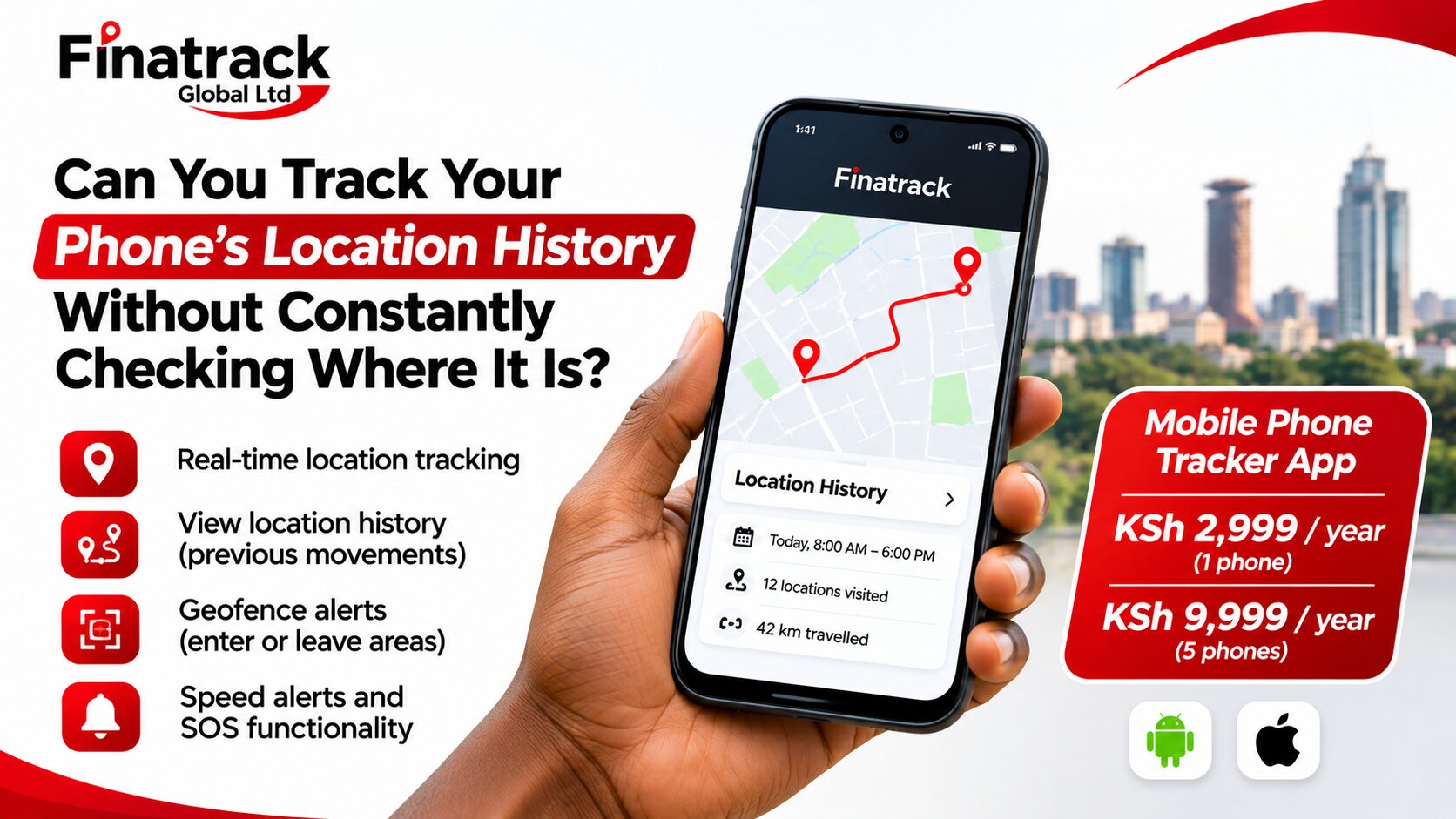
At Finatrack Global Ltd, our Mobile Phone Tracker App costs KSh 2,999 per year for one phone. For customers who need to monitor several authorised devices, we also offer a five-phone package at KSh 9,999 per year. These packages are suitable for individuals, families and businesses seeking location monitoring solutions for compatible Android and iPhone devices.
The Finatrack Mobile Phone Tracker App supports features including real-time location tracking, historical playback, geofence alerts, speed alerts and SOS functionality, subject to device compatibility, location permissions and network availability. Customers can consult our team to understand how the application is installed, configured and accessed through the monitoring platform.
For small businesses, the five-phone package may provide a practical starting point for coordinating a field team, while individuals who only need to monitor one authorised device can choose the annual single-phone subscription.
Is Mobile Phone Tracking Worth Investing In?
A mobile phone tracking application can be a useful investment for individuals and organisations that regularly require reliable location information for legitimate purposes. Businesses can use available location history to support field coordination, review work-related movements and improve operational planning. Families can benefit from voluntary location sharing when arranging travel or communicating during journeys.
However, tracking applications have limitations. Location information may be delayed, inaccurate or temporarily unavailable because of battery restrictions, network interruptions and environmental conditions. A tracking application also cannot establish precisely what an individual is doing simply because their phone has been detected at a particular location.
The greatest value comes from using the technology as a supporting tool rather than treating it as a replacement for communication, trust or professional management. When implemented responsibly, mobile phone tracking can reduce unnecessary calls, improve coordination and provide useful information for everyday decision-making.
Monitor Your Mobile Phone With Finatrack Global Ltd
Whether you manage employees working outside the office, coordinate family travel or want a convenient way to review your own phone’s location history, a mobile phone tracking application can provide greater visibility and convenience. With supported features such as live location monitoring, historical playback, geofencing and speed alerts, authorised users can access relevant location information without relying entirely on telephone calls.
Finatrack Global Ltd provides mobile phone tracking solutions designed for individuals, families and businesses across Kenya. Our application supports compatible Android and iPhone devices and offers location-monitoring features intended to improve coordination and provide useful information about recorded movements.
Our Mobile Phone Tracker App is available at KSh 2,999 per year for one phone, while our five-phone package costs KSh 9,999 per year. For enquiries, installation assistance or more information about our solutions, contact Finatrack Global Ltd on 0723 645 810 or visit our office at Vision Plaza, 1st Floor, Office 2, Mombasa Road, Nairobi. You can also explore our products and services at www.finatrack.co.ke.
Stop calling repeatedly just to confirm a location. With an appropriately configured mobile phone tracking solution, you can review available location information and coordinate activities more conveniently while respecting individual privacy.