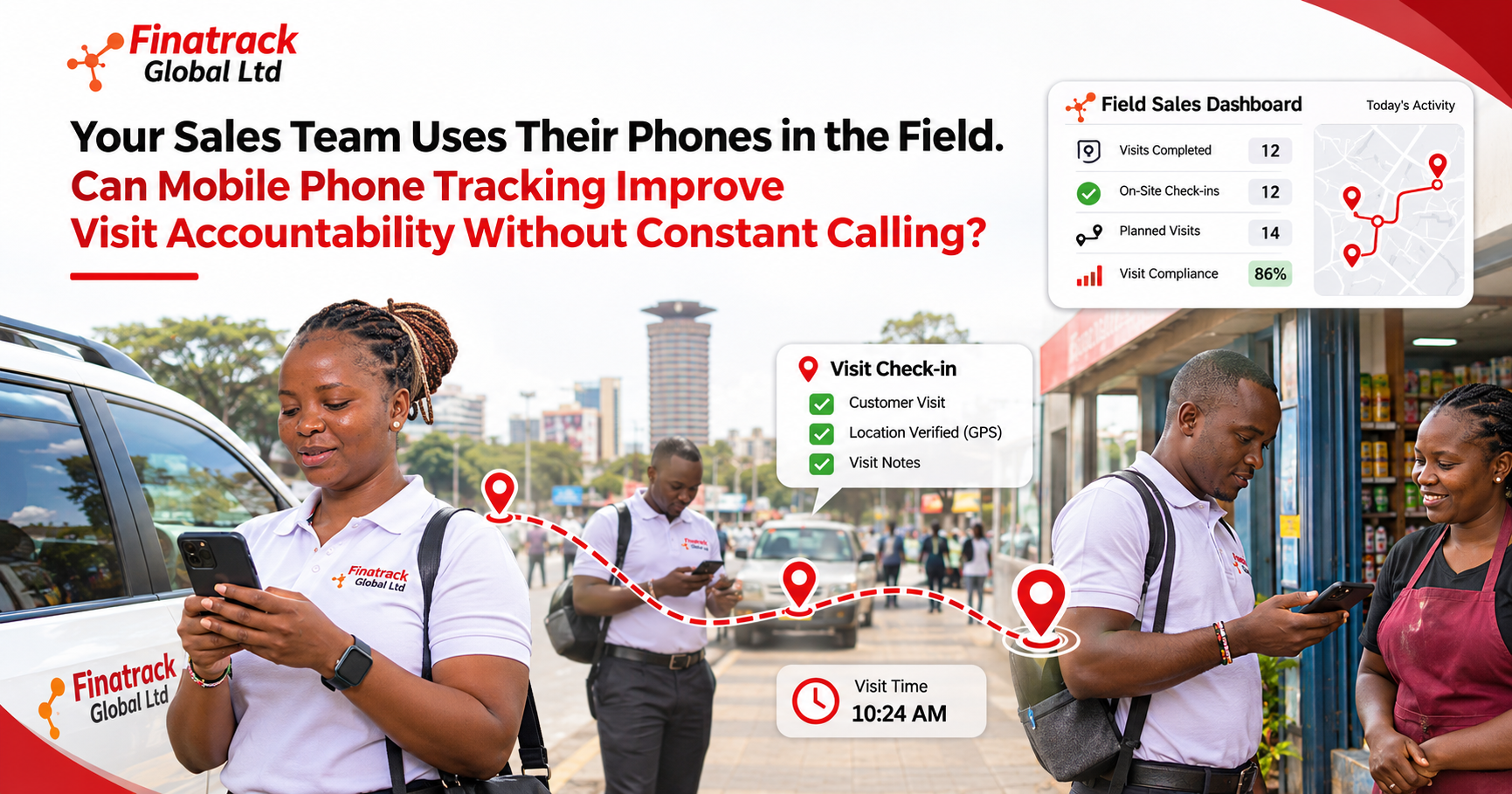
Managing a field sales team can quickly turn into a day of phone calls. A sales manager wants to know whether the representative reached Westlands, whether another salesperson visited a client in Industrial Area, whether the afternoon appointment in Kiambu happened and why somebody who left the office at 8:00 a.m. has submitted only two visit reports by the end of the day. The traditional response is to keep calling employees for updates, but this consumes management time and can make capable salespeople feel as though they are constantly being checked on.
Mobile phone tracking can provide another approach. When used responsibly, a smartphone can provide location information, historical movement records and geofence notifications that help a business understand whether field teams are reaching their assigned areas. The objective should not be to watch employees every minute of their lives. It should be to reduce unnecessary calls, improve visit accountability and give managers enough operational information to coordinate teams more efficiently.
The distinction matters because an employee’s phone can contain far more personal information than a company vehicle tracker. A vehicle normally represents a business asset whose movement can be directly connected to fleet operations. A smartphone may travel with the employee during lunch, after work and into private locations. Businesses considering employee phone tracking in Kenya therefore need to think about both operational efficiency and privacy before switching on continuous location monitoring.
The simplest business use case is field-visit verification. Imagine a company with eight sales representatives covering different parts of Nairobi. Every morning they receive a list of prospects and existing customers to visit. Without location information, the sales manager may depend almost entirely on employees reporting where they have been, which can create disputes when targets are missed or customer visits cannot be confirmed.
A mobile tracking application can create a more objective operational record. Historical playback can show the general movement of the tracked phone during the working period, allowing management to compare the day’s route with planned territories or customer locations. Instead of asking a salesperson to remember every movement at 5:00 p.m., the manager has a location record that can support the employee’s activity report.
That does not mean a location point proves that a sales meeting happened. A phone appearing at a client’s building does not establish that the customer was seen, that a presentation was made or that an order was discussed. GPS information should therefore be treated as supporting evidence rather than a substitute for customer relationship management records, sales notes or signed documentation.
The strongest workflow combines location information with a proper sales process. A salesperson arrives at a client’s premises, completes the meeting and records the outcome in the CRM or visit form. The tracking system provides a location and time context, while the sales record explains what actually happened. Together, those systems can create much better accountability than either one alone.
Geofencing can make the process even simpler. Instead of a manager constantly opening a map to watch employees move, the business can define important locations or operational areas. Depending on the tracking platform, notifications can be generated when the tracked phone enters or leaves a configured boundary.
A company could create geofences around major customer sites, branch offices, warehouses or assigned sales territories. When a representative reaches a particular customer location, the system can record the event without management needing to call and ask, “Have you arrived yet?” This can be particularly useful for supervisors managing several field employees at the same time.
Geofencing should still be designed intelligently. Creating an alert for every small location can generate so many notifications that managers eventually ignore them. A better approach is to identify the locations or boundaries that matter most to the business, such as major client appointments, distribution areas or branch visits.
Route history can also reveal whether territories have been designed efficiently. A salesperson may appear to be working hard while spending a large part of the day moving back and forth across Nairobi because appointments were scheduled poorly. The issue may not be employee performance at all; it may be route planning.
Suppose a representative travels from Mombasa Road to Westlands in the morning, returns to Industrial Area before lunch and then heads back toward Parklands in the afternoon. Each individual appointment may be legitimate, but the overall schedule wastes significant time in traffic. Historical movement can help management identify these inefficient patterns and group customer visits geographically.
This is where phone tracking changes from a security tool into a field productivity tool. Management is no longer asking only where an employee is. It is asking whether the day’s movement makes commercial sense.
The same principle applies to businesses with technicians, insurance advisers, loan officers, merchandisers, property agents and other staff who spend much of the working day outside the office. In all these roles, the employer may need a reasonable level of visibility over field operations without requiring employees to report their position every thirty minutes.
For sales teams, one of the largest benefits can simply be reducing management interruptions. A salesperson who is driving between appointments should not need to answer repeated calls asking where they are. A manager can review the operational platform when necessary and contact the employee only when something genuinely requires discussion.
This can also improve customer service. If a client calls asking when the representative is likely to arrive, the office may be able to understand the salesperson’s general progress without first calling the employee. The business can provide a better update while allowing the field representative to remain focused on driving or working with another client.
However, this is where responsible implementation becomes essential. In Kenya, location information is personal data. The Office of the Data Protection Commissioner specifically identifies location data as an example of information relating to an identifiable person, while the Data Protection Act requires personal information to be processed lawfully, fairly and transparently.
A business should therefore not quietly install tracking software on employees’ phones and assume that because the employees work for the company, anything is permitted. The Data Protection Act requires data to be collected for explicit, specified and legitimate purposes and to be limited to what is necessary for those purposes. Data subjects also have rights to be informed about how their information will be used.
For a field-sales programme, this means the organisation should be able to explain clearly why location information is being collected. A reasonable purpose might be confirming assigned business visits, coordinating field teams, improving employee safety or optimising sales territories. “We want to know everywhere employees go” would be a much harder purpose to justify because it is far broader than ordinary business operations require.
Employees should also understand when tracking takes place. If the organisation’s legitimate interest relates to field activity between 8:00 a.m. and 5:00 p.m., following a worker into private evening activities may be unnecessary and intrusive. The system design, policy and working procedures should therefore reflect the actual business need rather than collecting location information simply because the technology makes it possible.
The Data Protection Act recognises several potential lawful grounds for processing personal data, including consent, contractual necessity, legal obligations and legitimate interests where those interests are not outweighed by harm or prejudice to the individual’s rights and freedoms. Employers should identify an appropriate legal basis for their particular tracking programme rather than assuming consent is automatically the correct answer in every employment situation.
This is important because the relationship between an employer and employee can make consent more complicated than it initially appears. A worker may feel unable to refuse a request from the employer even when presented with a consent form. Businesses introducing systematic employee monitoring should therefore establish a clear compliance position and seek professional legal or data-protection advice where necessary.
Transparency remains one of the most practical safeguards. Before deploying mobile phone tracking, the organisation can issue a clear policy explaining what data is collected, the business purpose, who can access it, how long it will be retained and whether tracking applies outside working hours. Employees are much more likely to trust a system when they know exactly what it does.
The tracking data should also have limited internal access. A sales supervisor may need to view field activity, while an unrelated employee in another department has no reason to access colleagues’ location history. Access controls should follow business responsibilities rather than giving every administrator unrestricted visibility.
This follows the broader data-protection principle of collecting and processing only what is necessary. The ODPC states that personal data should be adequate, relevant and limited to the purpose for which it is processed, while retention should not continue longer than necessary. A business does not necessarily need to retain years of employee movement records merely because storage is inexpensive.
The organisation should decide in advance how long location history is genuinely useful. Operational records might be needed for a defined period to resolve customer-visit questions, review sales performance or investigate a particular incident. Once the information no longer serves the stated purpose, retention should be reviewed rather than allowed to continue indefinitely.
The Kenya Data Protection Act also requires organisations to consider stronger safeguards where processing is likely to create high risks to people’s rights and freedoms. In those situations, a data protection impact assessment may be required before processing begins. Businesses planning large-scale or particularly intrusive employee location monitoring should therefore assess privacy risks as seriously as they assess technical functionality.
This does not mean businesses should avoid useful technology. It means that tracking should be implemented deliberately. A well-designed system can improve accountability while respecting employee boundaries far better than informal practices where managers continuously call workers, demand live WhatsApp locations or ask staff to send photographs proving where they are.
In fact, an agreed business tracking system can sometimes be more structured and privacy-conscious than constant manual checking. Employees know which system records their field activity, management has defined access and the organisation can establish working-hour limits. The alternative may involve supervisors collecting location screenshots, WhatsApp messages and other information with no consistent retention or privacy policy.
Company-owned phones can simplify implementation because the organisation controls the equipment used for business. A field representative can be issued a work smartphone containing the required sales, communication and tracking applications. The phone is then clearly associated with business operations rather than the employee’s entire personal digital life.
Where employees use their own smartphones, the organisation should consider the privacy implications more carefully. A personal phone may remain with the employee around the clock and contain private communications, photographs, financial applications and family information. A location-tracking application should not create the impression that the employer has unrestricted access to the rest of the device.
Businesses should explain the actual scope of the technology. A legitimate location application does not automatically give the employer access to WhatsApp conversations, photographs, mobile-money balances or other unrelated phone content. Employees should understand what the application does and does not collect.
That clarity can reduce unnecessary fear. Workers sometimes hear the phrase “phone tracker” and assume management will be able to see everything happening on the device. In reality, a location-tracking solution can be designed specifically around GPS position, movement history, geofences and selected safety functions without giving the employer access to unrelated personal content.
Historical playback is one of the most useful features for field managers because it reduces the need to watch live movement. Management can review activity later when a genuine business question arises. If a representative says they covered five clients in Thika during the day, the route history can provide context without somebody having spent eight hours watching the employee move around a map.
This creates a healthier management approach. Tracking becomes a verification tool rather than entertainment for supervisors.
The system can also help settle disputes fairly. Suppose a customer complains that the salesperson never appeared for a scheduled appointment, while the employee says they arrived but the customer was unavailable. Location history may show that the phone reached the general customer location at the expected time.
That record does not prove exactly what happened inside the premises, but it can support further investigation. Management can combine it with phone logs, CRM notes or the customer’s account rather than automatically assuming one side is dishonest.
Location records can similarly protect employees from incorrect accusations. A company vehicle might be involved in an incident while management assumes a particular staff member was nearby. Phone-location history could provide additional context indicating that the employee was elsewhere, depending on the reliability and circumstances of the data.
This is another reason tracking data should not be viewed solely as a disciplinary tool. When used properly, objective records can protect employees as well as management.
Sales territory analysis is another valuable application. A manager may discover that several representatives repeatedly visit the same neighbourhood while another high-potential area receives very little attention. Mapping actual field movement against customer locations can reveal gaps that ordinary sales reports do not show.
The company can then redesign territories based on actual behaviour and opportunity. One salesperson may handle Upper Hill and Industrial Area, while another concentrates on Westlands and Parklands. Better territory allocation reduces unnecessary movement and can increase the number of productive customer interactions within the same working day.
The historical data can also reveal excessive travel between low-value prospects. If a sales representative spends four hours travelling to complete two small meetings, management may decide that some of those conversations should take place by phone or video while field time is reserved for higher-value opportunities.
This moves the discussion away from “Where is the employee?” toward the more important question: “Is the field operation generating sufficient value from the time and movement involved?”
Phone tracking can also support employee safety, particularly for staff who travel alone to unfamiliar locations. A salesperson attending meetings in remote areas may be able to use an SOS feature on a compatible application to send an alert when assistance is required. The exact response procedure should be defined beforehand so that an SOS signal reaches someone who knows what action to take.
A safety feature is useful only when the company has a response plan. Who receives the alert? Who calls the employee? When should security or emergency services be contacted? What happens if the employee cannot respond?
This type of planning can make location technology much more valuable than simply using it for performance monitoring. Employees are more likely to see the system as mutually beneficial when it also supports their wellbeing in the field.
Speed information can be another feature where employees drive while carrying the tracked phone, although businesses should be cautious about interpreting it. GPS speed information from a phone can provide context, but it is not necessarily equivalent to professionally calibrated enforcement equipment. It may help identify repeated patterns rather than serve as unquestionable proof of one isolated speeding event.
The same caution applies to every location record. Smartphone GPS accuracy can be affected by buildings, indoor environments, device settings and signal conditions. A salesperson standing inside a large commercial building may appear slightly away from the exact customer entrance.
Managers should therefore avoid creating excessively precise attendance rules such as declaring a visit false because the map marker was fifty metres from the customer’s office. Location data is most useful when interpreted together with operational context.
Battery management also matters. Continuous GPS tracking can increase power consumption depending on the application, phone and update settings. Employees should have access to chargers or power banks where field work requires prolonged smartphone use.
Permissions can affect tracking too. If the operating system restricts background location access, battery optimisation shuts down the app or the user disables location services, updates may become irregular. A good deployment should therefore include proper configuration and user training rather than assuming every missing point represents deliberate interference.
Connectivity should also be considered. Smartphones rely on cellular data to transmit information to the server, and mobile coverage can vary. An apparent gap in tracking may simply reflect a poor network area rather than an employee attempting to avoid monitoring.
For this reason, managers should look at patterns instead of immediately reacting to one missing update. Repeated unexplained outages during the same part of every working day may deserve investigation, while an occasional communication gap can be completely normal.
A business should also avoid turning location tracking into the only measure of sales productivity. A salesperson could spend the entire day moving between customers and still generate no meaningful opportunities. Another representative could spend two hours with one strategic customer and close a major contract.
Movement is activity, but activity is not automatically performance.
Sales management should therefore combine field location with commercial indicators such as qualified leads, proposals, follow-up activity, conversion rates, revenue and customer retention. Tracking can confirm that work is being carried out in the field, but it cannot replace good sales management.
The best systems use location information to remove uncertainty rather than micromanage employees. If a salesperson consistently meets targets, maintains accurate CRM records and covers the assigned territory effectively, there is little value in a manager analysing every stop made during the day.
Attention should focus on exceptions. Perhaps a customer visit cannot be reconciled, a representative repeatedly leaves the assigned territory without explanation or a large amount of field time is producing unusually little activity. These are situations where historical location information can help management ask better questions.
That approach creates a more mature workplace than treating every tracked coordinate as an opportunity for confrontation.
Finatrack Global Ltd provides a Mobile Phone Tracker App for Android and iPhone that can support real-time location viewing, historical playback, geofence alerts, speed information and SOS alerts depending on the configured service. The solution can be used by individuals, families and businesses that require location visibility without installing separate vehicle hardware.
The Finatrack Mobile Phone Tracker is available at KSh 2,999 per phone per year. Businesses or families that need several devices can track five phones under one account for KSh 9,999 per year, making it possible for a supervisor to manage several authorised phones from a central platform.
For a sales organisation, the strongest use is not simply watching dots move across a map. The greater value comes from reducing constant phone calls, verifying field coverage, improving territory planning, supporting employee safety and creating better historical records when customer-visit questions arise.
Any business using the system for employees should still implement it with clear policies and appropriate data-protection safeguards. Kenya’s ODPC confirms that location data is personal information, while the Data Protection Act requires transparency, purpose limitation, data minimisation, appropriate retention and respect for the rights of data subjects. The technology should therefore support legitimate business management rather than become uncontrolled surveillance.
For Mobile Phone Tracker enquiries and setup, call or WhatsApp 0723 645 810 or visit www.finatrack.co.ke.
A field manager should not need to spend the entire day asking employees, “Where are you now?” A properly implemented mobile tracking system can answer enough operational questions that managers are free to concentrate on coaching, customers and sales results. The most effective approach is not to track employees more aggressively, but to use location information intelligently, transparently and only where it genuinely improves the business.