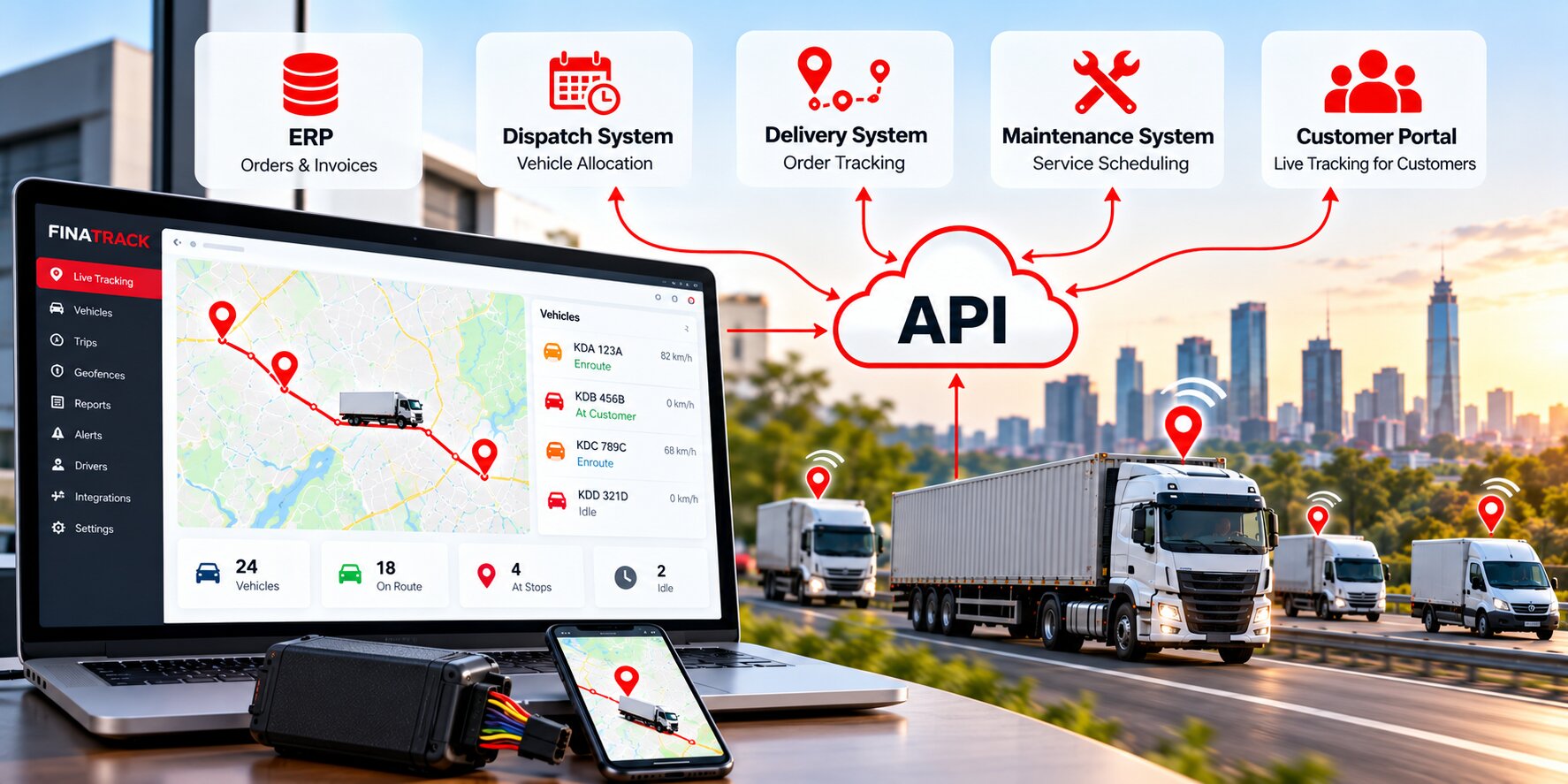
A company may have an excellent GPS tracking system and still waste hours every day moving information manually between different applications. The dispatcher checks one platform to see where the vehicles are, the sales team uses another system to manage customer orders, finance works from an ERP, while delivery staff update yet another application when jobs are completed. For Kenyan businesses operating growing fleets, GPS tracking API integration can help turn vehicle location data from an isolated tracking tool into information that automatically supports dispatch, customer service, delivery management and wider business operations.
This matters because modern fleet management increasingly involves more than knowing where a vehicle is. Businesses want to know whether a delivery vehicle has reached the customer, whether a technician is approaching the next job, whether a truck has left the warehouse, how long a vehicle remained at a delivery location and whether an order can automatically change status when the assigned vehicle arrives. These workflows become far easier when the tracking platform can exchange information with other business systems instead of requiring an employee to copy it manually.
The subject is particularly timely in Kenya. In August 2026, government discussions around the country’s growing telematics sector highlighted interoperability, secure data use, cybersecurity and connected digital transport systems as important areas for the industry’s development. The broader direction is toward vehicles, devices, cloud platforms and business applications exchanging information rather than operating independently.
An API, or Application Programming Interface, is one of the main technologies used to make this possible. An API provides a controlled method through which one software system can request information from another or, where permissions allow, send information back. Instead of an employee opening the GPS tracking website and manually reading a vehicle’s location, another authorised business application can potentially request that information programmatically.
Imagine a distributor with twenty delivery vehicles. Its ERP already knows which customer placed an order, the products being delivered, the invoice number and the driver assigned to the job. The GPS platform knows where the vehicle is and how it is moving. If the two systems are properly integrated, the business can potentially connect those records so that operational staff see both the commercial order and the vehicle responsible for fulfilling it.
A simple integration could allow the dispatch system to display the latest vehicle location directly inside the company’s existing dashboard. Staff would no longer need to keep two browser tabs open and manually match registration numbers between systems. More advanced implementations could retrieve trip history, drivers, geofences, maintenance information, analytics and other telematics data depending on what the tracking platform exposes.
Modern telematics platforms demonstrate how extensive these integrations can become. Wialon’s current platform API, for example, supports programmatic access to areas including devices, trips, drivers, geofences, maintenance, analytics and video depending on permissions and enabled modules. Its API uses dedicated keys and permission controls so an external system can be given only the level of access it requires.
This is important because integration should not mean giving another application unrestricted access to the entire fleet account. A customer tracking portal may only need permission to view the location of one delivery vehicle for a limited period. The accounting system may need mileage information but have no reason to access driver-facing dashcam footage. Good API design allows businesses to separate these responsibilities.
Delivery operations provide one of the clearest use cases. Suppose an order leaves a warehouse in Nairobi for a customer in Thika. The dispatch system can record the order as “in transit,” while GPS information provides the vehicle’s location. When the vehicle enters a predefined geofence around the customer’s premises, an integration could potentially trigger another workflow such as notifying the customer that the delivery vehicle has arrived.
The important word is potentially, because the exact automation depends on the capabilities of the tracking platform, business software and integration built between them. A GPS tracker by itself does not automatically update an ERP. The business needs software capable of receiving the tracking information, matching the vehicle to the correct job and deciding what should happen when a particular event occurs.
This distinction prevents unrealistic expectations. Installing a GPS tracker gives the business valuable telematics data, but connecting that information to an order management or enterprise system usually requires additional technical work. The integration may involve an API, webhooks, data streaming, scheduled synchronisation or another mechanism supported by the platforms involved.
GPS platforms can also provide real-time data streams to other systems. Wialon’s current connectivity architecture, for example, allows raw device information received from tracking hardware to be forwarded to third-party systems in real time. This means businesses with specialised software can use telematics data outside the original monitoring interface rather than being permanently locked into viewing it in one dashboard.
For a large logistics company, this could mean vehicle data feeding directly into a transport management system. The transport system already knows the customer, cargo, route, delivery deadline and assigned driver. GPS information adds the vehicle’s actual movement. Together, these datasets can give operations staff a much more useful picture than either system provides separately.
Customer communication is another strong use case. Many businesses repeatedly receive calls asking, “Where is my delivery?” Staff then call the driver or open the GPS platform, check the vehicle and respond manually. A well-designed integration can reduce this administrative workload by allowing customers to receive controlled tracking information, automated arrival notifications or estimated progress through the company’s existing customer portal.
This does not mean giving every customer unrestricted access to the fleet map. That could expose information about other clients, drivers or company operations. Instead, a business can design the integration to expose only the information relevant to a particular order. Once the delivery is completed, the customer tracking link or access permission can expire.
Field-service businesses can benefit in a similar way. Consider a company that sends technicians to install equipment, repair machinery or provide on-site services. The service management system knows which jobs are waiting and where the customers are located. GPS tracking knows where the service vehicles currently are. Connecting the two can help dispatchers identify which technician is reasonably positioned to respond to the next job.
This can reduce the familiar process of calling several employees asking, “Where are you now?” The dispatcher can instead use fleet location as one input when allocating work. The closest vehicle is not always the correct vehicle because skills, tools and workload also matter, but integrating GPS information gives the dispatch system another valuable variable for making the decision.
Courier and e-commerce companies can go even further. An order can move through several stages including received, packed, dispatched, approaching customer and delivered. GPS information cannot prove every one of these stages by itself, but it can help automate parts of the process. A vehicle leaving a warehouse geofence may support a “dispatched” event, while entry into the customer’s delivery zone may indicate arrival.
Businesses should still avoid confusing vehicle presence with proof of delivery. A GPS record can show that the vehicle reached a particular location and remained there for a period, but it does not necessarily prove that the correct package was handed to the correct customer. A reliable delivery system should combine location data with supporting information such as signatures, photographs, delivery confirmation codes or electronic proof-of-delivery records.
This is where integration becomes particularly powerful. Instead of treating GPS and proof of delivery as competing technologies, the business can combine them. The system can record that Vehicle 12 entered the customer’s geofence at 10:32 a.m., the driver’s delivery application recorded a signed confirmation at 10:39 a.m., and the vehicle departed at 10:46 a.m. Together, these records create a much stronger operational history.
Fleet information can also flow into ERP and accounting processes. A company may want to allocate vehicle operating costs to particular departments, projects or customers. Trip distance, vehicle usage and fuel information can potentially be matched with work orders or cost centres. This can help management understand which contracts are consuming the most transport resources.
Construction companies provide a good example. A contractor may operate pickups, trucks and machinery across several project sites. The ERP records project budgets, procurement and labour costs, while the tracking system records vehicle activity. If usage information can be connected with the relevant project, transport expenditure can be analysed more accurately rather than being treated as one general fleet cost.
Vehicle maintenance can also benefit from integration. The tracking system may provide mileage or engine-hour information depending on the equipment installed, while a maintenance platform manages service schedules, workshop jobs and parts. Connecting the two can allow service planning to be based on actual vehicle usage instead of requiring somebody to manually update odometer readings.
Wialon’s ecosystem, for example, documents APIs not only for tracking but also for logistics and fleet-maintenance applications, illustrating how telematics platforms can support integrations involving orders, routing and servicing. The wider principle is that fleet data becomes more valuable when it can participate in the company’s other operational workflows.
Integration can also reduce duplicate data entry. Without integration, a fleet manager might create Vehicle KDA 123A in the tracking system, then create the same vehicle again in an ERP, maintenance application and dispatch platform. Changes may then need to be made separately in every system. This increases the risk of inconsistent registration numbers, driver names and asset records.
A connected architecture can establish one system as the main source for certain information. The ERP might remain the master record for customers and jobs, while the telematics platform remains the source for vehicle location and trips. The systems exchange only the information they need. This is usually more reliable than trying to make every platform store and manage everything.
Security becomes critical once these systems are connected. An API key or token can potentially provide access to valuable fleet information, so it should be treated like a sensitive credential. It should not be pasted into public website code, shared casually between employees or stored in an unsecured document. Platforms increasingly provide scoped API permissions precisely so integrations can be limited to the minimum access required.
Wialon’s current API model, for example, allows keys to be assigned specific permissions, including read-only access to particular fleet resources rather than unrestricted account control. Teltonika likewise uses API keys or tokens for several of its connected platforms, demonstrating the importance of controlled authentication when telematics systems interact programmatically with outside applications.
This principle is especially important where remote vehicle commands are involved. Reading vehicle location is one thing; allowing an external application to issue commands is considerably more sensitive. If a platform supports functions such as remote immobilisation, command permissions should be tightly controlled and should never be casually exposed through an integration simply because an API makes it technically possible.
Businesses should therefore divide API functions according to risk. A customer portal may require read-only location access. An internal fleet dashboard may need trip and fuel data. Only specially authorised systems and personnel should have access to sensitive vehicle commands. Integration architecture should follow operational responsibilities rather than convenience.
Data protection also deserves attention. GPS records can reveal employee movements, customer locations, business routes and operating patterns. When fleet data is transferred into another platform, the organisation should understand where that information is stored, who can access it and how long it is retained. Connecting two systems does not remove the business’s responsibility to manage data appropriately.
The technical architecture should also plan for system outages. If the ERP becomes unavailable, the GPS platform should not necessarily stop tracking vehicles. Likewise, a temporary tracking-platform outage should not bring the entire company’s sales or accounting system to a halt. Good integrations are designed so that one system can recover gracefully when another becomes temporarily unavailable.
This may involve storing events in a queue and synchronising them later. For example, if a delivery vehicle reaches a customer while the ERP is unavailable, the integration may record the event and submit it once the ERP comes back online. Without this type of resilience, integration can actually make operations more fragile rather than more efficient.
The company must also decide how frequently information needs to move between platforms. Some workflows require near-real-time information, while others do not. A dispatch screen may benefit from frequently updated location information, but a monthly mileage report does not need to request new data every few seconds. Excessively aggressive API polling can create unnecessary load and cost.
Businesses should therefore match data frequency to the business decision. Customer arrival alerts need timely geofence events. Payroll or cost-allocation reports may only need daily summaries. Maintenance mileage could be synchronised periodically. Designing everything as a real-time workflow simply because it is technically possible can make a system more complex than necessary.
Another issue is vehicle identity. The ERP may recognise a vehicle by registration number while the telematics platform recognises it by device ID, IMEI or an internal unit number. The integration needs a reliable mapping between these identities. If that mapping is incorrect, information from one vehicle could potentially be associated with another asset.
Driver identity creates the same challenge. If several drivers share a vehicle, the business needs a clear method of knowing who was using the vehicle during each trip if driver-level reporting is required. This might involve driver assignment, login, identification tags or another method depending on the fleet system.
The strongest integrations are usually designed around specific business questions rather than technology for its own sake. “We want an API” is not a sufficiently clear requirement. A better requirement would be: “When a delivery vehicle enters the customer’s geofence, we want our order system to notify the customer automatically.”
Another useful requirement might be: “Every night, we want each vehicle’s daily mileage imported into our maintenance system.” A third could be: “We want our dispatch team to see the latest locations of all service vehicles directly inside our existing operations dashboard.” These clearly defined outcomes make it easier to determine whether API integration is justified and how it should work.
Small businesses do not necessarily need complicated integrations from the beginning. A company with three vehicles may manage perfectly well using the normal GPS platform. As the fleet and number of daily transactions grow, however, manually moving information between systems becomes increasingly expensive. Integration often becomes valuable when employees spend significant time repeatedly performing the same data-transfer tasks.
Large fleets have even stronger reasons to consider integration. A business managing 100 vehicles, hundreds of daily deliveries and multiple depots can generate thousands of vehicle events. Nobody should have to manually copy each location, mileage figure or arrival time into another platform. Automation allows staff to focus on exceptions requiring human judgement.
Interoperability is likely to become increasingly important as Kenya’s telematics market develops. Government discussions in 2026 have already identified interoperability as part of the policy direction for connected fleets and the wider intelligent transport ecosystem. For businesses, this means the ability of telematics systems to communicate with other digital platforms should increasingly form part of technology purchasing decisions.
When choosing a fleet-management provider, companies can therefore ask several practical questions. Does the tracking platform offer an API? What information can it expose? Can permissions be restricted? Is historical trip data available? Can geofence events be delivered automatically? Can device data be streamed to another system? Are there limits on the number of requests? What technical documentation is provided?
Businesses should also ask who will maintain the integration after it has been developed. APIs can change, business processes evolve and new vehicles or drivers are added. An integration should therefore be treated as an operational system that requires documentation, security controls and ongoing maintenance rather than a one-time programming project.
Finatrack Global Ltd provides GPS tracking, fleet management, fuel monitoring and AI dashcam solutions for private and commercial fleets in Kenya. Finatrack’s wired GPS tracker is available at KES 15,000, providing location, trip history, geofencing and other fleet information depending on the configured solution. Businesses with ERP, dispatch, delivery or customer-portal integration requirements can first define the information and workflows they need and assess the compatibility of the relevant telematics platform and business software.
For professional installation and enquiries, call or WhatsApp 0723 645 810 or visit www.finatrack.co.ke. A GPS tracking system should not necessarily remain a separate screen that employees open only when they want to find a vehicle. When the underlying platform supports secure integration, telematics information can become part of the wider business workflow, connecting vehicles with orders, deliveries, maintenance, customer service and management reporting. The real objective is not simply to connect software systems; it is to make fleet information reach the right person and trigger the right business action without somebody having to manually move the data every time.