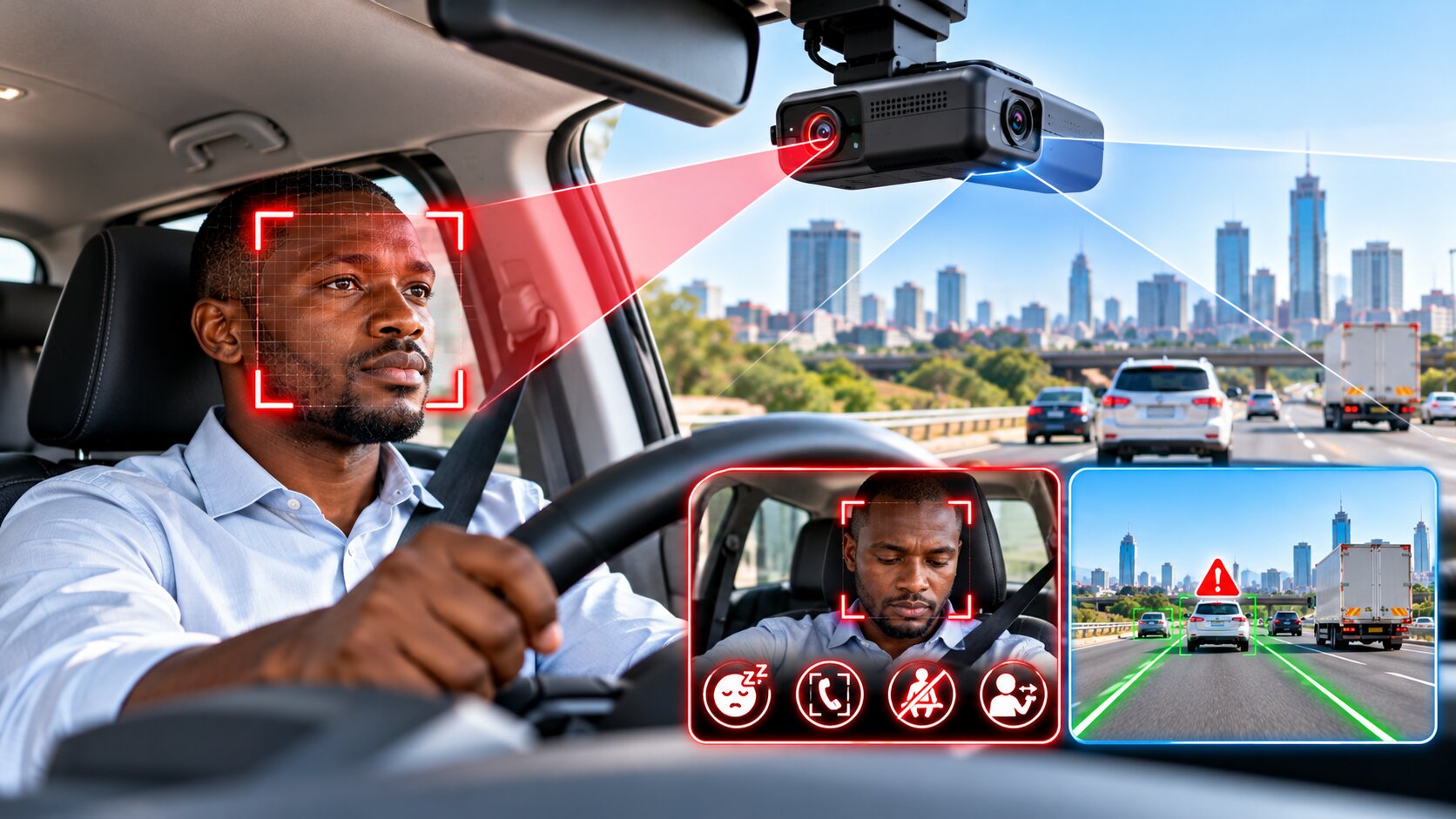
Installing an AI dashcam is only the first step toward effective driver monitoring. The camera may power on correctly, record video and appear normal on the monitoring platform, yet still struggle to detect fatigue or distraction accurately if the driver-facing lens is poorly positioned. For businesses using AI dashcams in Kenya, camera alignment can have a major influence on the quality of Driver Monitoring System alerts and the usefulness of recorded footage.
A Driver Monitoring System, commonly referred to as DMS, is designed to observe selected driver behaviours through a camera facing the person behind the wheel. Depending on the equipment and configuration, the system may identify signs associated with distraction, prolonged eye closure, mobile-phone use or other behaviours that require the driver’s attention to be monitored. For the technology to work properly, however, the camera needs a clear and consistent view of the driver’s face.
A camera mounted too high, too low or too far to one side may capture only part of the driver’s face. The system may see the forehead but not the eyes, or it may capture the driver’s profile instead of a usable frontal view. This can reduce the quality of the information available to the AI system and may result in missed events or unnecessary warnings.
The problem can become more noticeable when different drivers use the same vehicle. One driver may be tall and sit close to the steering wheel, while another may be shorter and position the seat farther back. If the camera is installed with only one seating position in mind, its view may become less effective when somebody else drives the vehicle. Fleet installations should therefore consider the range of normal seating positions likely to be used.
The steering wheel can also interfere with the camera’s field of view. In some vehicles, the wheel, dashboard or another interior component may partially block the driver’s face depending on the mounting position. A professional installer should check the actual view from the camera rather than assuming that a location is suitable simply because the device physically fits there.
Sun visors, dashboard accessories and hanging objects can create similar problems. Drivers sometimes add phone holders, decorative items or other accessories after the dashcam has been installed. An accessory placed directly in front of the driver-monitoring camera can reduce visibility or change how the system interprets the scene. Businesses operating shared vehicles should therefore include the camera area in routine vehicle checks.
Lighting is another factor. During the day, direct sunlight may create strong shadows across the driver’s face, while at night the interior becomes much darker. Many driver-monitoring systems are designed to work across changing light conditions, but camera quality and positioning still matter. A lens pointed toward a reflective surface or positioned where dashboard lights create glare may produce less useful footage than one installed with the operating environment in mind.
The camera lens itself should remain clean. Dust, fingerprints, grease or condensation can gradually reduce image clarity without making the device appear completely faulty. A driver-monitoring system may still produce video, but the quality available to the AI can deteriorate. Fleet managers should periodically inspect the lens and ensure it has not been covered, moved or damaged.
An incorrectly positioned camera may create false or excessive alerts. A fleet manager might receive repeated distraction notifications even though the driver appears attentive when the footage is reviewed. Before concluding that the technology is unreliable or the driver is repeatedly at fault, the camera angle should be checked. If the system cannot consistently see the driver’s eyes and face, its interpretation of behaviour may become less dependable.
The opposite problem can also occur. A poorly aligned camera may fail to produce alerts when a driver is genuinely distracted because the relevant movement occurs outside the camera’s usable view. This can create a false sense of security. A business may believe its drivers are being monitored effectively when the system is actually working with incomplete visual information.
This is why the installation process should include verification, not simply mounting the camera and connecting power. After installation, the technician should confirm the driver-facing image from the actual monitoring platform. The driver should sit in a normal driving position, and the installer should verify that the important facial area remains visible without requiring the driver to sit unnaturally.
The road-facing camera requires similar attention. ADAS features depend on the system having a useful view of the road ahead. If the camera is angled too far toward the sky, dashboard or one side of the road, lane and forward-risk information may be less reliable. Proper installation therefore involves balancing the road-facing and driver-facing views rather than treating the dashcam as an ordinary recording camera.
Windshield position can make a significant difference. A camera installed behind an area of heavy tint, stickers or visual obstruction may produce poorer footage. Likewise, placing the camera where windscreen wipers do not clear rain effectively can reduce road visibility during wet conditions. The best mounting location should support the system’s visibility while remaining safe and unobtrusive for the driver.
Fleet managers should also check the installation after windscreen replacement or major workshop work. A dashcam that was properly aligned before a windscreen change may be reinstalled at a slightly different angle. Even a relatively small change can affect the camera’s view. The system should therefore be checked again whenever it has been removed or physically disturbed.
Dashcam footage can help determine whether alignment is correct. If recorded clips repeatedly show only part of the driver’s head, excessive dashboard area or an off-centre road view, the installation should be adjusted. Fleet managers do not need to wait for the system to generate multiple inaccurate alerts before investigating something that is clearly visible in the footage.
Businesses should also avoid treating every AI alert as unquestionable proof of poor driving. AI dashcams are decision-support tools, and alerts should be reviewed together with video and operational context. Camera position, lighting, road conditions and driver movement can all influence what the system detects. The strongest fleet-management approach combines technology with human review and sensible operating policies.
Training drivers can also improve the effectiveness of the system. Employees should understand what the camera is monitoring, why the business is using it and why covering or repositioning the device can affect safety information. Where company policy allows, drivers should also know how to report a camera that has shifted or appears to be producing unusual alerts.
For businesses operating trucks, buses, vans or other vehicles with large cabins, installation becomes even more important because the distance between the camera and driver may vary significantly. A mounting location that works in a compact car may not be appropriate in a large commercial truck. Each installation should therefore be considered according to the vehicle interior rather than applying exactly the same position to every vehicle in the fleet.
Finatrack Global Ltd provides professionally installed AI dashcam solutions with DMS and ADAS capabilities for private vehicles and commercial fleets in Kenya. Finatrack’s AI Dashcam is available at KES 35,000, with professional installation intended to give the road-facing and driver-facing cameras an appropriate operating view. Businesses can also combine AI dashcams with GPS tracking and fleet-management solutions for broader visibility over vehicle movement and driver behaviour.
For enquiries and installation, call or WhatsApp 0723 645 810 or visit www.finatrack.co.ke. An AI dashcam may contain advanced technology, but the quality of the information it produces still begins with something very simple: can the camera clearly see what it is supposed to monitor? Proper positioning, clean lenses and periodic alignment checks can make the difference between a camera that is merely installed and a system that provides genuinely useful fleet-safety information.