Running a driving school in Kenya involves more than teaching learners how to operate a vehicle and preparing them for their driving tests. Behind every successful training session is a business that must manage vehicles, instructors, fuel expenses, lesson schedules and maintenance requirements. A driving school with several training cars may have vehicles operating across different parts of Nairobi throughout the day, making it difficult for management to know how each car is being used. While most schools maintain lesson schedules and instructor records, these documents do not always provide a complete picture of actual vehicle movements.
For driving school owners, every training vehicle represents a significant investment that must generate sufficient revenue to cover its operating expenses. Fuel, insurance, tyres, repairs and servicing can gradually reduce profitability, particularly when vehicles accumulate unnecessary mileage or remain in operation beyond scheduled training hours. GPS tracking technology provides an additional way to monitor training cars, review their movements and improve operational accountability. Although a tracking device cannot assess the quality of driving instruction, it can provide useful information that helps school managers organise their fleets more efficiently.
Why Driving Schools Need Better Visibility Over Their Vehicles
Unlike ordinary private cars, driving school vehicles are frequently operated by different learners under the supervision of instructors. A single vehicle may be used for several practical lessons in one day, travelling through residential neighbourhoods, busy commercial areas and designated training routes. The frequent changes in drivers, routes and operating conditions make these vehicles relatively demanding to manage.
Consider a driving school with five training cars operating around Nairobi. One vehicle may be conducting lessons in South B, another in Kasarani, while others are covering Thika Road, Ngong Road and nearby residential areas. Each instructor has a schedule, but the school owner may not have an easy way of confirming where the vehicles are located or how far they have travelled during the day.
Without an independent monitoring system, management may rely on instructor reports, manual logbooks and occasional telephone calls to understand vehicle movements. These methods can work for smaller operations, but they become less convenient as the number of instructors and vehicles increases.
A GPS tracking system allows an authorised manager to review the reported locations of training vehicles through a connected platform. Instead of contacting every instructor to establish where a vehicle is operating, management can access available location information and identify which cars are nearby when scheduling adjustments become necessary.
This visibility is particularly useful for schools operating several branches or managing vehicles that begin and end their lessons at different locations. It also provides information that can assist with investigating unexpected vehicle movements.
How GPS Tracking Can Help Verify Driving Lesson Routes
Practical driving lessons normally involve travelling along different types of roads to help learners develop confidence and experience. Depending on their level of training, students may practise basic vehicle control, turning, parking, junction navigation and driving in traffic under an instructor’s supervision.
For a driving school owner, understanding where training vehicles travel can be useful when reviewing lesson planning and instructor operations. A GPS tracker with historical route playback can record available vehicle movements, allowing authorised managers to examine the routes travelled during selected periods.
For example, an instructor may be assigned to conduct a two-hour driving lesson around a designated training area in Nairobi. After the lesson, the school’s management can review the recorded route to understand where the training vehicle travelled and whether its movements were broadly consistent with the scheduled activity.
This information may help identify repeated use of unsuitable routes, unnecessary travel between training locations or difficulties coordinating lessons across different areas. It can also support decisions about which routes are practical for learners at different stages of their training.
However, GPS tracking cannot independently establish whether a student received adequate instruction. A vehicle may travel along the expected route without the learner necessarily receiving meaningful training. Location records should therefore complement instructor supervision, student feedback and formal lesson records rather than replace them.
For schools seeking to improve training standards, route visibility is most valuable when combined with clear lesson objectives and regular assessment of instructional quality.
Can GPS Tracking Help Reduce Fuel and Unnecessary Mileage?
Fuel is a recurring expense for driving schools because training vehicles spend considerable time on the road. Unlike vehicles travelling directly between two destinations, training cars may repeatedly practise manoeuvres, make several stops and operate in slow-moving traffic. These activities can increase fuel consumption relative to the distance travelled.
Driving school owners must therefore distinguish between fuel used for legitimate practical training and consumption resulting from unnecessary vehicle movements. A car that covers additional kilometres outside scheduled lessons creates expenses without necessarily generating additional revenue.
Imagine a driving school operating six training vehicles, each covering an average of 80 kilometres daily. If poor scheduling or unnecessary movements add another 15 kilometres to each vehicle’s daily distance, the fleet accumulates 90 additional kilometres every day. Over 26 working days, this amounts to 2,340 kilometres of extra travel.
If the vehicles average 12 kilometres per litre, those additional journeys would consume approximately 195 litres of fuel. At an illustrative petrol price of KSh 180 per litre, the additional fuel expense would be KSh 35,100. These figures are hypothetical, but they demonstrate how avoidable mileage can affect a driving school’s operating budget.
GPS tracking can provide recorded journey information that helps management identify unexpected movements and assess whether training schedules can be organised more efficiently. However, the objective should not be to shorten necessary lessons or discourage instructors from spending adequate time teaching learners.
The greatest benefit comes from reducing travel that does not contribute to training, such as unnecessary trips between branches, inefficient vehicle allocation or unauthorised personal journeys.
Improving Instructor Accountability Without Constant Supervision
Driving school instructors play an important role in developing responsible motorists, but their work often takes place away from direct management supervision. Once an instructor leaves the training centre with a learner, the school owner may have limited visibility over the vehicle until it returns.
This can create operational challenges when lessons are delayed, schedules change or vehicles are used outside agreed arrangements. A school owner may receive conflicting explanations about where a training car was operating or why it returned later than expected.
A GPS tracking system provides additional information that can help management review vehicle movements and clarify operational questions. For example, if a vehicle scheduled to return at midday remains away from the training centre, management can review its available location information before contacting the instructor for an update.
The same information can support decisions about allocating vehicles for subsequent lessons. When a training car is running behind schedule, administrators may be able to make alternative arrangements rather than leaving students waiting without information.
However, monitoring should be introduced transparently. Instructors should know that company vehicles are fitted with GPS tracking devices and understand how the recorded information may be used. Because vehicle location records can be associated with identifiable employees and learners, driving schools should apply appropriate privacy and data protection safeguards.
The purpose of GPS tracking should be to improve vehicle accountability and operational coordination rather than create unnecessary surveillance of instructors. Management should also recognise that traffic delays, learner difficulties and unexpected road conditions can affect lesson durations for legitimate reasons.
Why Mileage Monitoring Matters for Driving School Vehicle Maintenance
Driving school vehicles often experience demanding operating conditions because they are used repeatedly by learners who are still developing driving skills. Frequent braking, clutch operation, low-speed manoeuvres and repeated starting and stopping can contribute to wear on certain components.
As a result, maintaining training vehicles requires careful attention to servicing schedules, tyres, brakes, clutch systems and other safety-related components. A mechanical problem that might be inconvenient for a private motorist can create significant disruption for a driving school because an unavailable training car may lead to cancelled lessons and dissatisfied students.
Mileage information can assist with maintenance planning by helping managers estimate how extensively each vehicle has been used. Where supported, GPS tracking systems provide journey-distance records that can be reviewed alongside vehicle odometer readings and servicing information.
For example, a training car that covers relatively high mileage every week may reach its next scheduled service sooner than a vehicle used less frequently. Without consistent records, management may overlook the accumulated distance and delay essential maintenance.
GPS-derived mileage is not always identical to the vehicle’s odometer reading, particularly where tracking updates are interrupted or positioning inaccuracies occur. Nevertheless, it can provide additional information that supports servicing decisions.
For driving schools, combining movement records with physical inspections and proper maintenance documentation can help improve vehicle availability and reduce unexpected interruptions to training schedules.
How GPS Tracking Can Improve Lesson Scheduling and Vehicle Allocation
One of the common challenges faced by growing driving schools is coordinating instructors, students and training vehicles. A school may have sufficient demand for lessons but still experience scheduling problems because the available vehicles are not positioned where they are needed.
For example, a driving school operating branches in Nairobi’s CBD and Embakasi may need to transfer a training vehicle between locations to accommodate additional learners. Without reliable information about current vehicle positions, administrators may spend time calling instructors before deciding which car should handle the next assignment.
With GPS tracking, authorised staff can review available vehicle locations and make more informed allocation decisions. A nearby training car that has completed its scheduled lesson may be assigned to another appropriate session, subject to instructor availability and the school’s training requirements.
Historical movement records can also help school owners understand how vehicles are distributed across different operating areas. If some cars consistently cover excessive distances between lessons, the business may need to review its scheduling arrangements or adjust where vehicles begin their daily activities.
Better coordination can reduce unnecessary travel and improve customer experience by helping driving schools manage appointments more consistently. However, GPS tracking should be treated as a supporting tool rather than a complete driving school management system. Student bookings, instructor qualifications, training progress and administrative records still require appropriate management processes.
Can GPS Tracking Improve the Security of Driving School Cars?
Training vehicles are valuable business assets, and their security deserves attention when they are parked outside operating hours or left at different locations. A driving school may own several cars, making it difficult for management to physically confirm that every vehicle remains at its designated parking location.
GPS tracking provides additional security capabilities through location monitoring and supported movement notifications. Where compatible features are available, school owners can configure geofence boundaries around training centres or parking areas and receive notifications when vehicles leave those locations.
For example, a driving school may park its vehicles at a designated compound in Nairobi after the final training session. If a car moves outside the configured boundary during the night, a functioning GPS tracking system may generate an alert, allowing an authorised manager to investigate.
Some wired GPS trackers also support ignition notifications and remote engine immobilisation when installed with compatible equipment. However, immobilisation must be implemented with appropriate safety controls and should never be used to stop a vehicle dangerously while it is moving.
GPS tracking does not guarantee theft prevention or recovery, but it provides information that may assist with identifying unusual movements and responding to suspected security incidents.
For driving school owners, the same device used to monitor lesson routes can therefore provide additional vehicle security benefits outside training hours.
Choosing the Right GPS Tracking System for a Driving School in Kenya
Before installing GPS trackers, driving school owners should identify the operational problems they want to address. A business primarily concerned about unexpected vehicle movements may prioritise location monitoring and security alerts, while one seeking better fleet coordination may place greater emphasis on historical routes and mileage information.
A suitable wired GPS tracker can support regular vehicle monitoring without the battery maintenance requirements associated with many portable tracking devices. Because driving school cars are used frequently, professional installation and reliable communication are important considerations.
Owners should also understand that GPS tracking is a business management tool rather than a substitute for compliance with driving school regulations. Driving schools in Kenya operate within a licensing framework overseen by the National Transport and Safety Authority, and training must be conducted according to applicable regulatory requirements. Installing GPS tracking does not replace the need for properly licensed instructors, suitable training vehicles or approved driving instruction procedures.
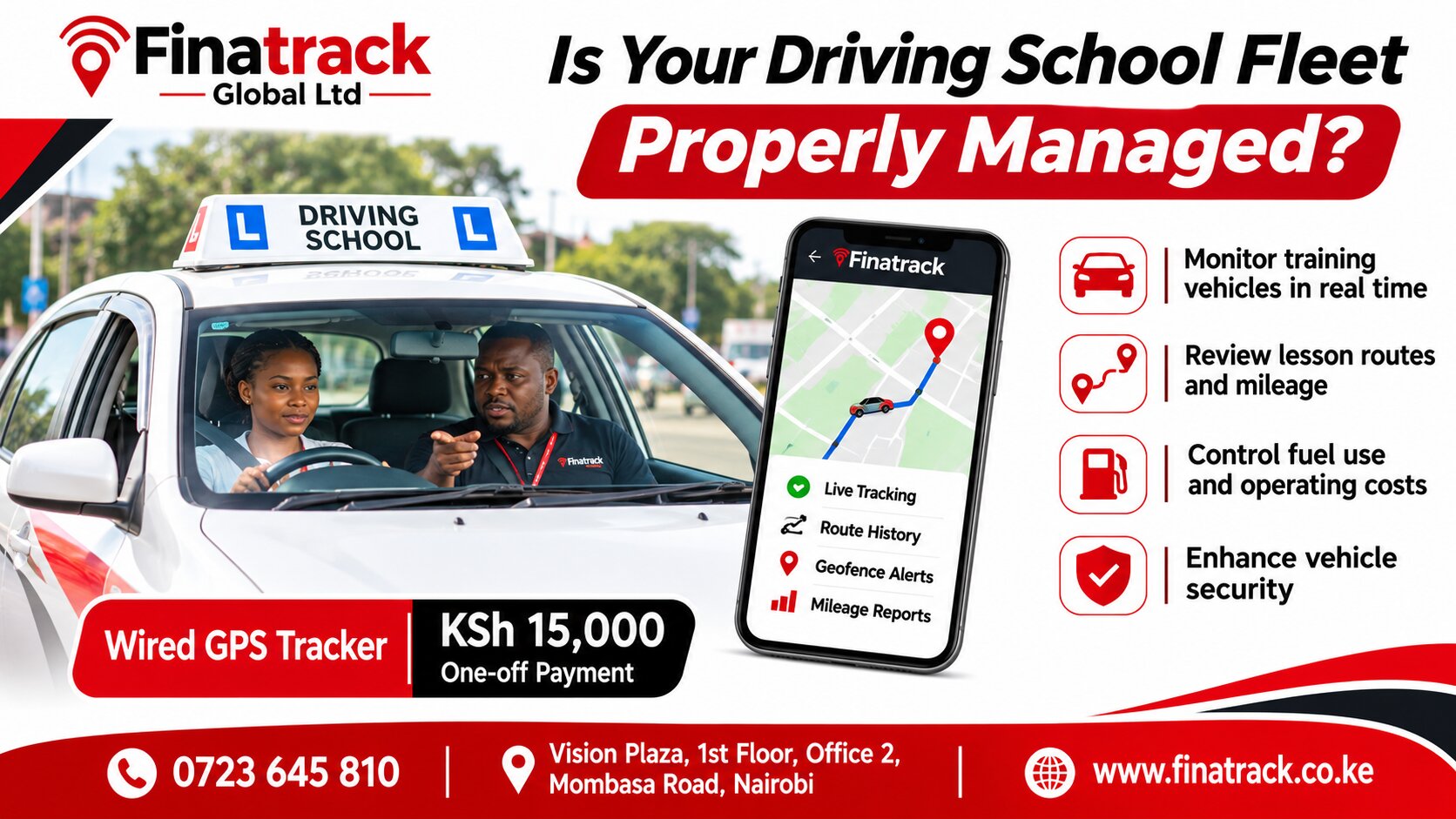
At Finatrack Global Ltd, our Wired GPS Tracker is available at KSh 15,000 as a one-off payment without an annual tracking subscription. Customers can alternatively choose an installation package costing KSh 10,000 with an annual subscription of KSh 3,000.
For driving schools operating several vehicles, the appropriate payment arrangement will depend on their available budget and long-term fleet plans. The one-off package may provide greater cost predictability for vehicles expected to remain in service for several years, while the subscription arrangement offers a lower initial installation cost.
School owners should confirm the supported tracking features, installation requirements and service terms before purchasing.
Improve Driving School Fleet Management With Finatrack Global Ltd
A successful driving school depends on more than attracting new learners. Training vehicles must be available when required, instructors must coordinate their schedules effectively, and management must maintain control over fuel, maintenance and other operating expenses.
GPS tracking provides driving school owners with additional information about vehicle locations, historical movements and selected security events. When used responsibly, this information can help improve vehicle allocation, investigate unnecessary mileage, support maintenance planning and strengthen accountability across the business.
Finatrack Global Ltd provides GPS tracking and fleet monitoring solutions for driving schools, private vehicle owners and commercial businesses across Kenya. Our wired tracking devices support vehicle location monitoring, route history and relevant security functions, depending on the selected equipment and configuration.
Our Wired GPS Tracker costs KSh 15,000 through a one-off payment arrangement, while customers seeking a lower initial installation expense can choose the KSh 10,000 installation package with a KSh 3,000 annual subscription.
For enquiries and professional installation, contact Finatrack Global Ltd on 0723 645 810, visit our office at Vision Plaza, 1st Floor, Office 2, Mombasa Road, Nairobi, or explore our vehicle tracking solutions at www.finatrack.co.ke.
Your driving school vehicles spend hours teaching others how to drive. Make sure you have the information needed to manage those vehicles efficiently, protect your investment and keep your business moving.