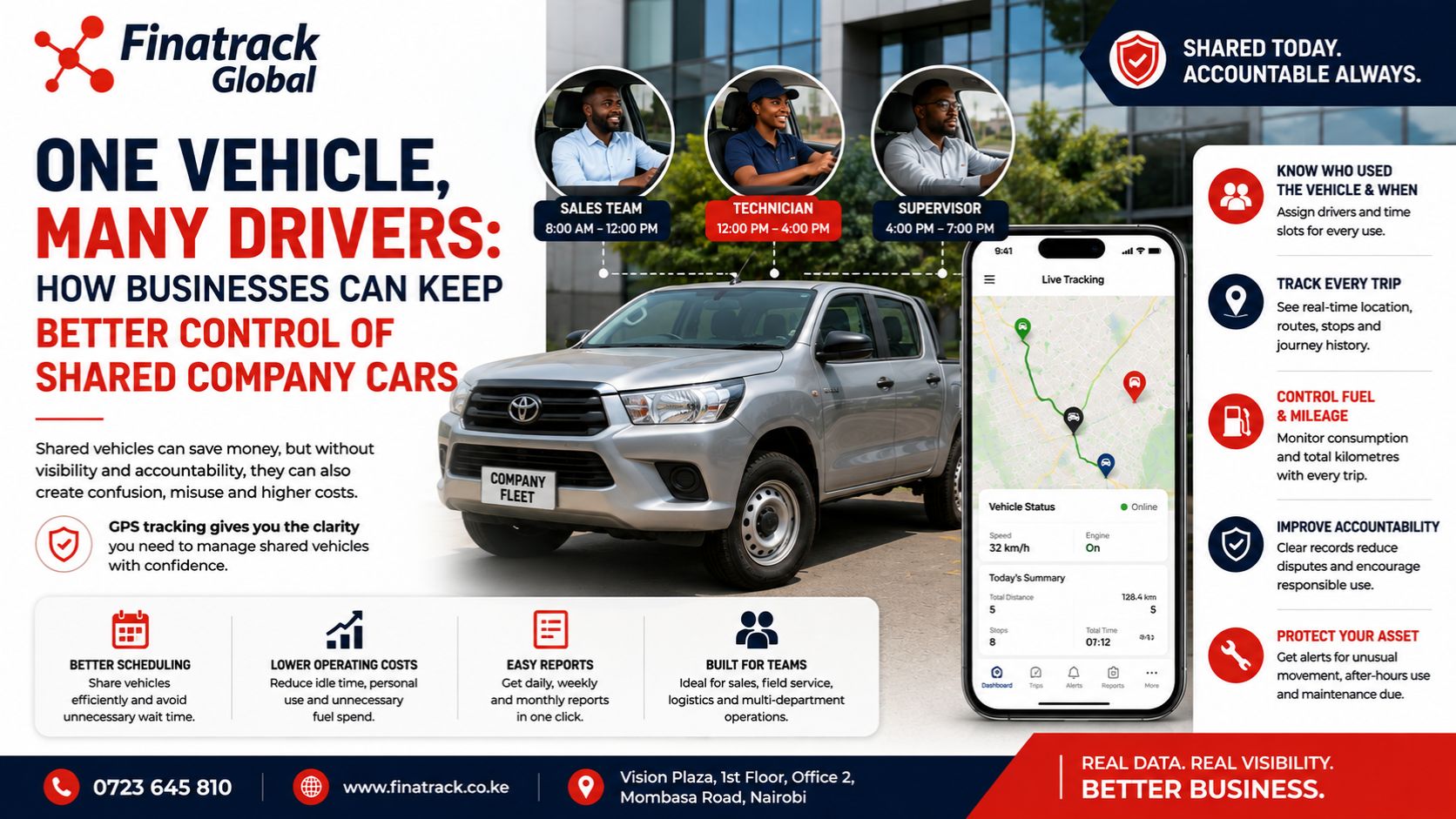
Shared company vehicles are common in many businesses. A pickup may be used by the sales team in the morning, collected by a technician in the afternoon and driven by a supervisor later in the day. The arrangement can help a company avoid buying unnecessary vehicles, but it can also create a difficult question when something goes wrong: who was using the vehicle at the time?
When several employees share the same car, responsibility can quickly become unclear. Fuel levels change, mileage increases, traffic fines appear, vehicles return late and damage may be discovered long after it happened. Without proper records, managers may spend more time asking employees what happened than actually managing the fleet.
The challenge becomes greater as the business grows. A company with two shared vehicles may still manage them through a notebook or WhatsApp group. Once several cars, departments and drivers are involved, those informal systems can become difficult to follow.
GPS tracking gives businesses another layer of visibility by creating a record of how the vehicle moved during the day. An authorised manager can review when a journey started, where the vehicle travelled, where it stopped and when it returned. This does not identify the driver automatically unless the company also uses a driver-identification process, but it gives management a reliable record of the vehicle’s activity.
That information becomes particularly useful when combined with a simple vehicle handover system. If the company records which employee collected a vehicle and at what time, the trip history can then be matched to the person responsible for that period.
Instead of asking five employees who may have used the vehicle, management can narrow the conversation immediately. The result is stronger accountability without needing to permanently assign every vehicle to one person.
Shared vehicles are often attractive because they improve utilisation. A car does not need to remain parked all day simply because the employee normally assigned to it is out of the office. Another department can use the same asset for legitimate company work.
The problem begins when nobody has a clear picture of how frequently the vehicle is being used. One employee may keep it longer than necessary while another team waits for transport. A department may repeatedly reserve a vehicle and then leave it parked for several hours.
Tracking information can help management understand whether shared vehicles are genuinely being used efficiently. If one car completes several productive trips every day while another spends most of the week parked, the company can review whether its allocation process makes sense.
This becomes useful when businesses are considering purchasing additional vehicles. Departments may report that transport is always unavailable, but utilisation records may show that existing cars are not being shared effectively.
Better scheduling can sometimes solve the problem without increasing the fleet. That saves the business from taking on another vehicle purchase, insurance cost, maintenance obligation and depreciation expense.
Mileage is another common source of disagreement. A shared car may accumulate hundreds of kilometres during a week, but nobody can clearly explain which trips created the mileage.
Trip history gives management a way to review how the kilometres were accumulated. The company can see whether journeys were consistent with official work or whether the vehicle travelled to unexpected locations.
This is particularly important when employees are allowed to take shared vehicles home. A vehicle may legitimately stay with one employee overnight because of an early customer appointment the following morning. Without clear policies, however, the same arrangement can gradually turn into personal use.
After-hours movement can be reviewed where appropriate. If a vehicle expected to remain parked overnight begins travelling late in the evening, management has information that may require verification.
The purpose should not be to assume that every after-hours journey is unauthorised. Emergency assignments, customer call-outs or operational requirements may be completely legitimate.
The value comes from visibility. Management can distinguish approved use from unexplained movement instead of discovering additional mileage days later.
Fuel control also becomes more complicated when many people drive the same vehicle. One employee may collect a car with a full tank and return it nearly empty, while another driver is blamed for high consumption because they happened to use it later.
Without trip information, it can be difficult to understand what really happened.
GPS tracking can show how far the vehicle travelled and how frequently it was used. Where a business operates suitable commercial vehicles and requires greater fuel visibility, dedicated fuel monitoring can provide additional information about refilling and unusual changes in fuel levels.
The objective is not simply to catch someone misusing fuel. Better information allows the company to understand whether consumption is consistent with actual vehicle activity.
Driving behaviour can also become difficult to manage in shared cars. A vehicle may develop worn brakes, damaged tyres or other mechanical issues, but nobody knows which driver has been operating it aggressively.
Telematics can provide information about events such as excessive speeding, harsh acceleration and harsh braking depending on the system installed. Managers can then identify patterns associated with particular periods of vehicle use when those periods are recorded against drivers.
One event should not automatically lead to disciplinary action. A sudden braking incident may simply mean the driver avoided an accident. Repeated behaviour over time is far more useful when deciding whether coaching or further investigation is needed.
Speed monitoring can be particularly valuable for branded company vehicles. When several employees use the same car, management still has a responsibility to ensure that the vehicle is being driven appropriately.
Members of the public do not know which employee is behind the wheel. They simply see the company’s name on the vehicle.
This means reckless driving can become a reputational issue as well as a safety concern.
Traffic incidents create another challenge. A shared vehicle may return with a scratch, dent or damaged tyre, and nobody accepts responsibility. If the damage is discovered several hours later, establishing when it happened can be difficult.
GPS trip records cannot show every incident, but they can help management identify where the vehicle travelled during the relevant period. Where AI dashcams are installed, video may provide additional context after an accident or road event.
For businesses operating valuable fleets, this can make internal investigations more structured and less dependent on conflicting explanations.
Vehicle security also deserves attention. Shared cars are often parked in different places depending on who used them last. One evening the vehicle may be at the company office, while the next it may be parked at an employee’s residence or customer location.
This creates changing security conditions.
Real-time tracking allows authorised managers to check where a vehicle is when necessary. Movement and ignition alerts can provide additional visibility depending on the configuration.
For higher-risk vehicles, businesses can also consider layered security. A wired GPS tracker can provide everyday monitoring while a wireless tracker or tracking tag offers another layer of protection.
An advanced alarm or immobilisation system may further strengthen vehicle security depending on the company’s requirements.
The greatest benefits still depend on internal procedures. GPS technology cannot solve poor vehicle management on its own.
A business using shared vehicles should have a simple process showing who takes the car, when they receive it, the purpose of the journey and when it is returned. This can be managed digitally or through a controlled vehicle register.
The process does not need to become complicated. It simply needs to create accountability.
Employees should also understand the rules surrounding fuel, personal use, after-hours driving, traffic offences and reporting damage. When expectations are unclear, even good tracking information can lead to arguments.
A clear shared-vehicle policy gives the data meaning.
Businesses should also control access to the tracking platform. Not every employee needs to see the location of every company vehicle.
Fleet managers, supervisors or authorised security personnel may need access, while other employees may only need to know whether a vehicle is available for booking.
Limiting access protects operational information and makes it easier to manage responsibility.
Professional installation is equally important. Shared vehicles often accumulate significant daily mileage and may be driven by many different people, so the tracking system needs to operate consistently.
Poor installation can result in unreliable reporting or unnecessary electrical problems. A professional installation should be followed by testing and basic training for the employees responsible for monitoring the fleet.
For a small company, a shared-vehicle system may involve only one pickup used by several staff members. For a larger organisation, there may be dozens of pool vehicles moving between departments, branches and customer sites.
The management principle remains the same.
If many people can use the vehicle, the company needs better records, not fewer.
GPS tracking helps create those records by showing where the vehicle went, when it moved and how it was used. Combined with clear driver handovers and sensible internal policies, it can significantly improve accountability without forcing businesses to assign every car permanently to one employee.
Finatrack Global Ltd provides professionally installed GPS tracking, fleet telematics, fuel monitoring, AI dashcams, vehicle security and backup tracking solutions for businesses operating shared and dedicated company vehicles in Kenya.
Installation can be arranged at the customer’s convenient location or at Vision Plaza, 1st Floor, Office 2, Mombasa Road, Nairobi.
For companies seeking better visibility and accountability across shared vehicles, contact Finatrack Global Ltd on 0723 645 810 or visit www.finatrack.co.ke.
When one vehicle has many drivers, the keys may change hands. Accountability should not.