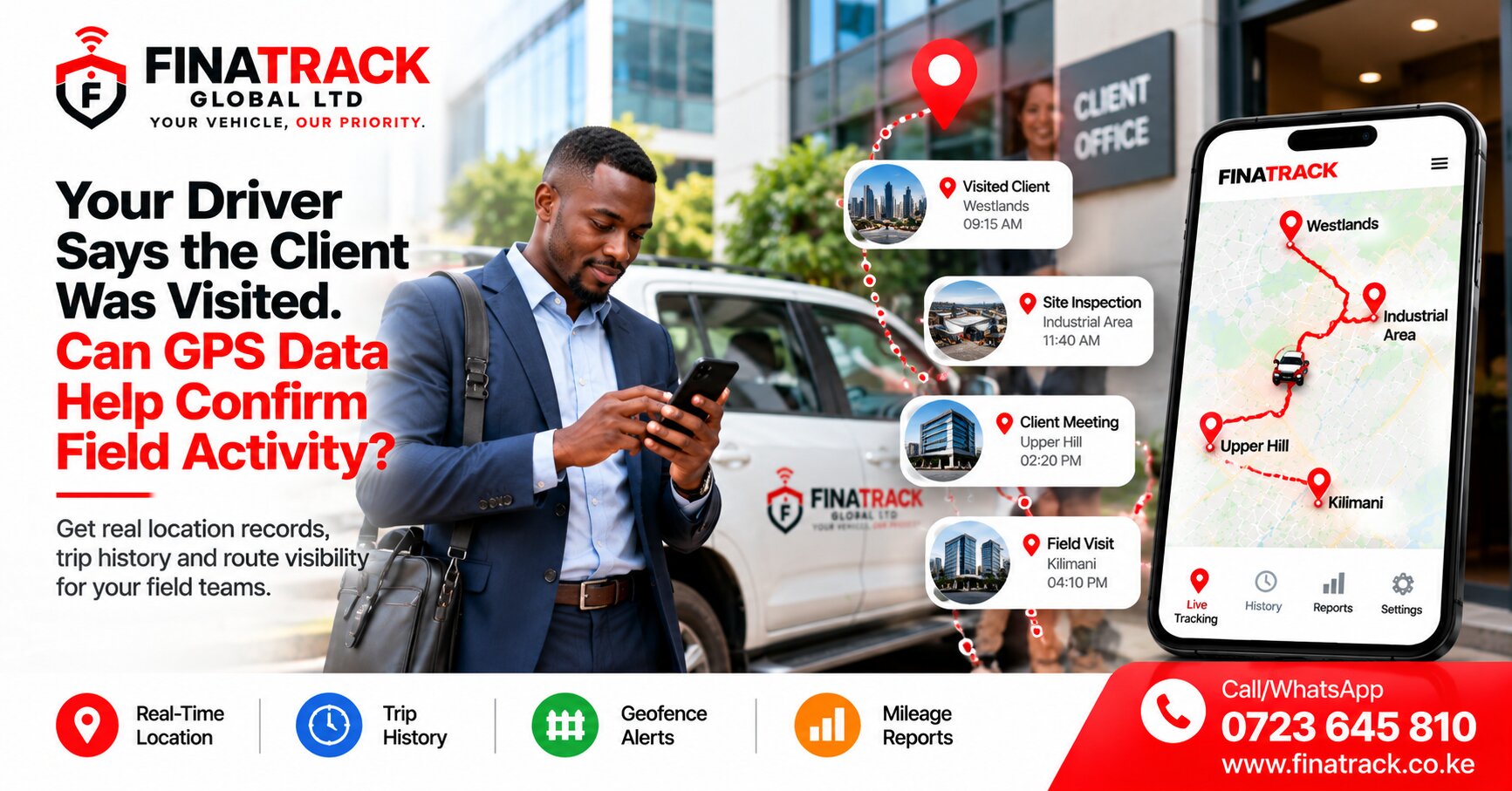
For many Kenyan businesses, managing employees who spend most of their working day outside the office can be difficult. Sales representatives, technicians, insurance agents, delivery teams and field officers may travel across Nairobi and other counties visiting customers, inspecting sites or completing assignments. Managers often depend on phone calls, handwritten reports and employee explanations to understand what happened during the day, but these records do not always provide a complete picture of how company vehicles were actually used.
GPS tracking can provide businesses with an independent record of vehicle movement that supports field activity management. An authorised manager can review the vehicle’s location, trip history and recorded stops through a tracking platform rather than repeatedly calling the driver for updates. If an employee reports visiting customers in Westlands, Industrial Area and Kilimani, for example, the trip history can help management see whether the company vehicle travelled through those areas during the relevant period. The information does not automatically prove that a meeting took place, but it can provide useful operational context.
This distinction is important because GPS location should support business records rather than replace them. A vehicle parked outside a customer’s premises does not prove that a sale was completed, a technician repaired equipment or a field officer held a meeting. Businesses should compare tracking information with customer records, job sheets, delivery documentation or other appropriate evidence. When several records point in the same direction, management gains a much clearer understanding of what happened without treating GPS as the only source of truth.
Trip history can also reveal patterns that might otherwise remain hidden. A field employee may consistently complete assignments efficiently, while another company vehicle may record repeated long detours between customer visits. Those additional kilometres may be caused by traffic, authorised personal errands, poor route planning or unnecessary journeys. Rather than immediately assuming misconduct, management can use the GPS record to ask informed questions and determine whether better scheduling or clearer vehicle-use policies are required.
The technology can also improve dispatch and customer service. If a customer requests urgent assistance, the office can check which available field vehicle is already closest instead of calling several employees to ask where they are. A technician near Upper Hill, for example, may be able to respond faster to a nearby customer than another employee travelling from the opposite side of Nairobi. Better visibility can reduce unnecessary mileage, improve response times and help businesses organise field teams more efficiently.
Geofencing and mileage monitoring can add further value. Businesses can create virtual boundaries around offices, branches, warehouses or important project areas and review when vehicles enter or leave those locations, depending on the tracking configuration. Mileage information can also help managers understand how intensively each vehicle is being used and identify unusual changes. A sales vehicle suddenly travelling substantially farther than normal may reflect increased business activity, a larger territory or unnecessary movement that deserves closer examination.
Tracking should still be implemented responsibly. Employees should understand that company vehicles are monitored and should know the business purposes for which the information is used, such as fleet security, route management, mileage control and field coordination. Access to tracking data should also be restricted to authorised personnel because vehicle history can reveal customer locations and employee movement. When businesses are transparent about the system, GPS tracking can support accountability without turning routine fleet management into unnecessary surveillance.
Finatrack Global Ltd provides GPS tracking solutions for businesses managing sales representatives, field officers, technicians, delivery teams and other mobile employees in Kenya. Depending on the installed solution, authorised users can monitor vehicle location, trip history, mileage, geofencing and selected operational alerts through the tracking platform. Finatrack’s wired GPS tracker is available at KES 15,000, with professional installation available at the company’s office or at a convenient customer location. Businesses seeking better visibility over field vehicles can contact 0723 645 810 or visit www.finatrack.co.ke. GPS tracking may not prove that every customer meeting happened, but it can give management a much clearer record of where company vehicles went, how they were used and whether reported field activity broadly matches actual movement.