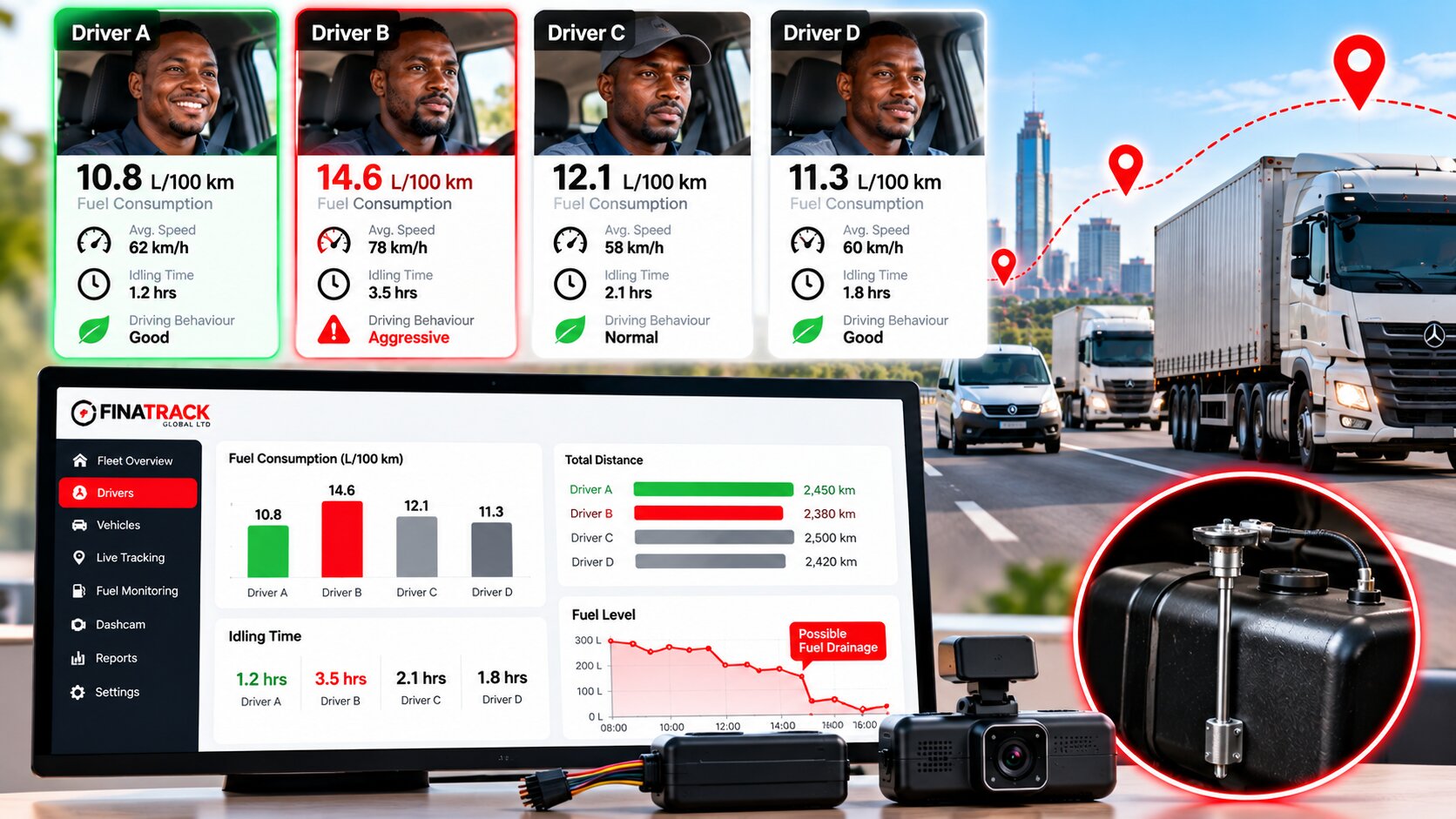
Two drivers may operate similar company vehicles, cover almost the same distance and complete comparable assignments, yet one may consistently cost the business much more in fuel and vehicle wear. Without reliable fleet data, management may only notice the difference when monthly fuel expenses rise or maintenance bills become unusually high. For businesses looking to improve driver fuel efficiency monitoring in Kenya, telematics can help compare how vehicles are being driven and identify where operating costs may be increasing.
The starting point is not simply asking which driver bought the most fuel. A driver covering 4,000 kilometres in a month will naturally consume more fuel than another covering 1,500 kilometres. A more useful comparison is the amount of fuel consumed relative to the distance travelled. Measuring consumption over 100 kilometres creates a common basis for comparing similar vehicles and similar assignments.
Suppose Driver A uses 12 litres to cover 100 kilometres while Driver B consistently requires 15 litres in a comparable vehicle on similar routes. The difference of three litres may appear small on one journey, but it becomes significant when multiplied across thousands of kilometres every month. For a commercial fleet operating several vehicles, small differences in driving efficiency can accumulate into a substantial annual expense.
GPS tracking can provide the mileage information needed to make these comparisons more reliable. Instead of depending entirely on odometer readings or handwritten driver logs, fleet managers can review recorded trips and distances travelled. When GPS mileage is combined with fuel-monitoring information, management gains a clearer picture of how much fuel a vehicle consumed relative to the work it completed.
Idling is one of the first behaviours worth examining. A vehicle can consume fuel while travelling zero kilometres. If one driver regularly leaves the engine running for long periods while waiting at customer locations, loading points or during breaks, their fuel consumption per 100 kilometres can become significantly higher even if their actual driving speed is reasonable.
This is why mileage alone cannot explain every fuel difference. Two trucks may each cover 500 kilometres, but one may have spent several additional hours idling. If management only compares distance and fuel receipts, the less efficient vehicle may appear to have a mechanical problem when driver behaviour or operational waiting time is actually contributing to the higher consumption.
Speeding can also affect operating efficiency. A driver who repeatedly accelerates aggressively and maintains unnecessarily high speeds may consume more fuel than another driver completing the same route more smoothly. Telematics can help management review speed patterns and compare them with fuel consumption rather than assuming every fuel difference comes from the vehicle itself.
Harsh acceleration and braking provide another useful signal. Frequent rapid acceleration requires more energy, while aggressive braking can indicate that the driver is repeatedly accelerating harder than necessary before slowing down again. When these events occur consistently, they can contribute not only to fuel expenditure but also to increased wear on brakes, tyres and other components.
Fleet managers should, however, be careful when comparing drivers. A driver carrying a heavily loaded truck through hilly terrain should not be compared directly with another driver operating an empty vehicle on a flat highway. Traffic conditions, payload, vehicle model, tyre condition, route elevation and operating environment can all influence consumption. Fair comparisons require similar vehicles performing similar work under reasonably similar conditions.
This is particularly important for mixed fleets. A small delivery van, pickup, heavy truck and refrigerated vehicle will naturally have very different fuel-consumption profiles. The objective should not be to find one fuel-consumption number that applies to every vehicle. Instead, businesses can establish realistic benchmarks for each vehicle category and then compare drivers or vehicles against those benchmarks.
Telematics can also reveal whether the problem is actually the vehicle rather than the driver. If several different drivers use the same truck and the fuel consumption remains consistently higher regardless of who is behind the wheel, the vehicle may require mechanical inspection. Tyre pressure, engine condition, fuel-system problems, alignment and other mechanical factors can influence consumption. Driver monitoring therefore becomes more useful when it is combined with vehicle-maintenance information.
Route differences can create another source of confusion. Driver A may appear less efficient because they spend most of the day in Nairobi traffic, while Driver B travels mainly on an open highway. The first vehicle may spend more time stationary, accelerate more frequently and operate at lower average speeds. GPS route history allows management to see these differences before making conclusions about individual performance.
A practical fleet analysis can therefore combine fuel consumed, kilometres travelled, idle time, speed events, harsh driving and route conditions. Instead of producing a simple ranking that labels one employee the “worst driver,” management can identify the specific behaviours contributing to the difference. One driver may need coaching on idling, another on acceleration and another may simply be assigned to a more demanding route.
This type of analysis can support more constructive driver coaching. Rather than telling an employee that they are “using too much fuel,” management can present a clearer picture: their vehicle is consuming more fuel per 100 kilometres than comparable units, while GPS records also show longer idling and more aggressive acceleration. Specific information makes it easier to agree on practical improvements and measure whether those improvements actually work.
Businesses can also create driver performance trends over time. A driver who improves fuel efficiency from 15 litres per 100 kilometres to 13.5 litres after coaching is delivering a measurable result. Management can recognise improvement rather than focusing only on poor performance. Positive incentives can sometimes be more effective than using telematics only for disciplinary purposes.
Fuel efficiency becomes even more valuable when multiplied across an entire fleet. Consider a company with 20 vehicles each covering thousands of kilometres every month. Reducing average consumption even slightly can translate into meaningful savings. Those savings can then contribute toward maintenance, fleet expansion or other operational priorities without requiring the business to reduce the amount of work being completed.
Driver comparisons can also reveal hidden operational problems. If every driver working on one particular route consumes more fuel than the company average, the issue may be congestion, poor road conditions, excessive waiting or inefficient scheduling. Management may then improve the route or customer schedule instead of trying to coach drivers out of a problem created by the operating environment.
Fuel receipts alone cannot provide this level of insight. A receipt tells management how much fuel was purchased and how much money was spent, but it does not explain the distance covered, the amount of idling, the route taken or the driving behaviour that occurred afterwards. Combining GPS tracking with fuel monitoring turns fuel expenditure from an accounting record into operational information.
The same data can help businesses investigate unusual changes. If a normally efficient driver suddenly records significantly higher fuel consumption for several weeks, management can check whether routes changed, the vehicle developed a mechanical problem or fuel-level records indicate unusual activity. Looking at the trend early can prevent an expensive problem from continuing unnoticed.
Privacy and fairness should remain part of the process. Employees should understand what fleet information is being collected and how it will be used. Driver comparisons should be based on relevant business objectives such as safety, fuel efficiency and vehicle utilisation rather than being used to create unnecessary surveillance. Clear internal policies can help build trust while still allowing the company to protect its assets and control costs.
Finatrack Global Ltd provides GPS tracking, fuel monitoring and fleet-management solutions for Kenyan businesses that want greater visibility over vehicle and driver performance. Finatrack’s wired GPS tracker is available at KES 15,000, while fuel monitoring solutions are available from KES 35,000 with a KES 1,000 monthly maintenance and system fee, depending on configuration. Businesses can combine location, mileage, trip history and fuel information to build a more accurate understanding of fleet efficiency.
For professional installation or enquiries, call or WhatsApp 0723 645 810 or visit www.finatrack.co.ke. The most expensive driver is not automatically the person who buys the most fuel. The better question is how much fuel each vehicle uses to complete comparable work, how that performance changes over time and whether driving behaviour, route conditions or mechanical problems are contributing to the difference. Telematics gives fleet managers the information needed to answer those questions with evidence rather than assumptions.