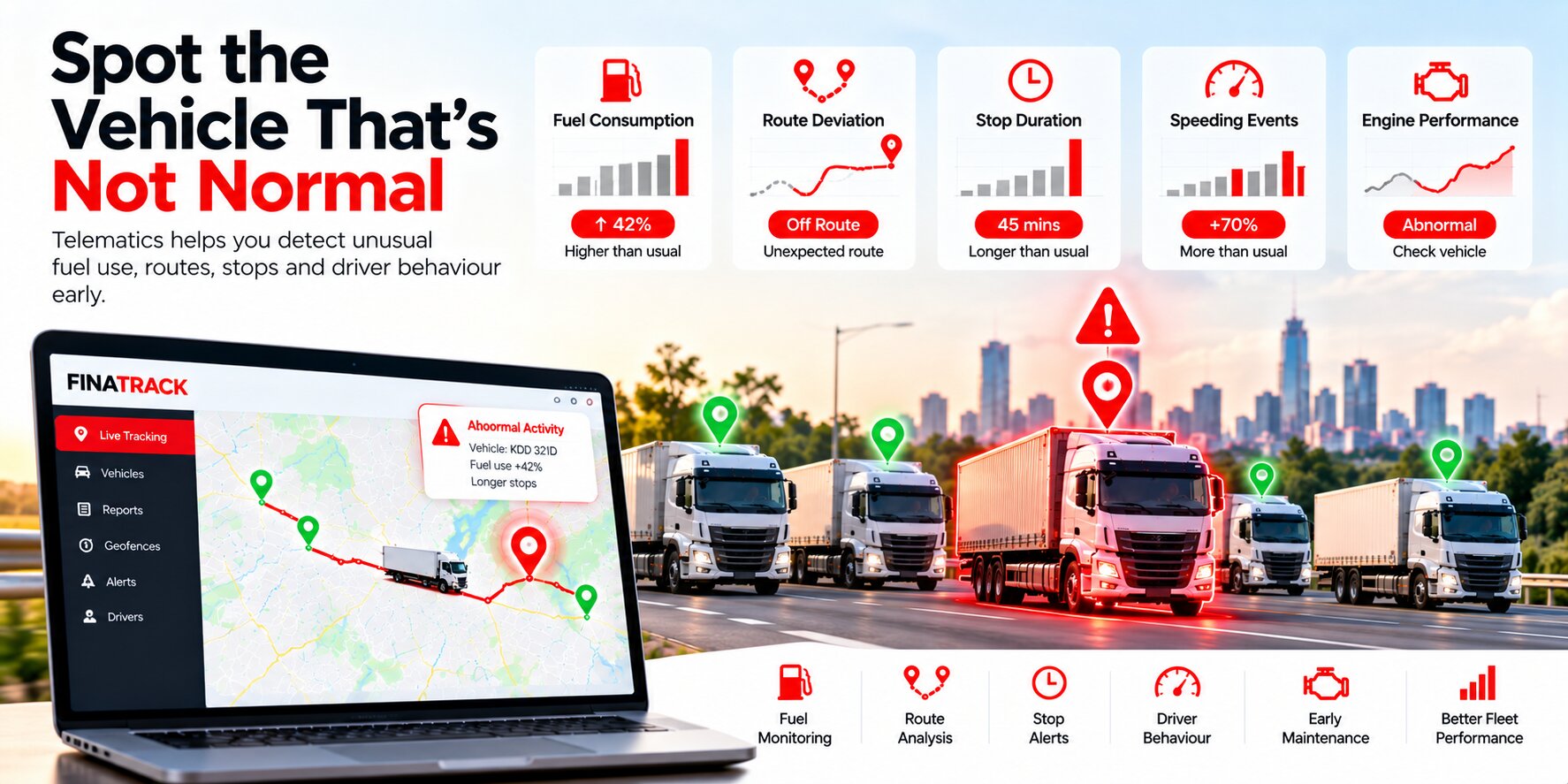
A fleet manager may have ten trucks running similar routes, carrying similar loads and working under roughly similar conditions. Nine of them consume fuel within a familiar range, spend predictable amounts of time at customer locations and follow relatively consistent routes. Then one truck begins behaving differently. Fuel use increases, stop durations become longer, mileage rises unexpectedly and the vehicle starts returning to the depot later than usual. Nothing has necessarily broken down, but something in the operating pattern has changed.
This is where fleet anomaly detection in Kenya can become useful. An anomaly is simply behaviour that differs noticeably from what is normal for that particular vehicle, driver, route or fleet. The objective is not to label every unusual event as a problem. Instead, telematics can help management identify changes early enough to investigate before they develop into fuel loss, maintenance problems, security incidents or productivity issues.
One of the strongest advantages of telematics is that it creates a historical record. A fleet manager does not need to judge a vehicle only by what happened today. GPS tracking, trip history, mileage, stop duration, fuel information and other available records can establish what normal operations usually look like. Once that baseline exists, sudden changes become easier to notice.
Consider a truck that normally travels around 300 kilometres per working day. Its routes vary slightly, but the overall distance remains fairly consistent. If the same truck suddenly begins recording 420 kilometres every day without any increase in assigned work, management has a reason to investigate. The additional distance could come from route changes, unauthorised vehicle use, detours, poor dispatch planning or a legitimate operational change.
The important point is that higher mileage itself is not automatically the anomaly. What matters is that the mileage differs significantly from the vehicle’s established pattern. If the company recently assigned the truck to a longer route, there may be nothing unusual at all. Telematics becomes useful because it shows the change; management still needs to understand the reason behind it.
Fuel consumption provides another strong example. A truck may normally consume a reasonably predictable amount of fuel for a familiar route. If consumption suddenly increases without a corresponding increase in mileage, load or operating conditions, the business should pay attention. The cause could be aggressive driving, excessive idling, mechanical deterioration, fuel leakage or possible fuel loss.
Fuel monitoring becomes even more valuable when combined with GPS information. A sudden fuel-level drop while the vehicle is travelling normally may be interpreted differently from a similar drop while the truck is parked for a long period at an unplanned location. Looking at the event together with location, time, ignition status and route history can help management build a much clearer picture.
Stop duration anomalies can also reveal hidden operational problems. Suppose a delivery vehicle normally spends between fifteen and twenty minutes at most customer locations. Over several weeks, one route begins showing stops lasting forty-five minutes or longer. The driver may be waiting because customers are not ready, paperwork may have become slower or the vehicle may be experiencing loading delays.
Without telematics, management may only notice that deliveries are finishing later. GPS stop records can help identify where the delays begin. This allows the company to investigate the customer, warehouse process, driver schedule or route instead of simply telling employees to work faster.
Repeated unplanned stops can create another pattern. One unusual roadside stop may be completely normal. The driver may have taken a break, checked the vehicle or responded to an operational issue. If the same vehicle begins making unexplained stops at the same location every afternoon, however, management has a reason to ask what is happening.
The same applies to after-hours movement. A company vehicle that is normally parked by 7:00 p.m. may suddenly begin moving late at night. One evening could represent an authorised assignment. Repeated movement outside working hours may indicate a change in operations, vehicle misuse or another issue that management should understand.
Geofencing can make these anomalies easier to recognise. A fleet can define areas around depots, customer sites, project locations or authorised operating zones. If a vehicle that normally remains within those areas repeatedly travels outside them, the platform can provide additional context. Again, leaving a geofence is not automatically wrongdoing. The value lies in identifying movement that differs from the expected pattern.
Driver behaviour can also change suddenly. A driver who previously maintained relatively stable speeds may begin generating more speeding events. Harsh braking or aggressive acceleration may increase at the same time. This could indicate changes in driving style, scheduling pressure, unfamiliar routes or even a vehicle problem that makes normal operation more difficult.
AI dashcam footage can add context where available. A telematics platform might show a pattern of sudden braking, but video may reveal that the vehicle is operating in particularly congested traffic or that the driver is consistently following other vehicles too closely. The combination of numerical data and visual evidence can prevent management from making conclusions based on one metric alone.
Anomaly detection is especially useful for maintenance. Mechanical problems do not always produce an immediate warning light or breakdown. Sometimes the first clue is a gradual change in operating behaviour. Fuel efficiency may deteriorate, engine hours may increase relative to mileage or the vehicle may begin spending more time stationary.
A fleet manager who knows the normal operating pattern can detect these changes earlier. If one truck consistently uses more fuel than comparable trucks on similar assignments, mechanical inspection may be appropriate even if the driver has not reported a problem. Telematics does not diagnose the fault, but it can indicate which vehicle deserves closer attention.
Tyres provide a simple example. Low tyre pressure can increase rolling resistance and contribute to higher fuel consumption. The GPS tracker cannot necessarily tell management that a tyre is underinflated, but the system may help reveal that fuel efficiency has changed. Physical inspection can then determine the mechanical cause.
The same principle can apply to braking problems, alignment, engine performance and other issues. An anomaly is not a diagnosis. It is an early signal that normal behaviour has changed enough to justify investigation.
Businesses should also compare vehicles against their own history rather than only against the fleet average. A heavy truck and a light delivery van will naturally produce very different fuel, mileage and speed patterns. Even two similar trucks may operate different routes. The most useful baseline may therefore be each vehicle’s own normal behaviour under comparable operating conditions.
Fleet-wide comparisons still have value when the vehicles perform similar work. If five trucks run the Nairobi to Nakuru route regularly and four show similar fuel and trip performance while one is consistently different, the outlier becomes easier to identify. Management can then examine whether the difference comes from the driver, vehicle condition, load, departure time or route choice.
Seasonal changes should also be considered. A vehicle operating during a busy delivery period may naturally cover more kilometres than during a quieter month. Construction fleets may change behaviour when projects move between sites. Agricultural fleets can experience seasonal workload changes. Good anomaly analysis therefore compares similar periods wherever possible.
One of the biggest mistakes businesses can make is creating too many alerts. If management receives a notification every time a vehicle stops, accelerates or moves slightly outside its normal pattern, employees may eventually ignore the system. The objective should be to identify meaningful deviations, not generate constant noise.
Fleet managers can define which changes deserve attention. A small increase in daily mileage may not matter. A twenty-five percent increase sustained for several days might. A five-minute longer stop could be insignificant, while repeated ninety-minute delays at one customer location may justify investigation.
The same threshold approach can be used for fuel. Normal measurement variation should not trigger accusations of fuel theft. Sudden, repeated and unexplained drops supported by location and timing information are much more useful. Telemetrics should help management focus on exceptions rather than encourage overreaction to ordinary fluctuations.
Data quality remains essential. A poorly calibrated fuel sensor can make normal fuel behaviour look abnormal. A GPS tracker with weak installation can generate inconsistent locations. An incorrectly positioned dashcam can produce unreliable alerts. Before management begins searching for anomalies, the underlying devices need to be installed and maintained properly.
This becomes particularly important when decisions affect employees. Telematics information should support investigation, not replace it. A driver should not automatically be disciplined because their vehicle shows unusual mileage. Management should verify assignment records, route changes, customer requests and other relevant information first.
A fair approach can actually make telematics more useful. Drivers may be more willing to cooperate with monitoring when they understand that the system is designed to identify operational problems as well as employee behaviour. A vehicle anomaly may ultimately reveal a mechanical issue, dispatch problem or customer delay rather than misconduct.
Anomaly detection can also help identify underutilised vehicles. Most discussions focus on vehicles doing too much, but unusual inactivity can be equally important. If a truck that normally completes several trips per week suddenly remains parked for long periods, management should understand why. The vehicle may be waiting for repairs, demand may have dropped or assignments may be poorly distributed.
In a large fleet, this information can influence purchasing decisions. A company considering another truck may discover that several existing vehicles are underused. Better scheduling may provide additional capacity without adding another asset. Telematics therefore supports both day-to-day monitoring and wider capital decisions.
Another useful area is route anomaly detection. Drivers may normally follow one established corridor but suddenly begin using a much longer alternative. The route may be legitimate because of congestion or roadworks, but repeated deviations can increase fuel, time and maintenance costs. Reviewing trip history helps management understand whether route changes are improving operations or creating unnecessary expense.
For high-value cargo, unexpected route deviations can also have security implications. A truck carrying expensive goods that leaves its expected corridor may warrant faster attention than an ordinary service vehicle. Risk thresholds should therefore reflect the type of vehicle, cargo and assignment.
Anomaly detection can become even stronger when GPS, fuel monitoring and AI dashcam systems are integrated. A sudden route deviation may trigger a location review, unusual fuel behaviour may appear at the same time and video may provide additional context. Instead of viewing each technology separately, management can investigate the complete event.
This does not require artificial intelligence in every case. Many useful anomalies can be identified through simple comparisons and reports. Fleet managers can review average fuel consumption, daily mileage, idle time, stop duration and speeding events against historical values. The important step is developing a routine for noticing changes.
More advanced platforms may eventually automate more of this process by highlighting unusual behaviour automatically. Instead of requiring the manager to search through dozens of reports, the system can surface the vehicles whose patterns differ significantly from expected behaviour. The fleet manager then decides whether the difference deserves action.
Businesses should also decide how long historical data should be reviewed. A one-week comparison may identify sudden changes, while three or six months of data may reveal gradual deterioration. Different questions require different time windows. Maintenance anomalies often develop gradually, while security anomalies may appear suddenly.
Monthly fleet reviews can therefore become more valuable when managers focus on change rather than only totals. Instead of asking, “How many kilometres did the fleet travel?” management can ask, “Which vehicles changed most compared with their normal pattern?” The second question is often more useful operationally.
A practical anomaly review might examine fuel consumption, mileage, route deviation, idle time, stop duration, speeding, after-hours movement and vehicle availability. The fleet does not need to analyse everything every day. Businesses can prioritise the measurements linked most closely to their operating costs and risks.
Finatrack Global Ltd provides GPS tracking, fuel monitoring, AI dashcam and fleet management solutions that can help Kenyan businesses build this kind of operational visibility. Finatrack’s wired GPS tracker is available at KES 15,000, while fuel monitoring and AI dashcam solutions can provide additional information for businesses requiring deeper fleet analysis.
For professional installation or enquiries, call or WhatsApp 0723 645 810 or visit www.finatrack.co.ke. The most important fleet problem may not be a vehicle that obviously breaks down or disappears. Sometimes it is the vehicle that quietly begins behaving differently from everything around it. When telematics establishes what normal looks like, unusual fuel use, routes, stops, mileage and driver behaviour become easier to identify before they grow into larger operating costs.