Kenya’s motorcycle transport industry is changing quickly. For years, fleet owners and boda boda operators mainly worried about petrol consumption, motorcycle theft, rider accountability and maintenance. Electric motorcycles introduce a different operating model. There is no petrol tank to monitor, batteries may be swapped several times during a working day, and a motorcycle can spend much of its time moving between customers, battery stations and different operating zones.
For businesses financing, leasing or operating several electric motorcycles, this creates a new fleet-management question: how do you know where the motorcycle is, who is using it, how far it has travelled and whether battery swapping is supporting or reducing productivity?
The subject is increasingly relevant in Kenya. The State Department for Transport reported on November 5, 2026 that Kenya had registered more than 50,000 electric vehicles by June 2026, with electric motorcycles accounting for the majority. The government is now moving implementation of the National Electric Mobility Policy to county level, while calling for further investment in charging infrastructure, battery technology and supporting skills.
That growth means electric boda boda operations should no longer be managed as experimental projects. A business operating ten, fifty or several hundred electric motorcycles needs the same level of operational discipline expected from any commercial fleet. The powertrain may have changed, but questions about theft, rider behaviour, utilisation and asset control remain.
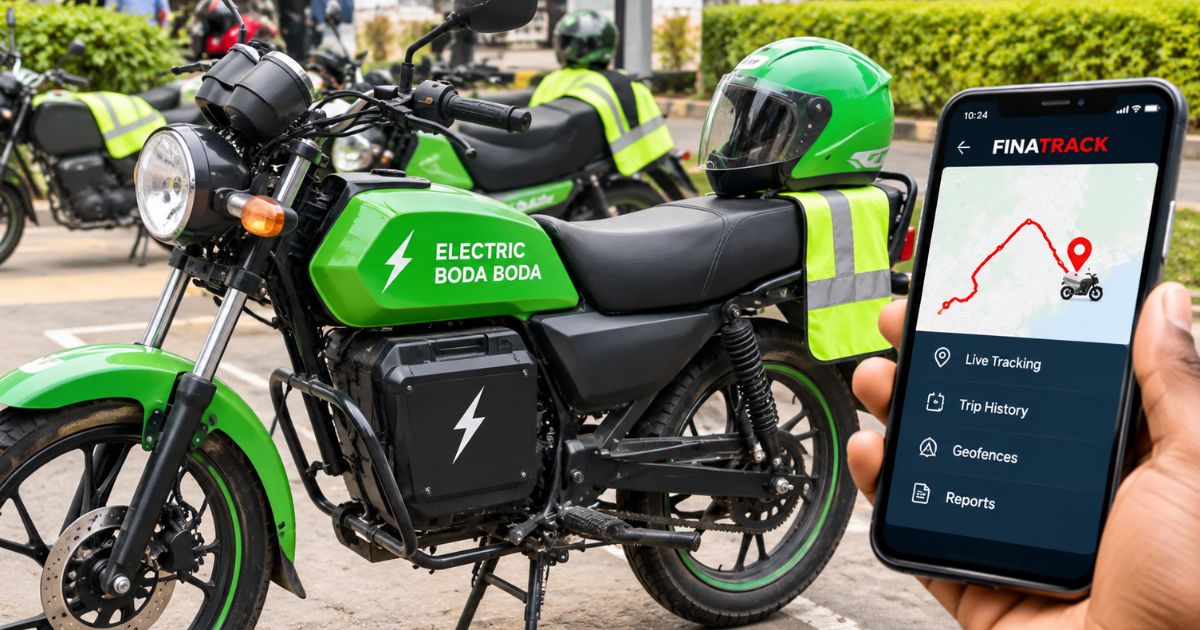
A conventional motorcycle GPS tracker can provide an important foundation. The tracker can help the operator see the motorcycle’s current or recently reported location, review previous trips, monitor movement and establish geofences around authorised areas. Depending on the tracker and configuration, businesses may also receive ignition, movement or other security alerts.
This becomes particularly valuable because boda boda motorcycles rarely remain at a fixed business location. They may spend an entire day moving across Nairobi, Kiambu, Machakos, Nakuru or other urban and peri-urban areas. Calling each rider repeatedly to ask where they are creates unnecessary administration and still does not provide a reliable historical record.
With GPS tracking, the operator can review where the motorcycle has actually been. A route-history report can show the areas covered during the working day, the time movement began, significant stops and when the motorcycle returned to its normal parking location. For fleet owners financing motorcycles to riders, this creates better visibility over assets that may spend almost all their useful life away from the office.
Electric motorcycles also make utilisation a particularly important measurement. A motorcycle can be fully charged and mechanically healthy while still producing very little business if it spends most of the day stationary. Fleet operators therefore need to understand how many kilometres each motorcycle travels, how long it remains active and whether particular units are being underused.
Suppose two electric motorcycles are assigned to similar operating areas. The first covers 150 kilometres during the working day while the second covers only 60. Management should not immediately assume the second rider is unproductive, because customer demand, battery availability, route conditions or mechanical issues may differ. But GPS records give management a clear reason to investigate the difference.
This is more useful than simply asking whether the motorcycle went out that morning.
Rider accountability creates another challenge. Some motorcycle fleets assign one motorcycle permanently to one rider, while others rotate bikes between employees or use shift-based arrangements. If several people can operate the same motorcycle, the tracking system may know what the motorcycle did without automatically knowing who was riding it.
This is where driver or rider identification can become valuable. Depending on the tracking hardware and fleet setup, the operator may use assigned rider records, RFID, Bluetooth identifiers, application login or another identification method to connect each operating period with the person responsible for the motorcycle.
The objective should not be unnecessary surveillance. The business needs a clear operational answer when a speeding event, route deviation, accident or unusual trip occurs. Knowing which rider was assigned to the motorcycle makes investigation significantly easier.
Geofencing can be particularly useful for electric boda boda businesses. A company may define an expected operating area around Nairobi, a delivery zone around a particular town or boundaries around battery-swapping and service locations. If a motorcycle moves outside the authorised area, management can investigate whether the movement is legitimate.
This could be useful for delivery fleets, financed motorcycles and corporate motorcycle operations. A company may have no objection to a motorcycle travelling widely during normal business activity but want to know when the asset leaves a county, crosses a defined boundary or begins moving late at night.
The alerts should still be configured sensibly. A motorcycle fleet operating throughout Nairobi should not receive a notification every time the rider crosses from one neighbourhood into another. Geofences should reflect genuine business risks rather than create constant alert noise.
Theft remains one of the strongest reasons to track electric motorcycles. The fact that the motorcycle is electric does not make it immune from being stolen or moved without permission. A professionally installed tracker can provide a location record that may assist the owner when responding to unexpected movement.
Fleet operators should still avoid treating GPS tracking as a guarantee of recovery. Trackers can be damaged, disconnected or affected by network and signal conditions. Motorcycle security works best when GPS tracking is combined with physical security, controlled key access, secure overnight parking and appropriate recovery procedures.
Electric motorcycles introduce an additional valuable asset: the battery.
Depending on the operating model, the battery may represent a substantial part of the motorcycle’s value and may not permanently remain with one bike. In a battery-swapping network, a rider can remove a depleted battery and exchange it for another charged unit. The motorcycle continues operating while the first battery enters a separate charging cycle.
This creates two different tracking questions. The first concerns the motorcycle. The second concerns the battery.
A standard GPS tracker fitted to the motorcycle normally follows the motorcycle itself, not every removable battery that passes through it. If Battery A is removed and Battery B is installed, the GPS tracker generally continues tracking the motorcycle because it is mounted on the bike rather than attached to the removable battery.
Battery management therefore requires its own systems.
Kenya’s existing Electric Vehicle Charging and Battery Swapping Infrastructure Guidelines specifically recognise battery swapping as part of the country’s EV ecosystem. The guidelines require swappable batteries to be BMS enabled for monitoring, analysis and safety, and they provide for unique battery traceability and centralised monitoring. They also contemplate IoT-based battery monitoring and remote management capabilities.
This distinction is critical for fleet managers considering electric motorcycle telematics. A GPS motorcycle tracker can tell you where the motorcycle travelled. It does not automatically tell you the state of charge, health or serial identity of every battery used by that motorcycle unless the tracking platform is integrated with the battery-management system or another compatible data source.
Businesses should therefore avoid promising themselves more information than the installed technology actually provides.
A good electric boda boda fleet may have two connected data layers. The motorcycle telematics system monitors the physical vehicle, while the battery-management platform monitors the battery. Where systems can be integrated, management gains an even clearer operational view.
Consider an electric motorcycle that begins the morning with Battery 238. The rider travels from Embakasi through Industrial Area and the CBD, then stops at a battery-swapping station in South B. The motorcycle tracker shows the journey and stop. The battery platform records that Battery 238 was returned and Battery 512 was issued.
Management can now understand not only where the motorcycle travelled but also when its energy source changed.
This can help answer a question that will become increasingly important as electric motorcycle fleets grow: how much productive riding occurs between battery swaps?
A motorcycle that covers substantial distance between swaps may have a very different operating pattern from one that repeatedly returns to a swapping station after relatively short trips. The difference could arise from battery condition, rider behaviour, route terrain, payload, traffic or operating conditions.
Management should not assume that more swaps automatically mean poor performance. Battery capacities differ, and operational conditions matter. The useful metric is whether the motorcycle is achieving the expected work for the battery system and route on which it operates.
Location data can help provide that context.
If one rider consistently swaps batteries after operating mainly on steep routes with heavy delivery loads, that may be understandable. If another motorcycle operating similar work requires significantly more swaps, the vehicle or battery system may deserve inspection.
Battery swapping also affects route planning. A petrol motorcycle can refuel at many service stations. An electric motorcycle operating under a particular battery ecosystem may depend on compatible swapping locations. Riders therefore need to know where those stations are relative to their normal working areas.
The government has acknowledged that Kenya’s EV infrastructure remains geographically uneven. As of November 2026, the State Department for Transport says approximately 90 percent of the country’s charging infrastructure is concentrated in Nairobi, and county governments are being encouraged to accelerate rollout outside the capital.
For electric motorcycle businesses planning expansion into new counties, this infrastructure question should be considered together with tracking data. A route may look commercially attractive because customer demand is strong, but the operating model may struggle if riders repeatedly travel long distances simply to access compatible energy infrastructure.
Historical GPS records can help identify these inefficiencies. Fleet managers may discover that motorcycles regularly leave their productive delivery zone and travel several kilometres to swap batteries. That movement consumes time and energy without directly generating revenue.
The company can then decide whether another swapping location, different rider allocation or a revised operating zone would improve productivity.
This illustrates an important difference between electric fleet management and petrol fleet management. In a petrol fleet, fuel cost usually dominates energy analysis. In an electric motorcycle fleet, the business may need to focus more heavily on charging or swapping downtime, battery utilisation, distance between energy events and station accessibility.
GPS tracking remains useful because it provides the location and movement layer connecting those operational events.
For delivery businesses, this can influence dispatch decisions. Suppose one rider is close to the next customer but also approaching the point where a battery swap will soon be necessary. Another rider is slightly farther away but has sufficient available range to complete the assignment without interruption.
A sophisticated dispatch process might eventually consider both location and battery status. A GPS tracker alone cannot necessarily make this decision because it may not know battery state of charge, but integrating vehicle location with battery-system information can make electric fleet dispatch much more intelligent.
Even without full integration, trip history can reveal patterns. If riders consistently make battery stops after a certain approximate distance, dispatch managers can plan assignments with that operational rhythm in mind.
Idle time also takes on a different meaning with electric motorcycles. A petrol boda boda may consume fuel while idling with the engine running. An electric motorcycle can remain stationary without the same traditional engine-idling fuel consumption. Yet stationary time still matters because a motorcycle that is parked is not completing trips.
Fleet managers should therefore pay more attention to utilisation rather than simply engine-on time.
A rider may spend ninety minutes waiting for customer requests at one stage. That could reflect low demand rather than poor performance. Another rider may spend the same period waiting at a service facility because the motorcycle requires maintenance. GPS stop records