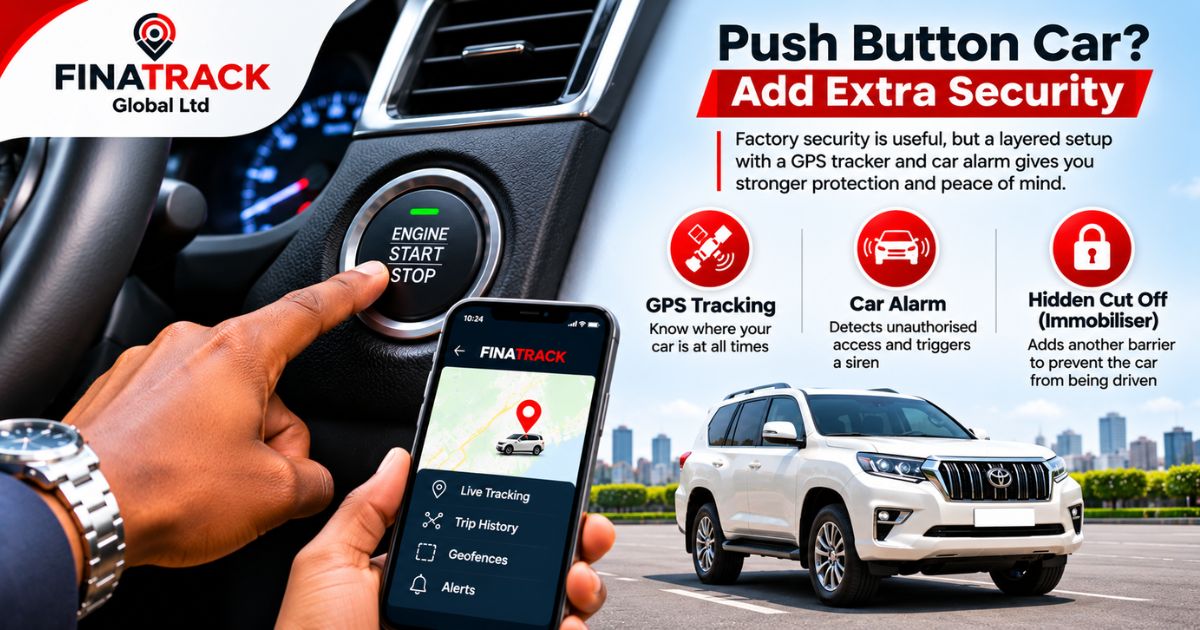
Modern vehicles can create a strong impression of security. You approach the car with the key in your pocket, touch the door handle, get inside and start the engine by pressing a button without ever inserting a physical key. The dashboard may display an immobiliser symbol, the doors lock automatically and the manufacturer may describe the vehicle as having advanced anti-theft technology. It is therefore reasonable for a Kenyan motorist to ask whether installing an additional GPS tracker, car alarm or hidden cut off is really necessary.
The answer depends on understanding that these systems perform different functions. Factory security normally controls authorised entry and engine starting, while an alarm is intended to detect or discourage certain forms of intrusion. A hidden immobilisation system adds another barrier to normal vehicle operation, while a GPS tracker gives the owner visibility over where the vehicle is and where it has travelled. Because these systems solve different problems, relying on only one of them can leave security gaps that become important if the first layer is defeated.
Push button start itself should not be confused with the vehicle’s complete security system. Many modern cars use an electronic key fob that communicates with the vehicle and allows the doors to unlock or the engine to start when an authorised key is nearby. This technology is convenient and can make traditional theft methods involving ignition barrels more difficult, but it also means that vehicle access increasingly depends on electronic communication between the car and its key.
One security concern associated with some passive keyless systems is relay theft. In a relay attack, criminals use electronic equipment to extend or reproduce communication between the vehicle and a legitimate key located some distance away, potentially making the vehicle believe that the key is nearby. Police crime-prevention guidance in the United Kingdom continues to warn owners of keyless vehicles about this risk and recommends protecting key signals and using additional security measures. The exact vulnerability varies between manufacturers, models and production years, so having push button start does not mean every vehicle is equally exposed.
Newer manufacturers have introduced improved security measures, including motion-sensitive keys, stronger authentication and other anti-relay technologies. These improvements are valuable, but they should not create the impression that any modern vehicle is impossible to steal. Vehicle security is strongest when one defeated system does not immediately give an unauthorised person complete control of the car.
This is the basic logic behind layered vehicle security. If somebody manages to overcome the manufacturer’s normal access system, another security layer should ideally remain between that person and the vehicle. An additional immobiliser, professionally installed hidden cut off, car alarm, wired GPS tracker or independent backup tracker can each create a different obstacle. The purpose is not to replace factory security but to strengthen it.
A professionally installed hidden cut off can provide one of these additional barriers. Depending on the vehicle and installation, the system can interrupt an appropriate circuit required for normal operation. An unauthorised person who succeeds in entering the vehicle may therefore discover that having access to the cabin does not automatically mean the vehicle can be driven away.
Installation quality is especially important with newer vehicles. Modern cars contain complex electronic control modules, CAN networks, sensors and safety systems, meaning installers should not simply cut random wires under the dashboard. Poor workmanship can cause warning lights, starting problems, unreliable electronics or other faults. A properly installed immobilisation system should therefore be designed around the particular vehicle rather than using exactly the same wiring approach on every model.
The hidden cut off should also be understood as an additional layer rather than a replacement for the factory immobiliser. Many vehicles already have an electronic immobiliser integrated into the original security architecture, which normally prevents the engine from operating unless an authorised key is recognised. A secondary hidden system creates another independent challenge that may not be obvious to someone familiar with the standard security system of that particular model.
No responsible security provider should suggest that a hidden cut off makes a vehicle impossible to steal. Given enough time, access and technical knowledge, security systems can potentially be defeated. The practical objective is to make theft more difficult, slower and less predictable. Every extra obstacle increases the amount of time and effort an unauthorised person may need to spend around the vehicle.
A car alarm adds another type of protection. Depending on the equipment installed, an alarm can react to events such as unauthorised door opening, impact or other triggers and activate an audible siren. This can attract attention and discourage continued interference, particularly when the vehicle is parked outside a home, office, apartment block or business premises.
An alarm, however, does not normally tell the owner where the vehicle has gone once it has left the parking location. That is where a GPS tracker performs a different role. Similarly, a GPS tracker may provide excellent location visibility but does not necessarily stop someone from forcing a door open. Treating the two technologies as competitors therefore misses the point; they are most useful when they complement each other.
A professionally installed wired GPS tracker allows the owner to view the vehicle’s current or recently reported location through a tracking platform, subject to satellite and cellular connectivity. It can also provide route history, allowing the motorist to review where the vehicle travelled earlier. If a vehicle disappears during the night, this information can become extremely valuable because the owner is not limited to knowing only that the parking space is empty.
Route history adds another layer of visibility because a vehicle may move and later return before the owner notices. Someone could potentially take the car away for a period and bring it back, leaving little obvious evidence that it had been used. Historical playback can show where the vehicle travelled, approximately when it left and when it returned.
Geofencing can provide earlier warning. A geofence is a virtual boundary created around a location such as a home, office, yard or regular parking area. If the vehicle leaves that boundary, the tracking platform can generate an alert depending on the configured system, allowing the owner to know that the car has moved even when they are not physically near it.
For example, a motorist may create a geofence around their residential parking area. If the vehicle is normally parked throughout the night but leaves at 2:30 a.m., an alert can provide an early indication that something unusual has happened. The owner does not have to wait until morning to discover that the car is missing.
Ignition information can provide another useful clue. Depending on the tracker and installation, the system may report when the ignition is switched on or off. An unexpected ignition event while the owner is away from the car may deserve investigation, although legitimate explanations such as a family member, mechanic or authorised employee should always be considered before assuming theft.
These alerts are most useful when they are interpreted together. A vehicle starting at a workshop during normal business hours may be completely expected, while the same ignition event at an unusual location in the middle of the night may be much more concerning. Good tracking systems provide information that helps the owner understand what is happening rather than encouraging panic over every notification.
Some wired GPS installations can also support remote immobilisation, depending on the vehicle and tracker configuration. This can provide an authorised method of preventing or interrupting normal vehicle operation under appropriate circumstances. The feature should be installed and used carefully because interfering with a moving vehicle can create serious safety risks.
Remote immobilisation should therefore not be treated like an ordinary phone button that the owner presses immediately whenever something appears suspicious. The first priority should be understanding what is happening, considering whether the vehicle is moving and following safe procedures. In a genuine theft situation, tracking information should support recovery efforts rather than encourage the owner to personally chase or confront suspected criminals.
Motorists should also understand that GPS tracking has technical limitations. The tracker normally depends on satellite signals to determine position and cellular communication to send information to the tracking server. Underground parking, covered structures and areas with weak mobile connectivity can temporarily affect the information displayed on the platform.
A tracker going offline therefore does not automatically mean it has been removed. The vehicle may simply have entered a basement or poor-coverage area. Depending on the device, stored trip records may be transmitted later when communication returns, allowing the owner to reconstruct part of the journey afterwards.
For motorists with higher-risk vehicles, this limitation is one reason an independent backup tracker can be valuable. The main wired tracker usually depends on the vehicle’s electrical system, although many devices include a small internal backup battery. A wireless GPS tracker or long-life tracking tag can operate independently from the main wiring and provide another tracking layer if the primary system is disconnected or damaged.
The backup device should provide genuine redundancy. Installing two trackers immediately next to each other under the dashboard means that anyone who finds the first device is likely to find the second at the same time. A professional security setup should consider separate installation locations and the different roles of the primary and backup devices.
Not every motorist needs several trackers. The appropriate setup should depend on the value of the vehicle, how and where it is parked, its theft exposure and the owner’s security priorities. A modest vehicle kept inside a secure private garage may require a simpler system than a high-value SUV frequently parked outdoors or used in higher-risk environments.
Traditional physical deterrents can still play a role even in technologically advanced vehicles. A visible steering-wheel lock may appear old-fashioned beside push button start and smartphone tracking, but it immediately shows that stealing the vehicle will require additional work. International police crime-prevention guidance continues to recommend physical security devices alongside electronic protection for keyless vehicles.
Key management remains equally important. Owners of passive keyless vehicles should avoid storing the key immediately beside doors or windows where relay equipment may have an easier time communicating with it. Depending on the vehicle, a properly functioning signal-blocking pouch or the manufacturer’s key-sleep function may provide additional protection.
Signal-blocking pouches should be tested periodically because they can wear out. The simplest test is to place the key inside the pouch and approach the locked vehicle. If the car still detects the key and unlocks normally, the pouch may no longer be providing the protection the owner expects.
The spare key deserves the same attention. Protecting the main key while leaving the spare beside a window or entrance defeats much of the purpose. Both electronic credentials should be stored securely, particularly overnight when the vehicle is parked close to the house.
Used vehicles create another security consideration. A buyer may receive two keys and assume they are the only credentials ever programmed for the vehicle. Depending on the manufacturer and vehicle history, having the keys checked or reprogrammed can provide greater confidence that old credentials belonging to previous owners are no longer relevant.
The new owner should also establish whether any aftermarket security equipment is already installed. A used vehicle may contain a tracker fitted by a previous owner, lender, insurer or fleet operator. If that device remains linked to somebody else’s account, the previous user could potentially continue seeing the vehicle’s location, creating an obvious privacy and security concern.
Existing equipment should therefore be identified, removed where necessary or formally transferred into the new owner’s control. The same principle applies when selling a vehicle. A tracker that remains in the car should not continue reporting to the seller’s account after ownership has changed.
Some modern vehicles also offer manufacturer connected-car applications that can show vehicle status or location. These services can be useful, but their availability varies by vehicle, country, subscription and manufacturer. Owners should not automatically assume that a factory application provides exactly the same functions or redundancy as an independent tracking installation.
Consumer location tags create another area of confusion. Small Bluetooth or crowdsourced tags can sometimes help locate an object, but they are not identical to dedicated cellular GPS vehicle trackers. Their update frequency, anti-stalking functions, communication method and intended use are different, which is why they are usually better viewed as an additional backup layer rather than a complete replacement for professional vehicle tracking.
Installation quality remains one of the most important elements of the entire security strategy. A sophisticated tracker installed in an obvious location may be easier to locate than a simpler device installed professionally. At the same time, placing a tracker behind excessive metal may make it harder to find while also reducing the satellite or cellular signal it needs to operate.
The installer therefore has to balance concealment with reliable communication. The same applies to alarms and hidden cut off systems, where the wiring should be secure, discreet and appropriate for the vehicle. Security should not be achieved at the expense of electrical reliability.
Every system should also be tested after installation. The owner should confirm that the tracking platform shows the correct vehicle location, route history records trips properly and geofence alerts arrive as expected. The alarm and hidden cut off should also be demonstrated so the owner understands how they operate before leaving the installation centre.
Testing is important because a security feature that exists only on an invoice provides no practical protection. Owners should understand what was installed, what each system does and what should happen when an alert occurs. They should also know whom to contact if the tracker suddenly stops reporting or another feature appears to fail.
Maintenance should continue throughout ownership. Battery replacement, dashboard repairs, accident repairs or electrical work can accidentally disturb hidden tracking and alarm wiring. After significant workshop work, the owner should check that the GPS tracker is communicating normally and that other security features continue to function.
This becomes particularly important when security equipment has been installed for several years. Internal backup batteries can weaken, older communication technology can become less suitable and connectors can deteriorate. A periodic security review allows the owner to confirm that the setup still matches the vehicle’s current value and risk.
For businesses, layered protection can be standardised according to fleet risk. Ordinary company cars may receive a wired GPS tracker, while executive or higher-value vehicles may use tracking together with an alarm and independent backup device. Commercial trucks may require another combination involving GPS, fuel monitoring and AI dashcams.
Private motorists can use the same principle by asking what would happen if somebody defeated the first layer of security. Would an alarm attract attention? Would an additional immobilisation barrier remain? Would the owner know that the vehicle had started moving? Would they be able to see where it went, and would another tracking layer remain if the main device was disabled?
Those questions reveal the real strength of a security setup much more clearly than simply asking whether the vehicle has push button start.
Finatrack Global Ltd provides GPS tracking, Advanced Car Alarm and layered vehicle-security solutions for motorists in Kenya. Finatrack’s Wired GPS Tracker is available at KSh 15,000, while the Advanced Car Alarm System with hidden cut off is available at KSh 7,500. Motorists who want both systems can choose the Wired GPS Tracker + Advanced Car Alarm combination at KSh 20,000, creating both location visibility and an additional vehicle-security layer.
Wireless GPS trackers and long-life Tracking Tags can also provide an independent backup option for customers who want additional tracking redundancy. The most suitable combination depends on the vehicle, parking environment and level of risk rather than assuming every car requires exactly the same security package.
For professional installation and enquiries, call or WhatsApp 0723 645 810 or visit www.finatrack.co.ke. A push button, electronic key and factory immobiliser remain valuable security technologies, but they should not create the impression that a modern vehicle cannot be stolen. Their strongest role is as the first layer of a wider security strategy.
The question for a vehicle owner should therefore not simply be, “Does my car already have security?” Almost every modern vehicle does. The more useful question is what remains if someone manages to defeat that first layer. When factory security, an alarm, hidden immobilisation, GPS tracking and an independent backup are combined appropriately, the owner no longer depends on one technology working perfectly every time.