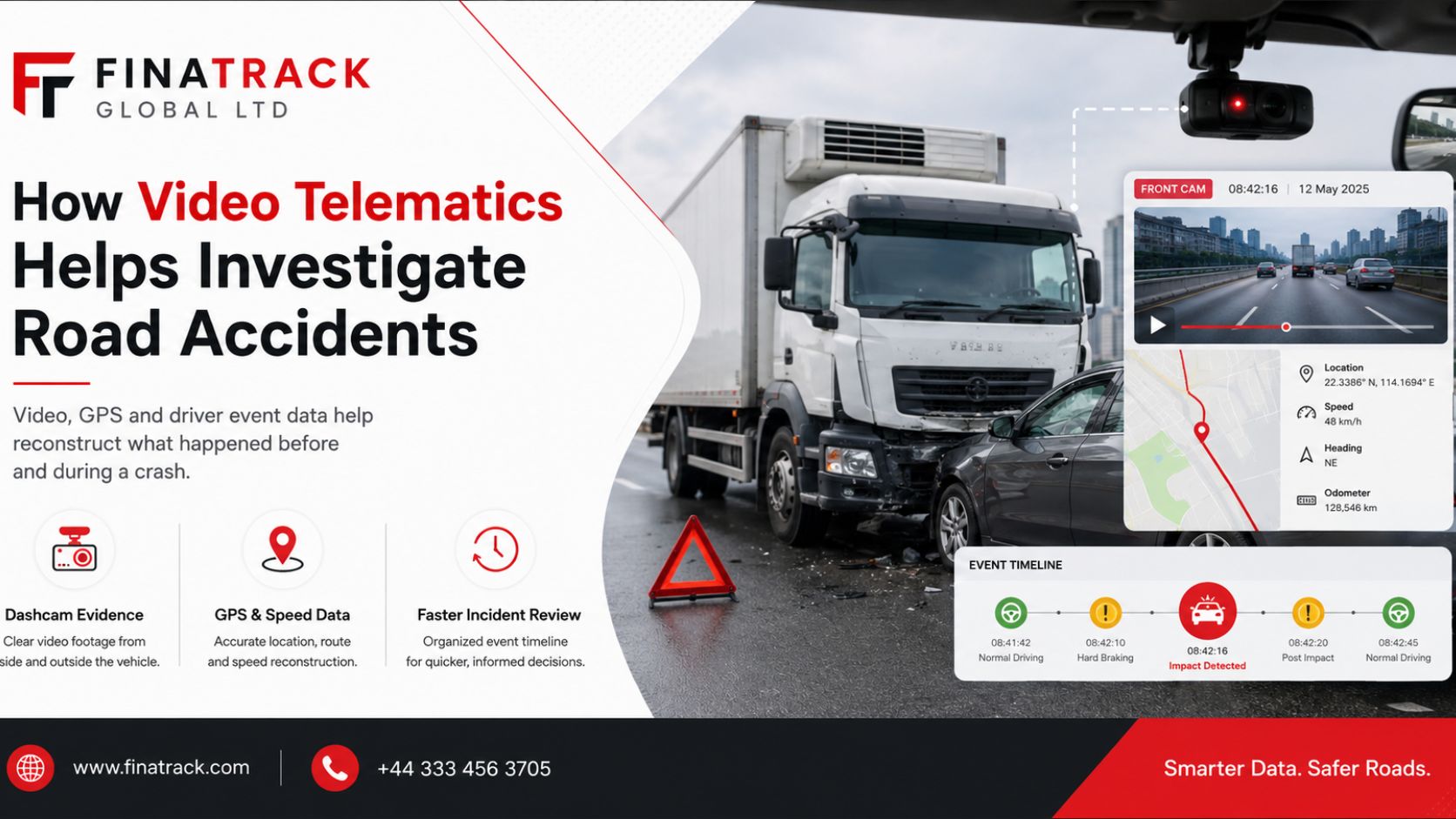
When a road accident happens, the first question is usually simple: what exactly occurred? Drivers may give different accounts, witnesses may only have seen part of the incident, and physical damage alone may not explain the full sequence of events. For fleet operators, insurers and transport managers, video telematics can provide an additional source of evidence by combining camera footage with vehicle data recorded before, during and after an incident.
Video telematics brings together onboard cameras, GPS tracking and vehicle information within a single monitoring system. Depending on the equipment installed, the platform may associate video with information such as vehicle location, speed, time, route and driving events. This allows investigators and fleet managers to examine an incident within a much wider context than would be possible from video footage or GPS location alone.
The importance of combining different sources of information is already well established in formal crash investigation. The US National Highway Traffic Safety Administration uses Event Data Recorder information as part of its crash investigations and combines vehicle data with scene evidence, photographs, witness interviews, police reports and other records. Video telematics follows a similar principle at fleet level by giving businesses additional information that can help reconstruct what was happening around a vehicle.
A conventional dashcam may record the road ahead, but a video telematics system can connect that footage to the wider fleet platform. Instead of searching manually through hours of recordings, an event such as harsh braking, sudden acceleration, swerving or another configured trigger can identify footage around the time of the incident. The US Federal Motor Carrier Safety Administration has used onboard monitoring systems in research where events such as hard braking or swerving triggered video recordings for later review.
This can make accident investigation considerably more efficient. If a delivery truck is involved in a collision at 2.30pm, management may be able to identify the vehicle, confirm where it was, review its route and examine associated video from immediately before and after the incident. The objective is not simply to watch the crash again, but to understand the sequence of events that led to it.
Speed information can be particularly useful when different versions of an accident emerge. One driver may claim the vehicle was travelling slowly while another person alleges excessive speed. Where reliable telematics data is available, the recorded information can provide another point of reference when the incident is reviewed.
Video can then add context to that data. A speed figure alone cannot show whether another vehicle suddenly entered the lane, whether traffic ahead stopped unexpectedly or whether a pedestrian stepped into the road. The combination of vehicle data and camera footage can therefore provide a more complete picture than either source on its own.
The National Transportation Safety Board has repeatedly highlighted the investigative value of onboard video in commercial vehicles. In a 2025 highway investigation report, the agency described video recording systems in commercial vehicles as providing invaluable information for crash investigations. The NTSB has also used onboard video systems directly during accident investigations and has advocated for their wider use in commercial transport.
Driver-facing cameras can add another important layer. A road-facing camera may show what occurred outside the vehicle, while an inward-facing camera can help establish what the driver was doing immediately before an incident. Where permitted and responsibly implemented, this can help determine whether distraction, fatigue or another observable behaviour may have contributed to the event.
Consider a truck that leaves its lane and collides with another vehicle. GPS data may show where the incident occurred, while telematics may record speed or harsh steering immediately beforehand. Road-facing footage can show lane position and traffic conditions, while driver-facing footage may provide information about whether the driver was looking at the road at the relevant time.
That does not mean every video clip provides a complete answer. Cameras have blind spots, recordings may not capture every angle and technical systems can occasionally experience communication or storage problems. Video telematics should therefore support an investigation rather than replace police findings, physical evidence, witness accounts or professional accident reconstruction.
The same principle applies when assessing liability. A short clip can sometimes create a strong first impression, but events leading to a collision may begin several seconds or even minutes earlier. Investigators should consider the complete available evidence before deciding what happened or who was responsible.
For commercial fleets, video telematics can also help resolve disputes more quickly. A company may receive a complaint that one of its drivers caused damage to another vehicle, while the driver insists that they were not responsible. Where properly retained video and telematics records exist, management can review the incident before making conclusions.
This can also protect responsible drivers. Fleet technology is sometimes discussed mainly as a way of identifying wrongdoing, but recorded evidence can be equally valuable when a driver is wrongly blamed. Footage may show that another road user entered the vehicle’s path unexpectedly or that the company driver took reasonable evasive action.
Insurance claims are another area where accurate incident information can be valuable. After a collision, businesses may need to provide information about where the vehicle was operating, what happened and the circumstances surrounding the loss. Video and telematics records can help the business preserve a clearer internal record of the incident, although insurers will still apply their own claims procedures and assess evidence according to the policy and circumstances involved.
The technology can also help management examine events that did not result in a collision. Near misses, sudden braking and dangerous lane changes may reveal risks before a serious accident occurs. Reviewing these events gives fleet managers an opportunity to identify recurring problems and provide targeted driver coaching.
A company may discover, for example, that several harsh braking incidents involve the same driver. Video may show that the problem is aggressive driving, but it could also reveal another explanation, such as a particularly difficult route, heavy pedestrian activity or unsafe traffic conditions. The purpose of reviewing the evidence should therefore be to understand risk rather than simply generate disciplinary cases.
Over time, these records can support a more preventative approach to fleet safety. Instead of waiting for a major collision before investigating driver behaviour, fleet managers can review patterns associated with speeding, distraction, harsh braking or other events and intervene earlier. FMCSA has recognised video event recorders as tools that can support identification and correction of risky behaviours as well as collision review and analysis.
The value increases further when video is integrated with conventional GPS telematics. Finatrack Global Ltd currently positions its fleet telematics services around driver behaviour insights, route information, utilisation and performance reporting, while its broader security offering includes dashcams and vehicle cameras. Combining these capabilities can give fleet managers greater visibility into both vehicle movement and the circumstances surrounding important driving events.
Businesses should nevertheless pay close attention to how video is stored and accessed. Vehicle cameras may capture drivers, passengers, pedestrians, customers or other identifiable individuals, which means the footage can involve personal data. Kenya’s Data Protection Act establishes principles governing lawful, fair and transparent processing of personal information, while Kenyan courts have recognised that CCTV recordings can constitute personal data.
For employers, this means video telematics should be introduced with a clearly defined purpose. Drivers should understand that cameras are installed, what they record and how the information may be used. Access should be restricted to authorised personnel, and footage should not be retained indefinitely simply because storage technology makes it possible.
This becomes particularly important with inward-facing cameras. A company may have legitimate safety reasons for monitoring fatigue or distraction, but the technology should not become uncontrolled workplace surveillance. The strongest approach combines a clear safety purpose with appropriate access controls, retention policies and employee communication.
Fleet managers should also establish a formal procedure for preserving footage after an accident. If a system continuously records and overwrites older video, important evidence could eventually disappear unless the relevant clip is saved. Companies should therefore know how to identify an incident, export or secure the associated footage and maintain an accurate record of who handled it.
The integrity of the evidence matters as well. Businesses should avoid unnecessary editing or alteration of original recordings before they are provided to insurers, investigators or other authorised parties. Keeping original files together with associated timestamps and telematics information can help preserve the context in which the recording was created.
Connectivity is another consideration. Some connected camera systems can transmit selected events to an online platform, but mobile network conditions may affect how quickly footage becomes available remotely. The system may still retain recordings locally depending on its design, which is why businesses should understand how both onboard storage and cloud transmission work before relying on the technology during an emergency.
For a small company operating a handful of vehicles, video telematics may initially appear more sophisticated than necessary. However, the financial consequences of even one serious road accident can include vehicle repairs, cargo loss, insurance claims, downtime, legal disputes and damage to customer relationships. Having reliable information about what happened can therefore become valuable far beyond the cost of the camera itself.
The benefits can be even greater for organisations operating large fleets. When dozens or hundreds of vehicles are on the road each day, managers cannot personally observe every journey. Video telematics gives them a way to investigate significant events without continuously watching every driver.
The goal should not be to create a control room where someone watches drivers all day. The more useful approach is event-based monitoring, where management focuses attention on incidents that genuinely require investigation, such as collisions, harsh braking, speeding events or driver safety alerts.
A road accident is often a matter of seconds, but understanding those seconds can require several different pieces of information. Where was the vehicle? How fast was it travelling? What happened in front of it? What was the driver doing? What happened immediately before impact?
Traditional GPS tracking can answer some of those questions.
Video telematics can answer several more.
When used responsibly, the technology gives businesses a clearer record of events, supports fairer investigations and provides information that can help reduce future risk. It does not replace professional accident investigation, but it can ensure that important evidence is available when questions arise.
For Kenyan fleet operators, the shift from basic vehicle tracking to integrated video telematics therefore represents more than an upgrade in technology. It represents a move from simply knowing where vehicles are to understanding what was happening when something went wrong.
Finatrack Global Ltd provides GPS tracking, telematics and vehicle security solutions for private motorists and commercial fleets in Kenya. Businesses seeking greater visibility into vehicle movement, driver behaviour and road incidents can contact Finatrack Global Ltd on 0723 645 810 or visit www.finatrack.co.ke.