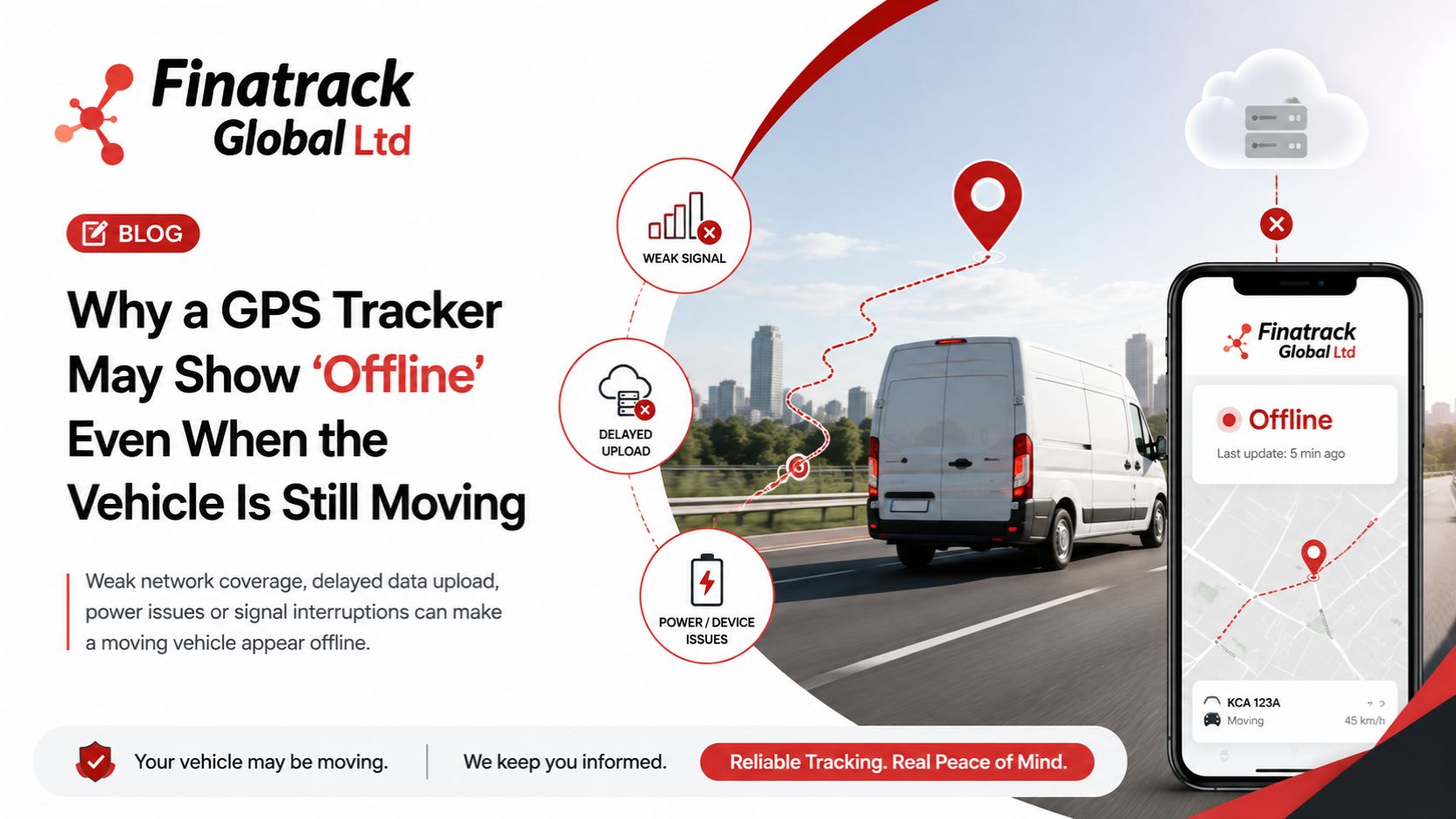
You open your vehicle tracking application and notice something worrying. The vehicle is supposed to be travelling, but the platform shows the GPS tracker as “Offline.” The last location may be several kilometres behind where you expect the vehicle to be, even though the driver confirms that the journey is continuing normally.
An offline status does not automatically mean that the vehicle has stopped, the GPS tracker has failed or somebody has removed the device. In most tracking systems, “offline” simply means the tracking server has not received recent information from the device. A professional GPS tracker normally combines satellite positioning with cellular communication, collecting coordinates through GNSS and transmitting them to a server through a mobile network.
This distinction explains how a vehicle can continue moving while appearing stationary on the tracking platform. The tracker may still be inside the vehicle and may even continue obtaining location coordinates, but if it cannot communicate those records to the server, the application has no new information to display. What you see on the map may therefore be the last successfully transmitted position, not necessarily the vehicle’s current position.
Mobile network coverage is one of the most common reasons for this behaviour. Teltonika’s technical guidance identifies lack of GSM signal as one reason a tracking device may stop sending information to its server. A vehicle can travel through a weak-coverage area while the tracker waits for cellular connectivity to improve.
This can happen on rural roads, remote construction routes, farms and other locations where cellular coverage is inconsistent. It can also happen temporarily inside certain buildings, parking structures or areas where the mobile signal available to the tracker’s SIM becomes weak. The important point is that mobile-network communication and GPS positioning are different parts of the tracking process. GPS itself is a satellite-based positioning service available independently of the local cellular network.
Consider a company truck travelling from Nairobi towards a remote delivery location. The tracker may send normal updates for the first part of the journey before reaching a section of road where the mobile network becomes unavailable. The truck continues travelling, but the fleet manager’s screen may continue showing the last point transmitted before communication disappeared.
A few minutes later, the vehicle may reach stronger coverage and suddenly appear online again. Depending on the tracker and its configuration, stored journey records may then begin transmitting to the server. Professional tracking devices can be configured to save records that have not yet been sent, allowing information to be transmitted when communication is available again.
This is why an offline period does not necessarily mean the missing section of the journey has been permanently lost. A tracking device with suitable internal memory can retain unsent records while communication is unavailable. Teltonika’s FMB920 documentation, for example, specifies internal flash memory and provides functions for reading records stored by the device.
When communication returns, the tracker may need some time to send previously stored information as well as new records. On some devices, the order in which stored information is transmitted can even be configured so that the newest records are prioritised before older ones.
For the vehicle owner, this creates an important difference between the vehicle being offline on the platform and the tracking device itself being completely inactive. The platform can only display what has successfully reached the server. A tracker that has temporarily lost cellular communication can therefore appear offline even though it remains powered and continues collecting information.
Network coverage is not the only possible explanation. A GPS tracker can also appear offline because the SIM card is not communicating correctly. Manufacturer troubleshooting guidance identifies issues such as an inactive SIM or GPRS service, a SIM PIN request and failure to obtain a GSM signal as possible reasons the device may not send data to the server.
This means a vehicle can be moving through an area with perfectly good network coverage while the tracker remains offline because its SIM connection has developed a problem. The customer may see the same symptom on the tracking application, but the underlying cause is completely different.
APN and communication settings also matter. A tracker needs the correct mobile-data configuration and the correct server address and communication parameters before records can reach the tracking platform. If those settings are changed incorrectly or the tracker cannot establish a suitable data connection, the vehicle can continue operating normally while the monitoring platform receives nothing.
This is why an offline tracker should be diagnosed systematically rather than by looking only at the map. A technician can examine whether the device recognises the SIM, whether it has GSM connectivity and whether it is successfully communicating with the configured server. Teltonika’s status tools, for example, separate GNSS information, GSM information and server-record information so that these different parts of the tracking process can be checked independently.
Electrical power is another possible cause. A wired GPS tracker depends on the vehicle’s electrical supply unless it has its own temporary backup power arrangement. If the tracker loses external power because of a disconnected wire, blown fuse, battery disconnection or interference with the installation, it may stop communicating even while the vehicle is later moved.
A platform may therefore show exactly the same word—offline—for several completely different situations. The tracker may have lost mobile coverage, the SIM may have stopped communicating, the device may no longer be reaching the server or its electrical supply may have been interrupted. The visible symptom is similar, but the correct solution depends on identifying the actual cause.
The last update time is one of the most useful pieces of information for the customer. Professional tracker status information includes fields showing when the device last sent a record and when the server last responded.
Suppose a vehicle is shown at Naivasha with a last update time of 10:42 a.m., while the driver says they are already approaching Nakuru at noon. The map should not be interpreted as evidence that the vehicle is still physically in Naivasha. It tells you that Naivasha was the latest position the server had successfully received at 10:42 a.m.
The age of the last update therefore matters just as much as the map pin. A location that was reported thirty seconds ago has a very different meaning from one that has not updated for three hours.
Fleet managers should train themselves to check both.
The route being travelled also provides useful context. If a company knows that its trucks repeatedly lose communication along a particular rural section and reconnect twenty minutes later, a temporary offline event there may be consistent with a known coverage gap. An unexplained offline event in an area where the vehicle normally communicates reliably should receive more attention.
Repeated behaviour can reveal patterns over time. If several vehicles using the same tracking service lose communication in approximately the same geographical area, network availability may be the common factor. If only one device repeatedly goes offline while other fleet vehicles in the same area remain connected, that particular tracker, SIM or installation deserves investigation.
The distinction becomes especially important when vehicle theft is a concern. An offline tracker should neither be ignored nor automatically treated as proof that thieves have found and disabled the device.
The right question is: what happened immediately before the tracker stopped communicating?
If the vehicle was travelling normally into a known low-network area, connectivity may be the most likely explanation. If it unexpectedly went offline shortly after an unusual ignition event, power disconnection or unauthorised movement, the situation may deserve faster escalation.
Trip history can help once the device returns online. If stored records are successfully transmitted, management may be able to reconstruct where the vehicle travelled during the period when live monitoring was unavailable. Devices that save unsent records can preserve valuable information for later transmission, although the amount retained depends on the hardware and its configuration.
This is one reason the quality and configuration of the tracker matter. A very basic system may not handle prolonged communication interruptions in the same way as a professional telematics device with significant internal storage and configurable data transmission behaviour.
Reporting configuration can also influence what the customer interprets as an offline problem. GPS trackers do not necessarily send information every second. Devices can create and send records according to configured acquisition and transmission settings, meaning the frequency of updates depends partly on how the system has been set up.
A tracker configured for less frequent reporting may therefore appear less responsive than one configured for more frequent updates even though both are functioning normally. Customers should understand the expected reporting interval of their particular system before assuming every short delay represents a fault.
Sleep modes can create additional confusion if customers do not understand how their devices behave. Some vehicle trackers can enter power-saving modes when the vehicle is stationary, reducing power consumption while continuing to operate according to configured rules. Teltonika’s FMB920, for example, includes GPS sleep functionality designed to reduce vehicle battery consumption under defined conditions.
A properly configured device should recognise when the vehicle becomes active and return to the required operating behaviour. If the tracker does not wake or report as expected when the vehicle starts moving, however, its configuration or installation may need to be checked.
Server communication can also be part of the problem. The device may have GNSS information and cellular service but still fail to deliver records successfully to the configured tracking server. Professional diagnostic information therefore includes details such as the communication socket, last record sent and last server response.
For customers, the technical details behind these connections do not need to become a daily concern. What matters is having a tracking provider capable of investigating them when something goes wrong.
The best first response to an offline tracker is therefore to examine the circumstances rather than panic. Check the last update time, last known location and direction of travel. Consider whether the vehicle has entered an area where network communication commonly becomes weak.
If the driver can be contacted safely and legitimately, confirm whether the vehicle is continuing its journey and whether anything unusual has happened. Drivers should not be encouraged to operate phones while driving simply because the monitoring platform has stopped updating.
Management should then watch whether the tracker reconnects once the vehicle reaches a different area. A short outage that repeatedly resolves itself at the same geographical location points towards a very different problem from a tracker that remains offline for hours after returning to a major town.
If the tracker does not reconnect in an area where communication would normally be expected, technical support should investigate the system. The provider may need to check the SIM, device status, communication settings, power supply or physical installation.
A customer should not repeatedly dismantle the vehicle dashboard or interfere with tracking wiring without knowing what they are looking for. Poor troubleshooting can create an electrical problem where none previously existed.
For fleet businesses, recurring offline events deserve documentation. A fleet manager can note which vehicle went offline, when communication stopped, where the vehicle was located and when it eventually returned online. Over several journeys, that information can reveal whether the problem follows a route, a mobile network pattern or a particular device.
This approach is more useful than simply saying that “the GPS is unreliable.”
The same applies to trackers used for security. A professional tracking system should be treated as part of a broader vehicle-security strategy rather than the only protective layer installed in the vehicle. A wired primary tracker can be supported by additional security measures such as an alarm, immobilisation system or independent backup tracking device depending on the customer’s risk profile.
The reason is simple: any single technology can face limitations. Cellular tracking can encounter communication gaps, wired equipment can lose external power and GPS satellite reception can be affected by the surrounding environment. Layered vehicle security reduces dependence on one component.
Vehicle owners should also understand that offline does not mean the same thing as GPS unavailable. A tracker can have a valid satellite position while cellular communication is unavailable. GPS.gov describes GPS as a satellite-based positioning service available on a continuous worldwide basis to civilian users, while professional vehicle trackers separately use cellular connectivity to transmit collected coordinates to remote servers.
This difference is perhaps the most important point for anyone using a GPS tracker.
GPS answers the question: Where is the device?
The mobile connection answers another question: Can the device tell the tracking server where it is right now?
When the second part fails temporarily, the tracking platform may show the vehicle as offline even while the first part continues working.
For businesses managing delivery vans, trucks, company cars or remote field vehicles, understanding this difference can prevent unnecessary confusion. Fleet managers can respond appropriately to normal communication gaps while still recognising unusual offline events that deserve investigation.
Private motorists benefit from the same understanding. Seeing an offline status is a reason to check what is happening, but it is not automatically proof that the tracker has stopped working or that the vehicle has been stolen.
A well-managed tracking system should provide the customer with more than a map. It should include professional installation, clear understanding of device status, reliable connectivity arrangements and technical support when a tracker behaves unexpectedly.
Finatrack Global Ltd provides professionally installed GPS tracking and vehicle-security solutions for private vehicles and commercial fleets in Kenya. Customers can monitor vehicle location, trip history, ignition activity and other configured alerts while receiving technical support when tracking devices unexpectedly appear offline.
Professional installation can be arranged at the customer’s convenient location or at Vision Plaza, 1st Floor, Office 2, Mombasa Road, Nairobi. For GPS tracking, fleet telematics and vehicle-security solutions, contact Finatrack Global Ltd on 0723 645 810 or visit www.finatrack.co.ke.