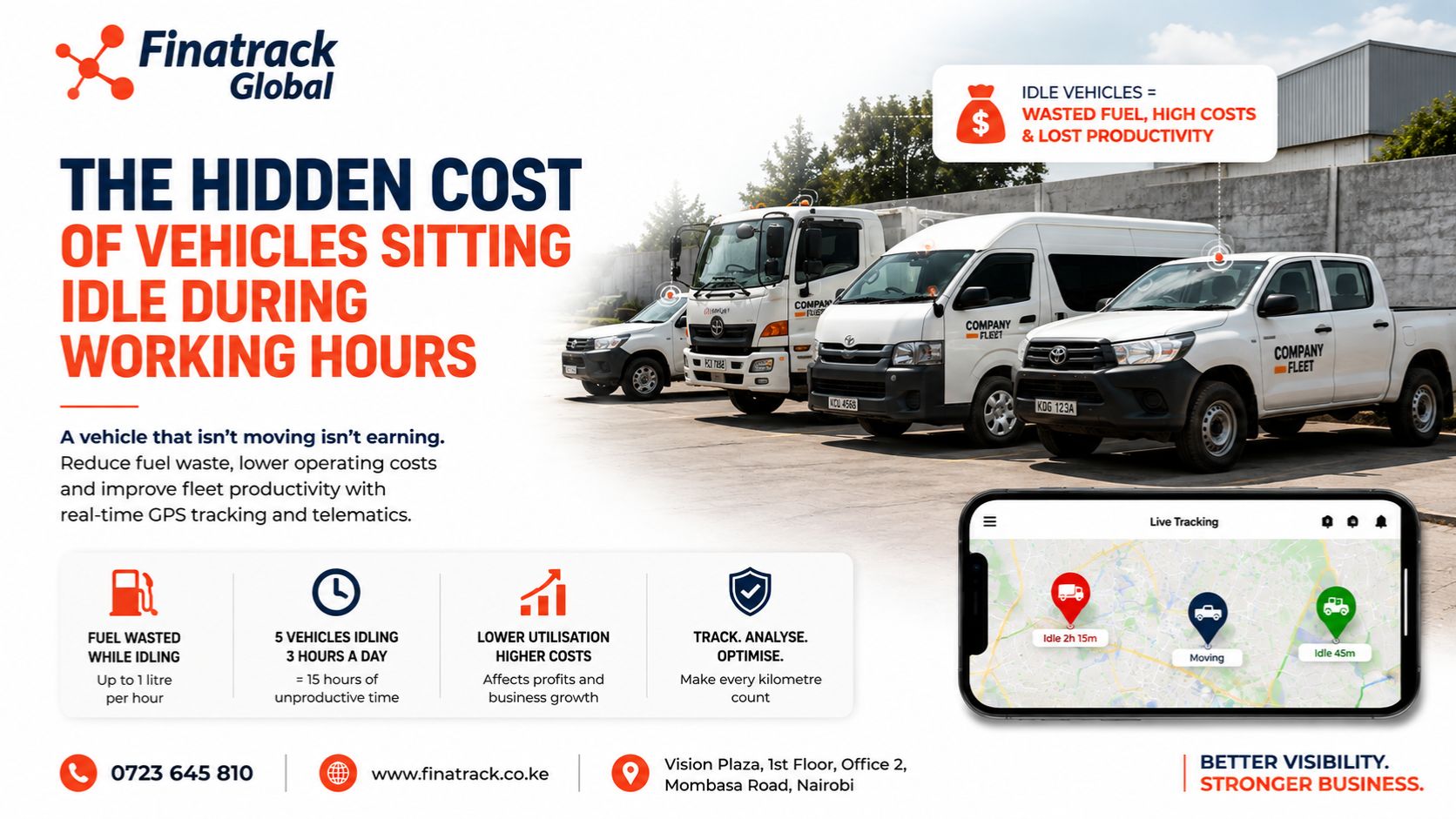
A company vehicle does not have to be stolen, damaged or involved in an accident to cost a business money. Sometimes the biggest loss comes from a vehicle doing almost nothing at all.
Across many businesses, pickups, vans, trucks and motorcycles spend large parts of the working day parked while other vehicles in the same fleet remain overstretched. Because the vehicles are physically available and no obvious incident has occurred, the cost of this underutilisation can easily go unnoticed.
The problem becomes clearer when businesses remember that a vehicle continues costing money whether it is moving or parked. Insurance, depreciation, financing, licences, maintenance and other ownership expenses continue even on days when the vehicle completes very little productive work.
A business may therefore own ten vehicles but effectively receive the productive output of only six or seven. The remaining vehicles still consume capital without contributing proportionately to revenue.
This is particularly common in companies where vehicles are allocated permanently to departments, branches or employees. One department may have several vehicles sitting outside the office while another struggles to complete customer visits because transport is unavailable.
Without accurate utilisation information, management may respond by purchasing another vehicle. The company adds another asset, another insurance policy and another maintenance obligation when the real problem may simply be poor allocation of the vehicles it already owns.
GPS tracking can help expose this problem by showing how frequently each vehicle is actually moving during working hours. Management can review trips, movement periods, stops and daily utilisation rather than relying on assumptions about how busy the fleet appears.
A vehicle that leaves the office every morning may initially look productive. Trip history may reveal that it travels only a short distance before remaining parked for most of the day.
Another vehicle may complete several customer visits, travel across multiple locations and remain active for most of the working day. Comparing the two gives management a much clearer picture of whether fleet resources are being distributed effectively.
The purpose is not to demand that every vehicle remain in constant motion. Many businesses naturally require vehicles to wait between assignments, and some vehicles exist specifically for emergencies or specialised tasks.
The important question is whether the level of inactivity makes commercial sense. A vehicle that remains parked for five hours because there is no work available represents a different situation from one waiting for an emergency call.
Idle time can also expose weaknesses in dispatching. A field service company may have technicians waiting for assignments in one part of Nairobi while another team travels a long distance to reach a customer.
Better vehicle visibility can allow dispatchers to determine which vehicle is closest to a new job and allocate work more efficiently. This reduces unnecessary travel while increasing the productive use of vehicles already on the road.
The same principle applies to delivery businesses. If one van consistently completes twice as many deliveries as another, the difference deserves investigation.
The slower vehicle may be covering a more difficult route, handling larger deliveries or experiencing traffic problems. It may also be suffering from poor route planning, excessive stops or inefficient job allocation.
Data helps management ask the right questions before reaching conclusions.
There is another form of idle time that costs businesses even more directly: a vehicle sitting stationary with the engine running. This frequently happens while drivers wait for customers, load goods, take breaks or remain parked outside offices.
Engine idling consumes fuel without moving the vehicle closer to its destination. Across one vehicle the cost may appear small, but across a fleet operating every working day, unnecessary idling can become a recurring expense.
A driver who leaves an engine running for short periods throughout the day may not consider the financial impact. When similar behaviour is repeated across ten, twenty or fifty vehicles, the accumulated fuel consumption can become significant.
Excessive idling can also contribute to additional engine running hours and maintenance requirements. The business is effectively paying for fuel and mechanical usage while receiving no additional kilometres or completed jobs in return.
GPS and telematics information can help managers identify vehicles that remain stationary for unusually long periods. The objective should not be to treat every stationary period as a problem, because traffic, loading, customer delays and operational requirements are legitimate parts of business.
What management should look for are repeated patterns. If one driver regularly records substantially more idle time than others performing similar work, there may be an opportunity for coaching or operational improvement.
Long parking periods during working hours can also reveal problems with scheduling. A vehicle may complete one job in the morning and then remain unused until late afternoon because the next assignment was not ready.
Instead of viewing this simply as driver downtime, management can investigate whether jobs are being planned efficiently. Better scheduling could allow the same vehicle to complete additional assignments without increasing the size of the fleet.
This is where fleet data begins to influence revenue rather than simply reduce expenses.
Consider a service company that owns six vans. If every van can realistically complete four customer visits per day but poor scheduling results in an average of only three, the business loses six potential service visits every working day.
Over a month, the missed capacity becomes substantial. Management may believe the company needs more vehicles and technicians when the first opportunity may actually be improving the productivity of the assets already available.
Underutilisation also affects the economics of vehicle ownership. A company vehicle normally loses value over time whether it is heavily used or lightly used.
If an expensive pickup spends most working days parked, the business still absorbs depreciation while receiving limited operational benefit. That capital might have generated better returns elsewhere in the business.
This is why fleet size should not be based only on how many vehicles departments request. It should also be influenced by how existing vehicles are actually being used.
GPS reports can help businesses compare vehicle activity over several weeks or months. Management can identify assets that consistently record high utilisation and those that remain inactive for unusually long periods.
A vehicle with very low utilisation may not necessarily be unnecessary. It could be reserved for management duties, specialised work or emergency response.
The difference is that management now has information to justify why the vehicle exists.
Fleet visibility can also improve vehicle sharing. Instead of permanently assigning a vehicle to one employee who may only need it occasionally, some businesses may benefit from operating shared pool vehicles.
Tracking information can help administrators understand which vehicles are available, where they are and how frequently each one is being used. This can make it easier to allocate transport according to actual demand.
Businesses with several branches can benefit from the same approach. One branch may have vehicles sitting idle while another regularly struggles with shortages.
Without central visibility, both branches may request additional vehicles. With fleet utilisation information, management may discover that transferring one existing vehicle would solve the problem at a much lower cost.
Vehicle utilisation also affects maintenance planning. A heavily used vehicle may require servicing much sooner than one that spends most of its time parked.
Understanding actual movement allows businesses to plan maintenance according to usage rather than assuming every vehicle experiences the same workload.
There is also a security advantage. A vehicle that should be parked during part of the day but begins moving unexpectedly can be identified more quickly through real-time tracking and alerts.
Similarly, a vehicle recorded as “idle” by management may actually be making unauthorised trips that are not part of the company’s operations. Trip history can help distinguish genuine inactivity from vehicle misuse.
The information becomes even more valuable when combined with clear fleet policies. Drivers and employees should understand what company vehicles are intended for, how jobs are allocated and what management expects during working hours.
GPS tracking should support good management rather than replace it. Software can show that a vehicle spent three hours at one location, but management still needs to understand why.
Perhaps the driver was waiting for goods to be loaded. Perhaps a technician was completing a complicated customer installation. Perhaps the vehicle simply had no assignment.
The numbers become useful when the business asks what they mean.
For senior management, this can change the way vehicle purchasing decisions are made. Instead of approving another vehicle because a department says it is busy, decision-makers can first review whether the existing fleet has unused capacity.
If current vehicles are consistently operating near their practical capacity, buying another asset may be justified. If several vehicles remain underutilised, better allocation may provide a much cheaper solution.
The strongest fleet management strategy is therefore not simply about making vehicles move more. It is about making sure movement, waiting time and fleet size all support the commercial needs of the business.
A vehicle parked because it is waiting for an important assignment may be doing exactly what the business requires. A vehicle parked every day because nobody has examined how the fleet is allocated is a different matter entirely.
Finatrack Global Ltd provides GPS tracking, fleet telematics, fuel monitoring, AI dashcams and vehicle security solutions that can help businesses gain greater visibility over how company vehicles are being used.
Businesses can use tracking information to review trips, vehicle movement, stops and utilisation while gaining better control over fleet operations.
Professional installation can be arranged at the customer’s convenient location or at Vision Plaza, 1st Floor, Office 2, Mombasa Road, Nairobi.
For businesses looking to understand whether their vehicles are genuinely productive or simply costing money while sitting idle, contact Finatrack Global Ltd on 0723 645 810 or visit www.finatrack.co.ke.
A fleet should not be measured only by how many vehicles a company owns. The more important question is how many of those vehicles are actually helping the business move forward.