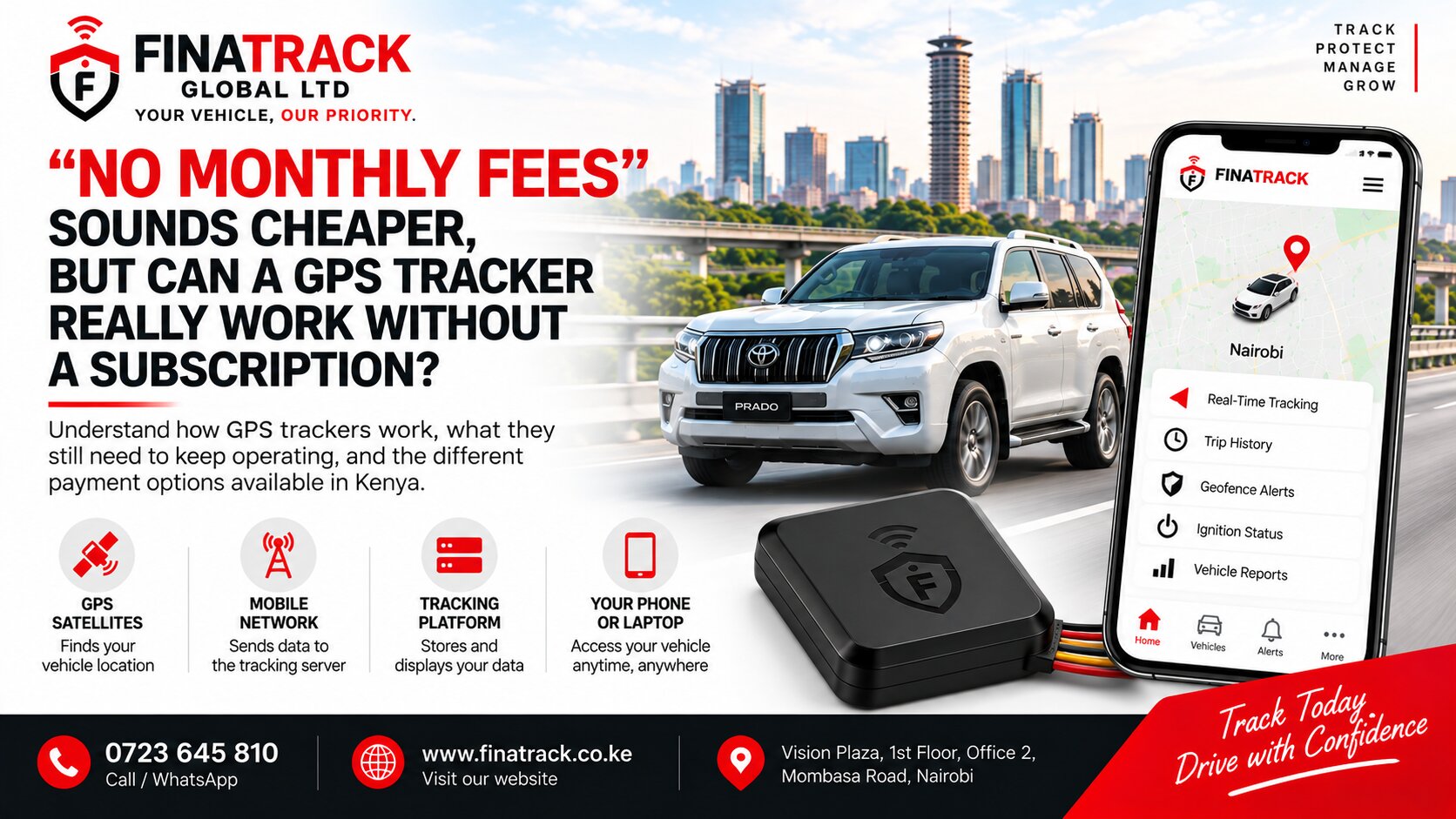
A GPS tracker advertised with “no monthly fees” can immediately sound like the better deal. After paying for the device and installation, most motorists would naturally prefer to continue tracking their vehicle without another bill arriving every month. The important question, however, is what the tracker still needs in order to send your vehicle location to your phone after the initial payment has been made.
A vehicle tracker can certainly operate without a traditional monthly subscription in some setups, but that does not necessarily mean the entire tracking service operates forever without any ongoing cost. A conventional GPS tracker normally requires satellite positioning, mobile network connectivity, a SIM or similar communication service, a tracking server and an application through which the customer views the vehicle. Somebody still has to provide and maintain those components even when the customer is not receiving a monthly invoice.
This distinction is particularly important for Kenyan motorists comparing GPS tracking offers. One provider may charge monthly, another may charge annually, while another may bundle several years of connectivity into the installation price. A fourth provider may advertise a one time payment while requiring the customer to maintain their own SIM card and data separately.
The phrase “no monthly subscription” therefore does not automatically mean the same thing across every GPS tracking company. It may simply describe how the provider collects payment rather than how the technology itself operates. Before choosing an offer, the customer should understand exactly what happens after the initial installation period.
A standard vehicle tracker normally determines its location using GPS or another satellite navigation system. That part does not require the tracker to buy mobile data every time it calculates its position. The challenge comes when the device needs to send that location from the vehicle to the owner’s phone.
For most professional vehicle tracking systems, this communication happens through a mobile network. The tracker contains a SIM or communication module that connects to the cellular network and sends information to a remote tracking server. The owner’s application then retrieves the information from that server and displays the vehicle on a map.
This means GPS location and mobile communication perform two separate jobs. The satellite system tells the tracker where the vehicle is, while the mobile network helps the tracker tell the owner where the vehicle is. A device can know its own position but still fail to show that position remotely if it has no communication service.
This is why a SIM card is commonly found inside conventional vehicle GPS trackers. The SIM allows the device to transmit small amounts of data containing coordinates, timestamps, speed, ignition status and other information depending on the system installed. Although each individual message may use relatively little data, the communication service still has to remain active.
A tracker can therefore work without the customer paying a monthly subscription directly to the GPS company, provided the communication arrangement has been structured differently. The cost might be included in the original selling price, charged annually or handled by the owner through their own SIM. The commercial model changes, but the tracker still requires the infrastructure necessary to communicate.
One option is a customer managed SIM card. In this arrangement, the vehicle owner purchases a tracker, inserts their own SIM and keeps enough airtime or data available for the device to transmit. There may be no monthly fee to the tracking company, but the customer becomes responsible for keeping the mobile connection active.
This approach can work for technically confident customers who understand how the device is configured. The owner must make sure the SIM does not expire, the network settings remain correct and the device has enough connectivity to send tracking information. If the SIM stops working, the physical tracker can remain hidden inside the vehicle while live tracking quietly disappears.
That creates one of the biggest differences between a standalone device and a professionally managed tracking solution. With a standalone tracker, the owner may become responsible for hardware, SIM management, configuration and troubleshooting. With a managed system, the provider normally handles more of these responsibilities as part of the service.
Another model is an annual tracking subscription. Instead of paying every month, the customer pays once for twelve months of connectivity and platform access. This still represents an ongoing service cost, but it reduces the inconvenience of monthly billing.
Annual billing is common in vehicle tracking because the service is expected to remain active continuously. The provider can maintain the SIM, tracking platform, server and technical support while the customer makes one scheduled payment each year. For businesses operating several vehicles, this can also simplify budgeting.
A third model bundles connectivity into the initial installation price for a defined period. A company might advertise a one time installation price that already includes the first year or several years of tracking service. The customer experiences no monthly charge during that period because the cost has effectively been prepaid.
This is why buyers should always ask what the quoted price actually includes. A tracker advertised at KES 15,000 may include equipment, professional installation and tracking access, while another device advertised at KES 5,000 may represent only the hardware. The difference cannot be understood correctly until both offers are broken down.
There are also providers that structure their business around one off pricing and absorb normal connectivity or platform costs within the original sale. This can be attractive to motorists because the payment experience is simple. The customer should still ask how long the service is expected to remain active and what happens if the SIM, server or platform later requires renewal.
A one time price is only valuable if the tracking service remains reliable. Saving monthly fees provides little benefit if the system stops communicating and the customer has no technical support. Vehicle security should therefore be evaluated according to reliability rather than billing frequency alone.
This becomes particularly important during theft. A GPS tracker may remain unused from a security perspective for months or even years before the owner genuinely needs it. The worst time to discover that connectivity expired six months earlier is after the vehicle has disappeared.
Customers should therefore distinguish between hardware ownership and tracking service availability. Once you purchase the tracker, the physical device may belong to you permanently. Remote tracking, however, still depends on communication and platform infrastructure continuing to operate.
The same distinction exists with many connected devices. Buying the hardware does not automatically make telecommunications services free forever. The cost may be hidden within another payment structure, but the underlying network still has operating expenses.
A professional tracking platform also creates ongoing costs beyond the SIM card. Servers must receive and store information from vehicles, applications need maintenance and customer accounts must remain accessible. Trip histories, alerts, geofences and reports all depend on software infrastructure that continues operating after the installation technician leaves.
For a single vehicle owner, these technical systems may be largely invisible. The customer simply opens the mobile application and expects the vehicle to appear. Behind that simple action, several systems need to communicate correctly.
The tracker has to obtain its location, connect to the mobile network, transmit information to the server and associate the data with the correct customer account. The server then has to store and present that information through the application. If one part fails, the customer may experience delayed updates or an offline vehicle.
This is why the cheapest subscription structure is not automatically the best value. A tracking company charging an annual service fee may be providing active SIM management, server hosting and technical support. Another company offering no subscription may provide a different level of service.
Neither model is automatically good or bad. The customer needs to compare what is included, how long it is included and what support exists when something goes wrong. The value of the tracker depends on the complete service rather than one line on the price list.
Motorists should also be cautious about the term “lifetime tracking.” The phrase can sound as though a device will operate indefinitely without any additional requirement. In reality, electronics age, network technologies change and businesses themselves can change over time.
Customers should therefore ask what “lifetime” means in the particular offer. Does it refer to the useful life of the device, the company’s platform access or a prepaid connectivity arrangement? Clear definitions prevent future disagreements.
A GPS tracker installed today may remain inside a vehicle for several years. During that period, the vehicle battery may be replaced, the owner may change phones and the tracker may experience wiring or connectivity problems. Access to technical support can therefore become just as important as the original device price.
Imagine discovering that your vehicle has stopped reporting after a battery replacement. The tracker may simply need its connection checked, but somebody needs to diagnose the problem. A professional provider can inspect the installation and determine whether the issue involves wiring, the SIM, configuration or hardware.
With a completely self managed tracker, the customer may need to perform much of this troubleshooting independently. This may be perfectly acceptable for someone comfortable with electronics, but it is not necessarily what every motorist expects when buying vehicle security. Convenience and support have value even when they create an ongoing service cost.
The tracking application itself should also be considered. Some inexpensive trackers use generic applications that support devices from many manufacturers. Others connect to platforms managed directly by the tracking company.
A generic platform is not necessarily unreliable, but the customer should understand who operates it and what happens if the service changes. A physical tracker can continue working electrically while becoming difficult to use if the associated software platform disappears or is no longer supported.
Businesses should pay even greater attention to platform continuity. A fleet manager may depend on historical trips, mileage reports, geofences and multiple vehicle access. Losing the platform creates a much larger operational problem than simply losing the location of one private car.
For fleets, subscription cost should therefore be compared with the value generated by the information. If tracking helps reduce unnecessary mileage, identify after hours use, improve dispatching or strengthen maintenance planning, the service can create operational value throughout the year. Focusing entirely on avoiding a monthly or annual charge may overlook those savings.
Small businesses often make this mistake when purchasing tracking equipment. The owner compares ten devices based mainly on installation price without considering the amount of management work each option creates afterwards. A system that requires separate SIMs, multiple applications and manual renewals can become difficult to manage as the fleet grows.
Standardised professional tracking can simplify administration. Vehicles appear through one platform, subscriptions can be managed centrally and technical support can address faults across the fleet. The service fee, where applicable, should therefore be evaluated as part of fleet management rather than simply an extra charge attached to the tracker.
The same principle applies to data storage. A customer may expect to review trips from several months ago, but historical records require server capacity. Different providers may retain data for different periods depending on their platform and service arrangement.
Before installation, businesses with reporting requirements should ask how long trip history is available. This matters where tracking information is used for mileage audits, fleet reviews or accident investigations. The cheapest service may not necessarily provide the historical depth the business requires.
Alerts also depend on the broader tracking infrastructure. Geofence, ignition, overspeed or power-disconnection information must travel from the tracker to the server before reaching the user. An inactive communication service means the device may no longer provide those alerts remotely.
This demonstrates why a tracker without connectivity is not the same thing as an active tracking service. The device may still be physically installed, but the most useful remote functions depend on data reaching the owner. Vehicle owners should never confuse the presence of hardware with confirmation that monitoring remains active.
One of the easiest ways to check the service is to open the application periodically and look at the last update time. If the vehicle has been used recently, the platform should show recent tracking activity according to the device configuration. An unexpectedly old timestamp deserves investigation.
This should be done regardless of whether the customer pays monthly, annually or has a one off package. Billing structure does not guarantee technical performance. Every tracking system should be checked occasionally.
Trip history provides another useful health check. Drive the vehicle and later confirm that the journey appears normally. If the car travelled several kilometres but no trip was recorded, technical support may need to investigate.
The customer should not wait until theft to perform this test. A tracker is most valuable when the owner already knows that the system is working. Security confidence should be based on actual recent communication rather than remembering that a technician installed a device several years ago.
Another issue to understand is mobile network technology. Older trackers may rely on previous generations of cellular communication, while newer devices increasingly use 4G technologies. Even if an old tracker currently works, customers should consider its long term support and compatibility.
A tracking package without recurring fees may appear cheaper partly because it uses older hardware. That does not automatically make the device unsuitable, but buyers should ask what network technology is being installed. The tracker is expected to remain in service for years, making future compatibility important.
The device should also be suitable for Kenyan mobile networks. Simply importing a tracker advertised as 4G does not guarantee that its frequency bands and configuration are ideal for local use. Professional suppliers should select hardware appropriate for the operating environment.
Network coverage itself will never be identical everywhere. Vehicles can travel through locations where communication becomes weak or temporarily unavailable. Depending on the tracker, location records may be stored and uploaded later once the network returns.
Customers operating vehicles in rural or remote areas should ask how the system behaves during these gaps. A tracker that stores journey data can provide useful historical information even when live visibility was temporarily interrupted. This can be particularly important for trucks, project vehicles and field fleets.
Subscription models can also influence roaming and cross border tracking. A Kenyan vehicle travelling into another country may require the tracker SIM to connect to a partner network. Whether that communication works and whether additional charges apply depends on the provider and SIM arrangement.
A motorist who regularly drives into Uganda or Tanzania should therefore not assume that a “no monthly fee” tracker automatically provides unlimited regional tracking. Cross border capability should be confirmed before the journey. The same applies to logistics companies operating across East Africa.
Another cost that motorists sometimes overlook is battery maintenance for wireless trackers. A wireless device may avoid a permanent wired installation, but its internal battery eventually requires charging or replacement. There may be no monthly tracking bill, yet the device still requires ongoing attention.
The owner should understand expected battery life and reporting behaviour. A wireless tracker configured for frequent updates can consume power faster than one designed primarily as a backup device. Battery performance and live reporting are often connected.
Tracking tags may operate under another commercial model entirely. Some technologies use alternative communication methods and may have longer battery life or different service requirements. Customers should therefore compare each security product according to how it actually communicates rather than assuming every small tracking device works like a conventional GPS unit.
The correct choice depends on purpose. A wired GPS tracker is suitable for continuous everyday monitoring, while a wireless tracker can provide flexible or backup visibility. A tracking tag can add another recovery layer depending on the technology.
For higher value vehicles, focusing only on subscription cost can therefore miss the larger security issue. The owner should ask what happens if the primary tracker is found, power is disconnected or communication is disrupted. Layered security may be more valuable than saving a modest recurring amount.
An alarm or immobilisation system can complement tracking. The alarm provides local intrusion awareness, while the tracker helps maintain remote visibility. An immobilisation layer can make unauthorised operation more difficult depending on the vehicle and installation.
These systems have different cost structures because they perform different jobs. A car alarm may not require a tracking server, while a GPS tracker usually depends on remote communication. Customers should not expect every security technology to follow the same payment model.
Remote immobilisation also requires careful consideration. If the tracking platform allows an authorised user to send commands to the vehicle, reliable communication becomes particularly important. A tracker without an active data connection cannot receive remote commands simply because the hardware is still powered.
This illustrates why connectivity is fundamental. The device needs a communication path in both directions where remote commands are part of the solution. Losing mobile service can therefore affect more than just the position shown on the map.
Businesses considering GPS tracking should calculate the service cost against the potential cost of not having reliable tracking. One stolen commercial vehicle can interrupt deliveries, customer visits or field operations. Poor fleet visibility can also create unnecessary fuel and mileage costs every working day.
Tracking should therefore be treated as an operational investment. The cost is justified when the information and security capability create more value than the business spends maintaining the system. The exact calculation will differ from one organisation to another.
A company operating two sales cars may mainly value theft protection and mileage records. A logistics company with twenty trucks may derive additional value from route visibility, fuel control and driver management. The same subscription price can therefore represent very different value depending on how the system is used.
Private motorists should use a simpler approach. Ask what you need the tracker to do and whether the package will reliably provide those functions over the period you expect to own the vehicle. If your main requirement is security, reliability should take priority over complicated features you may never use.
Then ask exactly how the service is paid for. Is the amount genuinely one off, does it include a specific number of years, will there be an annual renewal or will you manage the SIM yourself? A reputable provider should be able to answer clearly.
Customers should also ask whether technical support remains available after the initial payment. If the tracker stops updating six months later, who will inspect it? Does the package include any warranty or service arrangement?
The tracking application’s availability should be confirmed too. Can the vehicle be monitored from both a phone and a web platform if required? Can multiple authorised users access the vehicle where needed?
Fleet users should ask how additional vehicles are handled. If the business grows from five vehicles to twenty, will the same platform manage them all? A solution that works comfortably for one private car may become cumbersome for a larger organisation.
Another important question concerns SIM renewal and replacement. SIM cards can fail or require replacement just like other technology. The customer should know whether the tracking provider handles this or whether the responsibility belongs to the vehicle owner.
If the provider manages the connectivity, the service fee may cover more work than customers initially realise. The company is not simply charging for data; it may also be managing device communication, troubleshooting and platform administration. Understanding those components makes price comparison fairer.
Motorists should therefore be cautious about statements suggesting that subscription fees are always unnecessary exploitation. Some providers may charge more than others, but ongoing services have real operating costs. The useful comparison is whether the fee reflects genuine service and value.
The opposite caution is equally important. A monthly subscription does not automatically guarantee superior quality. Customers should still evaluate installation, support, hardware, application reliability and customer service.
The best tracking offer is the one where the commercial model is transparent. The customer should understand the initial cost, recurring cost if any, renewal schedule and what happens when payment stops. Hidden charges create more frustration than reasonable charges explained clearly from the beginning.
Finatrack Global Ltd provides vehicle tracking solutions for Kenyan motorists and businesses, including professionally installed wired GPS trackers. The wired GPS tracker is currently offered at KES 15,000 as a one off installation price, allowing customers to access core GPS tracking functionality without a standard monthly subscription attached to the basic wired tracker package.
The practical value of this approach is simplicity. Customers know the initial tracking cost while gaining access to vehicle location, trip history, geofencing, alerts and other supported functions through the tracking platform. The exact service arrangement and any future requirements should always be confirmed at installation so the customer understands how their particular tracking package is maintained.
Finatrack also provides wireless tracking and additional vehicle-security solutions for motorists who require backup protection or more specialised monitoring. The right system depends on the vehicle, how it is used and the level of security the owner requires.
Professional installation can be arranged at the customer’s convenient location or through Finatrack Global Ltd at Vision Plaza, 1st Floor, Office 2, Mombasa Road, Nairobi. Motorists and businesses looking for GPS tracking solutions can contact 0723 645 810 or visit www.finatrack.co.ke for more information.
A GPS tracker can therefore work without you receiving a bill every month, but the phrase “no monthly subscription” should never end the buying conversation. The tracker still needs power, communication, software and technical support to remain useful, and those services must be provided through some commercial arrangement. Before choosing any vehicle tracker in Kenya, understand not only what you pay today but also what keeps the device communicating tomorrow.