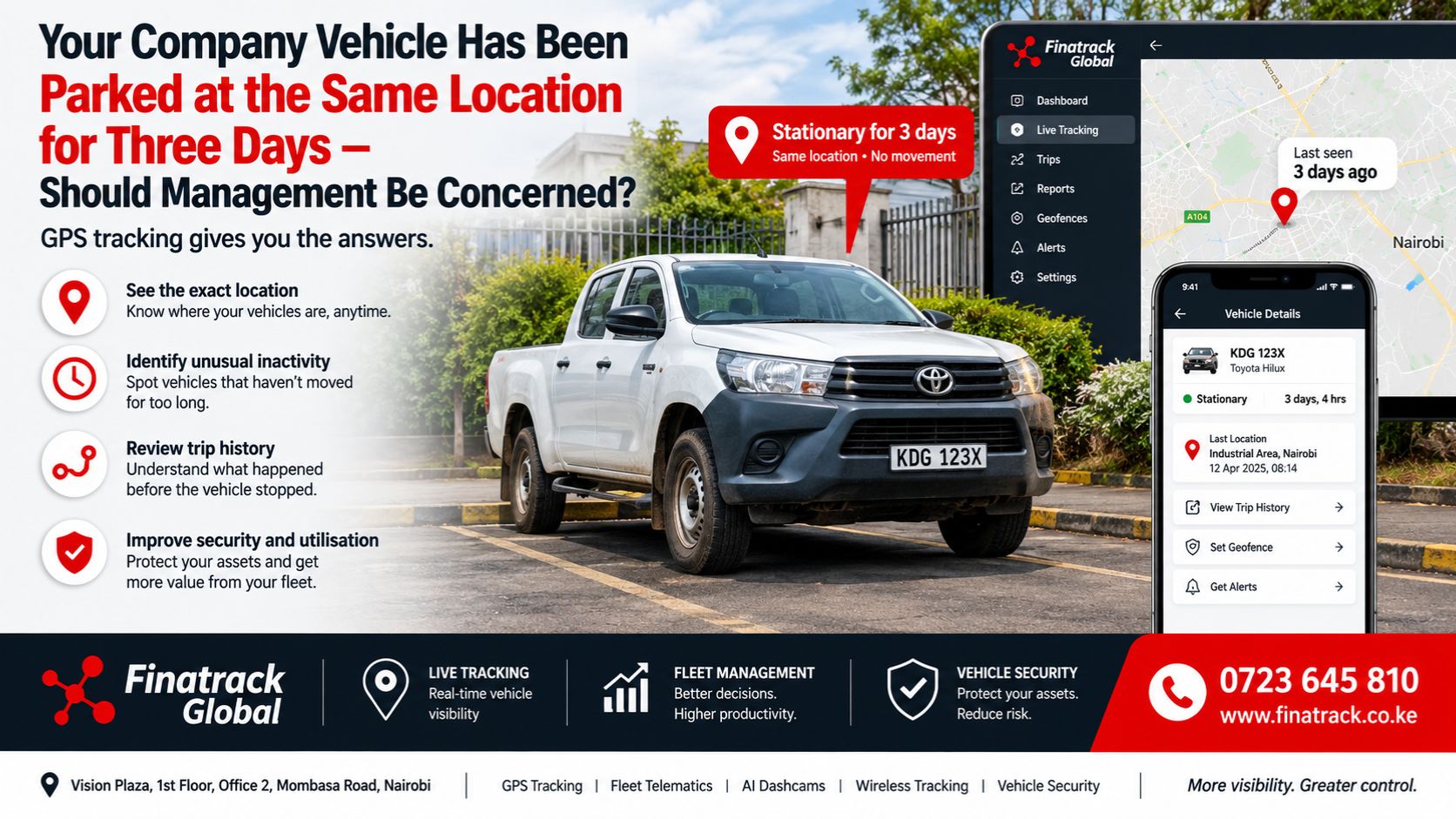
A company vehicle that remains parked in the same location for three days can mean many things. It may be waiting for an assignment, undergoing repairs, stationed at a project site or simply not required for current operations. But when management does not know why the vehicle has stopped moving, three days of inactivity should be enough to ask questions.
The concern is not necessarily that something is wrong. The real concern is that a valuable business asset has become inactive without management having a clear explanation.
For companies operating several vehicles, this can happen surprisingly easily. A pickup assigned to a field employee may remain at a customer location longer than expected. A truck may stop at a workshop and never return to service. A company car may be left at an employee’s residence while another department continues requesting additional transport.
Without reliable fleet visibility, these situations can remain unnoticed for days.
GPS tracking gives management a way to identify prolonged vehicle inactivity without physically checking every asset. An authorised fleet manager can see the vehicle’s last reported location, when it arrived there and whether it has moved since.
That information does not immediately explain why the vehicle is stationary, but it gives management a clear starting point.
A vehicle parked at the company’s authorised yard for three days may present little concern if the business simply has no immediate assignment for it. The same vehicle remaining at an unfamiliar roadside location for three days should receive a very different response.
Location provides context.
A fleet manager should therefore begin by determining whether the vehicle is parked somewhere expected. Is it at the company premises, an approved project site, an employee’s residence, a workshop or a known customer location?
If the answer is yes, the next question is whether management expected it to remain there for that long.
A construction pickup may legitimately stay at a remote project site for several days. A sales vehicle that normally completes customer visits every weekday should not remain stationary for the same period without an explanation.
Understanding the normal operating pattern of each vehicle is therefore essential.
Trip history can help establish when the vehicle reached the location and what happened immediately before it stopped moving. Management can review the last completed journey and determine whether the destination was connected to official work.
This can reveal situations that would otherwise remain hidden.
A driver may report that the vehicle is at a workshop, for example, but the tracking history may show that it was driven to an entirely different location. That does not automatically prove misuse, but it gives management a reason to verify the explanation.
There are also occasions when a vehicle has genuinely broken down.
A driver may park the vehicle while waiting for repairs, spare parts or recovery assistance. If this information does not reach the fleet manager promptly, the vehicle may simply appear inactive on operational records.
GPS tracking can help identify the location of the stranded vehicle so that maintenance or recovery support can be coordinated more effectively.
The issue then becomes less about security and more about downtime.
Every day a commercial vehicle remains unavailable can affect productivity. A service company may have fewer technicians available for customer visits. A delivery business may have to redistribute work to other vehicles. A contractor may struggle to move staff or materials between sites.
A parked vehicle may therefore be costing the business even when it is not consuming fuel.
The company is still paying for insurance, depreciation, financing where applicable and other ownership costs while receiving little or no productive use from the asset.
This is why prolonged inactivity should also be viewed as a utilisation question.
A company may own ten vehicles because management believes all ten are necessary. GPS records may show that two of them regularly remain parked for several days at a time.
That does not automatically mean those vehicles should be sold. Some assets may be maintained for emergency response, specialised work or seasonal demand.
But management should understand why each asset exists.
If a vehicle remains inactive repeatedly while other vehicles are heavily utilised, the company may have an allocation problem rather than a fleet shortage.
One department may be holding a vehicle that it rarely uses while another department is requesting an additional car.
Better fleet visibility can expose these imbalances.
Instead of approving another purchase immediately, management can review whether existing vehicles can be reassigned.
For larger businesses, that decision can prevent unnecessary capital expenditure.
Security should also be considered when a vehicle remains stationary in an unusual location.
A company vehicle parked away from controlled premises for several days may face greater exposure to theft, vandalism or interference. The risk may be even higher when the vehicle contains tools, equipment, stock or other valuable company property.
Management should know who has possession of the keys and why the vehicle has been left there.
Depending on the tracking system installed, ignition or movement alerts can provide additional protection. If a vehicle that has been stationary for several days suddenly begins moving, authorised personnel can be notified.
This can be particularly useful outside normal working hours.
A vehicle parked legitimately at a project site during the week should attract attention if it suddenly begins moving late at night without an authorised assignment.
The same principle applies to vehicles kept at employee residences.
Some companies allow employees to take vehicles home because their jobs require early departures, emergency response or direct travel to customers. This can be an efficient operating arrangement.
But it should not mean management loses visibility over the vehicle.
If the car remains parked at the employee’s home for three working days while they are expected to be carrying out field assignments, management may need to understand why.
Perhaps the employee is on leave and nobody reassigned the vehicle. Perhaps they are working remotely. Perhaps the car has developed a mechanical problem.
The purpose of GPS tracking is not to immediately assume misconduct. It is to make unusual situations visible enough to investigate.
Another possibility is that the tracker itself is no longer reporting correctly.
Fleet managers should distinguish between a vehicle that is genuinely stationary and a vehicle whose GPS device has stopped updating.
A tracking platform may show the same location repeatedly because that was the last position received before the device went offline.
This makes device status important.
If the vehicle is expected to be moving but the location has not changed for several days, management should first confirm whether the tracker is online and communicating normally.
A power problem, wiring issue, network interruption or device interference may require technical attention.
Simply looking at the map without checking tracker status can lead to incorrect conclusions.
This is why businesses should have a process for reviewing devices that remain offline or stationary for unusually long periods.
The responsible person should know whether to contact the driver, verify the vehicle physically or request technical support.
Waiting until somebody eventually notices that a vehicle has disappeared from normal operations is not a strong fleet-management system.
Extended parking can also expose maintenance problems.
A vehicle may repeatedly spend several days at garages because of recurring mechanical faults. If management focuses only on the repair invoices, it may overlook the larger operational impact.
Trip and utilisation records can show how frequently the vehicle is unavailable.
At some point, management may need to compare the cost of continuing to repair the asset with the cost of replacing it.
Downtime is part of the true cost of vehicle ownership.
A cheap vehicle that is constantly unavailable may ultimately cost the company more than a reliable vehicle with a higher purchase price.
Fleet data can help make that discussion more objective.
There is also the question of productivity.
A company vehicle does not necessarily need to travel long distances every day to justify its existence. But its availability should support a clear business purpose.
If a vehicle remains parked for three days because nobody has assigned it work, management should examine whether that reflects low demand, poor scheduling or excessive fleet capacity.
The solution may involve changing how vehicles are booked or shared between departments.
A centralised pool system can sometimes improve utilisation. Instead of one vehicle remaining permanently assigned to an employee who rarely needs it, several authorised employees can access the vehicle according to operational demand.
GPS tracking can support that arrangement by providing records of when and how the asset is used.
Prolonged inactivity can even become useful information when planning future fleet purchases.
Businesses frequently make purchasing decisions based on requests from departments rather than evidence of actual vehicle demand.
Before adding another vehicle, management can review whether existing assets regularly spend entire working days parked.
If they do, the first investment may need to be better fleet allocation rather than another vehicle.
For companies operating remote sites, the same principle applies with additional challenges.
A pickup may remain hundreds of kilometres from head office for several days. Physical verification may not be practical.
GPS tracking allows management to confirm that the vehicle remains at the project location and gives the business a record of when it last moved.
If the project manager confirms that the vehicle is intentionally parked, the matter may require no further action.
If nobody at the project knows why it has remained there, management now has a reason to investigate.
The most important lesson is that GPS data should trigger questions rather than automatic conclusions.
A stationary vehicle is not automatically a misused vehicle.
It may be exactly where it should be.
The management problem begins when nobody knows whether that is true.
Businesses should therefore define what unusual inactivity means for their fleet. A delivery van remaining stationary for six working hours may deserve attention, while a backup vehicle parked for several days may be completely normal.
The threshold should reflect the purpose of the asset.
Alerts and reports can then be configured or reviewed according to those operating requirements.
Employees should also understand the company’s expectations regarding vehicle availability, breakdown reporting and prolonged parking.
If a vehicle becomes unusable, the driver should report the problem rather than simply leaving it somewhere and assuming another department will handle it.
Good technology works best alongside good communication.
Access to location information should remain controlled. Only employees with legitimate responsibilities for fleet management, security or operations should normally have access to tracking data.
The purpose is to manage business assets professionally, not to create unnecessary monitoring of employees.
For a company with only three vehicles, a stationary vehicle may be noticed quickly because everybody knows what each car is doing.
For a business operating 30, 50 or 100 vehicles, one asset can remain inactive for days before somebody at head office realises it.
That is where fleet visibility becomes particularly valuable.
Finatrack Global Ltd provides professionally installed GPS tracking, fleet telematics, fuel monitoring, wireless tracking, AI dashcams and vehicle security solutions for businesses operating vehicles across Kenya.
Tracking systems can help authorised managers monitor vehicle locations, review trip history and identify unusual periods of inactivity depending on the solution installed.
Professional installation can be arranged at the customer’s convenient location or at Vision Plaza, 1st Floor, Office 2, Mombasa Road, Nairobi.
Businesses seeking greater visibility over vehicle movement, utilisation and security can contact Finatrack Global Ltd on 0723 645 810 or visit www.finatrack.co.ke.
A company vehicle parked for three days may have a perfectly reasonable explanation.
But if management does not know what that explanation is, that is already a fleet-management problem.