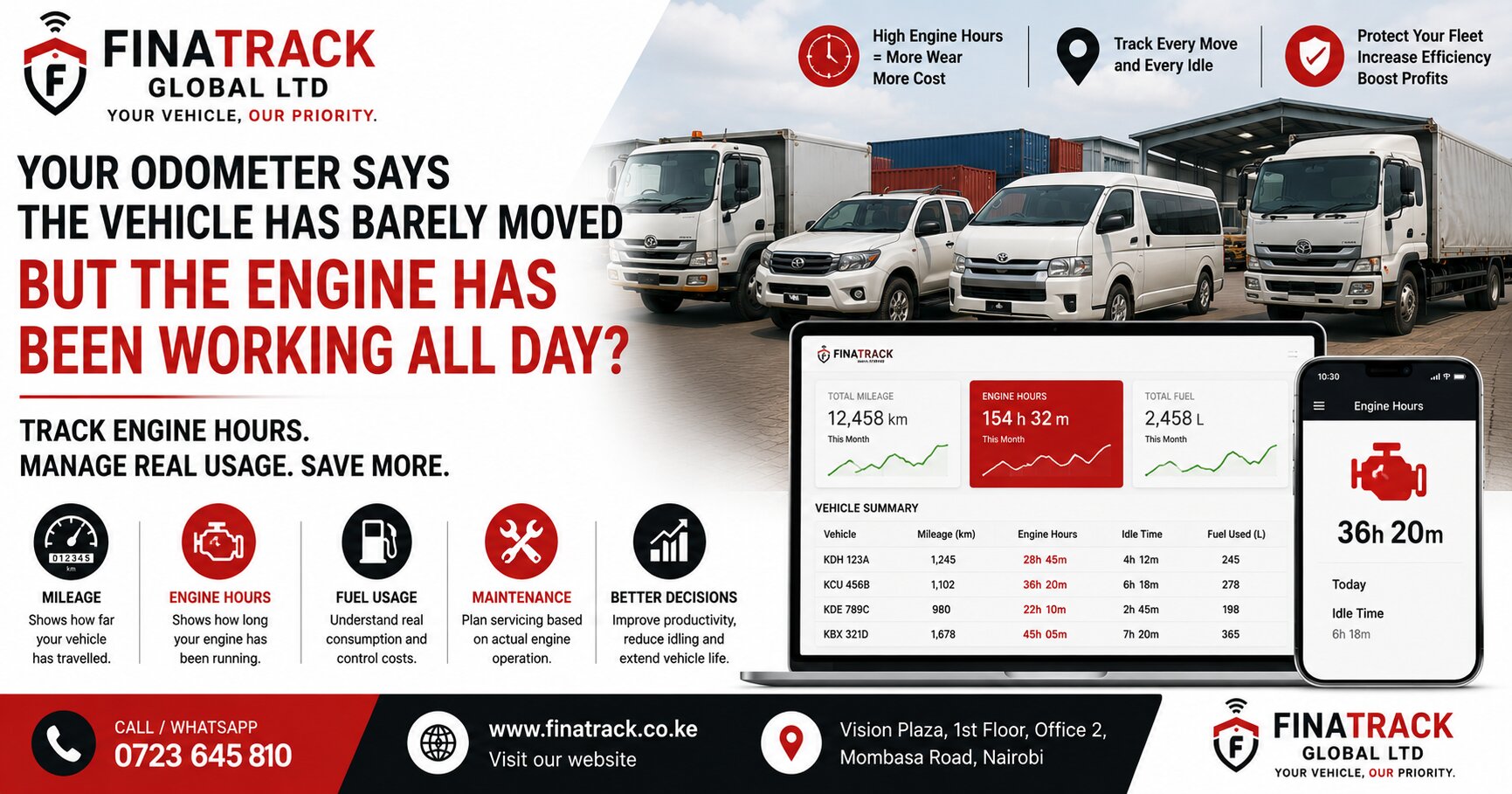
A company vehicle can spend an entire working day using fuel and accumulating mechanical wear without travelling very far. A delivery truck may queue for hours at warehouses, a construction pickup may remain running at a project site, while a service vehicle can spend long periods stationary with the engine on. If management looks only at kilometres travelled, these vehicles may appear lightly used even though their engines have been operating for much of the day.
This is why fleet managers should understand the difference between vehicle mileage and engine hours. Mileage tells the business how far a vehicle has travelled, while engine hours provide information about how long the engine has been operating. Looking at both can give businesses a much clearer picture of vehicle utilisation, fuel consumption and maintenance requirements.
For many Kenyan businesses, the odometer remains the main measure used to understand vehicle workload. Service intervals are often discussed in kilometres, fuel consumption is compared against distance travelled and managers may assume that a vehicle with low mileage has experienced relatively little use. That assumption can become misleading when vehicles spend substantial amounts of time idling or performing stationary operations.
Consider a truck that travels only 100 kilometres during a working day but spends another five hours waiting at loading points with the engine running. Another vehicle may travel 250 kilometres almost continuously with relatively little idling. Mileage alone makes the second truck appear much more heavily utilised, yet the first vehicle’s engine may have operated for almost as long.
The difference becomes particularly important for fleets working in industries where stationary engine operation is common. Construction companies, security firms, logistics businesses, recovery companies, refrigerated transport operators and field service organisations can all have vehicles whose engines remain active while little or no distance is being recorded. Understanding these operating patterns can help management avoid underestimating actual vehicle use.
Engine hours should not automatically be confused with ignition hours. Depending on the tracking system and vehicle integration, the available measurement may represent the period during which the ignition signal is active rather than a direct reading from the engine management system. More advanced telematics integrations may provide engine runtime information from the vehicle itself, while simpler GPS installations may estimate operating time using ignition status.
This distinction matters when businesses interpret reports. A vehicle can sometimes have ignition switched on while the engine is not actually running, depending on the vehicle and how the tracking system has been configured. Fleet managers should therefore understand exactly what their system is measuring before treating every reported hour as confirmed engine runtime.
The tracking provider should be able to explain whether the figure comes from ignition detection, an onboard diagnostic connection, CAN based data or another supported integration. Businesses should avoid assuming that every GPS tracker automatically reads detailed engine information directly from the vehicle. The available functionality depends on the hardware, installation and vehicle.
Even where the system uses ignition activity rather than direct engine data, the information can still be extremely valuable. Long periods of ignition activity while the vehicle remains stationary can reveal operating behaviour that mileage alone cannot show. Management can then investigate whether the stationary time is legitimate, avoidable or simply part of the vehicle’s job.
A delivery fleet provides a good example. One van may cover 180 kilometres during the day but spend most of the journey moving between customers. Another may cover only 90 kilometres while repeatedly waiting outside warehouses with the engine running.
The second vehicle may appear more economical because its mileage is lower, but that does not necessarily mean it consumed less fuel or experienced less engine use. Without operating time information, fleet management may reach the wrong conclusion about which vehicle is being used more efficiently.
Idling is one of the main reasons engine hours matter. When a vehicle remains stationary with the engine running, the odometer records little or no additional distance, but fuel continues to be consumed. The engine also continues operating along with various supporting systems.
This can make fuel analysis confusing. A fleet manager may see that a vehicle covered relatively few kilometres during the month yet consumed considerably more fuel than expected. The immediate suspicion may fall on fuel theft or poor driver behaviour, but extended engine operation while stationary could also be contributing.
GPS tracking and telematics can help management investigate the difference. If trip records show limited mileage but operating information reveals long stationary engine periods, the business has a more complete explanation for the fuel expenditure. Managers can then determine whether the idling is necessary or whether operating procedures should change.
This distinction is especially relevant in Nairobi traffic. A vehicle moving through congested roads can take a long time to cover a relatively short distance. The engine may remain operational for hours while the odometer accumulates only modest mileage.
A fleet manager comparing fuel purely against kilometres may therefore conclude that the vehicle is performing poorly. Traffic congestion, route conditions and idling can all influence the result. Engine operating information provides valuable context when interpreting urban fuel consumption.
The same problem can occur at loading bays. A truck may arrive at a warehouse and wait for an hour before loading begins, then remain stationary for another period while documentation is processed. If the driver leaves the engine running throughout the delay, the vehicle accumulates operating time without creating productive mileage.
When several trucks show the same pattern at one location, the problem may not be the drivers. The warehouse process itself may be inefficient, creating unnecessary vehicle waiting time. Telematics information can therefore expose weaknesses in business processes as well as driver behaviour.
Management can use the data to ask better operational questions. Why do vehicles consistently spend an hour at this warehouse? Can appointments be scheduled differently, can paperwork be prepared earlier or can loading procedures be improved?
Reducing these delays can save more than fuel. A vehicle that spends less time waiting becomes available sooner for its next delivery, meaning the same fleet may complete more productive assignments during the working day. Engine hours therefore contribute to understanding both vehicle costs and employee productivity.
Construction fleets are another strong example of why mileage alone can be misleading. A pickup or service truck working around a project may travel only short distances between different sections of the site. Its total monthly mileage may appear low despite the vehicle being operational almost every working day.
A service vehicle may remain stationary while powering equipment or supporting technicians, while trucks can spend substantial time queuing around loading areas. These vehicles are working, even though their odometers may not reflect the intensity of that activity. Management that looks only at kilometres may underestimate how heavily the fleet is being used.
Heavy equipment makes the difference even clearer. Excavators, loaders, generators and other machinery can operate for hours without travelling conventional road kilometres at all. Engine or equipment operating hours become far more useful than mileage when planning utilisation and maintenance for these assets.
A company managing both vehicles and machinery should therefore avoid using one measurement for everything. Road vehicles may require a combination of mileage and operating time, while stationary equipment may be managed mainly according to hours. The correct indicator depends on how the asset creates value.
Security patrol vehicles can also generate substantial stationary engine time. A patrol car may remain at a strategic position for part of the night while the driver monitors an estate, warehouse or commercial property. The vehicle is still providing operational value even when it is not moving.
This means management should not automatically treat every long idling period as waste. Some stationary engine use may be necessary for communications, lighting, climate control or the operational role being performed. The important question is whether the time is justified.
Comparing mileage with engine or ignition hours helps reveal unusual patterns. If one patrol vehicle spends significantly more time running while stationary than similar units working comparable shifts, management can investigate why. The difference may be legitimate, but it becomes visible instead of remaining hidden inside the monthly fuel bill.
Refrigerated and specialised commercial vehicles can present another challenge because vehicle systems may need to remain operational during loading, deliveries or waiting periods. Depending on the design, refrigeration or auxiliary equipment may operate independently or in connection with the vehicle’s engine. Fleet managers should understand the exact equipment configuration before interpreting operating time.
A vehicle may appear inefficient when judged solely by kilometres because some of its fuel is supporting another business function. The correct analysis should consider what the vehicle was doing during those stationary periods. Fleet telematics becomes valuable because it adds operating context to the raw mileage figure.
Engine hours can also improve maintenance planning. Many businesses schedule servicing mainly according to kilometres travelled, which remains appropriate for many maintenance requirements. However, vehicles that experience substantial stationary engine operation may deserve additional attention because their engines can accumulate significant operating time without corresponding odometer mileage.
Manufacturers may provide maintenance guidance based on mileage, time, operating conditions or other measurements depending on the particular vehicle. Fleet managers should follow the manufacturer’s recommendations and professional mechanical advice rather than creating their own service intervals purely from telematics data. Engine hours provide additional information that can support those decisions.
A vehicle used under demanding operating conditions may require different attention from another car with similar mileage. Long idling periods, heavy loads, dust, rough terrain and stop start operation can all influence the way a vehicle wears. Looking beyond mileage helps management recognise those differences.
This is particularly important when vehicles are compared internally. Two trucks showing 80,000 kilometres on their odometers may not have experienced identical mechanical workloads. One may have spent much of its life on long highway journeys, while another operated mostly in traffic, loading yards and construction sites.
The second vehicle could have accumulated considerably more stationary engine time and more frequent stop start operation. Treating both assets as identical simply because the odometer readings match can therefore oversimplify maintenance planning. Fleet data provides management with the additional context needed to make better decisions.
Engine hours can also help explain why some vehicles require repairs earlier than expected. Management may wonder why one truck with relatively low mileage experiences more maintenance than another higher mileage unit. Operating environment and engine runtime may provide part of the explanation.
This does not mean every mechanical problem should be blamed on idling. Vehicle age, maintenance quality, driving style, loads, road conditions and mechanical design can all affect reliability. The value of telematics is that it gives managers another piece of evidence rather than forcing them to rely on kilometres alone.
Fuel consumption analysis becomes stronger when operating time is considered. Traditional fleet analysis often compares litres consumed against kilometres travelled. This is useful for vehicles that spend most of their operating time moving, but it becomes less informative when substantial fuel is consumed while stationary.
Fleet managers can therefore examine both distance and operating patterns. A vehicle with high fuel use and high mileage may simply be completing significantly more work, while a vehicle with high fuel use and low mileage may have an idling, mechanical or operational issue requiring investigation. The same fuel bill can mean very different things depending on how the vehicle was used.
Dedicated fuel monitoring can provide another layer for fleets where fuel is a major cost. Fuel level information can be compared with vehicle movement and operating activity to help managers understand when consumption or unusual fuel changes occurred. The technology should be selected according to the type of vehicle and the level of control required.
Engine hours also help businesses identify unproductive operating time. A company vehicle may leave the office at 8 a.m. and return at 5 p.m., creating the impression that it was productive throughout the entire day. Tracking information may reveal that several hours were spent stationary with the engine active.
Some of that time may involve legitimate customer work, loading or waiting. Other periods may represent avoidable delays or employee habits that can be improved. Fleet management becomes more effective when managers investigate the reason rather than simply counting hours.
A salesperson may sit inside a running company car for long periods between appointments, for example. A technician may complete paperwork while leaving the engine on, while a delivery driver may leave the vehicle running during extended unloading periods. Individually these habits may appear small, but across several vehicles they can increase fuel consumption noticeably.
Driver coaching can help where unnecessary idling is identified. Employees should understand why the business wants to reduce avoidable engine time and how the behaviour affects fuel, maintenance and fleet efficiency. Presenting the information as part of cost and productivity management is usually more constructive than treating every idling event as misconduct.
The policy should also be realistic. Drivers need clear guidance on situations where continued engine operation is necessary and situations where switching off is expected. A blanket rule that ignores operational conditions can create confusion and resistance.
Engine hours can also improve driver comparison, but management needs to use the information fairly. A driver assigned to Nairobi deliveries may naturally experience far more stationary engine time than someone travelling long distance highway routes. Comparing the two directly without considering their assignments can produce misleading conclusions.
The most useful comparisons are usually between similar vehicles performing similar work in similar environments. If three vans serving comparable routes show similar mileage but one records much more operating time, management has a legitimate reason to investigate. The difference could involve traffic, route design, driver habits or customer waiting periods.
Route analysis can then provide additional context. If the vehicle with higher engine hours regularly travels through more congested corridors, the driver may not be responsible for the difference. The company may need to redesign the route or change delivery times instead.
This demonstrates why telematics should support better management rather than become a simple employee surveillance system. Data reveals patterns, but experienced managers still need to understand the circumstances behind them. The strongest decisions combine technology with operational knowledge.
Fleet utilisation can also be measured more intelligently when mileage and operating hours are considered together. A vehicle that records high mileage is clearly being used, but low mileage does not automatically mean low utilisation. Some vehicles provide value while stationary or while operating within a small geographical area.
This becomes important when management considers selling underused vehicles. A pickup may appear lightly used because it only accumulates 1,000 kilometres a month, yet it could spend many hours supporting field technicians on site. Selling it because the mileage appears low could create an unexpected operational gap.
The opposite situation is also possible. A vehicle may accumulate moderate mileage while spending much of the day running unnecessarily. Management could interpret the operating hours as high utilisation when much of that time is actually waste.
Understanding the purpose behind the hours is therefore essential. Productive operating time and unnecessary operating time are not the same thing, even though both can appear similar in a report. Managers need to investigate patterns rather than simply rewarding the highest number.
For businesses operating generators and stationary equipment, engine hours become even more important because mileage provides no meaningful information at all. A generator may run for hundreds of hours while remaining in exactly the same location. Maintenance, utilisation and fuel analysis therefore need to revolve around operating time.
Construction companies and remote project operators often manage vehicles and generators together. A fleet telematics strategy can help create better visibility over these different assets, although the equipment and integration required may vary. Managers should select the tracking solution according to the asset rather than assuming one device configuration is suitable for everything.
Engine hours can also support rental and equipment hire businesses. Machinery may be hired according to operating hours rather than kilometres, and telematics can provide additional information about how long equipment was active. The tracking data should still be combined with appropriate contractual and operational records.
For road vehicles hired to customers, mileage may remain the primary billing measure. For excavators, loaders or generators, hours may be much more relevant. Businesses managing mixed assets should therefore structure reports accordingly.
Engine operating data can also become useful when investigating after hours use. A vehicle expected to remain parked overnight may show unexpected ignition or engine activity even if it does not travel far. Someone could be sitting in the vehicle, moving it within a compound or using it for another activity without accumulating significant mileage.
Trip history alone might not make this obvious because there may be no significant journey. Ignition or engine activity information can reveal that the vehicle was active despite remaining near the same location. Management can then verify whether the activity was authorised.
Security is another reason this information matters. Unexpected ignition activity while a vehicle is parked can sometimes provide an early indication that somebody is interacting with the vehicle. When combined with movement, power disconnection or geofence information, the event can become more significant.
One isolated ignition event should still be interpreted cautiously. A driver may have started the vehicle to move it within the yard, a mechanic may be testing it or another authorised employee may have legitimate access. The context determines whether the activity is routine or concerning.
The same approach should be applied to maintenance investigations. If a fleet manager notices an unusual rise in engine operating time without corresponding mileage, the first step should be understanding what changed operationally. Automatically blaming the vehicle or driver can lead to the wrong solution.
Perhaps a customer began keeping trucks waiting longer during unloading. Perhaps a construction project changed its operating procedure or traffic conditions became worse on the normal route. Telematics can show that something changed, but management still needs to identify the cause.
Over several months, the data can reveal valuable trends. A fleet manager may discover that idling and stationary operating time rise sharply during certain periods of the year or around particular customer sites. This allows the business to address recurring inefficiencies rather than treating every month as an isolated problem.
Engine hours can also help management evaluate whether dispatching practices are efficient. A service vehicle may spend too much time waiting between assignments because jobs are poorly coordinated. The engine may remain running while the driver waits for instructions, increasing costs without improving customer service.
Better dispatching can reduce this waste. Real time GPS location allows the office to identify which technician or vehicle is closest to the next assignment. This can convert previously idle working time into productive customer activity.
The same concept applies to delivery vehicles. A truck that finishes one delivery and waits for an hour before receiving its next assignment represents unused capacity. Fleet visibility can help dispatchers plan the next movement sooner where the operation allows.
Businesses should also consider how engine hours affect vehicle replacement decisions. An odometer alone may not tell the complete story of how intensively a commercial vehicle has been used. A lower mileage truck with very high operating hours may have experienced considerably more working time than management initially assumes.
This does not automatically mean it should be replaced sooner. Vehicle condition, maintenance history and mechanical inspection remain essential. Engine hours simply add useful context when evaluating the asset’s operational life.
When buying used commercial vehicles, the same principle can be relevant where reliable operating hour information is available. Mileage should not be interpreted as the only indicator of previous use. The vehicle’s history and mechanical condition remain more important than one number viewed in isolation.
For businesses financing vehicles, better utilisation information can also support capital decisions. Management may discover that some assets are working far harder than others even when mileage differences appear modest. Reallocating workloads can help balance wear before purchasing more vehicles.
A business considering another truck should first understand whether current vehicles are genuinely operating near capacity. If several units spend excessive hours waiting rather than working productively, the company may have a scheduling problem rather than a fleet shortage. Telematics can help reveal the difference.
This can prevent expensive investment mistakes. Purchasing another vehicle introduces insurance, maintenance, tracking, financing and depreciation costs. Improving the utilisation of existing vehicles may be the more economical solution.
On the other hand, consistently high productive operating time across the fleet can support the case for expansion. If vehicles are working intensively and scheduling remains difficult despite efficient operations, additional capacity may genuinely be needed. Data gives management stronger evidence for making that decision.
GPS tracking alone should not be assumed to provide precise engine hour information on every vehicle. Some systems estimate activity from ignition status, while others require more advanced integration to access vehicle data. The available information depends on the tracker, vehicle and telematics solution.
Businesses interested in engine hour monitoring should therefore discuss the requirement before installation. The provider can determine which method is technically appropriate and what level of accuracy or information the system can provide. This prevents customers from expecting functionality that was never part of a basic tracking installation.
The same discussion should cover vehicle type. A modern truck, older pickup, generator and excavator may require different integration methods. The system should be designed around the asset rather than forcing identical hardware onto every application.
Professional installation becomes especially important when ignition detection forms part of the monitoring system. Incorrect wiring can cause the platform to show ignition permanently on or permanently off, making operating hour information unreliable. Testing should therefore be completed before the customer begins using the reports.
The installer should confirm that the platform responds appropriately when the vehicle starts and stops. A short test journey can also verify that movement and ignition information are being recorded correctly. Businesses planning to rely on this information for driver or maintenance decisions need confidence in the installation.
Tracker health should be checked regularly as well. If a device loses power or communication, engine and ignition records may become incomplete. A vehicle could continue operating normally while the fleet platform develops gaps in its history.
Managers should therefore review the last update time along with utilisation reports. A vehicle appearing to have very few engine hours may simply have had an offline tracker. Reliable data requires reliable devices.
Workshop visits can also interrupt monitoring. Battery replacement, dashboard repairs and electrical work can disturb tracker wiring or ignition connections. After significant repairs, management should confirm that location and ignition information are still reporting normally.
A simple post workshop check can prevent weeks of missing operating data. Start the vehicle, confirm that the tracker updates and review the platform after a short journey. Problems identified immediately are much easier to correct than gaps discovered months later.
Businesses should also avoid drowning in reports. The objective is not to collect every possible data point but to focus on information that supports decisions. Mileage, operating time, fuel consumption, idling and utilisation should be reviewed together where they are relevant to the fleet.
A small business may begin with a simple monthly comparison. Which vehicles travelled the most kilometres, which accumulated the most ignition or engine time and which showed unusually long stationary periods? Those questions alone can reveal important differences.
Larger fleets can compare similar vehicle groups and identify exceptions. A fleet manager does not need to investigate fifty normal vehicles if two units show dramatically different operating patterns. Exception based management makes telematics more practical.
The strongest insight comes from combining the measurements. High mileage with reasonable operating time may indicate efficient long distance use, while low mileage with high operating time may indicate heavy idling or stationary work. High mileage and high operating time may simply reflect a heavily utilised asset that requires closer maintenance attention.
None of these patterns is automatically good or bad. The value comes from understanding why they exist and whether they support the purpose of the vehicle. Data becomes useful when it leads to operational action.
Finatrack Global Ltd provides professionally installed GPS tracking and fleet telematics solutions for Kenyan businesses operating cars, vans, trucks, construction vehicles and other commercial assets. Depending on the vehicle and required telematics solution, businesses can use location, trip, ignition and other operating information to develop a clearer picture of fleet activity.
Professional installation can be arranged at the customer’s convenient location or through Finatrack Global Ltd at Vision Plaza, 1st Floor, Office 2, Mombasa Road, Nairobi. Businesses looking to improve fleet utilisation and operating visibility can contact 0723 645 810 or visit www.finatrack.co.ke to discuss a suitable solution.
A vehicle that has travelled only a few kilometres may still have spent most of the day working, waiting or burning fuel. Mileage tells an important part of the fleet story, but it does not always tell the whole story. When businesses compare kilometres with engine or ignition operating time, they gain a clearer understanding of how vehicles are being used and where fuel, maintenance and productivity improvements may be possible.