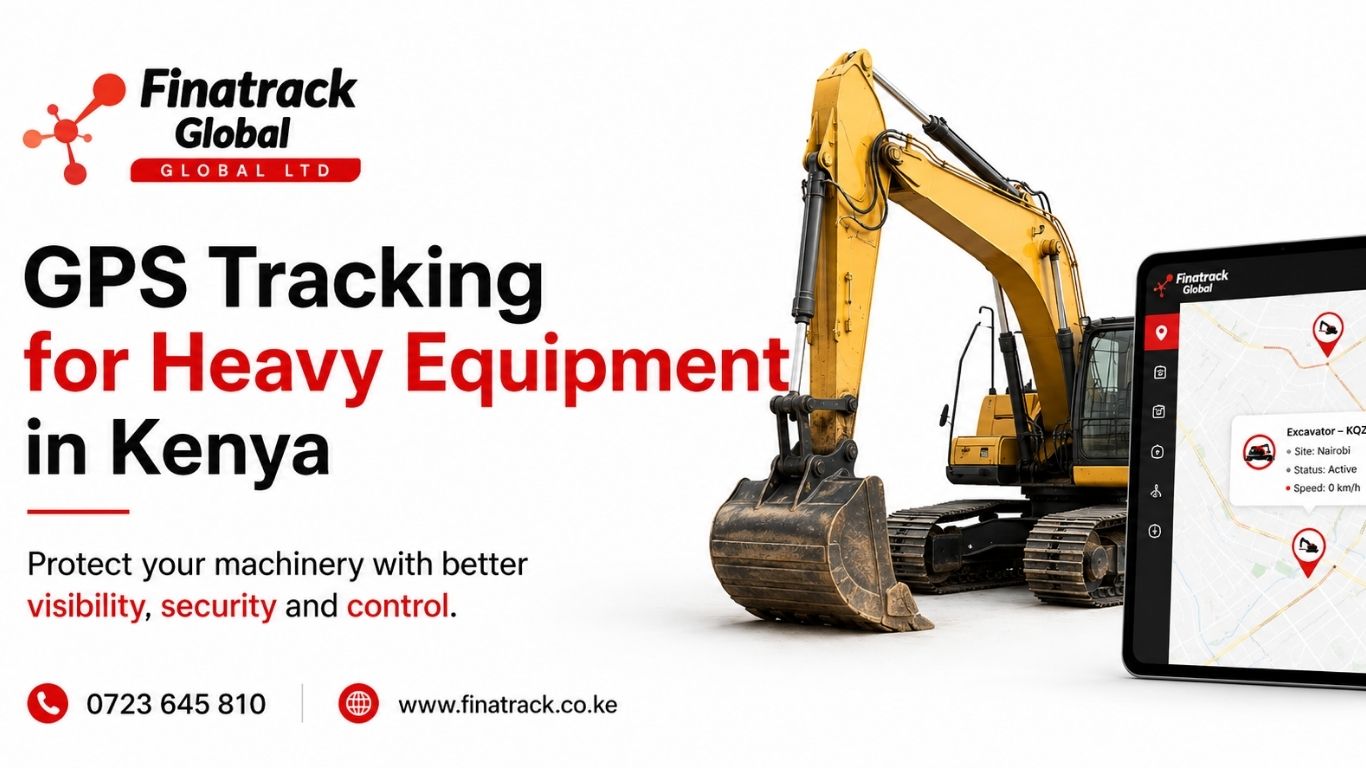
Heavy equipment is one of the most expensive assets owned by construction companies, contractors, quarry operators, agricultural businesses and infrastructure firms in Kenya. Excavators, loaders, graders, bulldozers, generators and other machinery can remain at remote project sites for weeks or months, often far from the company’s main office. When management cannot physically supervise these assets every day, knowing where they are and how they are being used becomes an important part of protecting the investment.
GPS tracking gives businesses greater visibility over heavy equipment operating away from headquarters. Depending on the equipment and tracking solution installed, authorised managers can monitor location, review movement history and receive selected alerts when unusual activity occurs. The technology does not replace physical security or responsible site management, but it provides an additional layer of information that can help businesses maintain control over valuable machinery.
The financial risk involved is significant because heavy equipment can represent millions of shillings in capital. A single excavator or loader may cost considerably more than several ordinary company vehicles combined, and replacing specialised machinery after theft can disrupt projects for weeks. The business may also face additional costs from hiring temporary equipment while waiting for replacement or recovery.
Construction sites create particular security challenges because they are often temporary environments. Machinery may be parked overnight behind fencing or guarded by security personnel, but sites can still be exposed to unauthorised access, especially when work is taking place far from populated areas. GPS tracking allows management to maintain some visibility even when the equipment is physically far from the office.
Location monitoring is one of the most practical benefits. A manager can confirm whether an excavator remains at the expected project site, whether a generator has been moved to another location or whether equipment assigned to one branch has unexpectedly travelled elsewhere. This can reduce uncertainty when several assets are distributed across different counties.
Movement history can also provide useful operational information. Heavy equipment may not travel long distances every day, but unexpected movement can still matter. A machine that should remain within a construction site suddenly changing location overnight deserves investigation, even if it has only moved a few kilometres.
Geofencing can make this monitoring more effective. A virtual boundary can be created around a construction site, quarry, farm or storage yard, allowing the tracking system to identify when the equipment enters or leaves that area depending on the configuration. Management does not need to watch the map continuously because unusual movement outside the approved zone can become visible through the platform.
This can be especially valuable for contractors operating multiple projects. One excavator may be assigned to a road project in Kiambu, another loader may be working in Machakos and a generator may be stationed at a project site in Naivasha. A central tracking platform can give authorised managers greater visibility over these assets without requiring constant physical inspection.
Unauthorised relocation is another risk. Equipment may be moved from one site to another without proper approval, particularly where several teams, subcontractors or site managers have access to the machinery. GPS records can help management understand when and where such movement occurred.
Not every movement outside a geofence indicates theft or misuse. Machinery may legitimately be transferred to another project, transported for maintenance or moved because of changing site requirements. The value of the tracking information is that management becomes aware of the change and can verify whether it was authorised.
Heavy equipment is also exposed to misuse during working hours. An excavator assigned to one project may occasionally be used for work unrelated to the company’s contract, especially when management is not physically present. Such activity can increase fuel consumption, engine hours and maintenance costs without generating revenue for the business.
GPS information can provide part of the picture by showing whether the equipment is moving within expected areas and when unusual activity occurs. Depending on the tracking equipment installed, additional telematics information may also help management understand utilisation. This creates a stronger basis for asking questions when actual operating patterns do not match project schedules.
Utilisation is particularly important because heavy machinery is expensive even when it is not working. Financing costs, insurance, depreciation and maintenance continue while equipment sits idle. A company may therefore own several machines while only a portion of them are being used productively.
Tracking information can help management understand which assets are active and which remain stationary for long periods. One excavator may be operating continuously while another sits unused at a nearby project for several days. The business can then investigate whether equipment should be reassigned rather than hiring or purchasing additional machinery.
This can support better capital allocation. Before acquiring another loader, grader or excavator, management can review whether existing equipment is being used efficiently. If underutilised machinery can be moved between sites, the business may avoid a significant unnecessary investment.
The opposite conclusion can also be valuable. If tracking records consistently show that every suitable machine is heavily utilised and project teams still require additional capacity, management has stronger evidence that another asset may genuinely be required. Investment decisions become more informed when they are based on actual utilisation rather than impressions from individual site managers.
Equipment transfers can also be managed more professionally with GPS tracking. Heavy machinery often moves between projects on low loaders, recovery trucks or other transporters, meaning the equipment itself may change location while its engine remains off. Management should understand this behaviour when interpreting tracking information.
A machine being transported from Nairobi to Nakuru may show significant movement without normal ignition activity, depending on how the tracker has been installed and configured. This does not necessarily indicate a technical problem. The tracking platform should be interpreted according to the way the equipment is physically being moved.
For businesses hiring machinery to third parties, visibility becomes even more important. An excavator may be rented for use at one project but later moved to another location without the owner’s approval. GPS tracking can provide the owner with information about where the asset is operating and whether it remains within the agreed area.
Rental agreements should still clearly define where the machinery may be used and under what conditions. GPS tracking works best when it supports a clear commercial arrangement rather than replacing proper contracts. The technology provides movement information, while the agreement determines whether that movement was authorised.
Theft remains one of the strongest reasons for tracking heavy equipment. Specialised machinery may be more difficult to steal than an ordinary car, but its high value makes any successful theft extremely costly. Equipment can also be dismantled, transported or moved across large distances if criminals have enough time.
A hidden GPS tracker can provide current or recent location information if the equipment moves unexpectedly. The effectiveness depends on the condition of the tracker, its power source and available communication network. This information can support appropriate security and law enforcement response when theft is suspected.
Businesses should not encourage employees to personally confront suspected thieves simply because a machine appears on a tracking map. Heavy equipment theft can involve organised criminal activity, and personal safety should remain the priority. Location information should support professional recovery procedures rather than impulsive confrontation.
Layered security is worth considering for particularly valuable machinery. A wired GPS tracker can provide the primary monitoring system, while an independently powered wireless tracker or tracking tag can provide an additional recovery layer. Physical security, site guards and other access controls remain important parts of the overall protection strategy.
Using more than one security technology reduces dependence on a single device. If someone finds and disconnects the primary tracker, another hidden device may continue providing useful location information depending on its technology. The objective is to make complete removal of visibility more difficult.
Power supply deserves special consideration when tracking heavy equipment. Some machines are used every day, while others can remain parked for long periods between assignments. A tracker that draws power continuously without appropriate configuration needs to be selected and installed carefully so that it does not create unnecessary battery problems.
The tracking provider should therefore understand the operating pattern of the machinery before installation. An excavator that works every day may require a different configuration from a generator or machine that remains unused for several weeks. Selecting the correct device and power strategy is essential for reliable long term operation.
Battery disconnection is also common on heavy equipment, particularly when machinery is stored or undergoing maintenance. If the GPS tracker depends on external power, disconnecting the main battery may interrupt normal reporting. Depending on the device installed, an internal backup battery may temporarily support operation.
Power disconnection alerts can provide useful information when configured. If a machine that should be parked securely suddenly loses tracker power overnight, management has a reason to check what is happening. The same event during scheduled maintenance may be completely legitimate, which means context remains important.
Equipment operating at remote sites also raises questions about mobile network coverage. GPS satellite positioning and cellular communication perform different functions within most tracking systems. The tracker may know where the machine is but temporarily be unable to send that information to the server when mobile coverage is weak.
This can happen in remote construction, agricultural or quarry locations. Depending on the tracking device and configuration, information may be stored and transmitted later when connectivity improves. Fleet managers should therefore understand the difference between a temporary communication gap and a device that has genuinely stopped functioning.
The last update time becomes particularly important in these situations. Seeing an excavator icon at a project site does not automatically mean that location is current if the tracker last communicated several days ago. Managers should always check how recent the information is before assuming the equipment remains where the map shows it.
A tracker that repeatedly loses communication at the same remote location and returns online when the machine moves closer to stronger network coverage may simply be experiencing connectivity limitations. A device that remains offline even after returning to a normally well covered area deserves technical investigation. Understanding these patterns prevents both unnecessary panic and dangerous complacency.
Fuel management is another major concern for heavy equipment operators. Excavators, loaders, graders and generators can consume significant amounts of diesel during a project, making fuel one of the largest operating expenses. When machinery is distributed across remote sites, management may struggle to verify whether fuel expenditure reflects actual equipment activity.
GPS location and utilisation information can provide useful context. If a machine appears to be largely inactive while fuel expenditure remains high, management has a reason to investigate. The explanation could involve legitimate idling, mechanical issues, unauthorised use or inaccuracies in fuel records.
For businesses requiring more detailed control, dedicated fuel monitoring may be appropriate depending on the equipment and tank configuration. Fuel sensors can provide additional visibility over fuel level changes, refilling and possible drainage events when professionally installed. Combining this data with GPS movement can provide a much clearer picture of how fuel is being used.
Fuel receipts alone cannot tell management whether the machinery was actually operating when the fuel was consumed. Telematics gives the company additional operational evidence. This becomes particularly valuable across multiple sites where management cannot physically inspect every machine daily.
Maintenance planning is another important benefit. Heavy equipment requires regular servicing, and delaying maintenance can result in expensive mechanical failures. Tracking and telematics information can help managers understand how intensively different machines are being used and determine which assets deserve closer attention.
A machine working ten hours every day on a major road project will naturally require attention sooner than another unit used occasionally. Applying identical maintenance assumptions to both can result in either premature servicing or dangerous delays. Utilisation data gives management a better foundation for planning.
Unexpected breakdowns can be extremely expensive because heavy machinery is difficult to recover and repair at remote sites. A failed excavator may stop an entire stage of a construction project, leaving employees and other equipment waiting. The cost of downtime can quickly exceed the cost of the mechanical repair itself.
GPS location can help coordinate technical assistance when a breakdown occurs. The service team can identify the equipment’s location more accurately and plan how technicians, spare parts or recovery equipment will reach the site. This is especially useful for machinery operating far from established roads or urban centres.
Tracking can also improve maintenance logistics between several projects. If a technician needs to inspect several machines, management can review where the equipment is located and organise the service route efficiently. This reduces unnecessary technician travel while helping more assets remain available for work.
Asset identification within the tracking platform should also be organised carefully. A business with multiple excavators or generators needs to distinguish each unit quickly using an internal fleet number, registration reference, serial identifier or other meaningful name. Searching through technical device numbers wastes time when management needs information urgently.
Clear asset organisation becomes even more important as machinery moves between sites. The tracking platform should reflect which equipment is assigned to which project so that management can identify changes quickly. Internal handover procedures should be updated whenever machines are transferred.
Heavy equipment tracking can also support contractor accountability. A project manager may report that machinery was operating at a particular site throughout the week, while tracking records provide independent information about where the asset was located. This can support internal management reviews when project costs or productivity appear inconsistent.
GPS information should nevertheless not be treated as proof of completed construction work. Knowing that an excavator was at a project does not prove how much earth it moved or whether the work met specification. Tracking provides location and movement evidence that should be combined with project records, supervisor reports and other operational information.
The same principle applies to equipment hired with operators. Management should avoid using GPS data as the only measure of employee performance. A machine remaining stationary may be waiting for materials, instructions, another contractor or site clearance rather than reflecting poor operator productivity.
Context is essential because construction projects involve many interdependent activities. Tracking identifies patterns that management can investigate; it does not explain every operational decision automatically. The strongest businesses combine telematics information with experienced project supervision.
Insurance and financial exposure also deserve consideration. High value machinery may be financed, leased or insured under conditions that require appropriate security controls. Businesses should understand the requirements applying to their individual assets and ensure that tracking arrangements are professionally documented where necessary.
Installation records can also be useful for internal asset management. The business should know which tracker is installed in each machine, when installation occurred and who has authorised access to the platform. Proper documentation reduces confusion when machinery is sold, transferred or serviced.
When equipment is sold, the tracking arrangement should also be addressed formally. The business needs to decide whether the GPS device will be removed, transferred to another machine or handed over to the buyer. Continuing to monitor equipment after legitimate ownership transfer without an appropriate basis creates unnecessary privacy and management problems.
Regular tracker health checks remain essential throughout the life of the equipment. A machine can continue working normally while its tracker has been offline for months, particularly if nobody routinely checks the platform. The business may only discover the problem during a theft or unauthorised transfer.
Managers should periodically review last update times and recent movement information across the equipment fleet. Units that have not communicated within the expected period can then be inspected. This simple practice keeps the tracking system operational rather than allowing devices to become forgotten accessories.
Trackers should also be checked after battery replacement, rewiring or major mechanical repairs. Technicians may accidentally disturb tracking equipment while working on unrelated components. Before the machine returns to remote operation, management should confirm that the tracker is online and reporting normally.
Professional installation is particularly important because heavy equipment operates in difficult environments. Dust, vibration, moisture, heat and rough terrain can quickly expose weak wiring or poorly mounted devices. A tracker designed and installed for ordinary city driving may not necessarily be appropriate for machinery working continuously on construction or quarry sites.
The tracking provider should consider equipment type, operating conditions, available power and required monitoring features before installation. Secure mounting and protected wiring help maintain reliable operation. A good installation should also remain discreet enough to reduce the likelihood of intentional interference.
For construction firms and contractors, the business case for GPS tracking extends beyond theft prevention. Location visibility can support equipment allocation, project accountability, maintenance planning, fuel management and utilisation analysis. A tracker becomes more valuable when management uses the information every week rather than only during an emergency.
For quarry and mining operations, the same technology can help management understand how equipment is distributed across large operating areas. For agricultural businesses, tractors, loaders and other machines operating far from the main office can be monitored more effectively. The exact use case changes, but the need for visibility remains similar.
The goal is ultimately to protect both the asset and the productivity it creates. A machine worth millions of shillings that sits idle unnecessarily or disappears from a site can create a major financial setback. Better information allows management to respond sooner and make more disciplined decisions about how equipment is used.
Finatrack Global Ltd provides professionally installed GPS tracking and telematics solutions for heavy equipment, machinery, commercial vehicles and other high value business assets in Kenya. Solutions can be configured according to the type of equipment, operating environment and security or management requirements of the organisation.
Professional installation can be arranged at the customer’s convenient location or through Finatrack Global Ltd at Vision Plaza, 1st Floor, Office 2, Mombasa Road, Nairobi. Construction firms, contractors and businesses seeking better visibility over heavy equipment can contact 0723 645 810 or visit www.finatrack.co.ke to discuss an appropriate tracking solution.
Heavy machinery should not disappear from management visibility simply because it has been deployed to a distant project. When a business knows where its equipment is, how it is moving and whether it remains within the expected operating area, it can protect valuable assets while making better decisions about utilisation, maintenance and project operations.