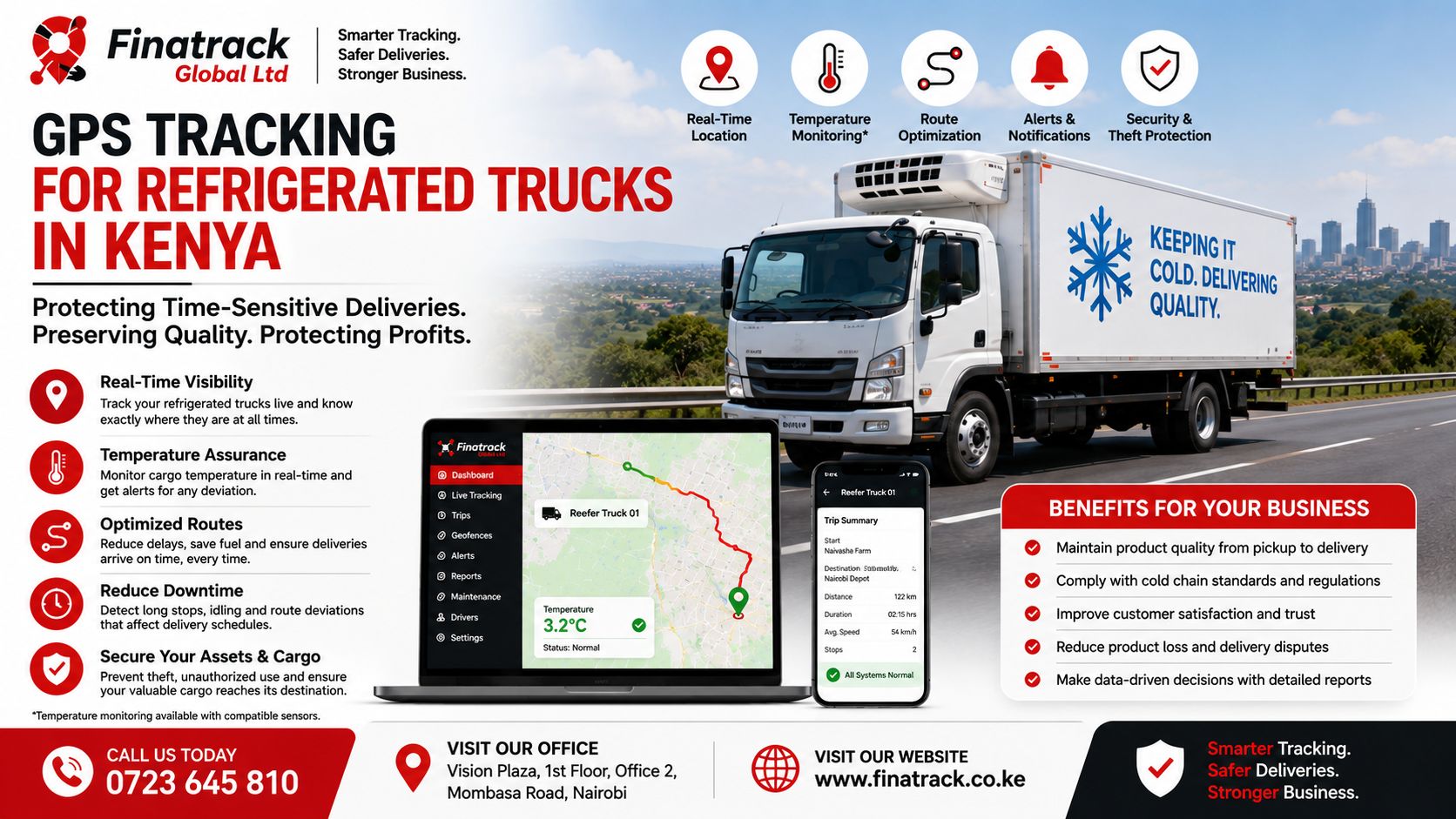
A refrigerated truck can arrive at its destination without being stolen, damaged or involved in an accident and still deliver a costly loss. For businesses transporting milk, meat, fresh produce, pharmaceuticals, flowers, frozen foods and other temperature-sensitive goods, time spent on the road matters almost as much as the condition of the cargo itself.
A delayed ordinary delivery may inconvenience a customer. A serious delay involving refrigerated cargo can affect product quality, delivery schedules and the commercial value of an entire load. This makes visibility particularly important for companies operating refrigerated trucks across Kenya.
Once a refrigerated vehicle leaves the warehouse, management needs more than an assurance that the driver is “on the way.” The business needs to know where the truck is, whether it is following the expected route, how long it has remained stationary and whether an unexpected delay requires intervention.
GPS tracking provides that visibility. An authorised fleet manager can monitor the current location of a refrigerated truck through a tracking platform instead of depending entirely on telephone calls from the driver.
Consider a truck carrying fresh produce from a farm in Naivasha to a distribution facility in Nairobi. Management expects the vehicle to arrive within a particular operational window. If the truck remains stationary for an unusually long period halfway through the journey, that information can immediately become important.
The vehicle may simply be caught in congestion. It may have developed a mechanical problem. The driver may have stopped for fuel, or there may be another legitimate explanation. The value of GPS tracking is that management becomes aware that something unusual is happening while there may still be time to respond.
For temperature-sensitive deliveries, minutes can sometimes matter. The longer a vehicle remains delayed, the longer its refrigeration equipment must continue maintaining the required cargo environment. If the delay becomes significant, fuel consumption, refrigeration performance and delivery coordination can all become concerns.
GPS tracking cannot by itself confirm that the cargo is at the correct temperature. That distinction is important. Standard vehicle tracking provides information about location, movement and related vehicle activity, while temperature monitoring requires appropriate sensors or specialised cold-chain monitoring equipment.
When these technologies are combined, however, a refrigerated transport company can gain a much clearer understanding of what is happening to both the vehicle and its cargo.
GPS data might show that a truck has been stationary for 45 minutes. A temperature-monitoring system may separately show whether the cargo compartment remains within the required operating range. Together, those pieces of information give management far more context than a phone call asking the driver whether everything is okay.
Route monitoring is particularly valuable for refrigerated fleets because unnecessary kilometres do more than increase fuel costs. They can also extend the amount of time sensitive goods remain in transit.
A driver who takes an unexplained detour may add an additional hour to the journey. Even if the refrigeration system continues operating normally, the business has unnecessarily increased travel time, fuel use and exposure to further delays.
Trip history allows management to review the route actually taken and compare it with expected operations. Repeated detours can then be investigated and better routing decisions introduced where necessary.
The objective should not be to force every driver to follow one route regardless of conditions. Road closures, congestion, accidents and customer instructions may justify alternative routes. Tracking gives management information that helps distinguish legitimate changes from unnecessary movement.
Geofencing can provide another useful tool. A transport company can create virtual boundaries around farms, warehouses, processing facilities, distribution centres and customer premises.
Depending on the tracking system configuration, management can identify when a refrigerated truck enters or leaves these locations. This can provide useful information about when the vehicle reached a loading point, when it departed and when it arrived at the destination.
For businesses coordinating perishable goods, those timestamps can help improve logistics planning.
A warehouse team expecting a refrigerated truck does not necessarily need to wait until the driver calls from the gate. Operations staff can monitor the vehicle’s progress and prepare unloading facilities as it approaches.
Reducing unnecessary waiting at the destination can be important. A refrigerated truck that arrives but spends another hour waiting for a receiving bay is still carrying goods that need to remain under controlled conditions.
The tracking data may eventually reveal that transport itself is not causing the company’s biggest delays. Vehicles may consistently arrive on time but remain stationary at customer premises for extended periods.
That information can change the conversation.
Instead of blaming drivers for long delivery cycles, management can investigate loading and unloading procedures, receiving schedules and warehouse coordination.
This is one of the wider benefits of telematics. It can expose inefficiencies that are difficult to see from an office.
Refrigerated transport companies should also pay attention to unplanned stops. A driver may make a legitimate stop for fuel or a required break, but repeated stops at unrelated locations can increase journey time.
Management does not need to treat every stop as suspicious. It should look for patterns.
If one truck regularly completes a route with two short stops while another vehicle on a comparable assignment spends long periods stationary, the difference deserves investigation.
Mechanical problems also carry greater consequences in refrigerated transport. A breakdown involving an ordinary delivery truck is expensive because of recovery costs and lost time. A breakdown involving temperature-sensitive cargo can put the value of the load at risk as well.
Real-time location information can help the company coordinate support more quickly. If a vehicle breaks down on a remote section of the route, management can see its location and communicate more effectively with mechanics, recovery companies or replacement vehicles.
The business may also be able to identify which support vehicle is closest.
Speeding presents another risk. Drivers transporting perishable goods can face pressure to recover time after delays, particularly when customers are waiting for deliveries with limited receiving windows.
Driving faster should not become the solution.
Excessive speed increases accident exposure and can place the vehicle, driver and cargo at risk. GPS telematics can help management identify repeated speeding incidents and address unsafe patterns before they result in a more serious problem.
Harsh braking and acceleration can also be relevant. Sensitive goods may be properly refrigerated but still suffer damage if they are transported carelessly.
A truck carrying delicate fresh produce, pharmaceuticals or other sensitive cargo should be driven with consideration for both road safety and the load being transported.
Driver behaviour information can help management identify repeated aggressive driving patterns. One harsh braking event may simply represent a driver responding correctly to a sudden hazard, but repeated incidents can justify further review.
Refrigerated vehicles also tend to represent significant investments. The truck itself may be expensive, the refrigeration equipment adds further value and the cargo can sometimes be worth considerably more than the vehicle carrying it.
Security therefore deserves serious attention.
GPS tracking can help management maintain location visibility throughout the journey. If a truck unexpectedly changes route, moves after it should have been parked or becomes difficult to contact, authorised personnel have vehicle data that can support their response.
For particularly valuable loads, layered tracking can provide additional resilience.
A wired GPS tracker can serve as the main fleet-management system while a wireless tracker or tracking tag provides an additional security layer. If the primary tracking equipment is interfered with, the business may still have another source of location information depending on the setup.
A vehicle alarm or immobilisation solution can add further protection when refrigerated trucks are parked at warehouses, depots or other locations.
No individual device can eliminate every security risk. The stronger approach is to combine technology with secure parking, driver procedures and clear escalation processes.
Fuel management also matters because refrigerated transport can have higher energy demands than conventional transport operations. The vehicle needs fuel for normal movement while refrigeration equipment may create additional operating requirements depending on its design.
Unnecessary mileage, excessive idling and poor driving can therefore become expensive.
GPS tracking allows managers to compare vehicle movement with operational activity. For appropriate commercial vehicles, dedicated fuel monitoring can provide further information about fuel levels, refilling and unusual reductions.
This can help businesses understand whether fuel expenditure is consistent with actual fleet activity.
When operating several refrigerated trucks, management can also compare utilisation between vehicles. One truck may be continuously deployed while another remains parked for much of the week.
This information can influence decisions about fleet expansion.
A company experiencing capacity problems may initially believe it needs to purchase another refrigerated truck. Tracking records may reveal that existing vehicles are not being allocated efficiently.
Alternatively, the data may show that every available vehicle is operating close to practical capacity. In that case, expanding the fleet becomes easier to justify using evidence rather than assumptions.
Historical trip information can also help when customers dispute delivery times.
A customer may claim that a refrigerated truck arrived hours later than agreed. The driver may provide a different account. GPS records can help management establish when the vehicle reached the relevant location and how long it remained there.
The system cannot confirm by itself that the cargo was accepted or that its condition met the customer’s requirements. Delivery documentation and, where necessary, temperature records remain important.
What GPS provides is an independent record of vehicle movement.
For food distributors, dairy processors, meat suppliers, pharmaceutical distributors, flower exporters and other cold-chain operators, bringing those records together can significantly improve accountability.
A strong delivery record might include the vehicle’s trip history, arrival time, departure time, delivery documentation and appropriate temperature records.
This gives management a more complete picture if a dispute occurs later.
The tracking platform should also be monitored by people who know what they are looking for. Installing GPS devices without assigning responsibility for fleet monitoring limits their usefulness.
Businesses should define which events deserve attention.
A 15-minute stop may be perfectly normal. A refrigerated truck remaining stationary for two hours at an unexpected location may require immediate verification.
An ordinary route variation may be harmless. A significant deviation involving valuable cargo deserves closer attention.
Management should establish these expectations before an incident occurs.
Drivers should also understand the purpose of tracking. The technology should support vehicle security, efficient routing, delivery coordination and responsible fleet management rather than becoming a substitute for communication between drivers and management.
Access to tracking information should remain restricted to authorised employees. Refrigerated transport routes can reveal customer locations, delivery schedules and other commercially sensitive information.
Not every employee needs unlimited visibility across the fleet.
Professional installation remains essential. Refrigerated trucks are commercial vehicles that may spend long hours on the road, travel significant distances and operate under demanding conditions.
Tracking equipment should be installed securely and tested properly. Managers should also know how to review trips, identify offline devices and respond to alerts.
The same attention should apply to any additional temperature or cargo-monitoring equipment. A temperature sensor that is incorrectly installed can provide misleading information, just as an unreliable tracker can create gaps in vehicle visibility.
Cold-chain management depends on trustworthy information.
For a business operating one refrigerated truck, GPS tracking can provide essential visibility over a valuable delivery asset. For a distributor managing dozens of refrigerated vehicles, it can become part of a wider logistics system supporting dispatch, route management, security and customer service.
The underlying principle remains simple.
A refrigerated delivery is not complete simply because the truck eventually reaches the customer.
The business needs to understand what happened between departure and arrival.
Finatrack Global Ltd provides professionally installed GPS tracking, fleet telematics, fuel monitoring, AI dashcams, wireless tracking and vehicle security solutions for commercial fleets operating in Kenya. Solutions can help authorised managers maintain visibility over refrigerated trucks, review journeys and respond to unusual fleet activity.
Professional installation can be arranged at the customer’s convenient location or at Vision Plaza, 1st Floor, Office 2, Mombasa Road, Nairobi. For refrigerated transporters, food distributors, pharmaceutical companies and other businesses seeking greater fleet visibility, contact Finatrack Global Ltd on 0723 645 810 or visit www.finatrack.co.ke.