What Happens to GPS Tracking When a Vehicle Enters a No-Network Zone?
A vehicle can leave Nairobi with its GPS tracker updating normally and then enter a remote road, farm, quarry, construction site or rural project area where the mobile signal disappears. On the tracking platform, the vehicle may suddenly appear to stop at one location even though the driver continues travelling. For a vehicle owner or fleet manager watching from the office, that can immediately raise concerns about whether the tracker has failed, been removed or switched off.
In many cases, however, a temporary loss of mobile network does not mean the GPS tracker has stopped working. GPS positioning and mobile communication perform different jobs inside a vehicle tracking system. GPS uses satellite signals to determine the device’s position, while the mobile network is commonly used to transmit those records from the vehicle to the tracking server.
This distinction becomes especially important when a vehicle enters what may be described as a no-network zone. The tracker may still be powered and may still be obtaining satellite coordinates, but without usable cellular connectivity it cannot immediately send those new records to the remote tracking platform. The owner may therefore continue seeing the last location that successfully reached the server rather than the vehicle’s actual current position.
Imagine a company pickup travelling from a town towards a remote construction project. The tracking system updates normally for most of the journey, showing the vehicle progressing along the road every few minutes. After entering an area with poor cellular coverage, however, the location stops changing on the manager’s computer even though the pickup continues towards the project site.
The most important thing to understand is that the vehicle has not necessarily stopped where the map shows it. That point may simply represent the last record transmitted before cellular communication was lost. If the driver continues travelling for another 40 kilometres without a network connection, the tracking platform may temporarily have no way of displaying that movement in real time.
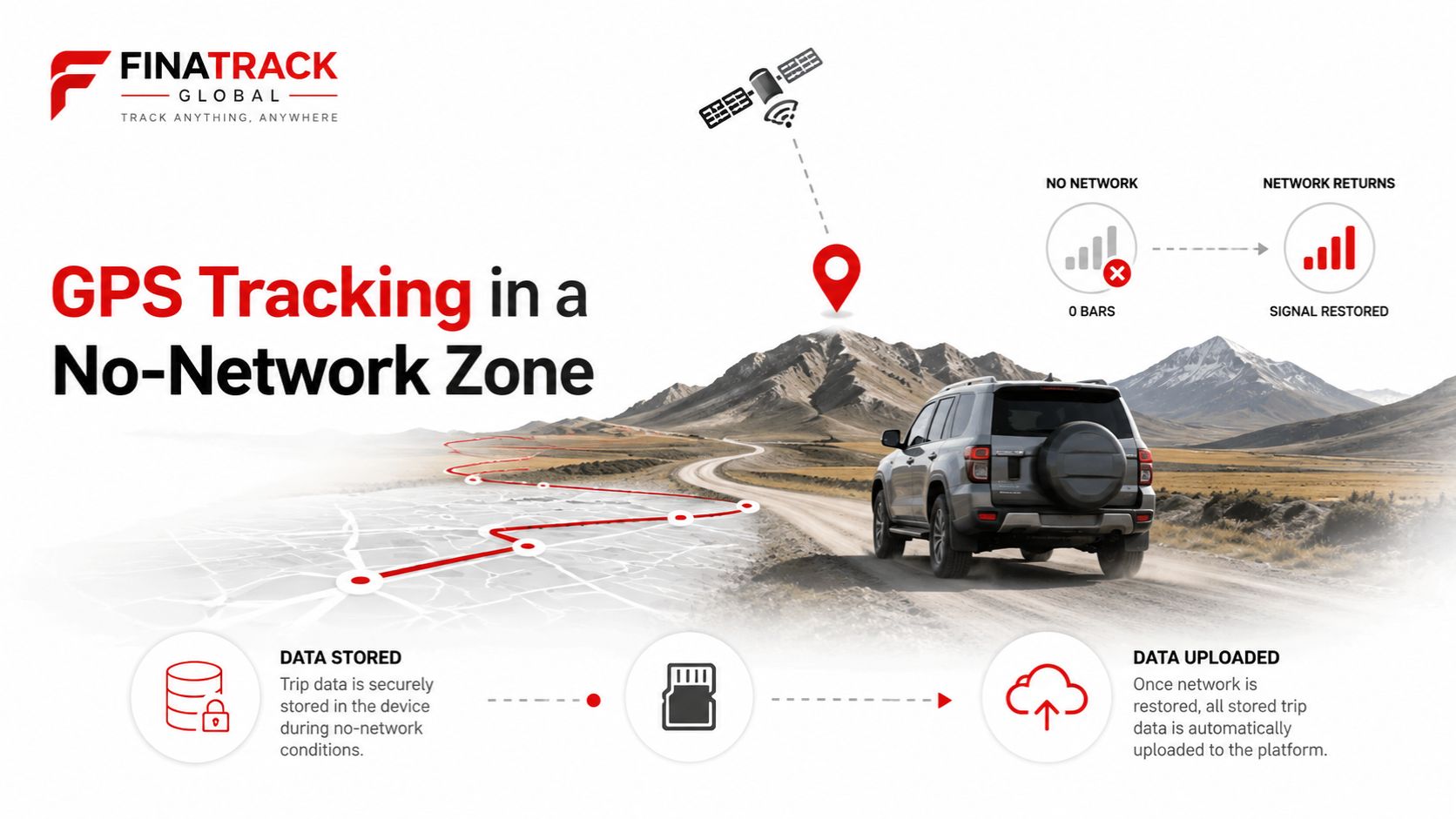
Professional GPS trackers can be designed to deal with such interruptions by saving records internally when mobile communication is unavailable. Teltonika documentation for several vehicle-tracking devices describes this behaviour: when GSM or data connectivity disappears, the device can continue storing records in its internal memory and begin sending them after communication returns.
This means a temporary loss of live tracking does not necessarily mean the trip history has been lost. Once the vehicle reaches an area where the tracker can communicate with the mobile network again, stored records can begin uploading to the server. The previously missing section of the journey may then appear in the tracking history, depending on the tracker, its memory and its configuration.
The distinction between live location and stored trip history is therefore critical. Live location depends on information reaching the server quickly enough for the customer to see it almost immediately, while historical tracking can include records that were stored locally and transmitted later. A tracker can therefore experience a temporary live-communication gap while still preserving useful information about where the vehicle travelled.
When connectivity returns, the tracking platform may appear to behave differently for a short period. Stored records may start arriving while the tracker is also generating new information about the vehicle’s current journey. Depending on the device configuration and the number of records waiting to be transmitted, the complete history may not appear instantly.
This becomes more significant when a vehicle remains outside mobile coverage for a long period. Every tracking device has finite storage, and the amount of information it can retain depends on its hardware and configuration. Some trackers can store thousands of records, but when device memory eventually becomes full, older information may be overwritten depending on how that particular tracker handles storage.
The frequency at which tracking records are created also matters. A vehicle configured to create location records very frequently generates more data than one configured with longer intervals. Businesses operating in remote areas should therefore discuss reporting frequency and storage requirements with their tracking provider rather than assuming that every tracker will behave identically during a long network outage.
A no-network zone should also not be confused with poor GPS satellite reception. The two problems are different. A tracker may have a strong satellite position but no mobile connection, or it may experience difficulty with both positioning and communication depending on the environment.
GPS itself is a satellite-based positioning system and does not depend on the local mobile operator to provide the satellite signal. As long as the receiver can obtain suitable satellite signals, it can determine position independently of cellular coverage.
The mobile connection becomes necessary when the vehicle wants to report that information remotely through a conventional cellular GPS tracking system. If the network disappears, the tracker may effectively know where it is while the person sitting in the office does not yet receive that updated information.
This is why the word offline can sometimes be misunderstood. When a tracking platform shows a vehicle as offline, it generally means the server has not received a recent communication from the device. Loss of GSM signal is one documented reason a tracker may stop sending records, but SIM, configuration, power or device problems can also cause the same visible symptom.
A fleet manager should therefore pay attention to where and when the tracker went offline. If several company vehicles consistently lose communication along the same remote section of road and return online after reaching the next town, the pattern may indicate a predictable network-coverage gap. If a tracker suddenly disappears on a route where it normally communicates reliably and remains offline long afterwards, the situation deserves further investigation.
The last update time can provide valuable information. If the platform shows that a truck last communicated at 10:32 a.m., management should not automatically assume that the truck is still physically parked at that location at noon. The location should instead be understood as the most recent information successfully received by the server.
This difference can become particularly important when monitoring theft or unauthorised vehicle movement. A vehicle that disappears from the platform immediately before entering a known poor-coverage area presents a different situation from a vehicle that unexpectedly goes offline inside Nairobi or another location where it normally reports consistently. Good fleet management requires context rather than treating every offline event as proof of interference.
Geofence and security alerts can also be affected by communication gaps. The tracker may record an event while it is offline, but a remote notification cannot reach the tracking server until communication is available again in a conventional cellular tracking setup. The customer should therefore understand that an alert generated in a no-network area may not always appear on their phone at the exact moment the event occurs.
This limitation is particularly relevant for businesses carrying high-value cargo or operating vehicles in areas where cellular outages may last for extended periods. GPS tracking remains useful, but managers should not design their entire vehicle-security strategy around the assumption that every location and every alert will always be visible in real time.
Where continuous communication outside cellular networks is essential, specialised satellite communication solutions also exist. Teltonika, for example, documents integration between selected fleet trackers and Iridium satellite communication equipment specifically for transmitting records after GSM connectivity is lost. Such solutions are more specialised than ordinary vehicle tracking and would normally be considered for operations where no-network areas are a routine and significant business risk.
For ordinary commercial fleets, the more practical starting point is usually understanding the routes the vehicles use. A transport company operating mainly between major towns has different connectivity requirements from a mining, agricultural or construction business whose vehicles spend much of their working day in remote locations.
The SIM arrangement also matters. Different mobile operators can have different coverage characteristics along particular roads and in different regions, so the tracking provider’s connectivity setup can influence how often communication gaps occur. For vehicles that routinely operate outside urban areas, this should be considered during system selection rather than only after the tracker repeatedly goes offline.
Cross-border operations introduce another layer. When a Kenyan vehicle crosses into another country, the tracker may need suitable roaming connectivity to continue sending information through cellular networks. The GPS positioning function may continue operating, but remote visibility depends on whether the device can communicate through an available network under its SIM and roaming configuration.
Power must also be considered when diagnosing an offline tracker. A vehicle entering a no-network area and a tracker losing electrical power can both result in the platform no longer receiving new information, but the underlying causes are completely different. A professionally installed system should allow technical support to investigate whether the problem is related to connectivity, power, SIM status or the device itself.
When the vehicle returns to network coverage, management should confirm that the tracker comes back online. The current location should begin updating again, and depending on the device configuration, previously stored trip information may also be uploaded. If communication does not return despite the vehicle being back in a normally well-covered location, the tracker should be checked rather than continuing to assume the problem is network coverage.
For fleet managers, regular review of offline behaviour can reveal useful patterns. A vehicle repeatedly disappearing at exactly the same geographical location is more likely to be experiencing a coverage limitation than one going offline unpredictably across several well-connected locations. Tracking history can therefore help management distinguish routine connectivity gaps from technical problems requiring attention.
Private motorists should use the same reasoning. If your vehicle is travelling upcountry and stops updating temporarily, check the last reported location and time before assuming the tracker has failed. If it returns online after reaching a populated area, weak cellular connectivity may have been the explanation.
However, an unexplained offline status should never simply be ignored when vehicle security is a concern. If the vehicle should be in a well-covered area and the tracker remains offline unexpectedly, contact the tracking provider so that the device status can be investigated. Where theft is suspected, vehicle owners should follow appropriate security and law-enforcement procedures rather than attempting to confront suspected offenders themselves.
The quality of the tracking hardware also becomes important in remote operations. Internal storage, supported mobile technologies, SIM configuration and reporting settings can determine how well a tracking system manages temporary communication interruptions. Businesses should therefore select their system based on where their vehicles actually work rather than simply purchasing the cheapest device available.
A construction company operating machinery on remote projects, an agricultural business managing vehicles across large farms and a logistics company transporting cargo across long-distance routes may all require different tracking configurations. Understanding expected network conditions before installation allows the system to be configured around real operating conditions rather than assumptions.
The central lesson is that GPS tracking does not necessarily stop simply because the mobile network disappears. The tracker may continue determining and recording where the vehicle is while waiting for an opportunity to transmit that information. What temporarily disappears is often the owner’s real-time visibility rather than the tracking device’s ability to collect location records.
Finatrack Global Ltd provides professionally installed GPS tracking and fleet telematics solutions for private vehicles and commercial fleets operating across Kenya. Businesses whose vehicles regularly travel to rural areas, farms, construction projects or remote locations can select tracking solutions according to their security, connectivity and fleet-management requirements.
Professional installation can be arranged at the customer’s convenient location or at Vision Plaza, 1st Floor, Office 2, Mombasa Road, Nairobi. For GPS tracking, technical support and fleet security solutions, contact Finatrack Global Ltd on 0723 645 810 or visit www.finatrack.co.ke.