What Happens When a Company Vehicle Is Towed Without Permission? Can GPS Tracking Detect It?
A company vehicle can disappear without anybody starting the engine. It may be lifted onto a flatbed, pulled by another vehicle or removed from a parking area while the ignition remains completely off. For businesses that rely only on ignition alerts to detect unauthorised vehicle use, that creates an important security gap.
Imagine a company pickup parked securely outside an office at the end of the working day. The keys are accounted for, the ignition is off and nobody expects the vehicle to move until the following morning. At 2 a.m., however, the vehicle begins changing location even though the tracking system still reports that the ignition is off.
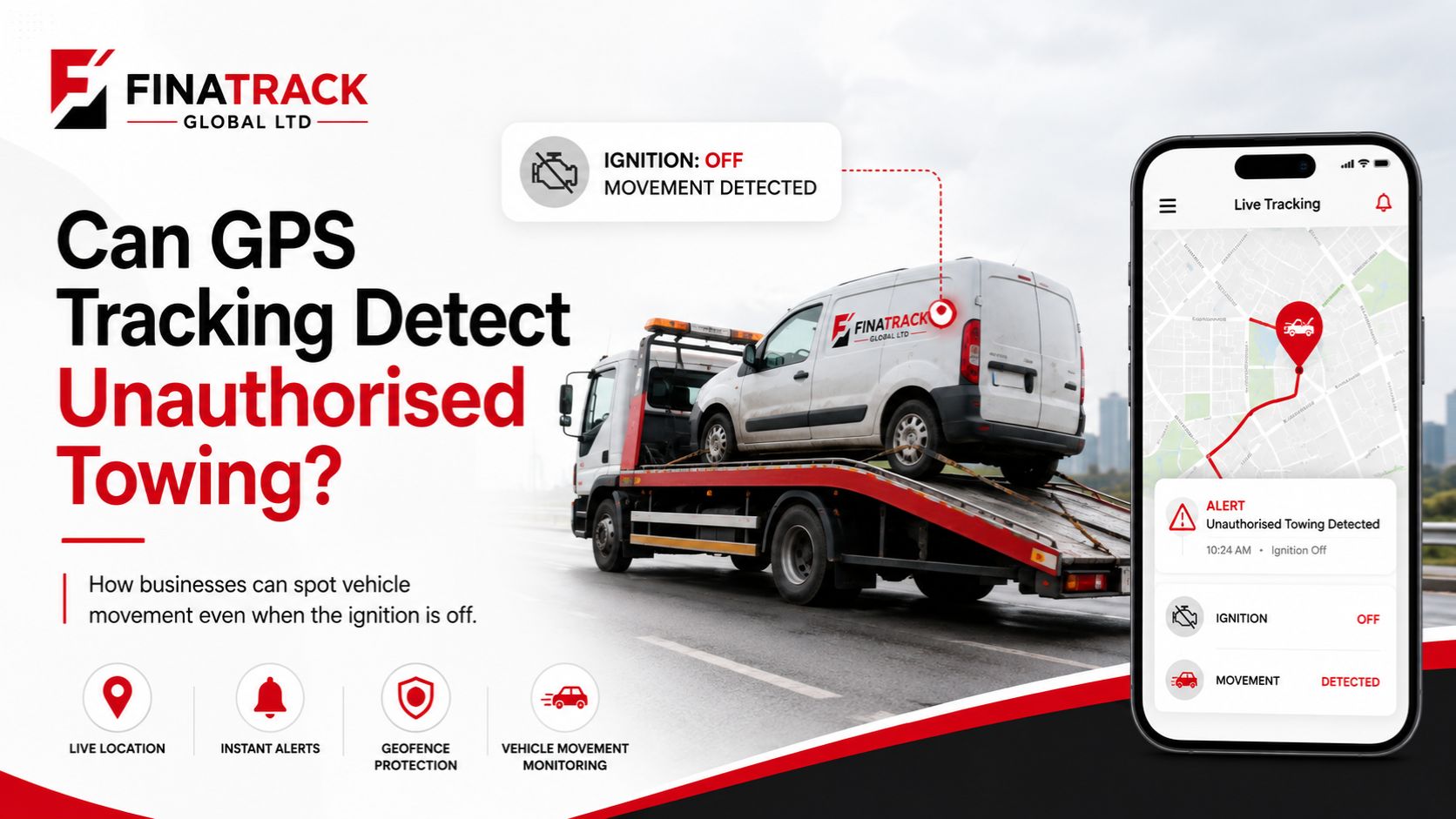
That combination of movement and ignition status can be an important warning. Depending on the GPS tracker installed and how the system has been configured, a fleet manager may be able to see that the vehicle is moving despite the engine not being started. Movement alerts, location updates and geofence notifications can provide additional information that helps management determine whether something unusual is happening.
The distinction between GPS location and ignition status is important. A vehicle tracker does not necessarily need the engine running to determine where a vehicle is located. The ignition connection simply provides additional information about whether the vehicle has been switched on in the normal way.
A properly installed tracker can therefore continue monitoring location while the vehicle is parked, depending on the equipment and installation. If that location suddenly begins changing while the ignition remains off, the event deserves attention. The system may not automatically know that the vehicle is being towed, but it can show that an asset expected to remain stationary is moving.
Geofencing can make this type of monitoring more useful. A business can create a virtual boundary around its office, warehouse, yard, project site or another approved parking location. When a vehicle unexpectedly leaves that boundary, the tracking system can generate an alert where the feature has been configured.
The alert itself does not prove that the vehicle has been stolen. A garage may have been authorised to collect it for repairs, a recovery company may be transporting it after a breakdown or property management may have ordered the vehicle moved. The value of the alert is that management becomes aware of the movement while it is happening rather than discovering an empty parking space hours later.
Time is particularly important when vehicle removal is unauthorised. If a company only notices the following morning that a vehicle has disappeared, the asset may already be far from where it was parked. Earlier awareness gives management more time to establish what happened and begin the appropriate security response.
If the GPS tracker continues communicating while the vehicle is being transported, authorised users may be able to follow its changing location through the tracking platform. The journey history can also provide information about when the movement began and the direction in which the vehicle travelled.
That information can be valuable during a recovery effort, but location data should be handled carefully. A business owner or fleet manager should not personally confront suspected thieves simply because they can see a vehicle’s position on a map. Tracking information should support a structured response involving the relevant authorities and appropriate security procedures.
Knowing where the vehicle is does not reveal who is moving it or what risks may be present at the destination. GPS tracking improves visibility, but it does not eliminate the need for safe decision-making.
The ability to detect unusual movement will depend on the tracker installed. Some devices contain motion sensors or accelerometers that can detect movement or vibration when the vehicle is parked. Other systems may rely more heavily on changes in GPS position before determining that the vehicle has moved.
This is why vehicle owners should ask more than whether a tracker provides real-time location. A better question is what happens when the vehicle moves while the ignition is off. Understanding that scenario can reveal whether the system is configured to provide meaningful information during towing or other forms of unauthorised movement.
Installation quality also matters. A security tracker needs to remain powered when the vehicle is parked if it is expected to monitor that vehicle outside normal driving periods. Professional tracking installations commonly use constant vehicle power while monitoring ignition separately, although the exact setup depends on the device and vehicle.
Some trackers may also include an internal backup battery. This can provide temporary operation if the main vehicle power supply is interrupted, depending on the device. Such backup capability can become particularly valuable if someone attempts to disconnect the vehicle battery or interfere with the tracking installation.
Power-disconnection alerts can provide another warning in systems that support them. If a vehicle that is normally connected to external power suddenly loses that connection, management may have a reason to investigate. Combined with movement information, ignition status and location changes, the alerts can create a clearer picture of what is happening.
No single alert should be treated as absolute proof of theft. A vehicle may lose external power during legitimate repairs, and a mechanic may tow it without starting the engine. What makes the information useful is the combination of unusual events and the business context surrounding them.
Consider a company car parked overnight at an employee’s residence. At 1.30 a.m., the tracking platform begins reporting movement even though the ignition remains off. The vehicle then leaves the normal parking area and begins travelling several kilometres away.
If nobody authorised recovery or transportation, management has a legitimate reason to investigate immediately. The same movement at 10 a.m. after the company arranged for a breakdown truck to collect the vehicle would have an entirely different explanation.
Good GPS monitoring therefore depends on understanding how each vehicle normally operates. A delivery truck that works overnight should not be monitored under exactly the same rules as a sales vehicle that normally remains parked after 7 p.m. Alerts should reflect actual operational patterns.
Poorly configured alerts can create another problem: too many notifications. If fleet managers receive constant alerts for ordinary activity, they may gradually stop paying attention to them. Important security events can then disappear among routine notifications.
The objective should be to identify events that genuinely deserve attention. Movement while ignition is off, unexpected departure from an overnight parking area or sudden activity during unusual hours may be particularly meaningful for vehicles that should normally remain stationary.
GPS tracking can also help when a vehicle has been moved for reasons other than theft. A company car might be towed by property management, local authorities or another authorised party without the fleet manager receiving immediate notice. Employees may initially assume the vehicle has been stolen simply because it is no longer where they left it.
Checking the tracking platform can provide a last reported location and show whether the vehicle has moved. That information gives management somewhere to begin making enquiries rather than searching blindly.
The same principle applies when vehicles are left at garages. A company may deliver a pickup to one workshop only for the vehicle to be transferred elsewhere for specialist repairs. If nobody communicates the transfer, management may become concerned when the vehicle is no longer at the original garage.
Trip history can show when the movement occurred and where the vehicle was taken. For businesses handing valuable assets to third parties, that visibility can improve accountability even when nothing criminal has happened.
Vehicle immobilisation should not be confused with protection against towing. An immobiliser can make it difficult or impossible to start the engine through normal means, but it cannot physically prevent a vehicle from being lifted or pulled away.
A vehicle with a strong immobilisation system can therefore still disappear if somebody has the equipment required to move it physically. That is one reason location monitoring remains useful even when the vehicle has additional anti-theft technology.
The strongest vehicle-security approach is usually layered. An alarm can draw attention to interference, an immobiliser can make unauthorised driving more difficult and a GPS tracker can maintain location visibility. A second wireless tracker or tracking tag can provide another layer if the primary device is discovered or disabled.
Layered security does not make a vehicle impossible to steal. It reduces dependence on one system working perfectly in every situation.
Physical security remains important as well. Secure parking, controlled access, good lighting and sensible key management should not be abandoned simply because a vehicle has GPS tracking. Technology works best when it supports good security practices rather than replacing them.
Businesses should know where company vehicles are supposed to be parked after working hours and who is authorised to move them. Garages, recovery firms and employees should communicate whenever a vehicle is being transported. This makes genuinely unusual movement much easier to identify.
Someone within the company should also be responsible for important security alerts. A notification received at 2 a.m. provides little value if nobody sees it until the next afternoon.
Companies protecting valuable vehicles should decide which alerts deserve immediate attention and who receives them. That person should know the next step, whether it involves confirming with the driver, contacting security personnel, checking with management or escalating a suspected unauthorised removal.
Routine system checks are equally important. A company should not discover during a theft incident that its GPS tracker stopped reporting several weeks earlier. Fleet managers should periodically confirm that installed devices remain online and are communicating as expected.
For businesses managing many vehicles, this becomes part of normal fleet security. One vehicle may be parked at headquarters, another at an employee’s residence and several more at customer or project locations. GPS tracking gives management a central way to maintain visibility over assets that cannot all be physically supervised.
The lesson is straightforward. Switching off a vehicle’s ignition does not mean the vehicle cannot move. It only means the engine is not operating in the normal way.
A vehicle can still be pushed, pulled, lifted or placed onto another truck.
GPS tracking can help businesses detect that change in location and investigate unusual movement earlier, provided the correct equipment has been professionally installed and the relevant alerts have been configured.
Finatrack Global Ltd provides professionally installed GPS tracking, wireless tracking, tracking tags, car alarms and fleet telematics solutions for businesses and vehicle owners in Kenya. Solutions can be configured to provide real-time location visibility, trip history, geofencing and selected security alerts depending on the system installed.
Professional installation can be arranged at the customer’s convenient location or at Vision Plaza, 1st Floor, Office 2, Mombasa Road, Nairobi. For businesses and vehicle owners seeking stronger visibility over vehicles whether they are driving or parked, contact Finatrack Global Ltd on 0723 645 810 or visit www.finatrack.co.ke.