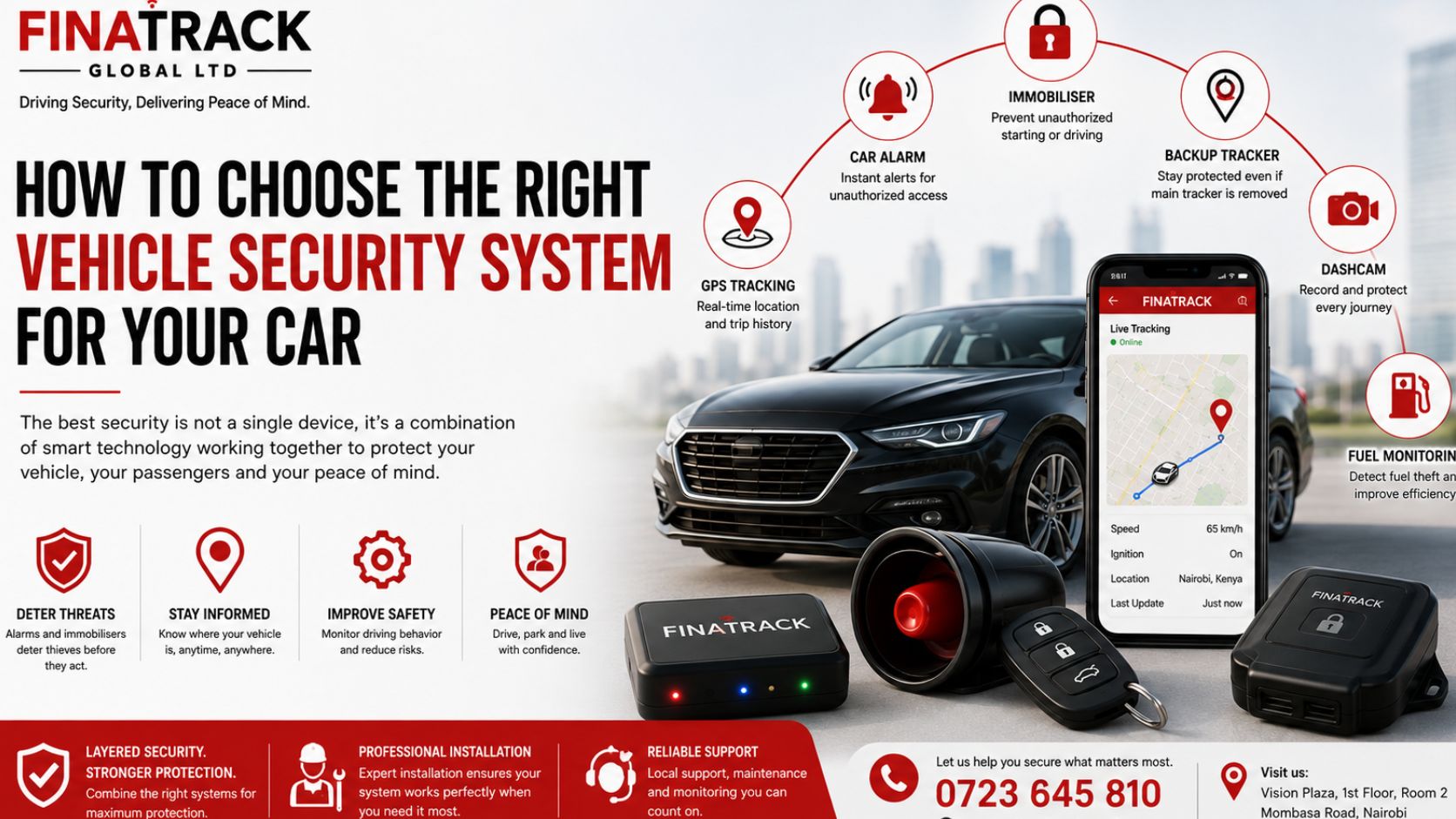
Buying a car is a major financial commitment, but protecting it should involve more than locking the doors and hoping for the best. Modern vehicle theft has become increasingly sophisticated, and criminals may target alarms, keys, electronic systems and tracking devices in different ways. For vehicle owners in Kenya, choosing the right security system therefore requires looking beyond a single gadget and thinking about how several layers of protection can work together.
The first step is understanding that vehicle security systems do not all perform the same job. A car alarm is designed to attract attention when unauthorised entry is detected. An immobiliser is intended to prevent the vehicle from being started or driven. A GPS tracker helps the owner monitor the vehicle’s location, while a wireless backup tracker provides an additional way of locating the car if the primary system is compromised. Dashcams, hidden cut off systems and other technologies can strengthen security further depending on the vehicle and the risks involved.
This means the best system for one motorist may not necessarily be the best solution for another. A privately owned car parked inside a secure residential compound faces a different risk profile from a taxi operating late at night, a company vehicle used by several drivers or a high value SUV frequently parked in public areas. Before choosing security equipment, the owner should first consider how the vehicle is used, where it is normally parked and the consequences if it is stolen.
For many motorists, a professionally installed GPS tracker provides a sensible foundation. A wired GPS tracking system can allow the owner to monitor the vehicle’s location through a smartphone or computer while also providing features such as trip history, ignition alerts, geofencing and speed information. Depending on the equipment and installation, remote engine immobilisation may also be available as an additional security function.
Location visibility is particularly valuable because traditional security devices mainly focus on preventing theft. GPS tracking adds another capability by helping the owner understand what is happening after the vehicle moves. If a car disappears from a parking area, the ability to see its location and movement can provide important information during a recovery effort.
However, relying on GPS tracking alone is not necessarily the strongest security strategy. A thief who discovers and removes the primary tracker may reduce the owner’s ability to locate the vehicle. This is why layered vehicle security is increasingly important.
A car alarm can provide the first layer. When doors are forced, windows are disturbed or the vehicle is otherwise tampered with, the alarm can attract attention and potentially discourage an opportunistic thief. Modern systems may also include additional controls such as hidden cut off features that make the vehicle harder to operate even after entry has been gained.
An immobilisation system provides another layer. Rather than simply making noise, an immobiliser interferes with the vehicle’s ability to start or continue operating under the appropriate conditions. Some GPS tracking systems can integrate remote immobilisation, allowing authorised action to be taken after suspicious activity has been confirmed.
Remote engine control must, however, be installed and used responsibly. A vehicle should not simply be switched off while travelling at speed because doing so could create a serious safety risk. Professionally configured systems are intended to manage immobilisation under safe conditions, such as preventing the vehicle from being restarted after it has stopped.
For motorists with higher security concerns, an independent backup tracker can be particularly useful. A wireless or magnetic tracker operates separately from the main wired GPS system and normally contains its own battery. Because it does not depend on the same wiring as the primary device, it can provide another source of location information if the main tracker is discovered or disconnected.
The value of backup tracking becomes clearer when considering how vehicle thieves may operate. If a criminal knows that a modern vehicle is likely to contain a tracker, one of the first objectives may be locating the installed device or interfering with its power supply. Having another discreet tracking technology installed elsewhere in the vehicle makes the security system more difficult to defeat with a single action.
Vehicle owners should also consider the risk of signal interference. GPS and mobile communication systems depend on radio signals, and criminals may attempt to use jamming equipment to interfere with them. Standard trackers may struggle to communicate during active interference, while specialised anti jamming or jamming detection systems can provide additional protection for vehicles considered at higher risk.
No GPS system should be marketed as completely impossible to jam or defeat. Security technology is constantly evolving on both sides. The objective is to increase the number of obstacles a criminal must overcome and improve the owner’s chances of detecting suspicious activity.
Dashcams can also form part of a modern vehicle security strategy. A standard dashcam primarily records what happens around the vehicle, while more advanced connected cameras can transmit video or provide driver monitoring features. For private motorists, footage may prove useful after accidents, vandalism or disputes. For businesses, video telematics can provide additional evidence about what was happening before and during an incident.
AI enabled dashcams can go even further by detecting behaviours such as driver fatigue, distraction or dangerous driving patterns. These systems are particularly useful for commercial fleets where security and road safety are closely connected. Preventing an accident can be just as financially important as preventing vehicle theft.
The right security package should therefore reflect the value of the vehicle. A motorist protecting an older, lower value car may reasonably choose a professionally installed alarm and standard GPS tracker. Someone protecting a high value SUV may be better served by combining a wired tracker, alarm, immobilisation capability and independent backup tracker.
The security needs of financed vehicles can also be different. Banks, SACCOs and asset finance institutions may impose specific tracking requirements because the vehicle serves as security for the financing arrangement. Borrowers should confirm those requirements before installing a system, particularly where the lender expects an installation certificate, approved tracking technology or immobilisation capability.
Businesses should take an even broader approach. For a company operating several vehicles, vehicle security is not only about theft prevention. The same tracking system can provide information about routes, vehicle utilisation, speeding, unauthorised trips and driver behaviour. A business may therefore obtain more value from a fleet telematics solution than from installing basic consumer trackers independently in every vehicle.
Fuel monitoring can also become part of the security strategy for commercial vehicles. For trucks and other fuel intensive assets, the loss being protected is not only the vehicle itself. Fuel theft, unauthorised drainage and poor fuel accountability can create substantial ongoing expenses. Integrating fuel monitoring with GPS tracking allows management to understand where the vehicle was when unusual fuel activity occurred.
Installation quality remains one of the most important factors regardless of which security technology is selected. An expensive tracker installed badly can be less effective than a simpler device installed professionally. Poor wiring can create electrical faults, obvious placement can make devices easier to discover and incorrect immobiliser installation can create reliability problems.
Vehicle owners should therefore avoid choosing an installer purely because the installation fee is the lowest available. They should consider whether the company uses trained technicians, whether equipment is properly tested and whether support is available after installation.
The security provider itself also deserves scrutiny. Modern tracking companies may handle sensitive information showing where a vehicle is located and where it has travelled. Customers should therefore consider licensing, data protection practices, account security and technical support alongside product features.
The tracking platform should also be demonstrated before purchase. Customers should understand how to log in, locate the vehicle, review previous journeys and respond to alerts. A security system becomes less useful if the owner cannot operate it confidently during an emergency.
Account security is another frequently overlooked part of vehicle protection. A GPS tracker may be carefully hidden inside the dashboard, yet an easily guessed password can expose the vehicle’s location to somebody who never touches the car. Tracking credentials should therefore be protected and only shared with authorised people.
Businesses should establish even clearer access controls. Not every employee needs to see every company vehicle. Fleet administrators should decide who can access the system, who can view reports and who, if anyone, is authorised to send immobilisation commands.
Price naturally remains part of the decision, but motorists should compare total value rather than simply the purchase cost. A low cost tracker may have annual platform fees, separate SIM card expenses or limited after sales support. Another system may cost more initially but include professional installation and more useful functionality.
Before paying, vehicle owners should ask exactly what the quotation includes. They should understand whether there are recurring charges, how mobile connectivity is managed, whether installation is included and what happens if the device stops communicating.
Warranty and support should also be considered. Vehicle security equipment can remain installed for several years, and customers should know whether the provider will assist if a tracker develops a fault or if they change vehicles.
The decision should ultimately begin with the risks the owner is trying to solve. If the main concern is unauthorised entry, an alarm may be important. If the concern is theft and recovery, GPS tracking should be considered. If criminals defeating the primary tracker are a major worry, backup tracking becomes more valuable. If the vehicle is operated by employees, telematics and driver monitoring may also be required.
For many motorists, the strongest approach is not choosing between an alarm, tracker and immobiliser.
It is combining them.
The alarm can warn that somebody is interfering with the vehicle. The immobiliser can make the vehicle harder to drive away. The GPS tracker can provide visibility if the vehicle moves. A backup device can provide another layer if the main system is compromised.
This layered approach does not make a vehicle impossible to steal. No security system can provide that guarantee. What it does is increase the difficulty of stealing the vehicle while improving the owner’s ability to detect, monitor and respond to an incident.
Finatrack Global Ltd provides vehicle security and GPS tracking solutions for private motorists, businesses and commercial fleets in Kenya. Available solutions include wired and wireless GPS tracking, vehicle alarms, immobilisation capabilities, tracking tags, dashcams, fuel monitoring and fleet telematics.
Choosing the right combination should depend on the vehicle, how it is used and the level of protection required.
The best vehicle security system is therefore not necessarily the most expensive device on the market.
It is the system designed around the risks your vehicle actually faces.
For professional vehicle security and GPS tracking solutions in Kenya, contact Finatrack Global Ltd on 0723 645 810 or visit www.finatrack.co.ke.