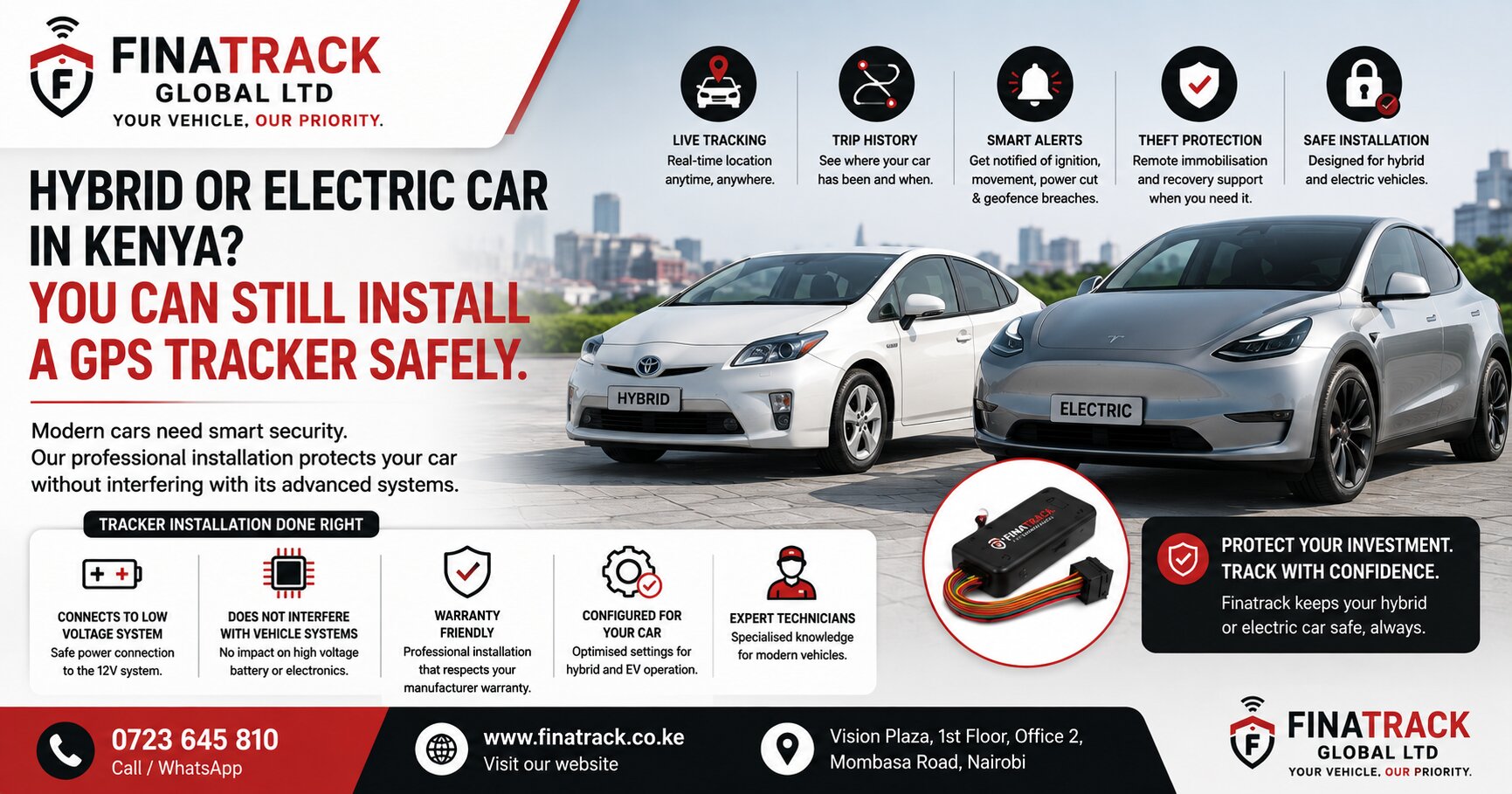
Hybrid and electric vehicles are becoming increasingly visible on Kenyan roads as motorists look for lower fuel consumption, newer technology and alternative ways of reducing everyday motoring costs. At the same time, these vehicles can represent a substantial financial investment, making security just as important as it is for conventional petrol and diesel cars. This naturally raises an important question for owners: can a GPS tracker be installed safely without interfering with the vehicle’s advanced electrical systems?
The short answer is that GPS tracking can be suitable for many hybrid and electric vehicles, but the installation needs to be approached differently from the assumption that every car has the same electrical architecture. Modern hybrids and electric vehicles contain sophisticated electronics, control modules, high voltage components and low voltage accessory systems that work together. A professional installer should understand which circuits can safely support aftermarket equipment and which areas should not be interfered with.
A GPS tracker itself normally requires relatively little electrical power, but where and how that power is obtained matters. In many modern vehicles, including many electric and hybrid models, there is a separate low voltage electrical system used to power accessories and control electronics even though the vehicle’s propulsion system uses a much higher voltage battery. Tracking equipment is generally installed through an appropriate low voltage circuit rather than connected directly to the high voltage propulsion battery.
This distinction is extremely important. The large battery responsible for driving an electric vehicle is not simply a larger version of the conventional battery found under the bonnet of an ordinary car. High voltage systems require specialist knowledge, safety procedures and appropriate equipment, and ordinary GPS tracker installation should not involve unnecessary interference with them.
A qualified installer should therefore identify the correct low voltage power source before any wiring begins. The installation should provide stable power to the tracker without compromising the vehicle’s electronics or creating unnecessary electrical faults. The technician should also understand how the particular vehicle behaves when parked, charging, sleeping or waking from its low power state.
Hybrid vehicles create an additional consideration because they combine a conventional combustion engine with electric propulsion technology. Depending on the design, the vehicle may switch the petrol engine on and off automatically during normal operation while still remaining ready to move. A tracking system that relies on simplistic assumptions about engine activity can therefore produce confusing ignition information if it is not configured correctly.
For this reason, the installer should understand how ignition or vehicle activity will be detected on the specific car. The tracking platform may need to interpret an appropriate low voltage signal rather than assuming that the combustion engine must be running whenever the vehicle is operational. Correct configuration helps prevent situations where the tracking application shows the vehicle as switched off even though it is moving normally.
Electric vehicles create a similar challenge because there is no traditional engine starting event. An EV may become ready to drive without the sound or vibration motorists associate with starting a petrol car. Tracking equipment therefore needs to recognise the vehicle’s operational state through an appropriate electrical signal or configuration supported by the installation.
This is one reason owners should avoid having sophisticated vehicles wired by technicians who approach every installation in exactly the same way. A wiring method that worked perfectly on an older petrol saloon may not be appropriate for a newer hybrid or electric SUV. The technology should be installed around the vehicle rather than forcing the vehicle to fit a familiar installation method.
Location tracking itself does not depend on whether the car is petrol, diesel, hybrid or fully electric. The tracker determines location using positioning technology and communicates that information to a tracking server through an available communications network. From the owner’s perspective, the application can still show the vehicle on a map in much the same way as a conventional tracked car.
The differences are mainly found in how the tracker receives power, how ignition or activity is detected and how additional features such as immobilisation are integrated. These areas require more careful consideration because modern vehicles increasingly depend on networked electronic systems. Poorly executed modifications can potentially cause warning lights, diagnostic errors or other electrical problems that have nothing to do with the GPS location function itself.
Owners should therefore distinguish between basic GPS tracking and more intrusive security modifications. A properly designed installation that simply provides power and tracking information may require relatively limited interaction with the vehicle. Adding remote immobilisation, alarms or hidden cut off systems can involve additional wiring and therefore deserves more careful technical evaluation.
Remote immobilisation is particularly important to discuss before installation. On many conventional vehicles, a relay can be incorporated into an appropriate circuit to prevent authorised engine operation when a secure command is issued. Modern hybrid and electric vehicles can have much more complex control systems, meaning the same method should not automatically be applied without understanding the manufacturer’s electrical architecture.
The installer should determine whether immobilisation is technically appropriate for the particular model. If integrating the feature creates unnecessary risk to the vehicle’s electrical systems, a tracking solution without that function may be a better choice. Vehicle security should never be strengthened by introducing another reliability problem.
Where immobilisation is installed, it should also be tested safely. The owner needs to know what the feature actually does, how to restore normal operation and under what circumstances it should be used. Remote immobilisation should never be treated as a button to press casually while a vehicle is moving because creating an unexpected loss of propulsion can introduce serious road safety risk.
Battery management is another common concern among hybrid and EV owners. People sometimes assume that because an electric vehicle contains a very large traction battery, a small GPS tracker could never cause a battery problem. In practice, the tracker may depend on the separate low voltage electrical system, and that smaller auxiliary battery can still be affected by poor wiring or inappropriate configuration.
This is particularly relevant when a vehicle remains parked for extended periods. Like other electronic accessories, a tracker continues requiring some power even when the car is not being driven. A professionally configured device should use appropriate power management settings, while an installer should consider how frequently the particular vehicle is used.
Many modern trackers can enter lower power operating modes when a vehicle remains stationary, depending on the hardware and configuration. This can reduce power consumption compared with operating at full activity continuously. The correct settings should balance battery preservation with the level of security and update frequency the owner requires.
An extremely aggressive sleep configuration may reduce power consumption but also change how quickly the tracker responds while the vehicle is parked. A security conscious owner may prefer a configuration that provides more regular communication, while a vehicle that remains stored for long periods may require a different approach. There is no single ideal setting for every car.
Professional installation should therefore begin with understanding how the vehicle is used. An electric car driven every day in Nairobi presents different requirements from a hybrid vehicle that remains parked for several weeks at a time. The owner should explain normal usage so that the tracking solution can be configured accordingly.
Charging creates another question for EV owners. Plugging the vehicle into a charging station should not normally prevent the GPS tracker from performing its basic function when the system has been correctly installed. The tracker is a separate low power accessory and should continue operating according to its configuration while the vehicle charges.
The owner may notice that the car remains stationary for several hours while charging, which is perfectly normal. Tracking information should therefore be interpreted within the context of EV operation. A long stop at a known charging location is very different from an unexplained stop during a delivery or business assignment.
Geofencing can become particularly useful for electric vehicles because regular charging locations can be incorporated into normal fleet management. A business could create virtual boundaries around its depot, offices or selected charging locations depending on the tracking platform. This can help fleet managers understand when vehicles return to operational bases without continuously watching the map.
GPS tracking can also provide ordinary trip history for hybrid and electric vehicles. Owners can review where the vehicle travelled, when journeys occurred and how much movement took place during a given period. This is useful for security as well as for businesses trying to understand vehicle utilisation.
For a private motorist, trip history can help answer questions about where the car travelled when it was being used by another authorised driver. For companies, the same information can support mileage analysis, route management and vehicle allocation. The propulsion technology changes, but the management value of journey information remains similar.
Security is particularly important because many modern hybrid and electric cars are relatively valuable. A newer EV or hybrid SUV may represent a substantial investment, and replacing it after theft can create significant financial disruption. GPS tracking provides additional visibility if the vehicle unexpectedly moves or disappears.
The owner should nevertheless avoid relying entirely on one tracker. A sophisticated vehicle can still benefit from layered security that combines GPS tracking with appropriate physical and electronic protection. The exact combination should depend on the vehicle, its value and the owner’s risk exposure.
A wired tracker can provide the primary monitoring system, while an independent wireless tracker or tracking tag may provide additional recovery visibility. This can be particularly useful if someone discovers or disconnects the primary device. Backup security should use a separate placement strategy rather than locating all devices in the same obvious area.
Electric vehicles may also attract technicians who assume the main high voltage battery makes tracker power loss impossible. The low voltage system remains relevant, and a tracker can still stop communicating if its local power supply is interrupted. Owners should understand what their device does when external power disappears.
Where supported, a power disconnection alert can provide useful information. If the tracker’s external power supply is unexpectedly removed, the owner may receive a notification depending on the hardware and configuration. The event may indicate legitimate service work, an auxiliary battery issue or possible interference with the tracker.
Context is particularly important because hybrid and electric vehicles may undergo specialist electrical servicing. A technician may legitimately disconnect parts of the low voltage system before carrying out repairs. The owner should therefore consider the vehicle’s location and maintenance schedule before interpreting every power alert as a security incident.
Workshop visits create another reason to confirm tracker operation afterwards. Hybrid and electric vehicles may be serviced by technicians who work around electrical systems that differ from conventional cars. Even when the tracker itself is not being repaired, wiring can be accidentally disturbed during another procedure.
Before leaving the workshop, the owner should check that the tracking application shows a fresh update. A short journey can then confirm that location and trip history are reporting normally. Where ignition detection or other configured features are important, they should also be checked.
This simple habit can prevent a vehicle from operating for weeks without active tracking. The car itself may function perfectly while the security device remains offline. Owners often discover this only when they open the tracking application during an emergency.
The same applies after low voltage battery replacement. Many vehicle owners focus on the main traction battery when discussing electric cars, but the auxiliary electrical system can still require maintenance. If tracker wiring is affected during battery work, the device should be checked afterwards.
A tracking system should also be reviewed after major software or electronic work if the vehicle’s electrical behaviour changes. Modern vehicles increasingly depend on software controlled modules, and what appears to be a tracking problem may sometimes involve the vehicle entering different power states. Technical support should investigate before unnecessary wiring changes are made.
Vehicle warranty is another concern. Hybrid and electric cars can be expensive to repair, so owners understandably worry that aftermarket equipment could affect warranty protection. The safest approach is to use professional installation practices and understand the applicable warranty terms for the specific vehicle.
Installing an aftermarket accessory does not mean every possible future vehicle problem is automatically caused by that accessory. However, poorly installed wiring that directly contributes to an electrical fault can create a difficult dispute. Quality installation and proper documentation therefore matter.
Owners of very new vehicles may also choose to ask the dealer or manufacturer representative whether there are specific recommended accessory connection points. Some models provide better locations for approved aftermarket accessories than simply tapping whichever wire appears convenient. Following appropriate technical guidance reduces unnecessary interference.
The installer should avoid disturbing high voltage components entirely unless properly qualified and the work genuinely requires it. High voltage cables and components in hybrids and EVs can present serious safety hazards. Ordinary GPS tracking should normally be designed around the vehicle’s appropriate accessory system instead.
This is another reason vehicle owners should disclose clearly that the vehicle is hybrid or electric when booking an installation. The provider can determine whether the technician and tracking hardware are suitable before arriving. Treating the car as an ordinary petrol model only after dismantling has begun is poor practice.
Device placement also needs thought. GPS and communication performance can be affected by heavy metal structures and certain installation locations. The tracker needs to remain discreet while still being able to function reliably.
Electric and hybrid vehicles can have different body structures, battery locations and electronics compared with the vehicles technicians are most familiar with. A professional installer should therefore test communication rather than assuming a familiar hiding location will work equally well. Concealment only has value when the tracker still performs properly.
For fleet operators adopting electric vehicles, GPS tracking can become part of the broader transition to electric mobility. The company may already be accustomed to monitoring conventional vans or cars and want similar visibility from the new electric units. Maintaining one central fleet view can simplify management during a period where both vehicle types operate together.
A mixed fleet may include diesel trucks, petrol cars, hybrids and electric vehicles simultaneously. The fleet manager should be able to identify each vehicle and review movement through one organised tracking environment where the system allows. The propulsion technology should not create unnecessary fragmentation in basic fleet visibility.
Vehicle groups can be organised according to branch, department, route or energy type if useful. Management may want to compare how electric vehicles are being utilised against conventional units without treating GPS tracking as the source of energy consumption information. The tracking data can show movement while other systems provide charging and battery performance information.
This distinction is important. A basic GPS tracker should not be presented as a complete electric vehicle battery monitoring system. The EV’s own onboard software or specialist fleet integrations may provide detailed traction battery state of charge, charging information and energy consumption that a conventional tracker cannot automatically see.
Businesses should therefore define what information they actually require. If the objective is theft protection, location, trip history and geofencing may be enough. If the company also wants detailed charging, battery health and energy analytics, a more specialised telematics integration may be required.
Avoiding exaggerated claims is particularly important with new technology. A GPS tracker does not automatically provide access to every data point available inside an EV simply because the car contains sophisticated electronics. The functionality depends on the tracker, installation and any authorised integration used.
Private vehicle owners generally need a much simpler solution. They usually want to know where the car is, receive relevant security alerts, review journeys and potentially maintain a backup recovery option. A professionally installed GPS tracker can provide that core security visibility without turning the vehicle into a complicated fleet project.
Hybrid owners can benefit in exactly the same way. A hybrid Toyota, Lexus or other model can still require theft protection even though its drivetrain is different from a traditional vehicle. The security requirement remains familiar even when the technology underneath the car has changed.
Owners should also be aware that a silent electric vehicle can move without the traditional sound of an engine starting. This makes reliance on hearing the vehicle leave less useful than it might be with older vehicles. Tracking and properly configured movement or ignition related information can provide additional awareness when unexpected activity occurs.
Geofence alerts can be particularly useful for vehicles parked at home or company premises. If the car leaves an approved area unexpectedly, an authorised user can investigate. A geofence alert still requires context because another family member, employee or workshop technician may have permission to move the vehicle.
The same principle applies to movement alerts. A vehicle may move while being loaded onto a transporter, towed or repositioned. Tracking information should trigger verification rather than automatic conclusions.
For fleet vehicles, speed monitoring may also be available in the same way as it is for conventional vehicles. Electric cars can accelerate very quickly, making driver behaviour management relevant even though the propulsion system is different. Companies should establish sensible driver policies and use telematics information appropriately.
Harsh acceleration data, where supported, can be especially relevant for powerful electric vehicles because rapid torque delivery can encourage aggressive acceleration. One event is not enough to judge a driver, but repeated patterns may justify coaching. Safer driving protects tyres, passengers and the business asset.
Maintenance planning still matters as well. Electric vehicles require different maintenance routines from combustion vehicles, but tyres, suspension, brakes and other components still experience wear. GPS mileage information can support scheduling even though the actual maintenance requirements are different.
Fleet managers should follow the manufacturer’s maintenance recommendations for the specific electric or hybrid model. GPS mileage is a management input rather than a substitute for manufacturer guidance. The same principle applies to conventional fleets.
An EV that accumulates high mileage may need tyre and other inspections sooner than a lightly used vehicle. Historical tracking records help management understand how usage differs across the fleet. This becomes useful when several cars of the same age have very different workloads.
GPS tracking can also help during breakdowns. An electric or hybrid vehicle experiencing a problem away from the office may require specialist assistance rather than an ordinary roadside mechanic. Knowing the vehicle’s current or last reported location helps management direct the appropriate recovery provider more accurately.
This can become especially important when the vehicle needs to be transported rather than driven. Electric vehicles can have specific towing and recovery requirements depending on the manufacturer and drivetrain. The tracking system helps locate the vehicle, while the recovery process should follow the correct technical guidance for that model.
Owners should not assume that the GPS company itself replaces specialist EV repair expertise. Tracking providers manage location and security technology, while qualified automotive technicians remain responsible for propulsion, battery and vehicle electrical repairs. Clear boundaries help ensure the correct professional handles each problem.
Data access should also be managed responsibly. Vehicle location can reveal sensitive information regardless of whether the car is electric or conventional. Private owners should protect account passwords, while businesses should restrict fleet access to authorised staff.
This becomes particularly important for executive EVs and high value vehicles. A senior manager’s movements should not become visible to unnecessary employees simply because the company has installed tracking. Security technology should protect the asset without creating a new information security risk.
Tracking account access should therefore be reviewed when staff responsibilities change. Former employees and previous fleet managers should not continue seeing vehicle locations after leaving the organisation. Good digital security is part of good vehicle security.
Owners should also make sure the tracking subscription remains active. A sophisticated EV can have a perfectly installed GPS device that becomes useless for remote visibility if the communication service or platform access has expired. Hardware inside the vehicle is only one part of the tracking system.
The application should occasionally be checked even when nothing is wrong. Confirm that the vehicle has a recent update, review one recent journey and make sure important alerts remain enabled. This simple routine helps identify tracking problems before they become urgent.
A newly installed tracker should receive the same attention. After installation, the owner should confirm that live or recently reported location appears correctly, trip history records a test drive and any configured functions operate normally. The technician should explain what the platform shows and what the different statuses mean.
For an electric vehicle, the owner should also ask how the tracker is powered and what happens when the vehicle remains parked for long periods. Understanding the installation creates confidence and makes future troubleshooting easier. A professional provider should be able to answer these questions clearly.
Hybrid and electric vehicle adoption does not eliminate the need for traditional asset protection. In many cases, these cars are newer and more valuable, which can make security even more important. What changes is the technical approach required to integrate the tracking equipment responsibly.
The best installation is one the owner barely notices during ordinary driving. The tracker should report reliably without introducing warning lights, battery problems or interference with the vehicle’s operation. Security technology should work quietly in the background until the owner actually needs it.
Finatrack Global Ltd provides professionally installed GPS tracking and vehicle security solutions for private motorists and businesses in Kenya. Owners of hybrid and electric vehicles can contact the company to discuss an installation approach suitable for their specific vehicle and required tracking functionality.
Professional installation can be arranged at the customer’s convenient location or through Finatrack Global Ltd at Vision Plaza, 1st Floor, Office 2, Mombasa Road, Nairobi. For enquiries about GPS tracking for hybrid or electric vehicles, contact 0723 645 810 or visit www.finatrack.co.ke.
Driving an electric or hybrid vehicle does not mean giving up the visibility and security benefits of GPS tracking. It simply means the installation should respect the technology already inside the car. With appropriate hardware, careful low voltage integration, professional testing and sensible security configuration, motorists can protect modern vehicles without treating advanced automotive electronics like those of an older conventional car.