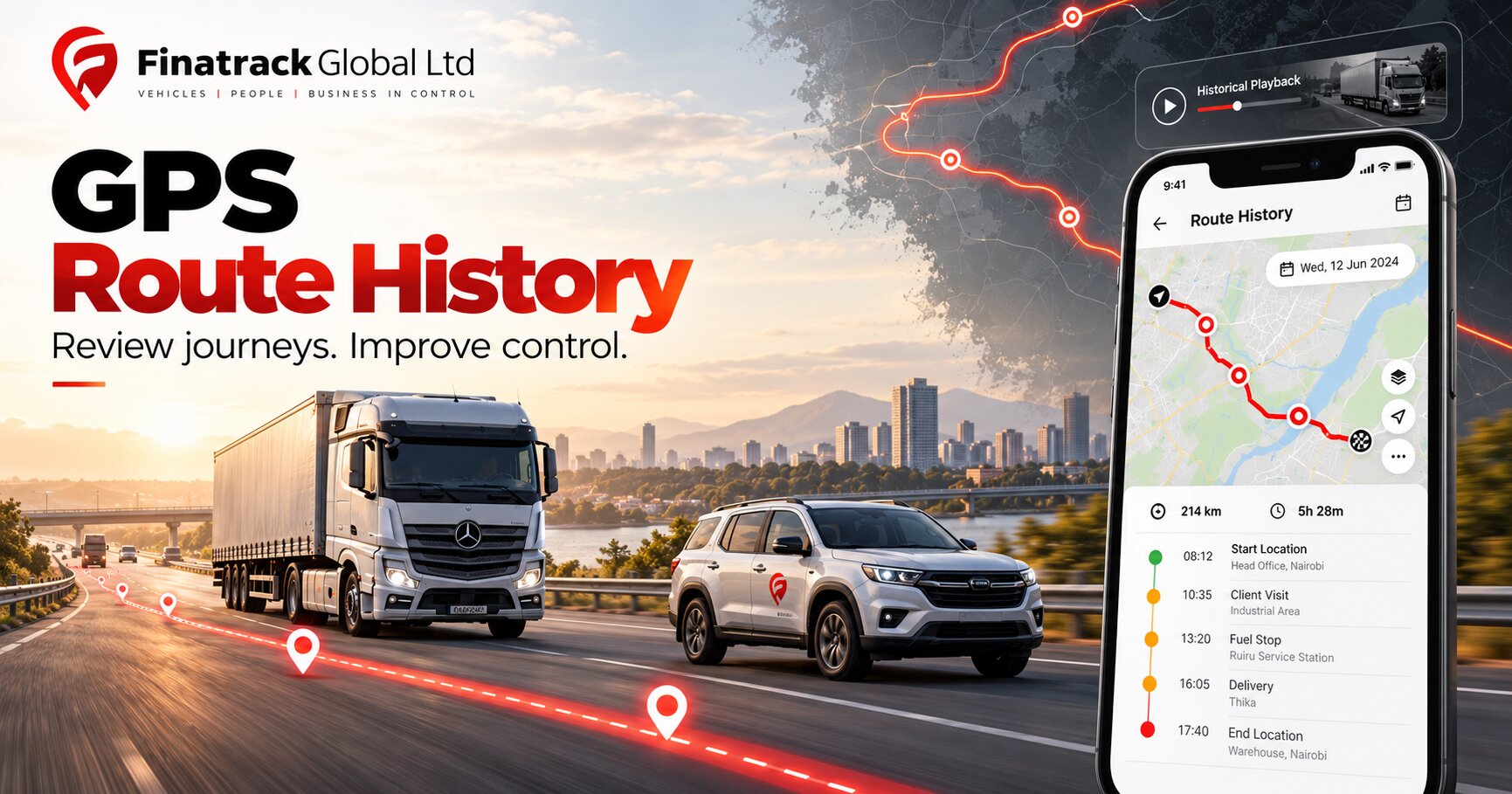
Real-time GPS tracking tells a business where its vehicles are now, but some of the most useful information becomes available after the journey has already happened. Historical route playback allows fleet managers to look back at previous vehicle movements, review the routes taken, identify stopping points and better understand how company vehicles are being used. For businesses operating several vehicles, this can turn GPS tracking from a simple location tool into a practical management system.
A company vehicle may leave the office in the morning, complete several assignments and return at the end of the day without management knowing exactly what happened between those points. The driver may have followed the planned route, encountered traffic, made an unexpected detour or spent longer than expected at a particular location. Historical route information gives management another source of evidence when reviewing these journeys instead of relying entirely on memory or verbal explanations.
For delivery businesses, route history can help confirm whether vehicles reached the locations they were expected to visit. A manager can review the journey later and see how the vehicle moved between different areas, where it stopped and whether the route generally matched the day’s assignments. This information can be particularly useful when customers raise questions about delayed deliveries or when the business needs to understand why a journey took longer than expected.
The same information can help companies identify unnecessary mileage. A vehicle that repeatedly takes long detours or makes unexplained trips may consume more fuel and accumulate more kilometres than necessary. One unusual journey may have a legitimate explanation, but repeated patterns can indicate an opportunity to improve route planning, driver supervision or internal vehicle-use policies.
Historical playback can also provide useful context when a vehicle is involved in an incident. If management needs to establish where the vehicle travelled before a breakdown, accident or complaint, the tracking platform can provide a timeline of movement. This does not automatically explain everything that happened, but it can help narrow down when and where the event occurred.
For businesses managing drivers, this creates greater accountability. A driver may report that a vehicle spent several hours at a customer location, while the tracking history may show that it stopped elsewhere for part of that period. The objective should not simply be to catch employees doing something wrong, but to give management reliable information that can support fairer and better-informed decisions.
Route history can become even more useful when combined with geofencing. A company may create virtual boundaries around offices, customer sites, depots or project locations and then compare geofence activity with historical journeys. This can help management understand whether vehicles entered expected areas and how long they remained there, providing a clearer picture of how assignments were completed.
Speed information can add another layer. A fleet manager reviewing a route may notice that a vehicle covered a particular section unusually quickly or received repeated speed alerts during the journey. This can help identify driving behaviour that may increase fuel consumption, vehicle wear or road-safety exposure. Over time, the business can use this information to support driver coaching and improve fleet standards.
Fuel monitoring can also be connected to the same operational picture. If a truck records an unusual change in fuel level, management can check its historical route to establish where the vehicle was at the time. A long unscheduled stop combined with a significant fuel drop may require further investigation. Looking at the location and fuel information together can be far more useful than reviewing either one separately.
For long-distance transport businesses, historical route playback can be especially valuable because trucks may spend several days away from the main office. Managers cannot physically supervise every journey, but they can review how the vehicle moved across different routes and identify patterns that require attention. This can support better route planning, more accurate reporting and stronger accountability.
Company cars can benefit from the same approach. Vehicles assigned to employees are often used away from direct supervision, and management may need to confirm whether they were used for authorised business activities. Historical route information can provide a record of movement without requiring supervisors to constantly call drivers for updates.
The information can also help businesses make better operational decisions. If several vehicles regularly experience delays on the same route, management may decide to adjust dispatch times or choose an alternative route. If one vehicle repeatedly takes longer than others to complete similar journeys, the company can investigate whether the difference is caused by traffic, driver behaviour, vehicle condition or another operational issue.
Finatrack Global Ltd provides a wired GPS tracker at KSh 15,000 as a one-off payment, with an alternative option of KSh 10,000 installation plus KSh 3,000 annual subscription. Depending on the tracking system installed, users can access features such as real-time location monitoring, historical route playback, geofencing, speed monitoring and vehicle alerts.
The value of route history extends beyond businesses with large fleets. A private motorist can also review where a vehicle travelled when it was being used by another person. This can be useful for family vehicles, company-issued cars or situations where the owner simply wants a better understanding of how the vehicle was used during a previous period.
Professional installation and correct system configuration remain important because reliable historical data begins with a tracking device that is communicating consistently. Customers should also understand how to access route history, select dates and review vehicle movement through the tracking platform rather than waiting until a problem occurs before learning how the system works.
GPS tracking is therefore not only about knowing where a vehicle is at the present moment. The history behind each journey can reveal patterns, inefficiencies and operational questions that may otherwise remain unnoticed. For businesses trying to control costs and improve accountability, looking backward can sometimes provide just as much value as watching the vehicle live.
Finatrack Global Ltd provides GPS tracking, fleet management, fuel monitoring, AI dashcams and vehicle security solutions for private motorists and businesses. Professional installation can be carried out at the company’s offices or at a customer’s convenient location.
For enquiries or professional installation, contact Finatrack Global Ltd on 0723 645 810, visit www.finatrack.co.ke, or visit the company at Vision Plaza, 1st Floor, Office 2, Mombasa Road, Nairobi.
S