A salesperson can leave the office at 8 a.m., return at 5 p.m. and appear to have spent the entire day working in the field. Yet several hours may have been lost travelling between poorly planned customer appointments, sitting in traffic, making unnecessary return trips to the office or covering areas that another salesperson could have handled more efficiently. For Kenyan businesses operating mobile sales teams, the cost of inefficient movement can quietly reduce the amount of time employees actually spend selling.
Company vehicles are meant to help salespeople reach customers, not turn employees into full-time drivers. When a sales representative spends four hours of an eight-hour working day behind the wheel, the business is paying for salary, fuel, vehicle maintenance and depreciation while receiving relatively little customer-facing time. GPS tracking can give management a clearer picture of how sales vehicles are being used and whether the routes being driven are helping or hurting sales productivity.
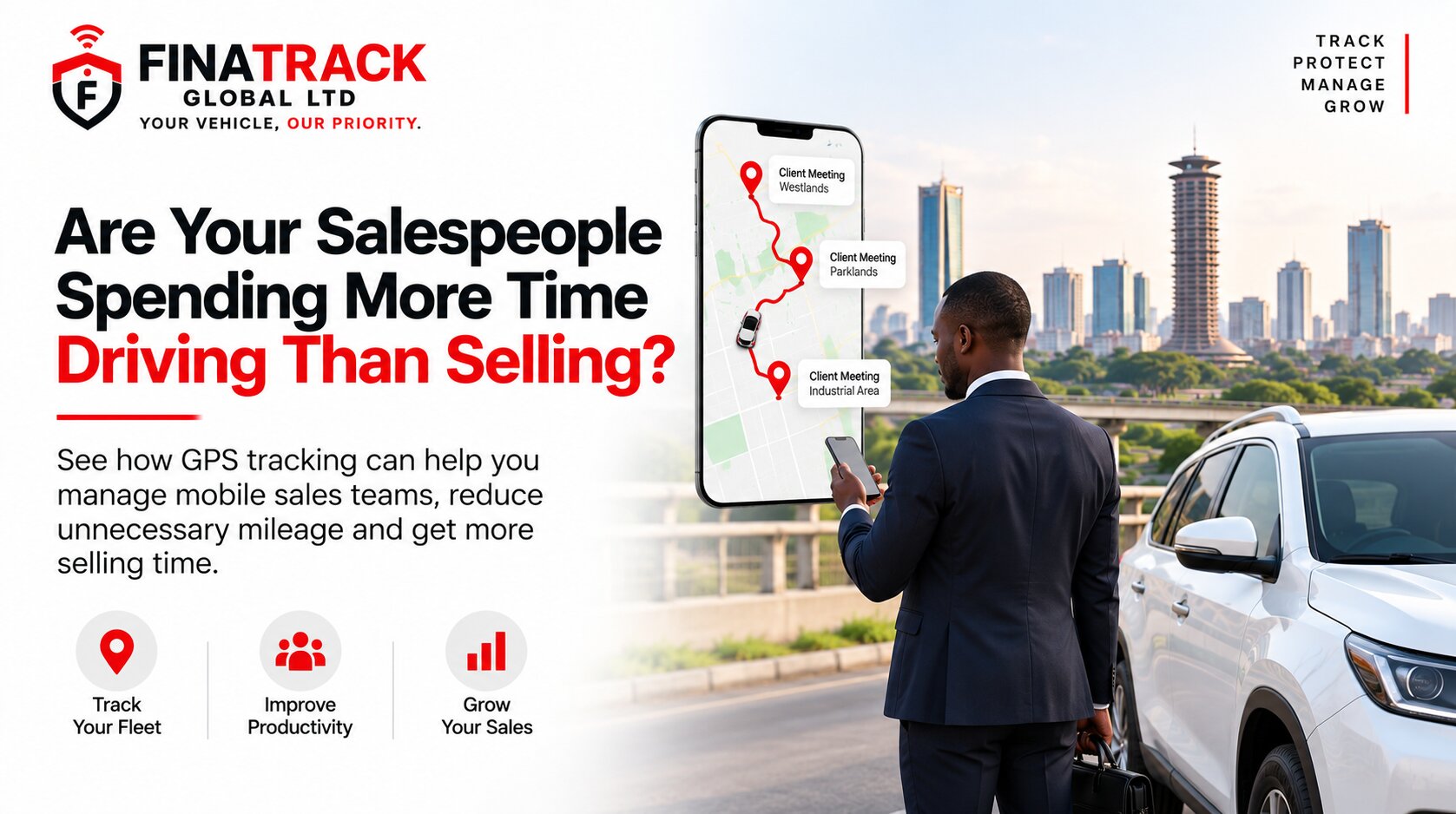
This is particularly relevant in Nairobi, where travelling a relatively short distance can sometimes consume a significant part of the working day. A salesperson may begin with a meeting on Mombasa Road, travel to Westlands for another appointment and later return towards Industrial Area before heading back across the city for an afternoon customer visit. Every appointment may be genuine, but the way they were scheduled can create unnecessary mileage and lost selling time.
GPS trip history can make these patterns visible. Instead of simply seeing how many kilometres a company car travelled during the month, management can review where those kilometres came from and how the salesperson moved between customers. The information can reveal whether appointments are being organised efficiently or whether the same areas are being crossed repeatedly throughout the day.
This does not mean management should use GPS tracking to question every route a salesperson takes. Nairobi traffic conditions, road closures, customer delays and unexpected business opportunities can all require route changes. The value comes from identifying repeated patterns over several days or weeks rather than treating one unusual journey as evidence of poor performance.
A company with several sales representatives can gain even more value by comparing their territories. One employee may regularly cover Westlands and Parklands, another may serve customers around Industrial Area and Mombasa Road, while another handles clients in Kiambu or Thika. If those territories overlap excessively, the business may be paying for several vehicles to travel through the same areas unnecessarily.
GPS tracking can help management review whether the territory structure still makes sense. Customers may have changed locations, new accounts may have been added and some areas may have grown faster than others. A territory plan created two years earlier may no longer reflect how the sales team actually operates today.
Historical trip information provides evidence for redesigning those territories. Management can identify the areas each representative visits most frequently and determine whether certain customer clusters could be assigned differently. A more logical territory structure can reduce travel time while allowing salespeople to spend more time with prospects and existing customers.
The financial effect can extend beyond fuel. Every unnecessary kilometre contributes to tyres, servicing, suspension wear and eventual vehicle depreciation. Reducing repeated cross-city journeys can therefore lower several operating costs at the same time.
Vehicle mileage can also help management understand whether the sales workload is distributed fairly. One salesperson may accumulate 4,000 kilometres in a month while another comparable employee covers only 1,500 kilometres. The difference may be completely legitimate, but it deserves to be understood.
The higher mileage employee may be responsible for a much larger territory or more customer visits. Alternatively, poor appointment planning may be forcing that salesperson to travel much farther than necessary. GPS trip history can help distinguish productive mileage from inefficient movement.
This matters because management should not automatically reward or criticise employees based on kilometres travelled. High mileage does not necessarily mean high productivity, while lower mileage does not mean someone is inactive. The more useful question is whether the travel resulted in meaningful customer activity.
A salesperson who drives 200 kilometres and meets three customers may be less efficient than another who covers 60 kilometres and completes eight quality meetings within a concentrated territory. GPS tracking provides the movement information, while the CRM, sales reports or customer visit records provide the commercial outcome. When the two are reviewed together, management gains a more meaningful picture of sales productivity.
The same approach can help identify long periods of unexplained inactivity. A company car may remain parked for three hours in the middle of the working day, but that does not automatically mean the salesperson was wasting time. The employee may have been conducting a major customer presentation, attending a tender meeting or negotiating an important contract.
Location information should therefore create questions rather than conclusions. If the vehicle remained at a known customer’s premises, the stop may represent some of the most productive time of the day. If similar unexplained stops appear repeatedly in locations unrelated to the employee’s territory, management may have a legitimate reason to investigate further.
This distinction is important for maintaining trust. GPS tracking should support sales management rather than become a surveillance system that treats every employee as suspicious. Staff should understand that the company is monitoring its vehicles for legitimate purposes such as security, route planning, mileage, maintenance and operational efficiency.
Transparency becomes particularly important where employees take company vehicles home. Some businesses allow this because salespeople begin customer visits directly from home instead of travelling to the office first. This can actually improve productivity by eliminating unnecessary morning and evening journeys.
The company should nevertheless have a clear policy covering personal use. If the vehicle is provided primarily for business, management needs to know whether evening and weekend journeys are permitted and who pays the costs associated with them. GPS records can help verify whether actual use remains consistent with the agreed arrangement.
After-hours mileage can become significant over time. A salesperson who adds only twenty unnecessary kilometres each evening can generate hundreds of additional kilometres during a month. The company absorbs additional servicing, tyre wear and depreciation even where the employee buys some of the fuel personally.
Clear policies are therefore more effective than vague assumptions. Employees should know whether limited personal use is allowed, what journeys require approval and whether vehicles must remain parked during particular periods. GPS tracking then provides objective records to support a policy that was already understood.
Sales teams can also use GPS visibility to improve customer allocation. A new prospect may call requesting an urgent visit, and the office may instinctively send the salesperson normally responsible for that account. The assigned representative could be across Nairobi while another qualified salesperson is already nearby.
Real-time or recently reported vehicle location can help management identify the closest appropriate employee. The business can respond faster without adding another vehicle or asking one salesperson to cross the entire city. This can improve both customer experience and fleet efficiency.
The same principle becomes valuable for companies with technical sales teams. An equipment supplier, insurance field team, pharmaceutical distributor or industrial sales company may have employees moving between several customer locations each day. Knowing where field staff are operating can help managers assign urgent opportunities more intelligently.
Location should not replace normal communication. A manager can see that a salesperson is near a particular customer but may not know whether they are already committed to another meeting. GPS provides useful operational context, while the employee provides the human information necessary to make the final decision.
This combination can reduce unnecessary phone calls as well. Managers do not need to repeatedly ask every salesperson where they are when the vehicle position is already available. Calls can focus on customer issues, deals and support rather than basic location reporting.
Trip history can also improve customer visit verification. Businesses often require sales representatives to submit daily or weekly reports showing the customers they visited. GPS information can provide supporting movement records where appropriate, particularly when the company needs to understand whether field routes correspond broadly with reported activity.
The tracker should not be treated as proof that a sales meeting actually happened. A vehicle reaching a customer’s premises does not prove that the representative met the decision maker, made a presentation or closed a sale. Customer relationship management records, visit notes and sales outcomes remain necessary.
What GPS can confirm more reliably is that the company vehicle travelled to the relevant location and remained there for a certain period. This can add useful context when sales records are incomplete or when management needs to investigate unusual movement. It supports the sales process without pretending to replace it.
Mileage reimbursement can become easier to manage as well. Some companies provide employees with business vehicles, while others reimburse mileage for specific journeys or mixed-use arrangements. GPS trip history can provide another record of distance travelled where company policy requires verification.
The company should still define which journeys qualify as business mileage. Travelling from the office to a customer may clearly be business use, while home-to-office commuting may be treated differently depending on company policy. GPS provides the kilometres, but management must define how those kilometres are classified.
Fuel management is another significant consideration. Sales vehicles often operate in urban traffic where fuel consumption can be influenced by congestion, idling and repeated short journeys. A vehicle may cover relatively little distance during a day while spending several hours with the engine running.
Comparing fuel expenditure with GPS mileage and trip activity gives management more context. If one sales car uses considerably more fuel than similar vehicles, the difference may be explained by longer routes, traffic conditions, mechanical problems or driving behaviour. The data provides a starting point for investigation rather than an automatic accusation.
Idling can become particularly expensive across a large sales fleet. A representative may leave the engine running while making phone calls, waiting for a customer or completing paperwork inside the car. A few minutes may seem insignificant, but repeated every day across twenty vehicles it can become a measurable fuel cost.
Where the tracking system provides suitable ignition information, management can identify repeated stationary engine periods. The objective should be coaching employees to reduce unnecessary idling rather than treating every stationary event as misconduct. Some situations will legitimately require the vehicle to remain running.
Route planning can also reduce fuel consumption significantly. If appointments can be grouped by location, vehicles spend less time crossing congested areas unnecessarily. A salesperson can potentially see more customers while travelling fewer kilometres.
For example, several meetings around Westlands, Parklands and Gigiri may be grouped on one day while Industrial Area and Mombasa Road customers are scheduled together on another. The exact arrangement will depend on customer availability, but GPS history can show whether current schedules consistently create inefficient movement.
This information can help sales managers plan future appointments more intelligently. The aim is not to create rigid routes that prevent salespeople from responding to opportunities. It is to reduce obvious inefficiencies while preserving the flexibility required for successful selling.
Driver behaviour is another area where GPS telematics can add value. Salespeople are often under pressure to reach several customer meetings within limited time, and unrealistic schedules can encourage speeding or aggressive driving. Management needs to recognise that driver behaviour can reflect both employee decisions and company expectations.
Repeated speeding alerts can therefore indicate more than one problem. The employee may require coaching, but the sales schedule may also be demanding journeys that are unrealistic under normal traffic conditions. GPS data helps management identify the pattern while operational review determines the cause.
Harsh braking and acceleration can provide additional information where supported by the tracking system. One isolated event has little meaning because Kenyan roads can require sudden reactions to motorcycles, pedestrians, potholes and unpredictable traffic. Repeated patterns across comparable journeys deserve greater attention.
Safer driving protects more than the vehicle. Sales representatives themselves are valuable employees, and road accidents can result in injury, lost working time, insurance claims and customer disruption. A good fleet policy should therefore prioritise employee safety alongside fuel savings.
AI dashcams can provide additional support for sales fleets where management requires more advanced driver safety monitoring. Depending on the system, video and driver monitoring information can provide context around incidents or risky driving. The technology should be used transparently and proportionately according to the company’s actual needs.
Maintenance planning also becomes easier when sales vehicle mileage is monitored accurately. Two company cars purchased at the same time can reach service intervals several weeks apart if one salesperson travels substantially farther. Using only calendar-based maintenance can therefore create unnecessary risk.
GPS mileage information helps fleet administrators identify which vehicles are accumulating distance fastest. Manufacturer recommendations and professional mechanical advice should still determine the actual service schedule, but tracking records make it easier to know when those intervals are approaching.
This can prevent salespeople from losing productive days because their vehicles unexpectedly break down. A company car in the garage may force the employee to postpone customer meetings, use taxis or borrow another vehicle from the fleet. Preventive maintenance protects both transport capacity and sales activity.
Vehicle downtime should therefore be viewed as a sales cost as well as a maintenance cost. A representative without transport may be unable to reach customers who require physical visits. Keeping fleet vehicles reliable supports revenue generation directly.
GPS tracking can also reveal whether one vehicle is being used disproportionately. A newly purchased car may become the preferred unit because it is more comfortable or fuel efficient, causing it to accumulate mileage much faster than older vehicles. Over time, the workload imbalance can accelerate maintenance and depreciation.
Management can use utilisation data to redistribute vehicles where practical. The objective is not making every car travel exactly the same distance, but ensuring there is a reasonable explanation for significant differences. Better allocation can extend useful fleet life.
This becomes especially relevant before purchasing another sales vehicle. Employees may report that the team needs more cars because transport is constantly unavailable, but GPS records can reveal whether the existing fleet is genuinely operating near capacity. Some vehicles may be underused while others carry most of the workload.
Reassigning an underused car can be far cheaper than purchasing another one. A new vehicle brings insurance, tracking, maintenance, fuel and depreciation costs in addition to the purchase price. Fleet visibility helps management establish whether that investment is truly necessary.
The opposite finding can also support expansion. If sales vehicles are consistently well utilised, territories are efficient and employees still cannot meet legitimate customer demand, management has stronger evidence that another vehicle may be justified. GPS data can therefore support investment rather than simply cost cutting.
Geofencing provides another useful tool for mobile sales operations. Virtual boundaries can be created around branches, sales territories or other important locations depending on the tracking platform. Management can identify when vehicles enter or leave selected areas without continuously watching the map.
This can help businesses managing regional sales territories. A vehicle assigned to Nairobi may unexpectedly begin travelling outside the normal area, while another assigned to Kiambu may regularly cross into neighbouring regions. The movement may be legitimate, but it becomes visible for review.
Geofencing should remain flexible enough to reflect how sales actually works. A salesperson may receive an important opportunity outside the normal territory and need to respond immediately. An alert should prompt verification rather than automatically classify the movement as unauthorised.
Trip reports can also help businesses understand how much of the working day is spent travelling. If salespeople consistently spend several hours between customer locations, management may need to reconsider territory size or appointment expectations. Adding more sales targets without addressing travel time can create unrealistic performance standards.
This is particularly important when comparing employees. A salesperson serving a compact Nairobi territory may be able to complete more daily visits than someone covering customers across several counties. Comparing their raw number of visits without considering travel requirements can be unfair.
GPS data provides geographical context that sales figures alone cannot show. Management can see whether lower visit numbers are associated with longer travel distances or more dispersed customers. Territory performance can then be assessed more realistically.
For companies selling to businesses across Kenya, this becomes even more important. A salesperson travelling from Nairobi to Nakuru may spend most of the day on one route while another employee completes several meetings within the city. Both may be working effectively despite producing very different daily visit counts.
Historical tracking can also improve planning for regional sales trips. Instead of repeatedly sending employees back and forth between Nairobi and the same county, customer visits can sometimes be grouped into one structured trip. This reduces mileage and makes better use of travelling time.
Sales managers can review previous journeys to understand which areas require frequent visits. Hotels, accommodation and field schedules can then be organised more efficiently where overnight trips are commercially justified. GPS data adds evidence to territory planning.
Security remains another important reason to track sales vehicles. Representatives may carry laptops, product samples, documents or other valuable business property. The vehicle itself also represents a significant company asset that spends much of its time away from head office.
A GPS tracker gives authorised users access to the vehicle’s latest reported location if something unexpected happens. Ignition, geofence or other selected alerts can provide additional information depending on the installation. The tracking system creates another security layer when the vehicle is parked at customer locations or taken home.
For higher-value sales vehicles, layered security may be appropriate. A primary wired GPS tracker can provide normal everyday monitoring, while an independent wireless tracker or tracking tag creates another recovery opportunity if the primary device is compromised. Alarm and immobilisation systems can provide additional protection.
Security spending should remain proportionate to the asset and its operating environment. A high-value executive sales vehicle may justify a stronger setup than a modest field car. The business should consider the financial and operational consequences of losing each asset.
Tracking account security also matters. Salespeople do not necessarily need access to the location of every other company vehicle. Where supported by the platform, access can be limited according to operational responsibility.
A salesperson may need to view their assigned vehicle while the sales manager or fleet administrator sees the broader fleet. Former employees should have access removed promptly when they leave. GPS information can reveal customer locations and business movement patterns, making it sensitive company information.
Businesses should also avoid relying on one shared username and password for the entire sales department. Shared credentials become difficult to control as employees join and leave. Individual or limited user access provides better accountability where the tracking platform supports it.
Employee privacy should remain part of the discussion. The fact that the vehicle belongs to the company does not mean tracking information should be used for unrelated curiosity about employees. The system should support defined operational purposes such as security, mileage, customer allocation and fleet management.
A clear vehicle-tracking policy helps establish these boundaries. Employees should understand what information is collected, why the company uses it and who can access it. Transparency makes GPS tracking easier to integrate into ordinary sales operations.
Management should also remember that GPS data has limits. It can show that a vehicle arrived at a customer’s location, but it cannot determine whether the salesperson had a productive conversation. It can show distance travelled, but it cannot measure the quality of a customer relationship.
GPS should therefore complement rather than replace sales management tools. Customer relationship management systems, sales reports, pipeline reviews and actual revenue remain essential. Telematics simply provides better information about the physical movement required to support those commercial activities.
The combination can be powerful. A manager may discover that one territory produces relatively little revenue despite generating extremely high vehicle mileage. That could justify reconsidering customer allocation, sales frequency or whether some meetings could be handled remotely.
Another territory may generate strong sales while requiring relatively little travel because customers are geographically concentrated. The business can then understand the logistical cost associated with different revenue streams. Fleet information becomes part of sales strategy.
This can also support decisions about inside sales versus field sales. Not every customer interaction requires a physical visit. If tracking records show representatives repeatedly driving long distances for short administrative meetings, some interactions may be handled through phone or video instead.
The aim should not be eliminating face-to-face sales because personal relationships remain valuable in many Kenyan industries. The goal is ensuring road time is used where physical presence genuinely adds value. GPS data can help expose journeys that consume significant time without clear commercial benefit.
Smaller businesses can benefit from this approach without complicated analytics. A company operating three sales cars can review one month of trip history and compare mileage with customer visits. The owner may immediately identify repeated routes or unnecessary office returns.
Larger businesses can analyse sales territories, branches and vehicle groups. Managers can compare the number of productive visits with kilometres travelled and identify areas where route planning deserves attention. The information becomes more useful as the fleet grows.
A practical monthly review does not need to involve hundreds of reports. Management can focus on total mileage, long journeys, after-hours use, repeated routes and unusual stationary periods. Exceptions can then be investigated rather than examining every trip individually.
The business can also identify positive patterns. A salesperson who consistently serves many customers within an efficient territory while maintaining reasonable mileage may provide a useful model for route planning. GPS tracking should recognise efficient performance as well as highlight problems.
This makes driver conversations more constructive. Instead of telling the whole team vaguely that fuel costs are too high, management can identify the actual routes or behaviours creating unnecessary cost. Employees can then understand what needs to change.
Sales targets should be considered alongside these findings. If management expects more customer visits while simultaneously asking employees to reduce mileage, territories and scheduling must make those objectives compatible. GPS data can expose unrealistic expectations before they create poor driving behaviour.
The system therefore becomes most valuable when management uses it to improve decisions rather than simply monitor people. Technology cannot redesign territories by itself, but it can show where current territory design is inefficient. It cannot close a sale, but it can help give salespeople more time to do so.
Finatrack Global Ltd provides professionally installed GPS tracking and fleet telematics solutions for Kenyan businesses operating mobile sales vehicles. Depending on the selected system, businesses can access real-time or recently reported location, trip history, mileage, geofencing, ignition information and selected alerts that can help improve sales fleet visibility.
Finatrack’s wired GPS tracker is available at KES 15,000, providing businesses with a practical way to monitor company vehicles and review how they are being used. Organisations requiring additional security can also consider wireless tracking, tracking tags, alarms and other layered vehicle-security solutions according to their needs.
Professional installation can be arranged at the customer’s convenient location or through Finatrack Global Ltd at Vision Plaza, 1st Floor, Office 2, Mombasa Road, Nairobi. Businesses seeking better control of mobile sales fleets can contact 0723 645 810 or visit www.finatrack.co.ke.
The most expensive part of a sales vehicle is not always the fuel it consumes. It may be the selling time lost while an employee sits in traffic, crosses the same area twice or travels farther than necessary between appointments. When GPS tracking is used to understand territories, routes, mileage and vehicle availability, the goal is not simply knowing where salespeople are; it is helping them spend less time getting to customers and more time winning business from them.
:::