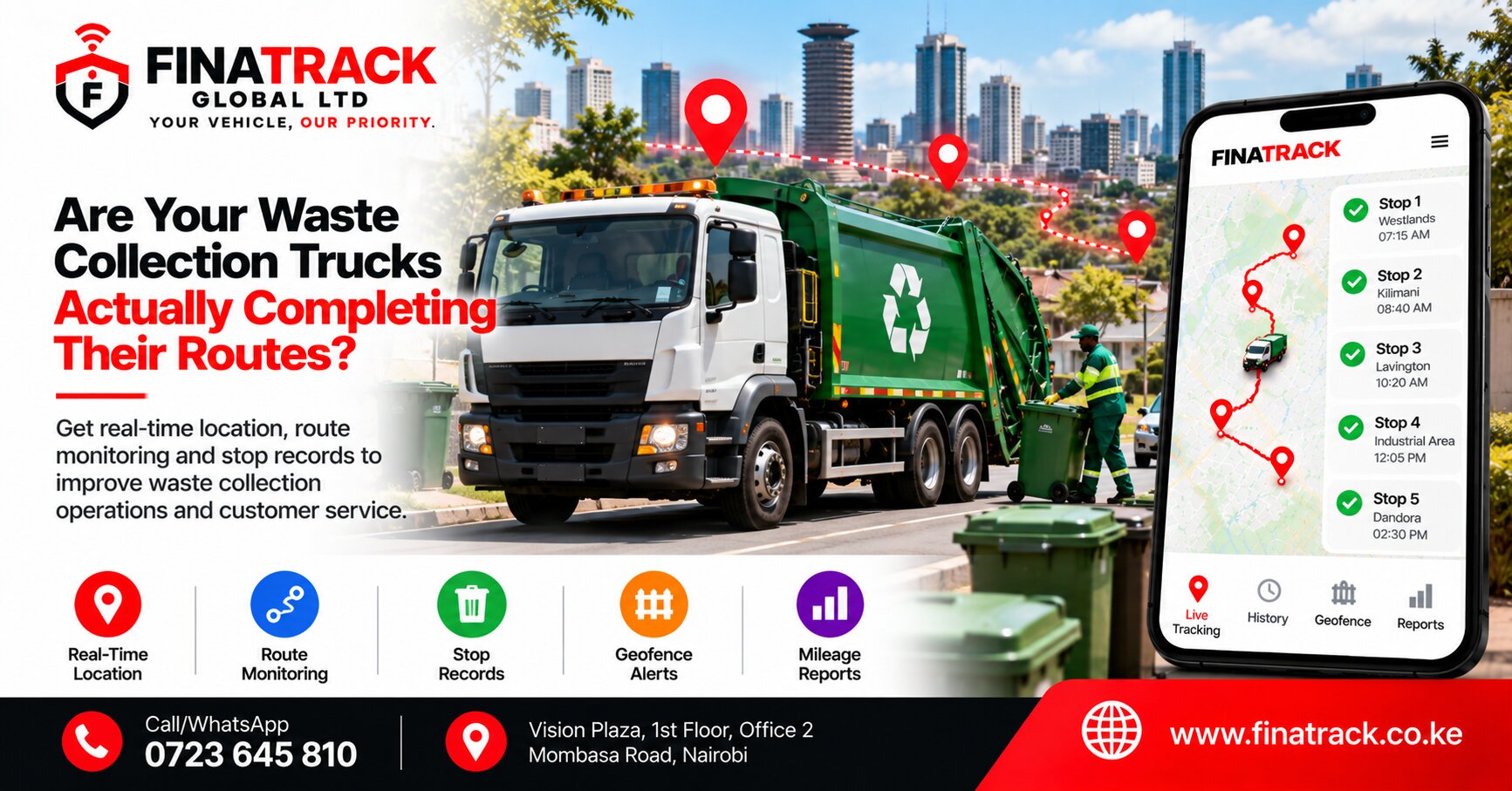
Waste collection is one of those services that customers notice immediately when something goes wrong. A truck may leave the yard in the morning with several estates, commercial buildings or collection points assigned to it, but by evening management may still be receiving complaints about bins that were never collected. For waste-management companies, county contractors and private garbage collectors in Kenya, GPS tracking for waste collection trucks can provide clearer visibility over where vehicles travelled and whether planned routes were broadly covered.
A GPS tracking system allows authorised managers to view the current or most recently reported location of collection trucks from a phone or computer. Instead of repeatedly calling drivers to establish where each truck is, the operations team can check the fleet map and see which vehicles are working in different areas. For a company serving several estates across Nairobi, this can make it easier to coordinate trucks, respond to missed collections and identify which available vehicle is closest when an urgent customer request comes in.
Trip history becomes particularly useful after the collection day is complete. Management can review the routes travelled by each truck and compare them with the areas that had been assigned for service. If a truck was expected to cover several collection points in Embakasi, South B and Industrial Area, for example, its recorded route can help establish whether the vehicle reached those areas. GPS does not prove that every individual bin was emptied, but it provides a useful movement record that can be compared with driver reports, customer complaints and collection schedules.
Geofencing can provide another practical way to monitor repetitive waste-collection operations. Virtual boundaries can be created around important locations such as estates, commercial centres, transfer stations, depots or disposal sites, depending on the tracking system. Management can then review when a truck entered or left those areas rather than watching every vehicle throughout the day. For companies operating regular weekly routes, these records can help identify collection areas that are repeatedly being reached late or missed entirely.
Waste collection trucks can also accumulate substantial mileage and fuel costs, particularly when routes are poorly planned. A driver may travel back and forth across the same part of the city because assignments were issued in the wrong order, while another truck may spend long periods travelling empty between distant collection zones. GPS trip records can help management identify these patterns and reorganise routes so that vehicles cover nearby customers together. Even modest reductions in unnecessary mileage can improve fuel efficiency and reduce wear on tyres, suspension and other components.
Vehicle utilisation and maintenance planning are equally important because waste trucks often operate under demanding conditions. One truck may work almost continuously while another spends much of the day parked or assigned to lighter routes. GPS mileage records help managers understand which vehicles are accumulating the most distance and therefore may require servicing sooner. The tracking system does not replace mechanical inspections, but it gives fleet managers another reliable source of information for planning maintenance before an unexpected breakdown interrupts an entire collection route.
The same technology can support better customer service and accountability. When a client says that a collection vehicle never arrived, the operations team can review the truck’s historical route before responding. If the vehicle reached the location but collection was not completed, the business can investigate the operational reason. If the truck never entered the area, management can identify a route or scheduling problem. The goal should be to use GPS records alongside staff reports and customer information rather than treating location data as automatic proof that a service was completed.
Finatrack Global Ltd provides GPS tracking and fleet-management solutions suitable for waste-management companies, county contractors and other businesses operating collection fleets in Kenya. Depending on the selected solution, authorised users can monitor vehicle location, trip history, mileage, geofencing and selected operational alerts through the tracking platform. Finatrack’s wired GPS tracker is available at KES 15,000, with professional installation available at the company’s office or at a convenient customer location. Businesses seeking better visibility over waste collection vehicles can contact 0723 645 810 or visit www.finatrack.co.ke. When customers expect reliable collection schedules, knowing where your trucks went, how efficiently they covered their routes and which areas were missed can turn GPS tracking into a practical fleet-management tool rather than simply a security feature.