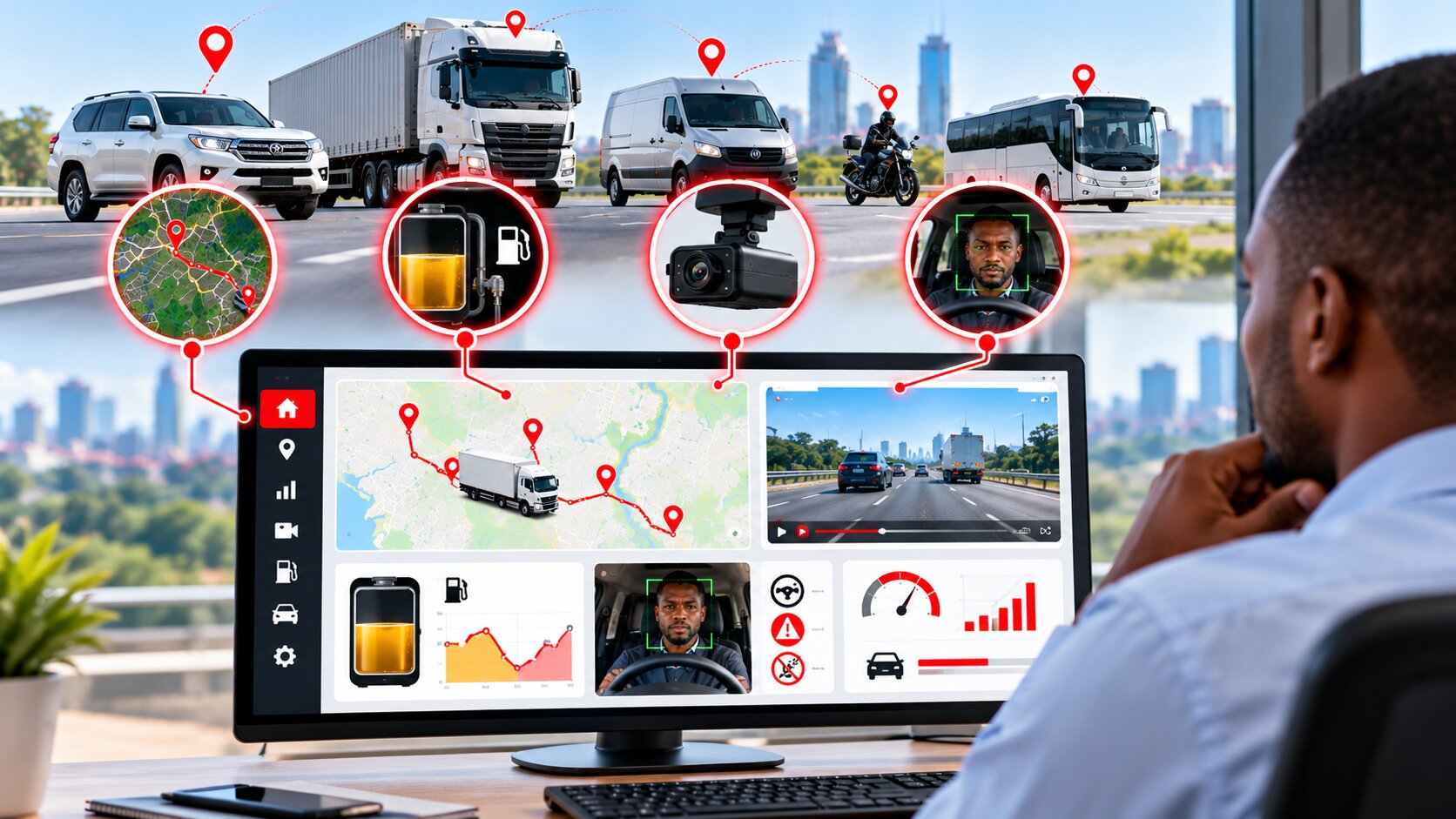
A fleet manager may use one system to check vehicle locations, another to review fuel levels and a third to watch AI dashcam footage. Each system may work well on its own, but switching between several platforms can make daily fleet management slower and more difficult. For businesses operating growing fleets in Kenya, an integrated fleet management system can make information easier to understand by bringing vehicle location, fuel, video and driver behaviour into a more connected operational view.
The biggest advantage of integration is context. A GPS platform may show that a truck stopped for forty minutes, while the fuel-monitoring system shows an unusual fuel drop during the same period. An AI dashcam may then provide video around that event. When these records are viewed together, management can investigate what happened much faster than when each system has to be checked separately.
This is particularly useful for fuel investigations. A fuel sensor may show a sudden reduction in the tank, but that information becomes more valuable when the fleet manager can immediately see where the vehicle was parked, whether the engine was running and how long the vehicle remained there. If video is also available around the same time, management may have additional context for deciding whether the event was normal consumption, drainage, maintenance activity or something that requires further investigation.
Driver behaviour is another area where integration can help. GPS telematics may record speeding, harsh braking or unusual route activity, while an AI dashcam can provide visual information around selected events. A speeding alert tells management that the vehicle exceeded a threshold, but video may help explain whether the driver was overtaking, reacting to traffic or repeatedly driving aggressively. Combining the two forms of information can make driver coaching more evidence based.
An integrated system can also reduce the amount of time fleet managers spend searching for information. Imagine managing fifty vehicles and receiving a complaint about one truck at 3:20 p.m. Instead of opening a GPS platform, checking a separate fuel system and then logging into another application for dashcam footage, management can ideally move between related records from one operational environment. The faster the information can be connected, the faster the business can respond.
Integration can also improve fleet reporting. Management may want to know which vehicles travelled the most kilometres, which consumed the most fuel, which recorded the most driver-risk events and which spent the longest time idling. Viewing these measurements together can reveal patterns that are difficult to identify when reports come from separate systems. A vehicle may appear productive because it covers high mileage, for example, but become less attractive when fuel consumption and maintenance costs are considered alongside that mileage.
The same approach can improve maintenance planning. A fleet manager could review mileage, engine hours where available, fuel-efficiency trends and driver behaviour together. A vehicle that is being driven aggressively, consuming more fuel and approaching a service threshold may deserve attention sooner than another unit with similar mileage but normal operating behaviour. Integration does not replace mechanical inspection, but it can help management decide which vehicles should be checked first.
Businesses should still avoid assuming that every system must be forced into one interface at any cost. Different technologies may have different strengths, and some specialist tools may provide deeper functionality than a general fleet dashboard. The goal should be useful interoperability, where important information can be connected without losing reliability or making the platform unnecessarily complicated.
Data quality remains important as well. Combining several systems does not automatically create better decisions if the underlying information is inaccurate. Fuel sensors must be calibrated properly, GPS trackers must be installed correctly and dashcams must be aligned so that they capture useful footage. Integration becomes valuable only when the data entering the platform can be trusted.
User access should also be controlled carefully. A dispatcher may need vehicle locations but not necessarily access to driver-facing video. A finance manager may need fuel reports without needing live tracking for every vehicle. An integrated platform should therefore support sensible access controls so that employees see the information required for their responsibilities without exposing unnecessary data.
For larger organisations, integration can also support management dashboards. Senior managers may not need to watch every vehicle moving on the map. Instead, they may want a summary showing fuel efficiency, utilisation, downtime, speeding events, vehicle availability and other key indicators. A connected fleet system can transform raw tracking information into operational metrics that help management make wider business decisions.
Integration becomes especially valuable when incidents occur. If a vehicle is involved in an accident, the company may need to understand where it was, how fast it was moving, what route it followed and what the dashcam recorded. If the same vehicle also showed unusual driver behaviour earlier in the journey, that information may provide additional context. Bringing these records together can significantly simplify internal investigation.
The same applies to theft and security incidents. GPS location can show where the vehicle travelled, while power-disconnection events may reveal when the main tracker lost external power. A backup wireless tracker can provide another source of location information, and dashcam footage may provide supporting context depending on what was recorded. Layered vehicle security becomes more useful when the information can be reviewed as part of one coherent response.
Small businesses can also benefit from integration even when they do not operate a large fleet. A company with five delivery vehicles may not need an enterprise-level command centre, but it can still benefit from seeing location, route history and fuel information without managing several disconnected systems. The value comes from reducing administrative work and making important fleet information easier to act on.
Finatrack Global Ltd provides GPS tracking, fuel monitoring, AI dashcam, vehicle security and fleet-management solutions for businesses in Kenya. Finatrack’s wired GPS tracker is available at KES 15,000, the AI Dashcam at KES 35,000, while fuel monitoring solutions are available from KES 35,000 with a KES 1,000 monthly maintenance and system fee, depending on configuration. Businesses can select the combination of technologies that matches their fleet requirements and operational risks.
For enquiries and professional installation, call or WhatsApp 0723 645 810 or visit www.finatrack.co.ke. A fleet with several connected technologies should not become harder to manage simply because more data is available. The strongest fleet-management approach is one where GPS location, fuel information, video and driver behaviour can be interpreted together, allowing managers to spend less time searching across systems and more time making decisions that improve security, productivity and operating costs.