A customer says the delivery never arrived. The driver insists they reached the destination. The delivery note cannot immediately be found, and nobody in the office knows exactly what happened. For businesses making dozens or hundreds of deliveries every day, situations like this can quickly turn into difficult customer disputes.
Traditionally, the first response is to call the driver. Management asks where the vehicle went, what time it arrived and how long it remained at the customer’s premises. The driver may provide an accurate explanation, but the business is still depending largely on memory and verbal information.
GPS tracking can provide another source of operational evidence.
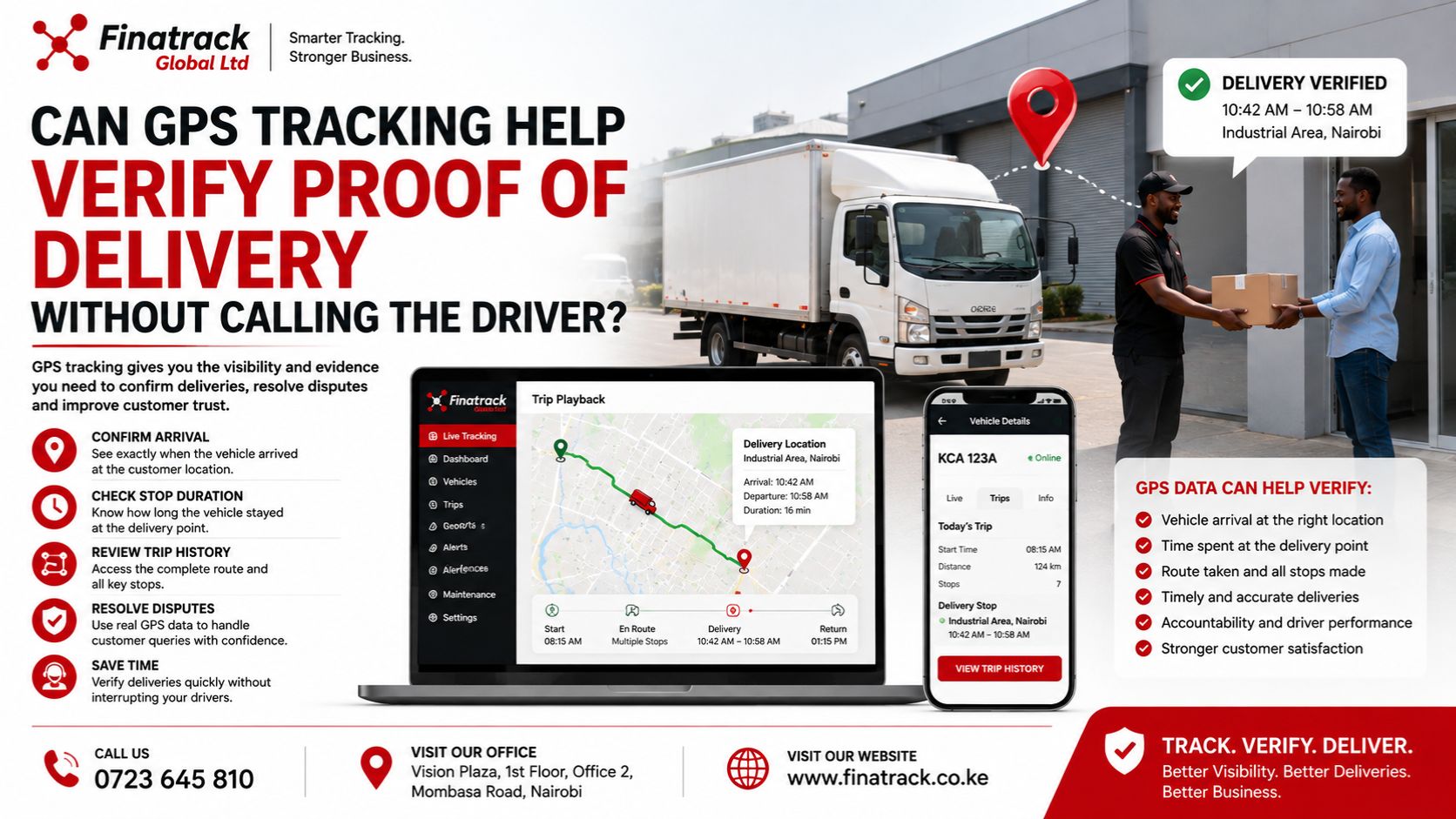
A professionally installed tracking system can record the vehicle’s movements throughout the journey. Depending on the platform, management can review the route taken, arrival time, departure time, stop duration and historical location of the vehicle without first calling the driver.
That information can help answer an important question: did the delivery vehicle actually reach the customer’s location?
Consider a distribution van scheduled to deliver goods to a customer in Industrial Area, Nairobi. The customer later claims that no vehicle arrived. Instead of immediately arguing with the customer or questioning the driver, an authorised manager can review the vehicle’s trip history.
If the tracking record shows that the van entered the customer’s area at 10:42 a.m. and remained there for 18 minutes, the business has useful information showing that the vehicle was physically present near the expected delivery location.
This does not automatically prove that the correct goods were handed to the correct person.
GPS tracking should therefore be understood as supporting evidence of vehicle movement rather than a complete replacement for signed delivery notes, electronic proof-of-delivery systems or other customer confirmation processes.
Its value is in helping establish what happened around the delivery.
The difference can be important during disputes.
A paper delivery note may show that someone signed for goods, but it does not independently show where the company vehicle was at the time. GPS records can add location and timing information that supports the delivery record.
When the two sources of information agree, management has a stronger operational picture.
A signed delivery note showing a 10:45 a.m. delivery and GPS history showing the vehicle at the customer’s premises between 10:42 a.m. and 11:00 a.m. creates a much clearer record than either piece of information alone.
Geofencing can make this process even more useful for businesses serving regular customers.
A company can create virtual boundaries around warehouses, branches, customer premises or delivery zones. Depending on the tracking system configuration, the vehicle’s entry and exit from these locations can be recorded or used to generate alerts.
For a distributor delivering regularly to supermarkets, pharmacies, hotels or construction sites, this can help build a more structured record of when vehicles reached important customers.
Instead of searching through an entire day’s route, the fleet manager can use location information to understand when the vehicle entered the customer’s area and how long it remained there.
Stop duration can reveal another part of the story.
A delivery vehicle may technically reach the customer’s location but leave after only one or two minutes. That may be reasonable if the driver simply collected a document, but it may also raise questions if the scheduled delivery involved unloading a large quantity of goods.
On another occasion, the same vehicle may remain at the customer for 45 minutes because unloading, security procedures or receiving documentation took longer than expected.
The GPS platform does not automatically explain the reason for the stop.
What it provides is a timestamped movement record that gives management a better starting point for investigation.
This can also help protect drivers from unfair accusations.
A customer may insist that the delivery vehicle never arrived when tracking data shows that the driver reached the agreed location and remained there for a reasonable period. Management can then investigate whether the problem occurred after arrival rather than assuming the driver failed to attend.
Perhaps nobody was available to receive the goods. Perhaps security refused access. Perhaps the customer provided the wrong delivery point.
GPS data can help narrow the problem.
The opposite can also happen.
A driver may report that a delivery was attempted when trip history shows that the vehicle never travelled near the customer. Management then has a legitimate reason to investigate further.
This creates accountability without forcing the business to rely entirely on one person’s explanation.
For companies handling many deliveries, the time savings can become significant.
Imagine a dispatcher managing 30 vehicles and receiving five customer complaints during the afternoon. Calling every driver interrupts employees who may already be travelling to the next destination.
With trip history available, the office can first review the relevant vehicle’s movements.
In some cases, the issue may be resolved without disturbing the driver at all.
The dispatcher can confirm that the vehicle arrived at the destination, check approximately when it arrived and determine how long it stayed. Only questions that cannot be answered from the system need to be escalated to the driver.
This improves safety as well.
Drivers should not be repeatedly answering calls while operating company vehicles simply because the office lacks visibility. A tracking platform allows many routine location questions to be answered without contacting the person behind the wheel.
The benefit extends beyond disputes.
Customer service teams can use live tracking information to provide more useful delivery updates.
If a customer calls asking whether a delivery vehicle has left the warehouse, the office can check its location. If the vehicle is approaching the destination, the customer can be given a more informed update.
This is much better than telling every customer, “Let me call the driver and get back to you.”
For businesses competing on reliability, that level of visibility can improve the customer experience.
Historical trip records can also help companies measure whether delivery schedules are realistic.
Management may discover that a vehicle regularly reaches a particular customer on time but remains there for more than an hour because of unloading delays. The problem is no longer transport.
It may be the receiving process at the customer’s premises.
Another customer may consistently require only ten minutes.
Over time, this information can help businesses allocate more realistic delivery windows and improve route planning.
Proof of arrival can also become useful for field service companies.
A technician may be scheduled to visit a customer’s premises to install equipment, carry out maintenance or repair a fault. If a dispute arises about whether the technician attended, vehicle trip history can provide supporting information showing whether the service vehicle reached the area.
Again, location information does not prove that the technician completed the work.
It shows that the vehicle associated with the assignment was present.
The distinction matters.
Businesses should avoid describing GPS tracking as absolute proof that a delivery was successfully completed. A vehicle can arrive at a customer’s premises without the goods being handed over.
The strongest operational process combines several records.
GPS tracking can show vehicle arrival and departure. A signed or electronic delivery record can confirm receipt. A customer name, photograph, barcode scan or digital timestamp may provide additional evidence depending on the company’s delivery process.
Together, these records can create a much stronger proof-of-delivery system.
AI dashcams or video telematics may also provide additional context in some operations, particularly where vehicles regularly handle valuable goods or disputed deliveries.
Video should be managed appropriately and should not replace good delivery documentation, but it can add information surrounding certain incidents when required.
For transport managers, another benefit is identifying deliveries that take longer than expected.
A route may appear inefficient because the driver returns to the warehouse late every day. GPS data may reveal that the problem is not driving speed or route choice.
The vehicle may be spending 30 or 40 minutes waiting at several customer premises.
That information can help management negotiate better receiving arrangements with customers or adjust route schedules rather than blaming the driver.
Delivery verification can also help businesses manage third-party contractors.
A company may outsource some transport work but still require confirmation that contracted vehicles visited specified locations. Where suitable tracking arrangements are in place, location history can provide an additional operational record.
The company should establish clear expectations about what information is collected, who has access to it and how long records are retained.
Tracking information can reveal commercially sensitive details about customers, routes and operating patterns.
Access should therefore remain limited to authorised personnel.
A customer service employee may need to confirm whether a delivery vehicle reached a destination, while another staff member may have no legitimate reason to browse historical movements across the entire fleet.
Good access control becomes more important as the organisation grows.
Businesses should also ensure that drivers understand why company vehicles are being tracked.
The purpose should be clear: vehicle security, delivery visibility, route management, customer service and operational accountability.
When technology is implemented transparently and combined with sensible procedures, it can reduce disputes rather than create unnecessary conflict between managers and drivers.
Installation quality remains important.
If a tracker reports intermittently or frequently goes offline, the business may discover gaps precisely when it needs historical information to investigate a disputed delivery.
Commercial vehicles should therefore use professionally installed tracking systems that are tested and supported properly.
Management should also know how to retrieve historical trips.
A tracking system provides little business value if every customer complaint still results in staff calling technical support because nobody in the company knows how to review yesterday’s route.
Training should form part of the implementation.
For a small distributor making ten deliveries a day, GPS trip history can help resolve occasional customer disagreements.
For a logistics company operating dozens of vehicles, it can become part of a much larger proof-of-service process involving dispatch, customer support, delivery documentation and fleet reporting.
The principle remains straightforward.
When a customer asks, “Did your vehicle actually come here?” the business should have more information than the driver’s memory.
Finatrack Global Ltd provides professionally installed GPS tracking and fleet telematics solutions for businesses operating delivery, distribution and field service vehicles in Kenya. Tracking systems can help authorised managers review live vehicle locations, previous trips, stops and movement history depending on the solution installed.
Professional installation can be arranged at the customer’s convenient location or at Vision Plaza, 1st Floor, Office 2, Mombasa Road, Nairobi.
Businesses seeking better visibility over deliveries and field operations can contact Finatrack Global Ltd on 0723 645 810 or visit www.finatrack.co.ke.
A delivery note can show what was received.
GPS tracking can help show whether your vehicle was actually there.